
As part of our efforts to provide clarity and useful information to our potential investors and stakeholders, we have released the following annex regarding what is the VC secondaries asset class, its distinct flavors (GP led, LP led, direct) and some insights relevant to the global market.
We have prepared an extensive report regarding the structural drivers from the Latin American region (Latam) that will drive growth in technology for the next decade.
Executive Summary and Chapter 1: Why invest in Latin America?
Chapter 2: Why is Latin America a good market for new financial technology
Chapter 4: The state of fich and expected future trends for Latin America and Closing Remarks
Below we present a brief summary of the key reasons. However, we strongly encourage you to explore the data and citations in more detail by reviewing our full report.
As presented in the cited research, despite stellar results in tech company formation and liquidity events, Latam received less than 0.16% in VC investments as percentage of its GDP in 2022 while comparable regions like South East Asia (SEA) and India received between 0.47 and 0.72%. In consequence, Latam’s VC markets have still space to even grow 3-4x just to catch up with the levels presented in Asia.
Latam’s population ins considerably younger than the developed economies population and more educated than its peers in Asia or Africa. Moreover, penetration of digital technologies is high and relatively close to the levels of adoption in Europe or the US, which makes the region fertile soil for the incubation of tech-based products and solutions.
In a context of regional warfare (Middle East, Ukraine), international tensions and potential escalation of a trade war between US and China in the next 4 years, we expect that Latam will position itself as a neutral market that will attract fleeting investment from both sides of the spectrum.
Liquidity events (IPO and M&A) at lowest levels of the last 5 years. Volatility and recession concerns affected both the IPO and M&A activity. Between 2021 and 2023 the transaction volume of the IPO market decreased by 83% while the M&A activity shrunk by 47%. This unusual halt of the exits has strained fund managers, especially those that were raised between 2012 and 2014, whose portfolios have not been able to reach maturity despite having top performing companies.
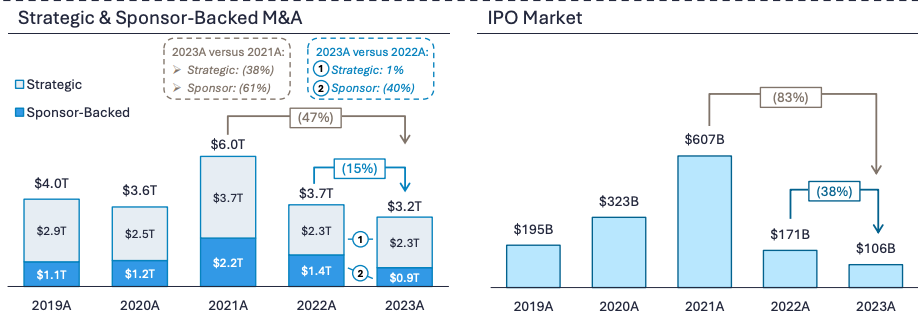
Source: Lazard 2023 Secondary Market Report. (left axis: $US T, right axis: $US B*)**
As we mention in the Annex: What to know about VC secondaries?, VC secondaries are essential to provide liquidity to top founders in harsh times as the one we presented above.
According to Pitchbook analysis, early stage VCs have been selling stakes in their portfolio companies with relevant discounts. In words of Miguel Luiña from Hamilton Lane -a VC secondaries fund with $921B AUM-, sellers have offered their stakes at top performing companies with prices up to $60% lower than the next round’s headline valuation. Moreover, as Industry Ventures pointed out, those companies offering secondaries deals are precisely those with the most solid fundamentals and performance, considering the “flight to quality” moves carried out by VC investors in the last two years. As explained in the cited article, this phenomenon refers to most of the low quality investments carried out in the 2021 “frothed market” adjusting their valuations or going out of business and top performers being able to defend their valuations despite the rough context.
As we mentioned earlier, Latam suffers from a notable underdevelopment of its VC industry. While the North American venture markets were inaugurated back in the 1960s, and reached maturity in the 1980s, Latam’s VC investments were inaugurated as recently as the 2010s with the first checks from American top funds (a16z, Sequoia, Benchmark) and Softbank. For this reason, as shown in the chart below, the amount of capital deployed in the region between 2016 and the first half of 2024 was only the 1.64% of the worldwide available resources in this asset class (despite accounting for more than 10% of the world’s GDP) . This disparity is even larger in the VC secondaries market, considering that only the 0.73% of the resources were invested in Latin America.
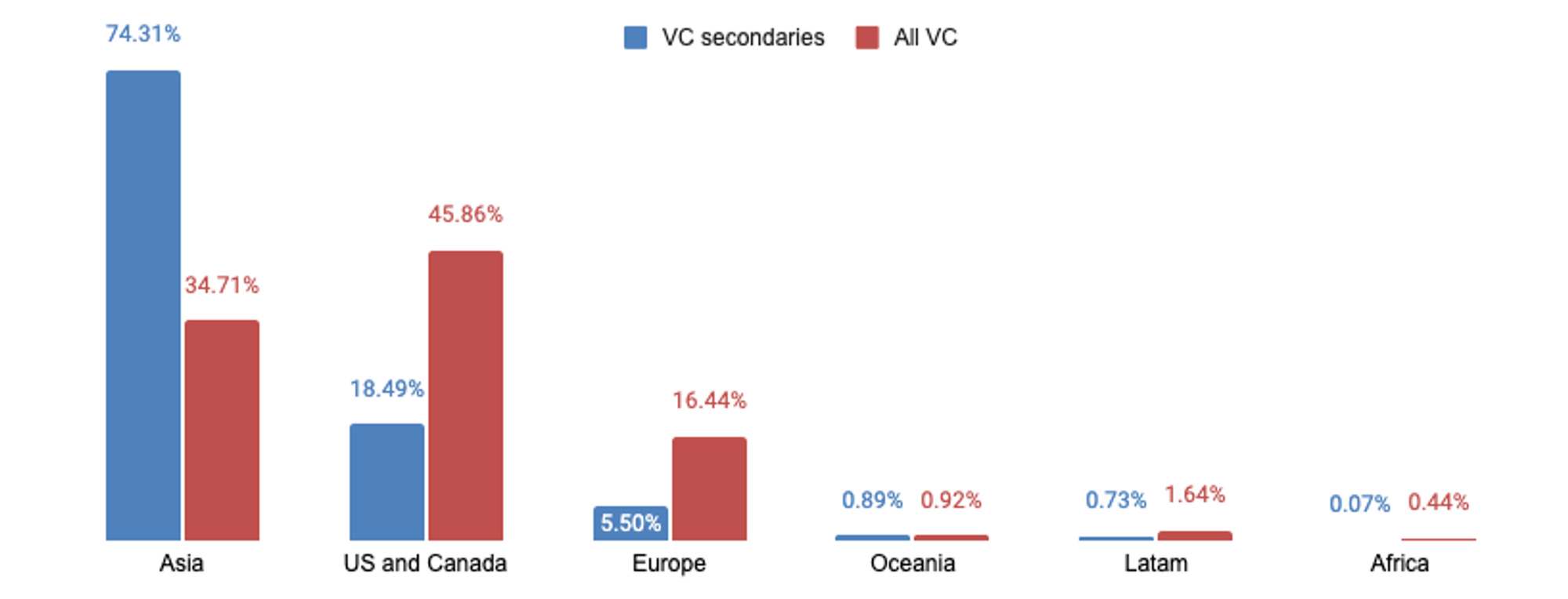
Source: Paramo Partners using Pitchbook data
Key actors in the secondaries markets have noted their expectations of a continued expansion in the next 5 years. As mentioned by Jonathan Gray from Blackstone Strategic Partners, this secondaries fund has seen a 2x growth in 2024 when compared to the previous year activity. As top companies and funds needs for liquidity expand, they expect this sector to keep growing at least at a 60% YoY rate. For this reason, they expect to launch its largest secondaries fund up to date in recent days.
Bradbury, R. (2024) Old VC funds breathe new life into secondhand stakes trading. Pitchbook Analysis
Lazard (2024) 2023 Secondary Market Report.
Sloan, T. (2024) Blackstone plans to launch biggest secondaries fund yet. Secondaries Investor.
Swildens, H. (2016) Limited Partner Secondaries and Signals of Defaults. Industry Ventures.
Skandakumar K. et al (2023) VC secondaries: types, trends and a comparison to PE secondaries.
Temkin, M. (2024) VCs sacrifice future gains for cash amid IPO dry spell.
No posts
Comments
Nothing yet. Say the first thing.
Sign in to join the conversation.