
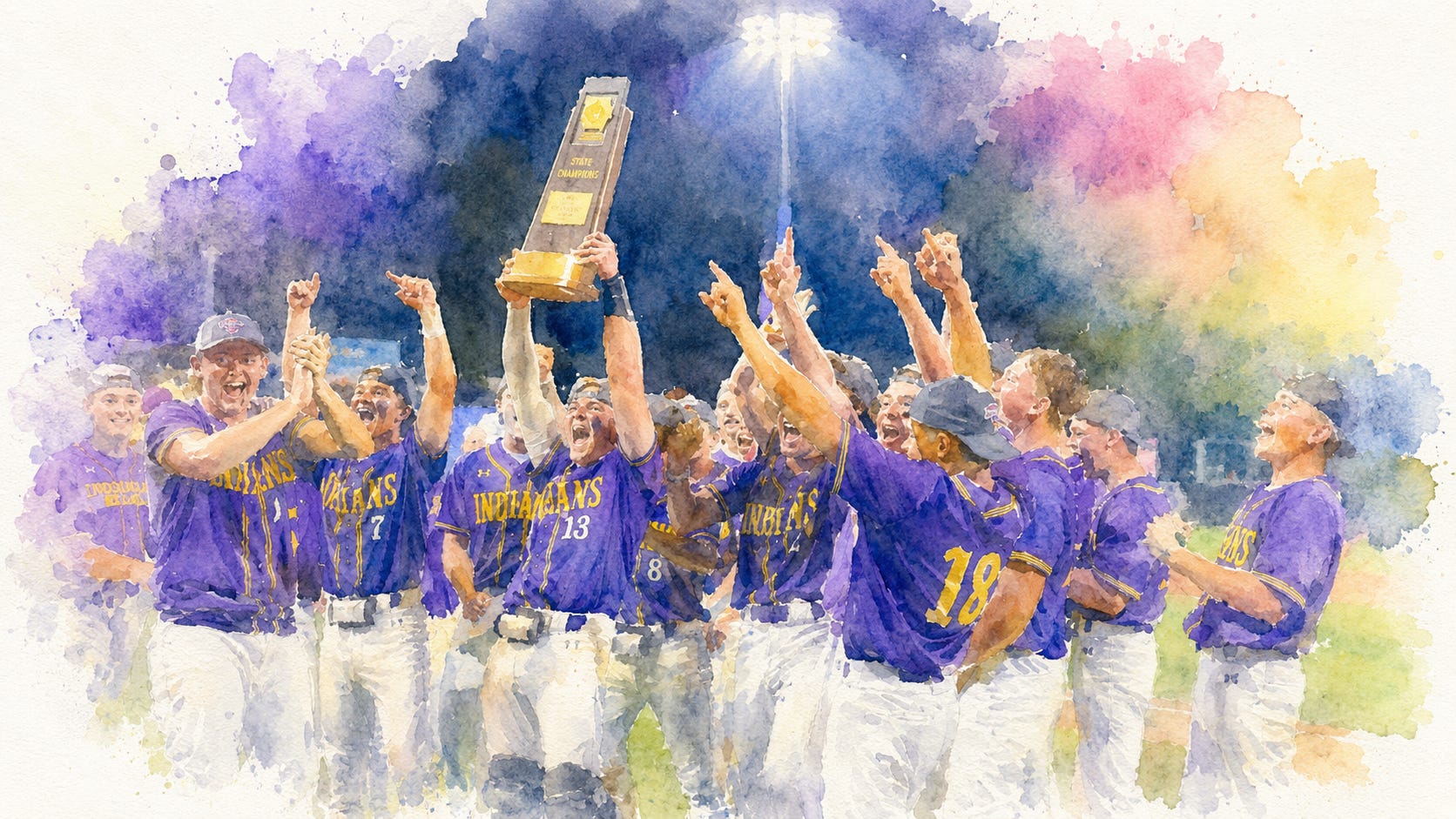
Thank you, you Indianola boys of summer.
You stretched the summer as long as you could to the final game of the season and ended the way only four teams in the state can: winning the state baseball championship.
It was the city’s first despite its long history of great ballplayers and coaches whose names are etched into the lore of the community.
Much of that history was written by the late Joe Blake, the Yankees farmhand who became the scion of Iowa’s first family of baseball.
Four of his sons played college baseball and Ben, Casey and Pete played pro ball. Casey played 13 years in the major leagues and hit 167 homers, the most for an Iowa-born player.
I ruefully remember the Indianola teams of the early 1990s that faced my beloved East Scarlets.
Casey, Pete and Jay Sirianni slaughtered us on the mound and at the plate.
It felt like watching homicide by curveball.
Jay is the son of John Sirianni, who won 510 games as the longtime Simpson College baseball coach.
Casey Blake coached third base for this Indianola club.
Baseballs are still taking a beating from the Blakes. Casey’s son, George, was the team’s best hitter and pitcher. His nephew, Bo, hit second in the lineup behind his cousin and was third on the team in hitting.
The 2026 Indianola baseball team was glorious to watch for old duffers like me who don’t give a wit for advanced statistics and love to see teams put the ball in play, field and throw with confidence.
Indianola could beat opponents in all sorts of ways. Their pitchers dominated, and the defense sparkled, especially the infield, with Bryant Ritchie at first, Colby Rockhold at second, Bo Blake at third and Dallas Harlan at shortstop.
They knocked down balls, got the lead runner whenever possible, backed up every play and turned a 6-4-3 double play as easily as most of us turn the key in our front door.
The pitchers threw strikes. The top four — Bo Blake, Ritchie, Jackson Foust and Asher Brueck — were a combined 30-0.
And the hitters? Oh, my goodness, how they smashed line drives.
They smacked a homer now and again, but they excelled at shooting the ball through the infield and driving scorchers into the outfield gaps.
They stretched singles into doubles and doubles into triples. More than a third of Indianola’s 340 hits were for extra bases.
When a hit didn’t move them far enough, they stole second and sometimes third. Indianola stole 111 bases in 126 attempts.
And they moved the runners with 44 sacrifices.
Imagine that: great bunting in the all-or-nothing age of dingers and strikeouts.
Every time an Indianola kid dropped a bunt in the dead zone between the mound and second base, I wanted to stand up and salute like the colors had just been presented.
I grew to love this team.
(Don’t tell anyone on the east side of Des Moines I said that. I still work over there, and nobody likes a disloyal Scarlet alumnus.)
What a thrill it was to cover their playoff run and championship.
This was my first championship, too.
I began my journalism life as a sports writer. I wrote my first paid story for The Des Moines Register about the fading tradition of high school letter jackets when I was a senior.
My first assignment from the gentleman scholar Dave Witke, who was Register sports editor when I was a kid, was to cover a baseball doubleheader between Hoover and East.
I never became a full-time sports writer. The legends of the Big Peach, the Register sports bullpen, were in their prime when I came up in 1993.
So I covered suburbs, city councils, school boards, county supervisors, courts, cops, crime, the weather (which in Iowa can be considered a crime), retail, consumer affairs and general assignment features before eventually becoming a city columnist.
I won a few awards for sports writing, but I was a news guy poaching in the sports department’s territory.
I covered Major League Baseball during a four-month stint at USA Today in the summer of 1999. The sports department had 15 satellite TVs, each tuned to a different game.
It was a glorious sight for a baseball junkie. I wrote the American and National League notes columns and the occasional game story for the cover of the sports section.
My best story from that summer was missing a story.
I took the train from Washington, D.C., to New York one weekend to have dinner at Mickey Mantle’s restaurant and see the Yankees play Atlanta at the old Stadium. The Yankees won 11-4. Bernie Williams and Chuck Knoblauch hit home runs, and Paul O’Neill went 3-for-5 with two RBIs.
They held a moment of silence before the game for John F. Kennedy Jr., whose plane had gone missing.
I got a call in my hotel room that night from one of my reporter pals at the paper. She said they wanted everybody in the newsroom early to give the JFK Jr. story maximum attention.
I took the train back to D.C. the next morning. When I arrived at the sports department, I saw all the beat writers crowded around the TV.
There was Mel Antonen, a South Dakota guy who could talk agribusiness as well as the infield fly rule.
Rod Beaton was the minor league guru and once famously argued with the cantankerous Barry Bonds.
Chuck Johnson was the Detroit native with the 1,000-watt smile.
And legendary columnist Hal Bodley, who started covering baseball in 1958 and still writes for MLB.com, was there, too.
I asked what was going on.
“Cone is throwing a perfect game at the Stadium,” somebody said.
I was brokenhearted. David Cone had been my favorite pitcher since I read a Sports Illustrated for Kids article about him during his years with the Mets.
He played Wiffle Ball in his backyard as a kid. Sometimes, on the mound, he used arm angles and grips he’d learned in his youth.
“Bummer,” I said. “I was just at the game on Saturday and took the train back this morning.”
The baseball editor said, “I wish I’d known that. I would have had you cover this game.”
Apparently the New York bureau guy went to cover Yogi Berra’s return to Yankee Stadium after a long absence because of a feud with George Steinbrenner.
Berra was there for Old-Timers’ Day along with Don Larsen, who threw a perfect game in the 1956 World Series.
I went back to my desk and sat down. Not only did I miss my chance to see my favorite pitcher throw a perfect game, I missed writing the gamer. It was too much for my 24-year-old mind to bear.
But 27 years later, the Indianola baseball team gave me a champion to cover. I did so in an unusual way.
I live with osteoarthritis, especially in my knees. I tore my meniscus in 2021 and have used a walker or cane ever since.
Arthritis is a mean condition. It flares up when it’s too cold, too humid, rainy or a butterfly sneezes.
I manage it with quarterly cortisone injections and Tylenol. It hurts to stand for much more than 10 minutes, and on the bad days, every step hurts.
I can’t go to ballgames anymore. Most places have good parking, but walking on uneven ground feels like doing the Macarena on a ledge of the Empire State Building.
I fell in early June, just a few days after school was out. I thought I had escaped it with a bruise on my arm.
But hip and shoulder pain lingered all summer. My hip feels OK now, but my shoulder still hurts.
So I could not sit with the sun on my arms and cover doubleheaders the way I did as a kid. I covered the games remotely by radio and streaming feeds.
I know it’s not the same as being in the press box, hearing the chatter of the crowd and taking in the sights, sounds and walking tacos.
A dozen years ago, I would have cried sacrilege at the notion of covering anything remotely.
But that was when my legs worked and I didn’t have to wonder how many steps stood between me and my destination — and whether I would have enough strength to get back to my car.
I embraced the technology that allowed me to follow this Indianola team, the Carlisle softball team’s state tournament run and the Simpson College softball team’s run deep into the NCAA Division III World Series.
I wish I could have been there for all the games. But I could not.
Fortunately, Indianola Independent Advocate owner Amy Duncan is more flexible than I used to be.
She let me cover these games and stayed up late to edit the stories for the next day’s newsletter and website. She gave a half-disabled man in his late middle age a chance to live out his boyhood fantasy.
I interviewed Indianola coach Nathan Carlin about a half hour after the game ended. I asked if I could talk to Zach Benge, the senior catcher who went 2-for-4 with a two-run double and a momentum-swinging solo home run.
The coach said he’d have Benge call me. He did, after 2:30 a.m.
My phone roused me after the bus had rolled into Indianola High School to a crowd of adoring fans.
I chatted with Benge, added a few quotes to the story, texted Amy about the changes and went to bed.
Never a sports writer, I don’t even make my living as a journalist anymore. I teach middle school English.
But for one summer, despite the limitations of my body, I covered champions.
That almost makes up for the David Cone thing.
DANIEL P. FINNEY teaches middle school English. He was a reporter and columnist for the Des Moines Register, Omaha World-Herald, St. Louis Post-Dispatch, and USA Today during a 27-year newspaper career. His column appears in the Indianola Independent Advocate and is distributed by the Iowa Writers Collaborative.
Comments
Nothing yet. Say the first thing.
Sign in to join the conversation.