
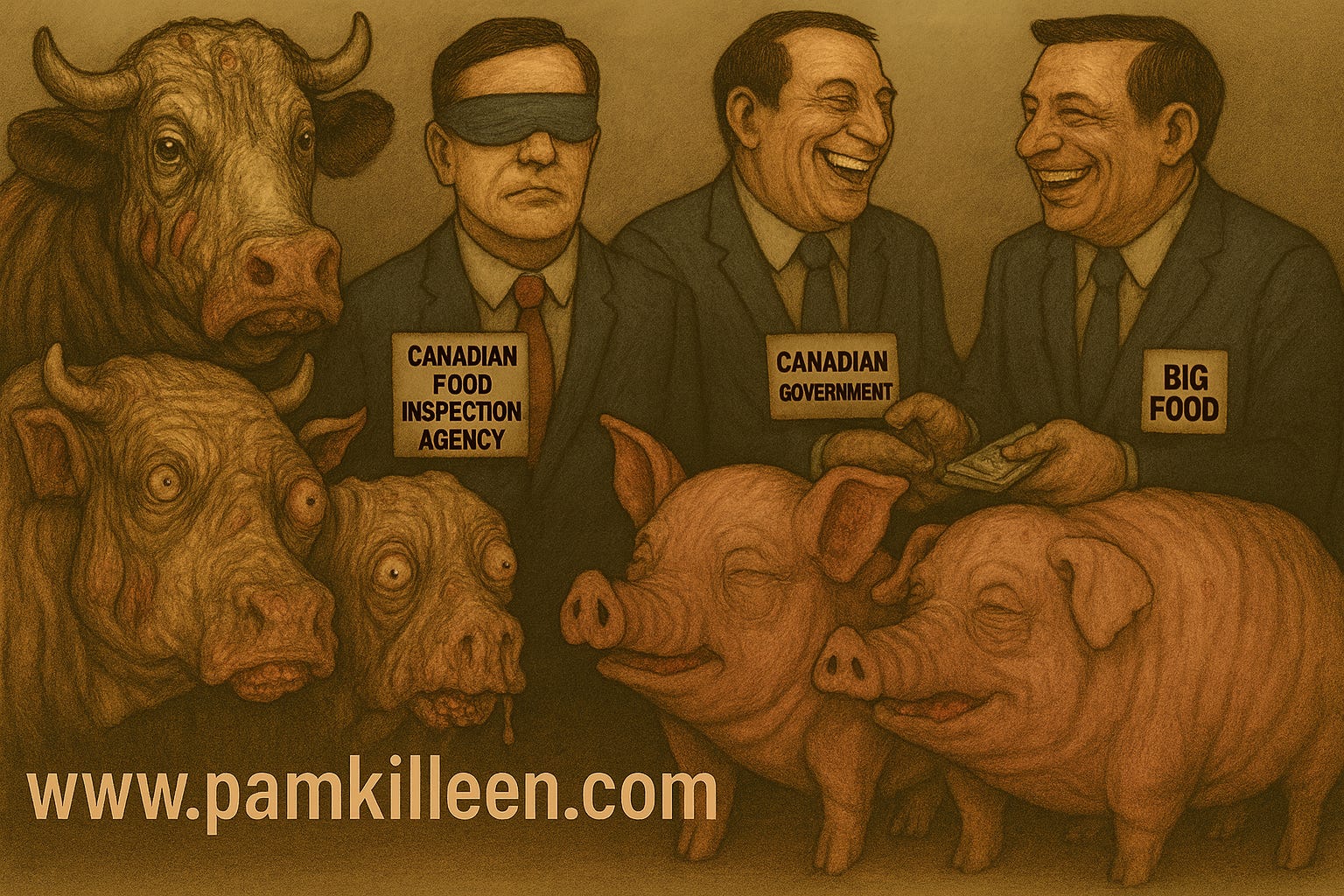
In early November 2025, Health Canada updated its Novel Foods Regulation and quietly removed cloned cattle, pigs, and all their offspring from the “novel foods” list.
There was no press conference, no public debate, no front-page headlines. Just a short update on a government webpage and a few industry memos. Yet this one change has very real consequences for every Canadian who buys meat or dairy.
In plain language, the decision means:
No mandatory pre-market safety review for meat or milk from cloned animals or their descendants.
No requirement to label these products as coming from cloned lines.
Beef, pork, milk, cheese, yogurt, and other dairy from cloned animals or their offspring can now be sold exactly like conventional food.
Most Canadians still have no idea this has happened.
The main cloning technique used for livestock is called somatic cell nuclear transfer (SCNT). In simple terms, scientists take the nucleus (the DNA center) from a body cell of an adult animal and put it into an egg cell whose own nucleus has been removed. This egg is then stimulated so it starts dividing like a normal embryo and is implanted into a surrogate mother.
It sounds elegant on paper. In practice, it has been a biological train wreck since the first famous clone, Dolly the sheep, in 1996.
Nearly 30 years later, the numbers are still brutal:
Live-birth success rates are typically only 1–5 %. That means hundreds of eggs and many surrogate mothers are used to produce just one surviving clone.
70–90 % of pregnancies fail before birth.
Surviving clones often suffer from Large Offspring Syndrome (oversized bodies and organs), breathing problems, heart defects, immune system weakness, and signs of premature aging.
Many of these problems come from epigenetic errors—faulty chemical “switches” on DNA that control how genes are turned on and off. Even if the DNA sequence is the same, these switches can be badly mis-set during cloning, so the animal is not a true copy of the original.
A 2022 review in the journal Theriogenology summed it up bluntly: despite decades of work, the overall success rate for cloning mammals has hardly improved. It is still common to reconstruct hundreds of eggs to get a single live clone, and the survivors show a high rate of developmental problems and poor health.
Yet Health Canada now treats products from these animals as “compositionally equivalent” to regular meat and milk—meaning that if the fat, protein, and a few standard nutrients look similar in lab tests, regulators consider them safe.
Those basic nutrient tests, however, do not capture epigenetic problems or the many subtle physiological abnormalities that can show up over an animal’s lifetime.
Back in 2008, geneticist Prof. Joe Cummins and biophysicist Dr. Mae-Wan Ho reviewed the science behind cloned food animals. They pointed out that SCNT rarely re-sets all the epigenetic marks correctly.
Their conclusion was stark:
Cloned animals are not true copies of the original donor.
Around 4 % of genes in the placenta and a smaller but still significant portion in organs like the liver show abnormal expression patterns.
These errors translate into developmental failures, hidden health defects, and reduced lifespan, even in animals that initially appear “normal.”
Some abnormalities can be passed on to offspring, especially through mitochondria—the tiny energy factories inside cells that contain their own DNA.
In other words, when clones are bred, the resulting calves or piglets may carry forward invisible problems that standard safety tests will never catch.
That paper was written 17 years ago. The basic biology has not changed. What has changed is the way regulators are choosing to classify—and ignore—these risks.
Supporters of cloned livestock say we need this technology for efficiency, uniformity, and a more secure food supply. This script should sound familiar, because it is the same one used to sell genetically modified (GM) crops over the past three decades.
Industry promised:
Higher yields to “feed the world.”
Less pesticide use.
More resilient crops.
Independent evidence tells a different story.
An Independent Science Panel review found that independent research and on-farm surveys since the late 1990s showed GM crops failed to deliver on claims of significantly higher yields or major reductions in chemical use. In fact, unstable engineered lines and crop failures were recurring problems.
A Friends of the Earth report in 2008, Who Benefits From GM Crops?, looked at years of data on cotton, soy, and corn in the United States and concluded that genetic engineering was, at best, neutral for yield. Average cotton yields stagnated after Bt cotton was introduced; similar patterns appeared in Argentina, Australia, and Colombia.
The Union of Concerned Scientists echoed this in its 2009 report Failure to Yield, concluding that after 20 years of research and more than a decade of commercial use, GM crops did not increase yields in a reliable, sustainable way, while traditional plant breeding outperformed genetic engineering.
In many regions, farmers rushed to buy expensive GM seed and the paired herbicides, only to end up indebted and disappointed when yields failed to match the hype. Some became trapped when non-GM seed was pushed out of the market, leaving them with no real choice.
Dr. Mae-Wan Ho, Prof. Joe Cummins, and Hartmut Meyer called this pattern the “biotechnology bubble.” For every product that made it to market, they noted, dozens failed—often with serious animal welfare or ecological consequences. Examples included:
A “super pig” engineered with a human growth hormone gene that became arthritic, ulcerous, blind, and infertile.
A “super salmon” designed to grow faster that developed huge heads and died because it could not see, breathe, or feed normally.
Cloned offspring of Dolly the sheep that were far more likely to die at birth than normal lambs.
Despite this track record, we are now asked to believe that copying elite farm animals through cloning will be different—that this time the technology will be precise, safe, and controlled.
The pattern is clear: bold promises up front, hidden problems later, and profits protected in between.
Cloning is not a tool for your local mixed family farm. It is a costly, high-tech process used almost exclusively by large breeding companies and industrial operations.
The goal is simple: make more exact copies of a tiny number of “super-producer” animals—pigs that gain weight extremely fast, cows that produce huge volumes of milk, or boars and bulls with traits suited to crowded confinement systems.
These animals are optimized for:
rapid growth in feedlots or barns
compatibility with automated feeding and milking systems
uniform carcasses for industrial processing
They are not optimized for animal welfare, flavor, or resilience on pasture.
By contrast, small regenerative farms that raise heritage and rare breeds—Tamworth, Gloucestershire Old Spots, or Berkshire pigs; Highland, Dexter, or Pineywoods cattle; Guernsey, Jersey, or Milking Devon cows; old-style poultry breeds—have no economic or biological reason to clone. Their animals reproduce naturally, live outside, and are selected for taste, hardiness, and maternal instincts.
Given Health Canada’s decision, the most reliable way to avoid cloned meat and milk is to step outside the industrial system entirely.
The gold-standard approach is simple:
Choose farms that:
Raise animals on pasture.
Use heritage or rare breeds.
Can look you in the eye and say, “No, we do not use cloned animals or semen from cloned lines.”
When you buy this way, you gain:
Near-100 % certainty about how your food is produced.
Better nutrition—pasture-raised meat and dairy typically contain more omega-3 fats, conjugated linoleic acid (CLA), vitamins A, E, and K2, and minerals.
Better flavor and texture.
A real relationship with the person who raises your food—many will gladly show you their farm.
How to find them in Canada:
National and regional directories such as EatWild.com, FarmMatch.com, LocalLine.ca, and provincial “buy local” lists (Harvest Ontario, BC Farm Fresh, Aliments du Québec, and others).
Look for words like “heritage breeds,” “100 % grass-fed,” “regenerative,” “pasture-raised,” “no cloning,” or “animal-welfare approved.”
Join a CSA (community-supported agriculture) for meat or dairy, where you pay upfront and receive regular deliveries.
Visit winter farmers’ markets and on-farm stores.
This one decision lets you bypass the industrial pipeline where cloning and other high-tech breeding tools are actually used.
Under current rules, organic standards do not allow cloned animals, so products carrying the Canada Organic logo are a strong second-line option for people who cannot buy directly from a farm.
You can also:
Ask brands and grocery chains for written confirmation that they do not source from cloned lines.
Contact your Member of Parliament and demand mandatory labelling for food from cloned animals and their offspring.
Share credible articles, reports, and interviews so more Canadians understand what changed in November 2025.
Europe still bans food from clones and their progeny.
The United States allows cloned products without labels, but in practice their use remains rare because of high costs and consumer wariness.
Canada has now chosen the quiet U.S.-style route—allowing the technology in while removing the only real guardrail we had: the “novel food” classification and its extra scrutiny.
We are told not to worry, that regulators have everything under control, and that new technologies are the only way to feed a growing world. The experience with GM crops, failed “super animals,” and the biotechnology bubble suggests otherwise.
Cloning does not fix the real problems in our food system. It does not restore soil, reduce chemical use, or improve animal welfare. It does not address affordability or access. What it does very well is protect and multiply the most profitable genetics for large companies, while asking the public to shoulder the unknown long-term risks.
We do not have to accept this as the only path.
You can still choose food from real animals raised on real grass by real farmers. You can still support farming systems that build soil, respect animals, and nourish people instead of balance sheets.
Those choices are still on the table—but only if we make them now, while we still can.
References & Further Reading
Malin K, Witkowska-Piłaszewicz O, Papis K. The many problems of somatic cell nuclear transfer in reproductive cloning of mammals. Theriogenology. 2022;189:246-254.
Cummins J, Ho MW. Cloned Food Animals Not True Clones. Institute of Science in Society; 2008.
duBreton. Cloned Meat Enters the Canadian Food Supply Without Labeling or Review. Newswire; Nov 6, 2025.
Global News. If cloned meat enters the food supply, will Canadians know? Nov 16, 2025.
Charlebois S. Cloned meat is coming soon. Health Canada just doesn’t want you to know. Agri-Food Analytics Lab, Dalhousie University; Oct 29, 2025.
Dogra B. GM Crops and Their False Promise of Higher Yield. Countercurrents; June 2025.
Pam Killeen is a health coach, podcaster, and co-author of the New York Times bestselling book The Great Bird Flu Hoax (2006). She writes and speaks extensively on health, nutrition, and systemic corruption in science and public policy.
No posts
Comments
Nothing yet. Say the first thing.
Sign in to join the conversation.