
Depending on what part of the world you belong to, Azad Kashmir, Pakistan-occupied Kashmir, or Pakistan-administered Kashmir is one of the ways to identify this region. The terminology itself is reflecting the unresolved territorial dispute between India and Pakistan. The decades, dominantly known through the prism of interstate rivalry. However, the recent anti-establishment protests in Rawalakot, Muzaffarabad, and Mirpur, compel one to look beyond a single, familiar narrative.
The unrest is not simply an extension of the Kashmir dispute. It is also a manifestation of Pakistan’s deeper, longstanding political history – including power, resources, and representation with its peripheral regions.
At the core of the current uprising are 12 seats in Pakistan-controlled Kashmir Legislative Assembly. These seats represent refugees from Indian Jammu who migrated to Pakistan after the 1947 Partition; ultimately settling in mainland provinces of Punjab and Sindh. The reservation has long served a political and symbolic purpose. It reinforces Pakistan’s position that the former princely state of Jammu and Kashmir remains a disputed entity and that representation must include displaced communities from areas currently in India.
However, for the Joint Awami Action Committee (JAAC), the issue is more localised, representing a democratic imbalance and economic disfranchisement. A coalition of traders, lawyers, students, and civil society actors, formed in 2023 has long argued that these seats dilute local representation by allowing electoral rights to citizens of Pakistan residing outside the territory to influence its political future. The group, recently designated as a terrorist organisation by Islamabad, has linked this reservation to the broader demands around governance, economic rights, and accountability.
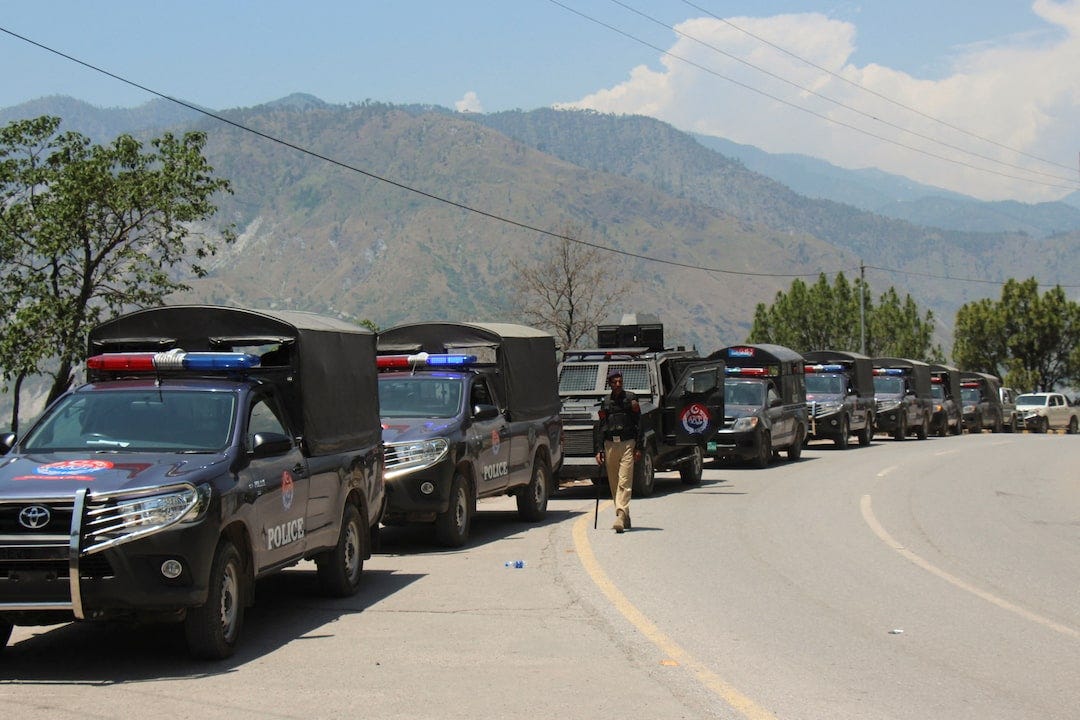
When the Supreme Court of Pakistan upheld the constitutional basis of these seats in June, the JAAC interpreted it as a rejection of one of its central demands. The subsequent confrontation between protesters and the state transformed what began as an institutional dispute into a wider political crisis; at least 22 people, including civilians and security forces, have been killed in these clashes. The territory remains shut for the third straight day, as of June 12, and a communication blackout has been imposed by the state.
For the Pakistani government in Islamabad, the dispute is tied to the state’s broader diplomatic position on Kashmir. Mirroring its own constitutional claims, India reserves 24 seats out of 114 for the territories across the Line of Control (LoC), under the legal provision of Section 14(4) of the Jammu and Kashmir Reorganisation Act, 2019. Therefore, an alteration in this arrangement will likely open a fresh Pandora’s box, potentially suggesting a shift in Pakistan’s constitutional understanding of Kashmir’s status.
For me, the resemblance of the protests with other federal-periphery conflicts in Pakistan was quite revealing. The initial demands of the protest were largely economic, overtime expanding into the territory of political representation, fiscal arrangements, and Islamabad’s political will towards this region. The state’s expected response of framing this unrest as an externally driven movement has done little to mitigate the persistence of these grievances. In many ways, the protests in Pakistan-controlled Kashmir have brought to light the broader patterns of resource grievances in Balochistan, disputes over federal authority in Sindh, and demands for greater accountability in Khyber Pakhtunkhwa. However, it is imperative to understand that the current movement is highly localised with no overt links to separatist sentiments, as often witnessed among Baloch and Pashtun groups.
The question of state-driven nationalism and pluralistic ethnic identities continues to remain central to Pakistan’s existential discourse.
The language of unrest in Kashmir, however, can obscure crucial distinctions.
While both Kashmir divided by the LoC share a political and territorial history, their cultural and social identities are not identical. The population of Pakistan administered areas are essentially associated with Pahari, Gujari, and Punjabi linguistic and cultural traditions, while the Valley has its own Kashmiri language, and heritage; a minority of Kashmiri-speakers can be found near Neelam regions on the Pakistani side of the border. The social and economic networks of this region also have stronger connections with the Punjab province and the wider Mirpuri diaspora.
Thereby, any links to the political mobilisations in the Valley would be incorrect.
With the upcoming elections in July, Islamabad’s challenges are here to stay. Conducting polls with bolstered security measures and restrictions could risk reinforcing perceptions of democratic deficit. Meanwhile, any delay in elections could deepen anti-government sentiments. Either way, Pakistan’s long-term advocacy around Kashmiri self-determination should be held under the scanner and resolving this contradiction will require more than one election cycle.
Thanks for reading Pakistan Paigham! This post is public so feel free to share it.
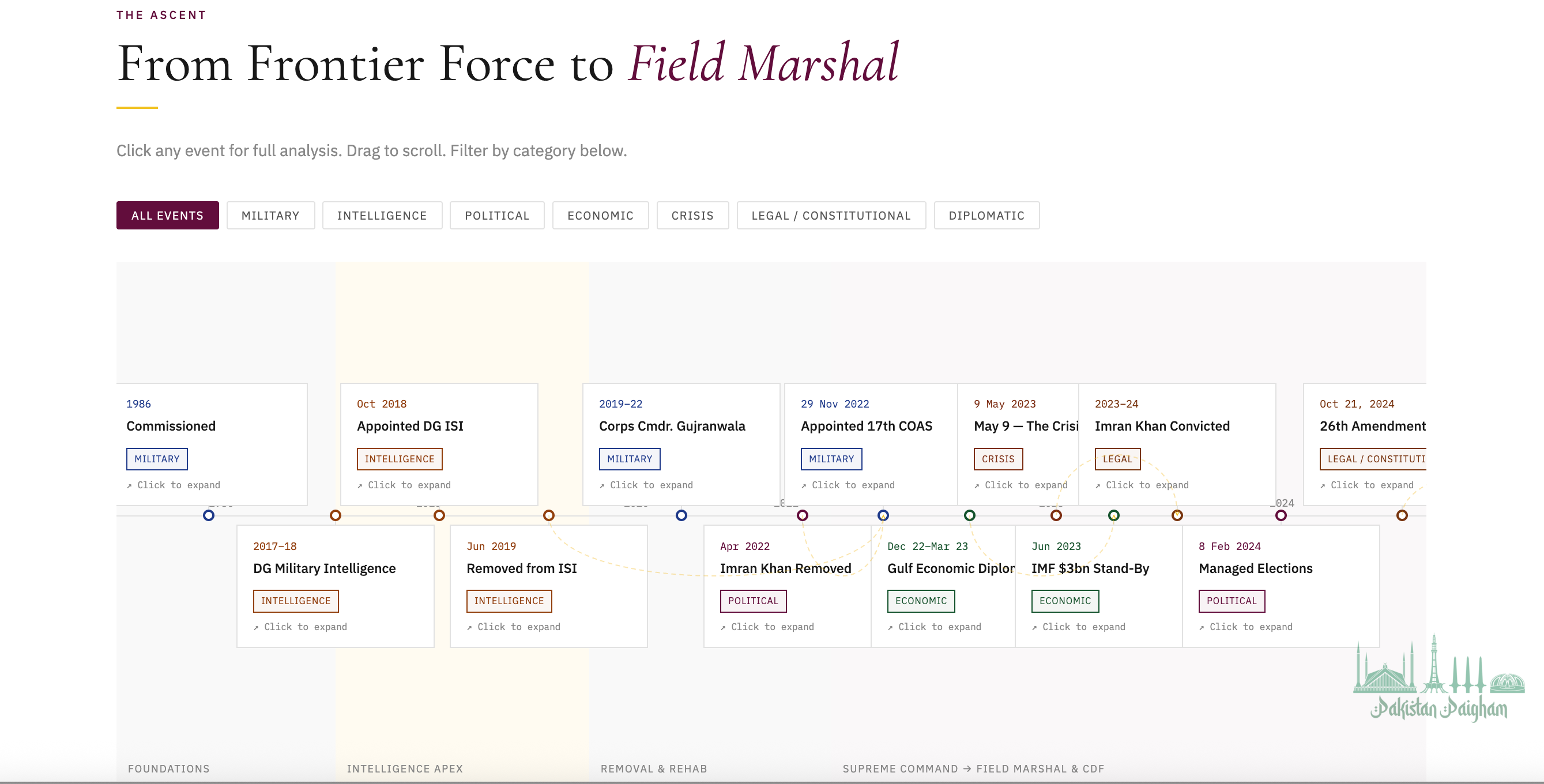
In my recent AI explorations, I put together a structured, interactive repository tracking Pakistan Army Chief Field Marshal Asim Munir’s rise through timelines, appointments, and key events. This is a pilot project and very much a work in progress. I welcome your feedback, suggestions, and collaborations.
You can find the link to the webpage here.
Learn the nuances of West Asia’s history, its ideological faultlines and why West Asia matters more today than ever before in this 5-week course. Take a deep dive into the politics and society of the nations that are defining the region, and how the world’s powers have engaged West Asia for the past century.
Leave the course with an unparalleled understanding of what’s at stake in West Asia and how it is reshaping the world order.
The programme is led by Raja Karthikeya, Adjunct Fellow leading West Asia studies at the Takshashila Institution. His areas of research include geopolitics of West Asia, peace mediation, counter-terrorism, nuclear disarmament and the impact of climate change on peace & security.
No posts
Comments
Nothing yet. Say the first thing.
Sign in to join the conversation.