
The debate over whether India and Pakistan should resume dialogue found new life after an open letter, signed by over 100 retired officials, diplomats, and civil society members from both countries called for renewed engagement. India’s closely held position that ‘terror and talks’ and ‘water and blood’ don’t flow together, saw some pushback after Congress MP Shashi Tharoor argued in an op-ed for greater people-to-people engagement with Pakistan. Former Foreign Secretary Nirupama Rao echoed a similar sentiment shortly thereafter.
More unexpectedly, comments by Rashtriya Swayamsevak Sangh (RSS) General Secretary Dattatreya Hosabale, later clarified by RSS publicity chief Sunil Ambekar as referring specifically to people-to-people engagement, gave renewed impetus to what seemed to be a settled debate.
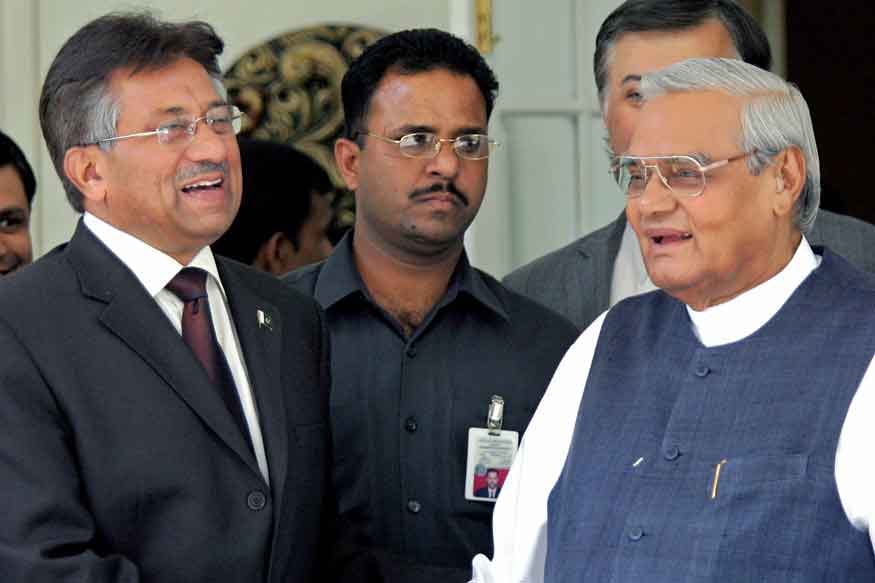
Predictably, the conversation has once again fallen into familiar binaries. One camp in India invokes its painful history of diplomatic disappointments, from Kargil to Pathankot, from the Parliament attack to Mumbai, from Uri to Pahalgam, to reaffirm the ‘no talks and terror’ proposition. The other argues that neighbours cannot remain in perpetual hostility and that dialogue remains an indispensable instrument of statecraft. I have often found myself leaning towards the latter view, borrowing the typically used observation that while countries can choose their friends, they cannot choose their neighbours.
Personal views aside, history suggests that both positions, while grounded in legitimate concerns, oversimplify a far more complex strategic reality.
The first point worth recognising is that India’s Pakistan policy has displayed far greater continuity than it is often credited for. Governments have changed, rhetoric has evolved and tactics have shifted, but India’s core strategic objectives have remained remarkably consistent: preserving territorial integrity, preventing the internationalisation of Kashmir, deterring cross-border terrorism and avoiding full-scale conventional war. What has changed over the decades are the instruments employed to pursue these objectives, not the objectives themselves.
Pakistan, meanwhile, has historically viewed India through the prism of an existential threat. The rivalry with India has remained central to Pakistan’s existential narrative and, to varying degrees, its state identity. Whether that formulation remains relevant nearly eight decades after Partition is a valuable subject of debate. Yet for Pakistan’s military establishment, the persistence of the India threat continues to serve an institutional purpose – it reinforces the military’s centrality in national politics and economy, legitimises its dominant role in policymaking and justifies a disproportionately monumental share of state resources.
This asymmetry in how the relationship is perceived has made engagement particularly difficult.
The present phase of bilateral relations is significant for the depth of the downturn following the four-day military confrontation in May 2025, but more importantly for its longevity. Historically, India and Pakistan have fallen in the familiar cycle of crises followed by gradual diplomatic re-engagement, confidence-building measures and, eventually, another breakdown. This cycle has repeated itself after Kargil, after the Composite Dialogue, after Mumbai and even after earlier periods of military escalation.
However, nearly a decade of diplomatic disengagement has produced a different reality. Trade has ceased, diplomatic representation is absent, sporting and cultural exchanges find no sentimental support, visa regimes have become increasingly restrictive and high-level political engagement has all vanished. Concurrently, the escalation ladder has become more unpredictable.
However, deterrence is rarely absolute. India’s military responses have imposed greater costs on Pakistan, but they have not eliminated the possibility of future crises. Equally, diplomatic disengagement has not, by itself, produced sustainable deterrence.
If both sides are ever willing to return to the negotiating table, the temptation, if any, of any grand political gesture should be avoided. The history of Lahore, Agra, Aman ki Asha and summit diplomacy suggests that symbolic, leader-driven initiatives rarely survive crises. Institutional and public memory on both sides runs too deep.
Instead, any future engagement should begin from the ground up rather than the top down. There should be a key distinction between political reconciliation and limited strategic cooperation.
Climate change offers perhaps the clearest example. Glacier melt in the Himalayas, transboundary air pollution, floods, heatwaves, locust infestations and disaster management do not recognise the Line of Control. According to the World Bank, climate-related disasters could reduce Pakistan’s GDP by as much as 18-20 per cent by 2050. The consequences of environmental degradation will inevitably spill across the subcontinent. Climate cooperation, therefore, should not be viewed as a peace process but understood as a shared risk management.
The same logic applies to technical cooperation on flood forecasting, public health, disaster warning systems and humanitarian issues such as fishermen and medical visas. None of these require political normalisation, nor do they require either side to compromise its Kashmir position.
History has already demonstrated that grand gestures repeatedly fail. It has also demonstrated that complete disengagement does not eliminate strategic risk. The next phase of India-Pakistan relations is therefore unlikely to be defined by either romantic peace initiatives or permanent hostility. It will require something less cinematic but perhaps more durable: pragmatic statecraft grounded in realism rather than symbolism.
Thanks for reading Pakistan Paigham! This post is public so feel free to share it.
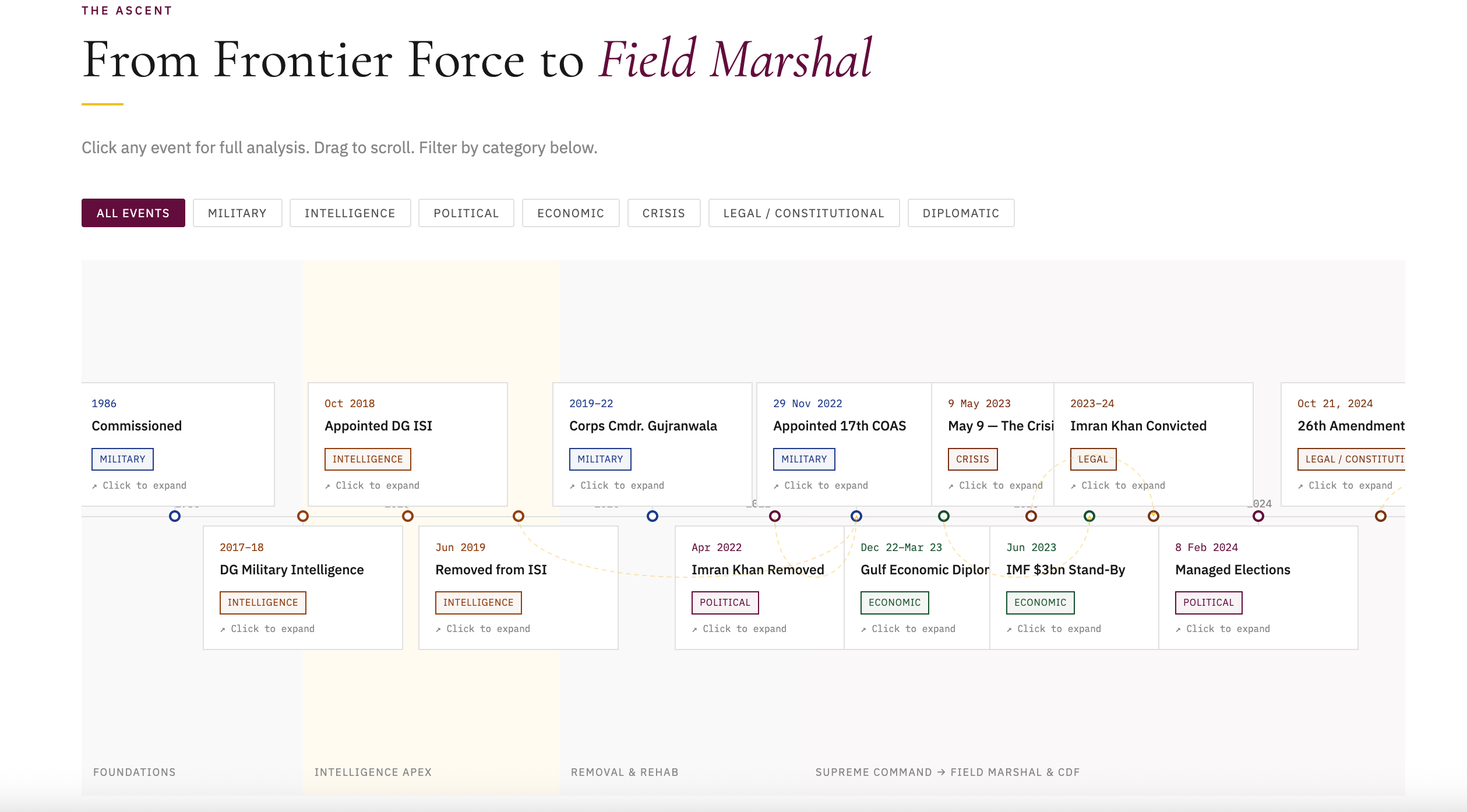
After several days of waiting for Claude tokens, a small side project is finally live.
Asim Munir remains a difficult, yet fascinating, figure to interpret. His public profile is managed, his statements measured, and much of influence exercised through institutions. However, given his domestic rise and growing international attention makes him an increasingly important subject of study for curious minds and policy wonks.
I built this webpage using Claude to bring together timelines, key events, speeches, appointments, and developments associated with his rise. The intention is simply to create a structured repository that makes it easier to trace patterns, place events in context, and follow the evolution of his role over time. Chronology, I believe can be a useful analytical tool.
This project is an experiment in using AI not simply to generate content, but to organise information and build a foundation for deeper research for students, policymakers, diplomats, and academics.
Edit: It's a pilot project and a perpetual work in progress. I'd love to hear how it helped you, or any suggestions and ideas you have to make it better.ACCESS THE WEBPAGE HERE https://lnkd.in/equ27Pps
No posts
Comments
Nothing yet. Say the first thing.
Sign in to join the conversation.