
At around 2am, when you are awake for the third night running and the world around you is resting peacefully, a particular kind of fear and hopelessness can take hold. For yet others, it is the gym sessions that have stopped working, and the uninvited weight that is gathering around their midriff. Or pehraps its bloat, a feeling of dread on waking up, or a peristant lack of energy. There are a constellation of vague and unsettling worries that drive many of us to open a browser and start searching for what other people think the answer might be.
This, in a nutshell, is how the wellness industry, and sketchy influeners, have grown into such a vast endevour. At its best our online voyages will take us to influencers flogging supplements and cold plunges. At worst, we might end up in forums discussing substances people are injecting that doctors have never heard of and be tempted to do the same. BP-157, anyone? A peptide for which one of its pivotal studies is a phone survey of a few handful of users after they went to a knee clinic. It isn’t that people are knowingly reckless; rather, many do not understand how and why medicine is slow and careful.
Medicine’s caution, and its general inability to tell us how to use drugs to improve ourselves, means the gap between treating a disease, and human flourishing, is a wide one. It is a hole that the $2trn wellness market has sprung up to fill. Longevity and health influencers promise us that we can take control of our lives and our health if we follow their advice.
Beyond a few harmless interventions, an entire informal pharmacopoeia has taken root. I’ve been writing about one corner of it — peptides, and their alleged powers of tissue repair, skin rejuvenation, recovery and so forth. Working with Tim Cross at The Economist, we look at how peptides occupy a strange regulatory limbo: not approved as medicines, and legally sold as “experimental chemicals” but without the oversight that guarantees that you are getting what you are being sold and it works. In short, they are untested, unregulated and potentially contaminated. Nonetheless they seem to be increasingly popular. In the absence of proper clinical trials, users have built their own body of folk pharmacology or “bro science”.
A few peptides are well-known and tested in humans. Semaglutide and insulin for example. But there are now hundreds of different peptides being sold online according to one contact. And the evidence base is thin: there can be nothing more than a few papers testing the substances in cells in a dish or on mice. Users cannot be sure what they are injecting, whether vials are contaminated, and whether what they are injecting is even good for them.* With large potential downside for a small potential gains, it is hard to understand why people are taking these risks.
The full piece is here. One of my favourite anecdotes in it is that doctor Jordan Shlain was asked by a patient to get hold of a vial of L-carnitine—because all the “bros and longevity people” were telling the patient that he had to do it. Dr Shlain sent the bottle for testing and found it contained multiple unidentified compounds, including two synthetic stimulants with ecstasy-like properties, an agricultural weedkiller and an industrial chemical.
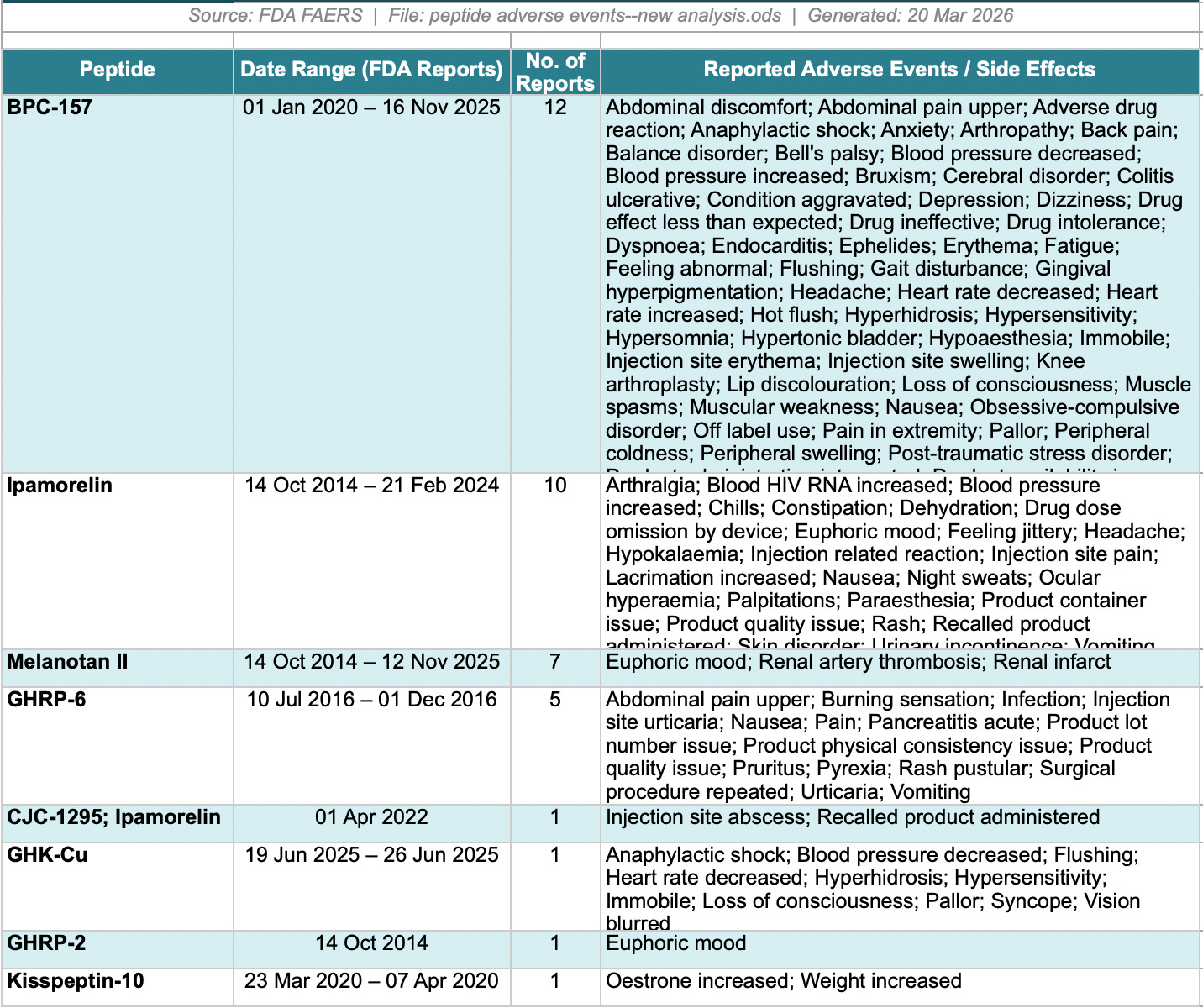
Talking to experts about the adverse events they have encountered I’ve come across a case of carpal tunnel syndrome, anaphylactic shock, and one removal of pituitary glands that medics believe were related to the use of peptides. In a side project with another colleague at work, we extracted adverse event reports from the FDA’s FAERS reports peptides and using AI I’ve generated a database to summarise the records (but please check directly with FAERS yourself before quoting any of this).
The use of performance enhancing drugs is part of a broader story I’m working on around enhancement. For those who haven’t come across it, the Enhanced Games is an international sporting competition — backed by investor Christian Angermayer — explicitly designed around performance enhancement. Athletes are encouraged to use substances currently banned by the World Anti-Doping Agency. (This competition is using approved medicines as enhancements.)
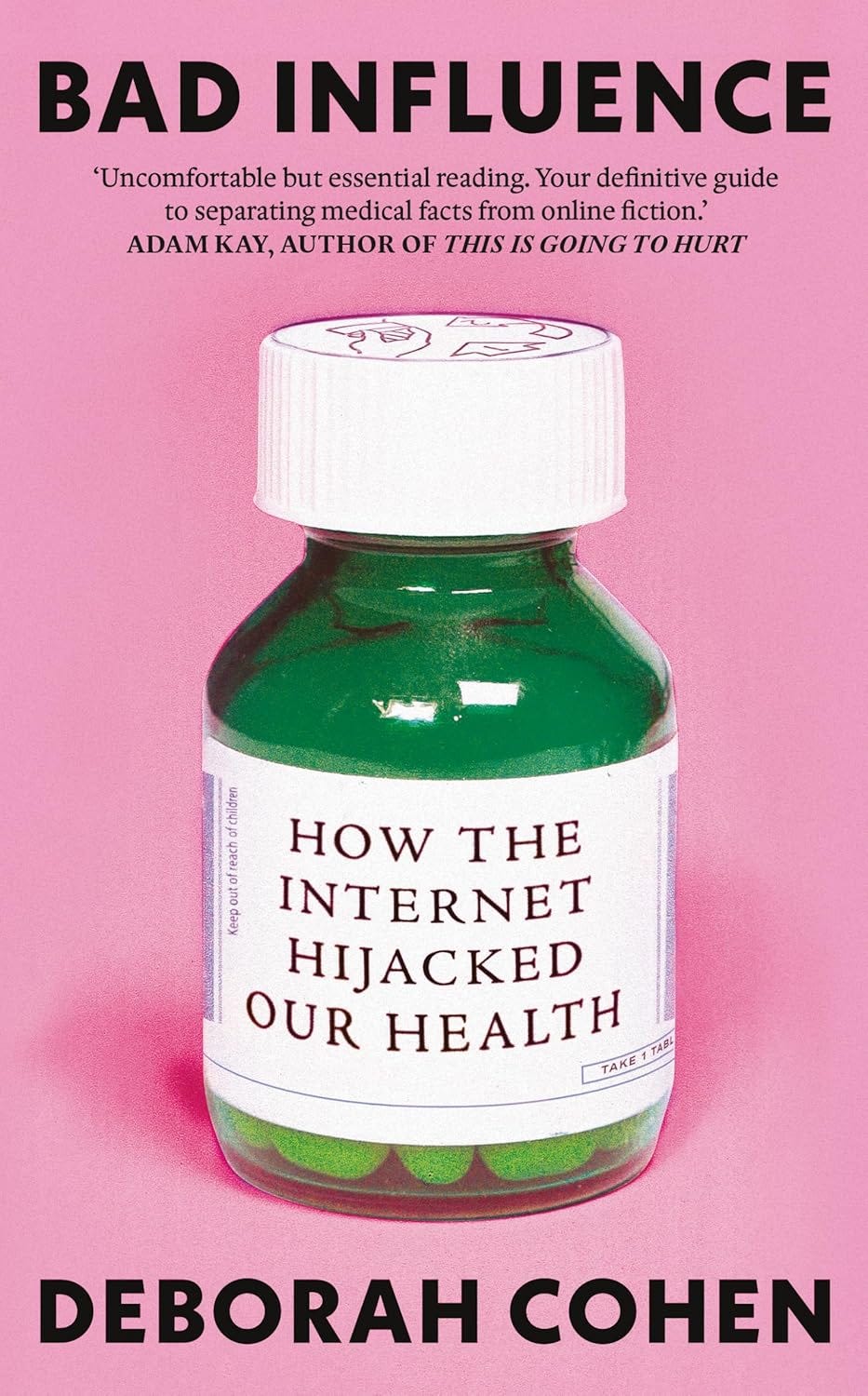
If you want to understand how the internet became our new medicine cabinet, Deborah Cohen’s Bad Influence: How the Internet Hijacked Our Health (Oneworld, 2026) is the book to read. Cohen is a former BMJ investigations editor and BBC Newsnight health correspondent, and she’s written what is probably the most rigorous account yet of how social media has transformed, and often distorted, the way people make health decisions. (Full disclosure: Cohen is also a friend.) It is a very timely book.
Related reads on Overmatter:
Notes
* RFK is planning to solve part of this problem by allowing a number of peptides to be made in the US again by compounding pharmacies.
Comments
Nothing yet. Say the first thing.
Sign in to join the conversation.