
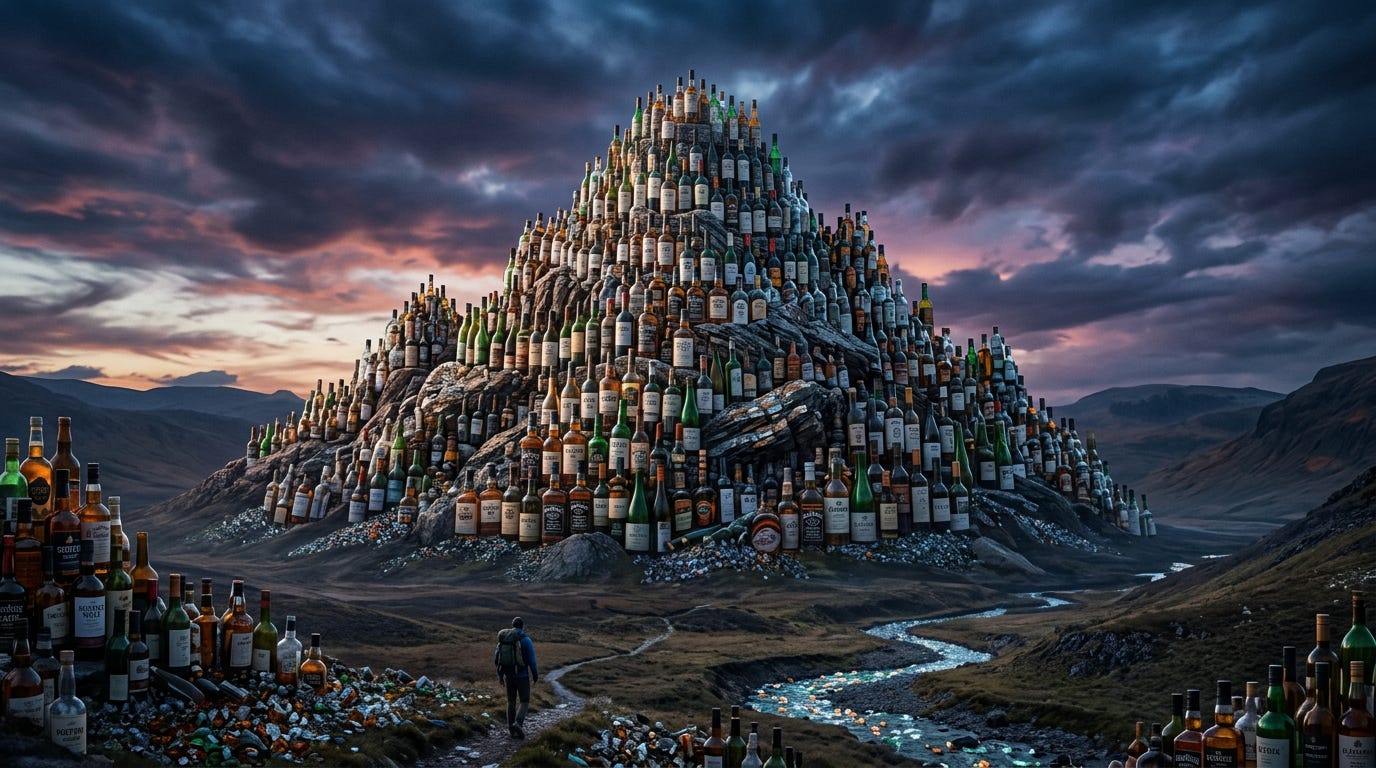
Spend any time at a work social or a school event and it is hard not to notice that people are not drinking as much. It may even be entirely alcohol free. Something has changed in recent years in many rich countries and one framing of this has been the idea of peak booze, that many parts of the world are past the point of their peak drinking years and are moving to different drinking habits.
In a previous piece a reader commented that the global slide from peak booze was rather modest. On the face of it, that seems true. The problem with drinking data is that aggregate numbers have a habit of hiding the trends that matter. And rich countries1 are definitely drinking a lot less. The reason the global slide is not larger is that a small number of countries are getting richer for the first time, and drinking more. But in most wealthy countries that shift is easy to see. Most, but not all.
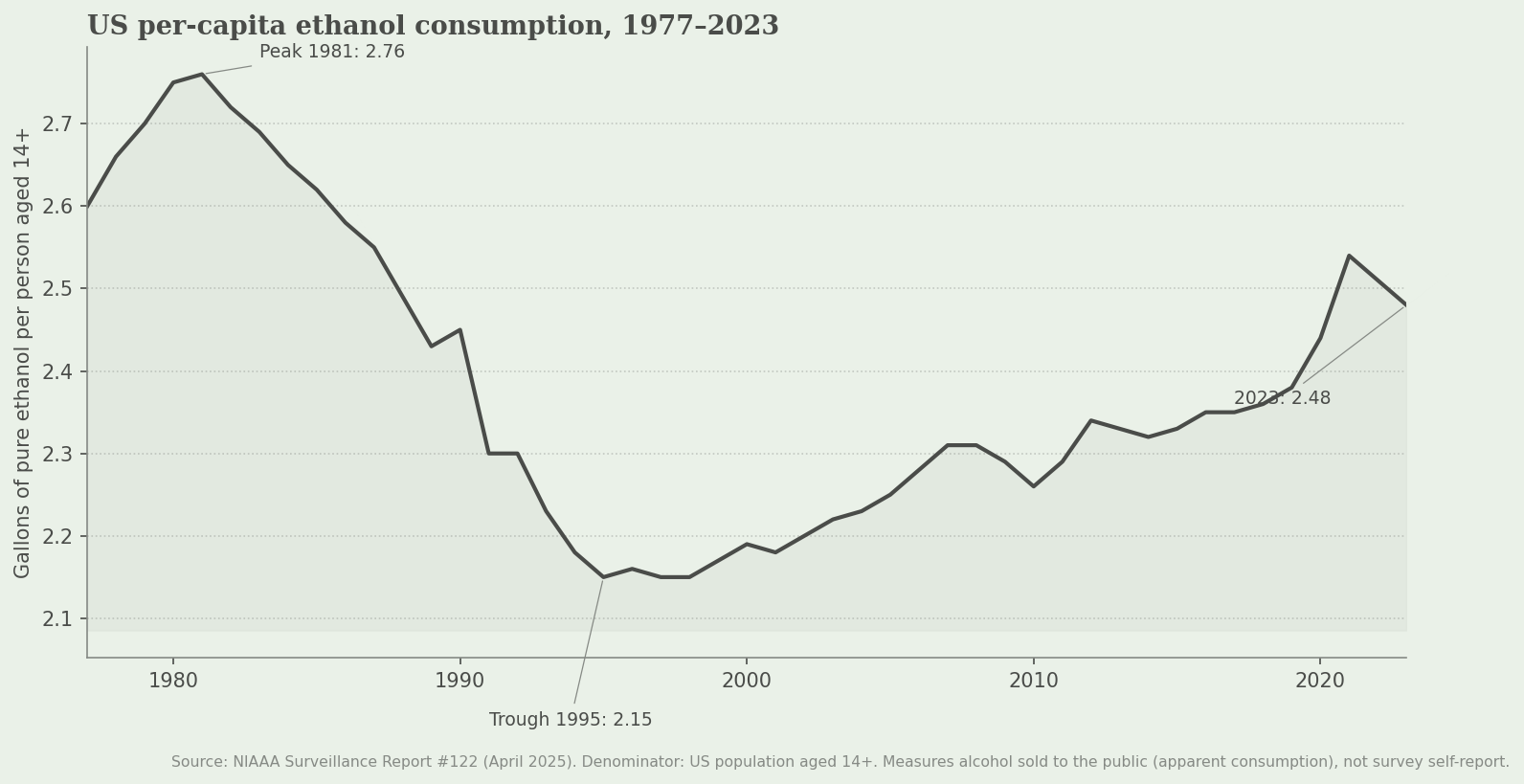
In the last century, America had its peak booze moment in 1981, after this there was a big shift in drinking habits. But that all changed in 1995. Today consumption looks less like the downward slope you see in rich countries and more like a trough — imagine it filled with wine, if you like.
In 2022 and 2023 it looks like there is renewed decline. It could just be a blip. Or it could be the same thing we see globally: two very different stories hiding in one trend line.
We have long known that there has been a major long-term decline in drinking amoung the young around the world—America included. But in America something else has been going on: middle-aged and older Americans—particularly women—have been drinking a lot more.
From here on in we need to get into the weeds of the data a bit. Feel free to skip to the end if you don’t want to read all this. But the data on youth drinking in America can be seen in a few places. One is in a series from the 2024 National Survey on Drug Use and Health.
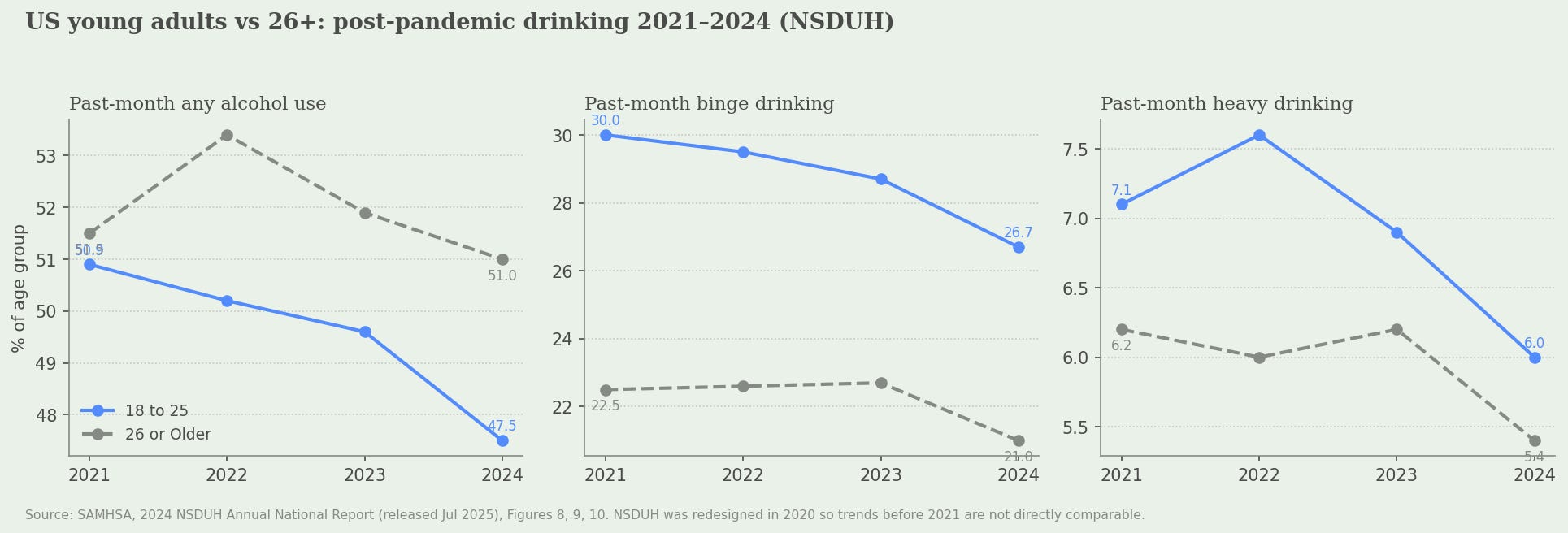
On the left chart, young and old seem to be drinking about the same just after the pandemic then they diverge. A longer time series from White (2020) tells us that past-month drunkenness among 12th graders fell from a striking 37% (male)/25% (female) in 1991 to a more modesst 19%/16% in 20182. Data from Monitoring the Future backs this up in more detail through 2025.3 Grucza et al. (2018) found essentially no increase in binge drinking for 18- to 29 year olds between 2000 and 2016.
Boozy boomers and wine-loving women
But binge drinking has increased in older generations—with older generations bingeing more. Average annual increases in binge drinking across 2000 to 2016³ were 1.1% for 30- to 49-year-olds, 2.7% for ages 50 to 64, and 3.4% for individuals aged 65 and over. Binging boomers!
But, wait. It isn’t just old people. Women are drinking more. McKetta & Keyes (2019) found binge drinking among women aged 30–44 without children doubled from 21% in 2006 to 42% in 2018—mostly millennials and some Gen X. It also rose for women of every age group, whether or not they had children.4
So what does this all mean?
So one way of looking at the recent drop in American consumption is that it might be a blip—or some artefact. But equally it could be a sign that youth drinking patterns are finally starting to assert themselves on the national trend line. Even if next year’s data isn’t another dip, there are good reasons to think that the next decade is going to be more of a downward slide. Boomers powered the rise, and they are slowly draining out of the data through demography—and the young have different attitudes towards booze they are likely to take with them as they age.
The visible cultural shift can be seen in everything from #sobercurious to the growth of the no- and low-alcohol market, to the rise of dry socialising at work venues and school events. The trend is set, and the peak booze moment of the last century in America is very much in the rear view mirror.
Notes - For sources and methods see footnote: 5
Between 2005 and 2014, past-month binge drinking among Americans aged 50 and older rose from 6% to 9% for women versus 20% to 22% for men. Past-year alcohol-use disorder at 50+ nearly doubled for women over the same period — 1.3% to 2.4% — while remaining essentially flat for men at 5.0% to 5.1%. (White 2020.)
Monitoring the Future, a University of Michigan survey of American secondary-school students, shows this decline has continued. Past-year alcohol use in 12th grade fell from 73% in 2000 to 41% in 2025; in 10th grade from 65% to 24%; in 8th grade from 43% to 11%. Past-two-week binge drinking in 12th grade fell from 30% to 9%.
Grucza, R.A. et al. (2018), “Trends in Adult Alcohol Use and Binge Drinking in the Early 21st-Century United States: A Meta-Analysis of 6 National Survey Series”, *Alcoholism: Clinical and Experimental Research*, 42(10): 1939–1950.
Sources and methods. The per-capita consumption series is from the US National Institute on Alcohol Abuse and Alcoholism’s Surveillance Report #122 (April 2025). Young-adult drinking figures for 2021–2024 are from the 2024 National Survey on Drug Use and Health, released by SAMHSA in July 2025. Long-run teen figures are from Monitoring the Future 2026 (December 2025). Age- and sex-specific trend estimates are drawn from three peer-reviewed studies: Grucza et al. (2018) in *Alcoholism: Clinical and Experimental Research*; White (2020) in *Alcohol Research: Current Reviews*; and McKetta & Keyes (2019) in *PLOS Medicine*. The cross-country chart was produced from Our World in Data. Aside from that chart, numbers were extracted and plotted with the assistance of an AI coding tool (Claude), which also helped cross-check each figure against its published source. All numbers in this piece (except those on the OWID chart) have been verified against the original documents.
Comments
Nothing yet. Say the first thing.
Sign in to join the conversation.