
Do you understand Eyjafjallajökull? I didn’t either - until I went on a vacation. Six years ago, my wife and I took a road trip around Iceland. Eleven days. Eight stops. An unforgettable memory.
Until that trip, I associated Iceland simply with a historic event: Ronald Reagan and Mikhail Gorbachev’s meeting in the capital city Reykjavík. They talked about a nuclear treaty.
And a barely worth mentioning association was my having read “Independent People” by Halldór Laxness - Iceland’s only Nobel Prize winner in Literature.
To be honest though, there was already another quasi-personal connection with Iceland. An Icelandic volcano had erupted in 2010, spewing ash in the atmosphere and bringing transatlantic air traffic to a halt. We were on our way back from Europe to Minnesota, and the eruption nearly stranded us in Istanbul, Türkiye.
That volcano was Eyjafjallajökull.
I know what you are thinking. Yes, I did know about Eyjafjallajökull, but I didn’t understand Eyjafjallajökull.
The understanding began with beer. With Egils Gull - simply called Gull – to be precise.
The process needed waterfalls too. Fortunately, there is no dearth of waterfalls in Iceland. Iceland is one of the most glacier-rich countries in the world. Most of them sit right on top of volcanoes. Not surprisingly, there are literally hundreds of waterfalls in Iceland.
One of the first waterfalls we saw was Gullfoss. It is an iconic, multi-tiered waterfall with massive amounts of water plunging into a deep canyon. I remembered the hotel bar from last night, and simply assumed that Iceland’s most popular beer was named after the country’s most iconic sight.
“No, gull means golden,” said the bartender, when I asked him later that night.
🎥 Gullfoss waterfalls
We visited more waterfalls: Goðafoss, Skógafoss, Dettifoss, and others. It dawned on me that foss probably means waterfall in Icelandic. And Goða sounded so similar to God. This time I was proven right on both counts – with the proviso that the accurate translation of Goða is “of the gods”. The names translate neatly into ‘waterfall of the gods,’ ‘waterfall of the forests,’ and simply ‘the falling waterfall”.
🎥 A brief moment of sun on a rainy day was all I needed to capture a rainbow at Skogáfoss waterfalls
There was another insight. Icelandic language loves compound words.
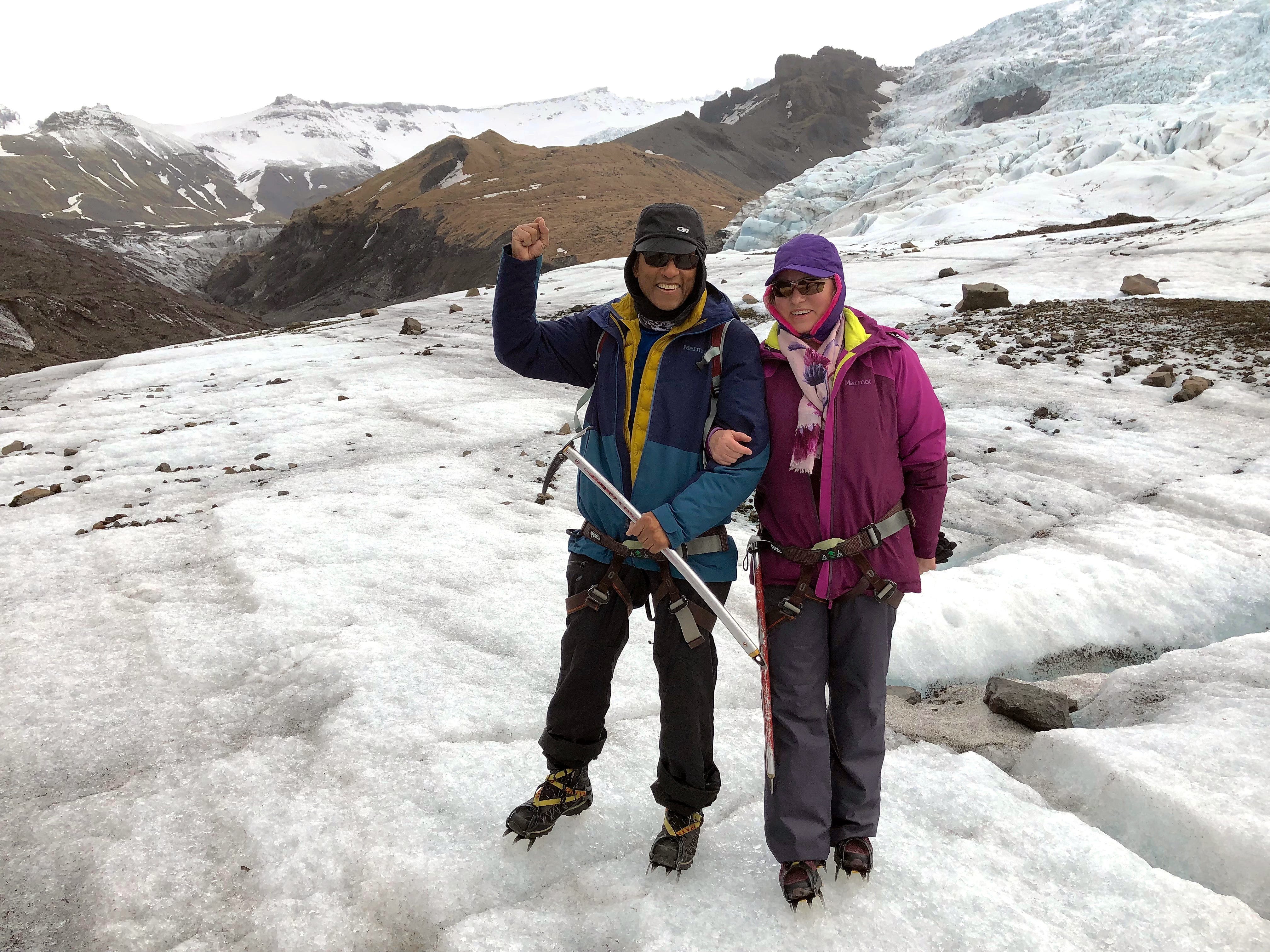
I tucked that insight into my mental backpack as we continued our road trip. And unpacked it again as we were climbing Vatnajökull - Iceland’s largest glacier. Of course, we had a professional guide with us.
By then, I was having fun trying to decipher strange-sounding Icelandic words. I learned that the name of the glacier combines two words: vatna = water, and jökull = glacier.
That’s when I understood Eyjafjallajökull.
It is simply the combination of three words: “eyja + fjalla + jökull“. Translated literally “island + mountain + glacier”.
That solved another riddle that has been bothering me for a while. How on earth can Icelanders remember such strange words like Eyjafjallajökull? It’s simple. Would you have much trouble remembering the name of a place if it were called “Islandmountainglacier”? I bet you wouldn’t. But for non-English speakers that would be a challenge!
For many people, including me, compound words inevitably bring the German language to mind. Sometimes that association is simply fun. Consider a made-up word that nobody actually uses: “Donaudampfschifffahrtselektrizitätenhauptbetriebswerkbauunterbeamtengesellschaft”. It is grammatically correct but exists mostly to amuse or intimidate. It means “Society of junior officials of the main electrical works department of the Danube steamship company.”
On the other hand, Kraftfahrzeughaftpflichtversicherung, with its 34 letters, is a perfectly customary word in everyday use. It means “motor vehicle third-party liability insurance”.
It turns out that German isn’t unique. Most languages allow compounding in some form, including English, Chinese, Japanese, and Arabic.
Compounding is especially prolific in Germanic languages such as Dutch and the Nordic languages: Swedish, Norwegian, and Danish, etc. Germans, however, are simply bold about it.
As I dug a bit deeper, I discovered that while Germans are bold about compounds, Sanskrit takes the idea to the extreme: entire sentences can collapse into a single word.
In case you are not familiar with Sanskrit, think of it as India’s version of Latin. Both are ancient, classical languages. They are no longer spoken daily. Latin gave us French, Spanish, Italian, and more; Sanskrit gave us Hindi, Bengali, Marathi, and their relatives.
It is likely that some of you have encountered Sanskrit words – especially if you are into yoga. Many yoga positions are named in Sanskrit. Some examples:
Śavāsana (corpse pose) is a compound of Śava (corpse) + āsana (pose).
Trikoṇāsana (three-angle pose) comes from tri (three) + koṇa (angle) + āsana (pose).
Bhujaṅgāsana (cobra pose) comes from bhujaṅga (cobra) + āsana (pose)
Adho Mukha Śvānāsana (down facing dog pose) comes from Adho (downward) + Mukha (face) + Śvana (dog) + āsana (pose)
I don’t know Sanskrit, but my mother tongue is Bengali – which descended from Sanskrit.
Bengali, too has compound words, although I never thought about it consciously. Partly because they are not as bold as German ones. Perhaps also because one uses a native language more instinctively than analytically.
There was another surprise. I had learned German many decades ago, including its fondness of compound words. But it took my engagement with the Icelandic word Eyjafjallajökull to start thinking about compound words in Bengali.
Here too, I have a hypothesis. German language and its compound words were taught to me, whereas Icelandic compound words came to me through self-discovery. The latter is always a more powerful way of learning.
As I looked inward, I realized that Bengali is replete with compound words. Many evade detection unless consciously scrutinized. They are usually simple, short and poetic.
But here, I wanted something bold and bombastic to stand head-to-head with Kraftfahrzeughaftpflichtversicherung or Eyjafjallajökull! And I found one. My favorite is কিংকর্তব্যবিমূঢ় (pronounced: king-kortobbo-bimurh). It can be broken down as:
কিং (king) - what
কর্তব্য (kortobbo) - duty
বিমূঢ় (bimurh) - confounded
It literally means “utterly perplexed about what to do”.
Call me biased, but in elegance, the Bengali compound word কিংকর্তব্যবিমূঢ় beats German Kraftfahrzeughaftpflichtversicherung by miles.
As we have seen, compound words are not a German eccentricity; they are one of the quiet universals of human language. That brings to mind the concept of a universal grammar (UG) underlying all human languages. Many linguists have proposed such an idea, including Noam Chomsky. But the concept remains controversial.
Chomsky once remarked that a Martian linguist might view all human languages as little more than dialects of a single language: different on the surface, yet strikingly similar underneath.
I often write about topics for which I have no official credentials. But here, that would be a bridge too far. I’ll instead wait for a Martian linguist to read this essay and tell us whether Chomsky was right.
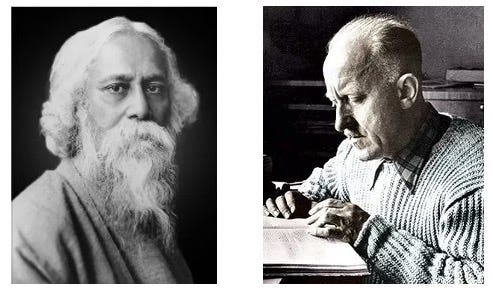
Note: Like Icelandic, Bengali too has a single Nobel laureate in Literature - Rabindranath Tagore.
Besides being a poet, Tagore was a language-shaper. He was deeply attentive to how words combine naturally rather than mechanically. If German compounds are engineered, Tagore’s Bengali compounds are grown. They often feel organic, almost inevitable, rather than constructed - mirroring thought and emotion rather than logic alone.
New to this publication? Read here what it is all about: WELCOME to Outsights of a Conspecific
If you enjoyed this reflection, you might also like An Opinion on Opinions .….. or When My Grandfather Challenged the Truth.
I write solely for the pleasure of writing. That pleasure is even greater when others enjoy reading.
If this piece resonated with you, feel free to subscribe (it’s free). I publish about once every three weeks, and you’ll get an email when something new is out.
And if you know someone else who might enjoy this kind of writing, please consider sharing it with them too.
No posts
Comments
Nothing yet. Say the first thing.
Sign in to join the conversation.