
Imagine being asked, “Ihre Papiere bitte”. Or, more mundanely, “Your ID, please”. Not a situation most people would look forward to.
Relax. This is not a political essay. Not because politics are not important. Quite the opposite. Here, I want to explore something unfashionable: bring people together.
“Who are you?” is an uncomfortable question, even when it is asked innocently. There is an added sense of awkwardness when it comes from a friend. Not any friend, but one you’ve known for more than half a century.
But that’s exactly what my friend asked in the middle of one of our long irregular phone conversations where we chat about essentially nothing.
We were reminiscing our shared childhood in Bangladesh - how we drifted apart for many decades and eventually reunited again in the United States. My own journey was longer, and less direct – winding through multiple continents, cultures, languages, and political systems during the most formative years of my life.
My friend asked a perfectly reasonable question. Who am I indeed? Or perhaps meaning who have I become.
To my surprise, I realized I had never thought about this seriously. Wrong-footed, I deflected the question with something trivial that I don’t even remember anymore. But the question lingered unanswered - until my next visit to the local library.
One of my small rituals in the library is to browse the staff display table. This time, as I was about to leave, I saw a librarian place a book on the table titled “Identity and Violence: The Illusion of Destiny”. The word “identity” immediately caught my attention. What a coincidence! I thought. (Only later did I notice the author - Amartya Sen – someone I had long meant to read.)
But isn’t life itself an unbroken chain of coincidences – from birth to the present moment? I don’t say this in a deterministic sense. At every turn, we have a choice to make. This time, I made mine and took the book home.
As I began reading, I understood why my friend’s question had felt impossible. It assumed there was a single, tidy answer. But our identity rarely offers one.
For example, I am - in no particular order - a baby boomer and retiree, a scientist and inventor, a naturalized American fluent in Bengali and German, a husband, father, and son, a Muslim, a hiker and tennis player, a hobby photographer, a hobby writer, a reader, and a one-time line dancer (until the Covid killed my local line dance scene). I am also someone deeply interested in geopolitics, who has lived on three continents under very different systems.
Where would I have started to answer my friend? He knew all these anyway.
I am not special. Each of you have a similar long list of identities –with different details., of course.
As I read on, I encountered a second aha moment: our identity is not permanent. The identity we project depends on the context or the situation. I had difficulty answering my friend’s question also because it lacked context.
That reminded me of a kaleidoscope.
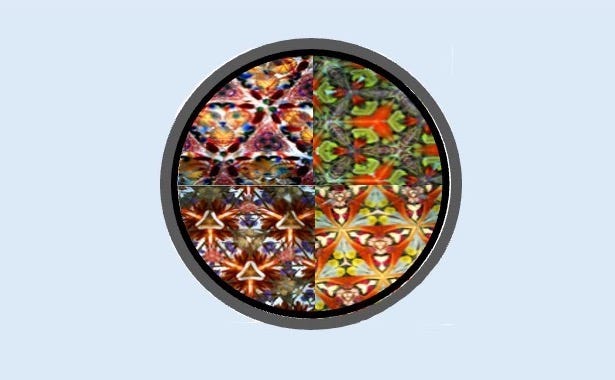
The picture inside a kaleidoscope comes from many differently colored and shaped pieces. Rotate the kaleidoscope, and a different picture emerges. Our identity behaves similarly – different contexts bring different aspects to the fore.
I like the kaleidoscope analogy also for another reason. If some pieces are removed or others added, the pictures that emerge will be different. We too, add or remove aspects of our identity over time – I was not always a scientist or a retiree, and I am no more a schoolboy.
The biggest aha moment though, was about group identity. If our personal identity is kaleidoscopic, the identity of a group is like a magnifying glass - focusing on some pieces while ignoring others
Take five random people. Thanks to everyone’s multifaceted identity, it’s always possible to find some aspect they share. Sometimes the commonality is small; sometimes it is large. See the “yellow” area in the Venn diagram.
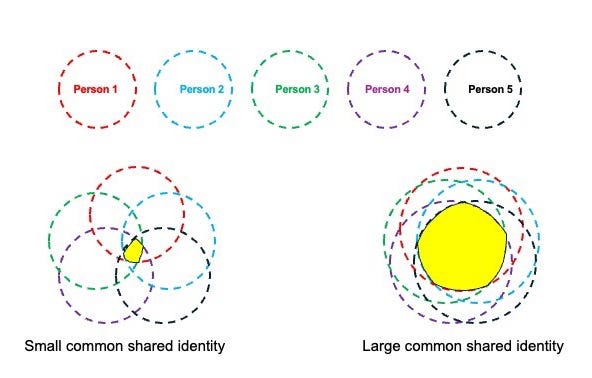
Defining groups this way is legitimate and useful. The danger comes when we focus solely on the “common identity” and ignore everything else. Soon we start viewing people through a distorted prism – narrowly focusing on the mole but ignoring the beauty of the face.
What also gets lost is that each member of a group carries many other identities. Some of those identities can be common with a supposed rival group.
I’ll keep my promise not to write a political essay, but as Leon Trotsky said, “You may not be interested in politics, but politics is interested in you.” Be aware that idea of a single, unitary identity is often used to divide society between “us” and “them.”
It’s a bit like the classic glass half-full versus half-empty question. We tend to be happier when we appreciate what we have rather than obsess over what we lack. Likewise, a society becomes richer and more harmonious when we look beyond the aspects of identity that divide us and recognize the many ways we are connected.
As for my friend’s unanswered question? I am ready for it now. Next time, I’ll start with a kaleidoscope – and maybe we’ll both enjoy the view.
New to this publication? Read here what it is all about: WELCOME to Outsights of a Conspecific
If you enjoyed this reflection, you might also like Reading English with Chanachur
I write solely for the pleasure of writing. That pleasure is even greater when others enjoy reading.
If this piece resonated with you, feel free to subscribe (it’s free). I publish about once every three weeks, and you’ll get an email when something new is out.
And if you know someone else who might enjoy this kind of writing, please consider sharing it with them too.
No posts
Comments
Nothing yet. Say the first thing.
Sign in to join the conversation.