
True to the spirit of this blog, here I am once again venturing into territories where I have no formal credentials. I am neither a philosopher nor an artist. And the most I can claim about photography is that I love taking photos as a hobby – without ever having achieved any distinction.
Still, I take courage from my recent post, The Art of Photography, which, to my great surprise, has garnered the highest views among all my posts!
In that post I had suggested that there are two kinds of photos: photos for preserving memory, and photos as art.
I also proposed that the latter involves two distinct steps. First, a photographer discovers a beauty worth photographing. This beauty may be overt or covert, as noted in my previous post.
Next, the photographer takes a photo to capture that beauty. A photo is a success only to the extent that a later observer gets a sense of the emotions that moved the photographer to pick up the camera in the first place.
Then I went on a vacation.
I went to Rome, to be precise. That was last December. The timing was good for avoiding too many tourists. But the weather was rainy and gloomy – something most photographers would rather avoid.
In hindsight though, it was a blessing. The difficult conditions forced me to think more deliberately about taking photos. As I did, three ideas emerged:
Talk to the “beauty”
Shoot the vibe, not the thing, and
Bad lighting? So what?
Let’s look at them one by one.
A photographer can capture only a beauty he or she actually sees. Unfortunately, beauty doesn’t reveal itself willingly. It is obviously true of covert beauties. But even an overt beauty does not reveal all its layers at once. They must be discovered.
Here I am reminded of a recurring theme in the Persian poet Omar Khayyám’s Rubáiyát: truth and beauty reveal themselves naturally, not through coercion.
To paraphrase him - in spirit, if not verbatim:
“The gentle touch, not force, unlocks the rose;
The beauty of the beloved yields to patience.”
And that gentle touch, for me, takes the form of a conversation with the beauty. Perhaps it is merely a conversation with myself, but it feels real as it unfolds. As I frame the picture in the viewfinder, a silent voice begins to guide me. It points out elements and subtleties I had missed. Things that make the picture more appealing. I continue this exchange until I am satisfied. It is an intense yet fleeting process.
Looking back, I realize that every one of my photos that I find impactful was guided by such a conversation – even though I wasn’t aware of it until my Roman vacation. Since then, I no longer attempt to photograph anything, however interesting it may seem, unless I feel that the conversation has begun.
Even in December, Rome is full of tourists. As we trekked from one historic must-see to the next, I observed the same scene repeated: tourists clicking away, posing before landmarks or framing themselves against historic backdrops. If preserving memory is the goal, that’s perfectly fine.
But that’s not my thing.
I remember visiting Paris long ago and feeling no desire to photograph the Eiffel Tower.
Part of it stems from my lack of interest in photographing something everyone else is photographing – much like my lack of interest in reading a book everyone else is reading. (If you are curious what I mean, you can check it out here Reading Like a Drunken Sailor).
Another part is an awareness of my own limitations. After all, for a dollar or two I could buy a postcard with a photograph whose quality I could never approach. So why bother? I did eventually take a selfie with the Eiffel Tower in the background. That was purely for memory’s sake.
There was, however, a third reason, one I recognized only after my Roman vacation. That is my interest in shooting a vibe rather than an object. My goal is to capture the feelings and emotions of a moment. The object may appear in the photo, but only as a prop.
Lighting conditions are among the most important elements in photography. True - but not decisive. Good photos can be taken in any lighting condition; they will simply be different kinds of photos.
So, instead of making the absence of sun an excuse, welcome the rain and the darkness. Embrace the shadow, the reflection, and the imperfection.
Couple that mindset with shooting the vibe, and you might even be thankful that it was a rainy day. That’s exactly what happened when I took Photo A below.
With that in mind, let’s look at two photos I took in Rome – Photo A and Photo B – and see how these three ideas came into play.
“The best spot to see St. Peter’s Dome is from here,” our guide announced, pointing towards the distant dome. We were about to begin a guided tour of the Vatican Museums, and she wanted us to take advantage of the vantage point.
People rushed outside. I too, followed – reluctantly. It was a lightly drizzling, gray day, matching the gray dome in the distance. I stood off to the side. People got busy taking pictures: group photos and selfies, with the gray dome serving dutifully as background. Some aimed straight-up.
I watched them, rather than the dome. I don’t shoot things anyway - certainly not on a dull, cloudy day like this.
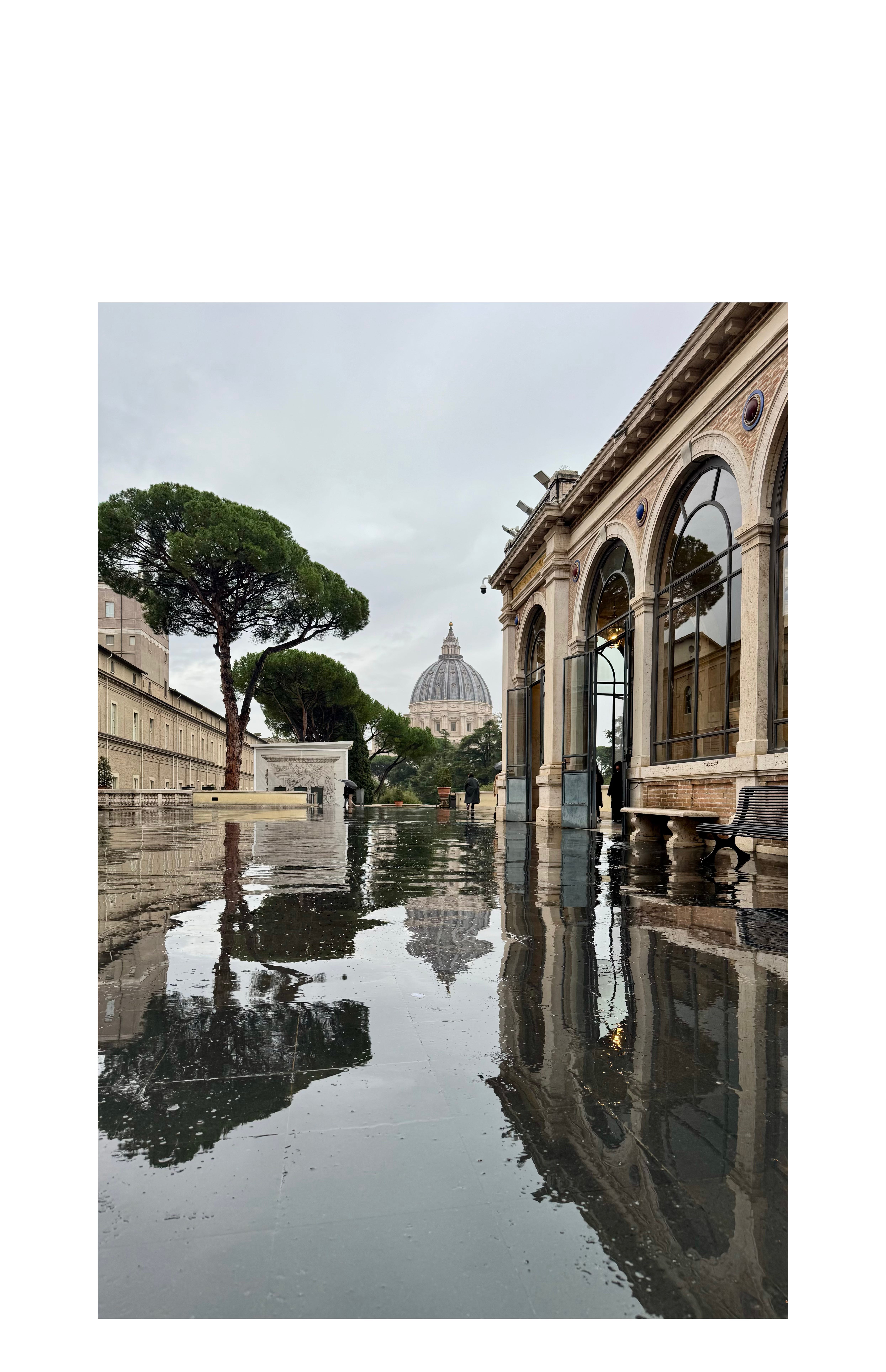
As I stood there, I became intrigued by the deep black sheen of the wet pavement. It reflected the people walking around. On one side, I noticed the reflection of a green tree. Interesting contrast with the dark black, I thought, and moved around a bit. Then I saw the distant dome reflected as well.
What if I take a photo of the reflection of the dome rather than dome itself?
That’s when the conversation began.
Good idea, came a quiet response.
I opened my phone’s camera and framed both the distant dome in the distance and its reflection. Get down close to the pavement. I did. Lower still. I did that too, giving the dark, wet pavement more emphasis in the foreground. What about the tree? I made sure to include it, and its reflection – on the left. And the beautiful façade on the right? Now I did. I saw its reflection too.
The conversation continued until I was satisfied. I clicked the photo. In that moment, I was grateful it wasn’t a sunny day!
Santa Marinella is just one hour away from Rome by local train. It is a small coastal town on the Tyrrhenian Sea, and we visited it one afternoon for a few hours.
As the sun began to set, I stood at a lookout facing the sea. The narrow coastline was strewn with large, dark boulders. The sea was calm and gray beneath a dim sun, and the sky littered with unremarkable white-gray clouds. The small lookout itself was untidy, framed on both sides by high fences.
I saw no beauty and felt no urge to take a photo. No reason to come back to the Tyrrhenian Sea again, I thought, and started towards the train station. Then I turned back – one last time.
That’s when I noticed the balustrade. It bordered the lookout towards the sea. It had been there all along.
Interesting, I thought. I liked the classical, vase shaped balusters. I opened my phone’s camera and framed the balustrade - with the sea in the background. Only then did I notice the large paver stones beneath my feet.
That’s when the conversation began.
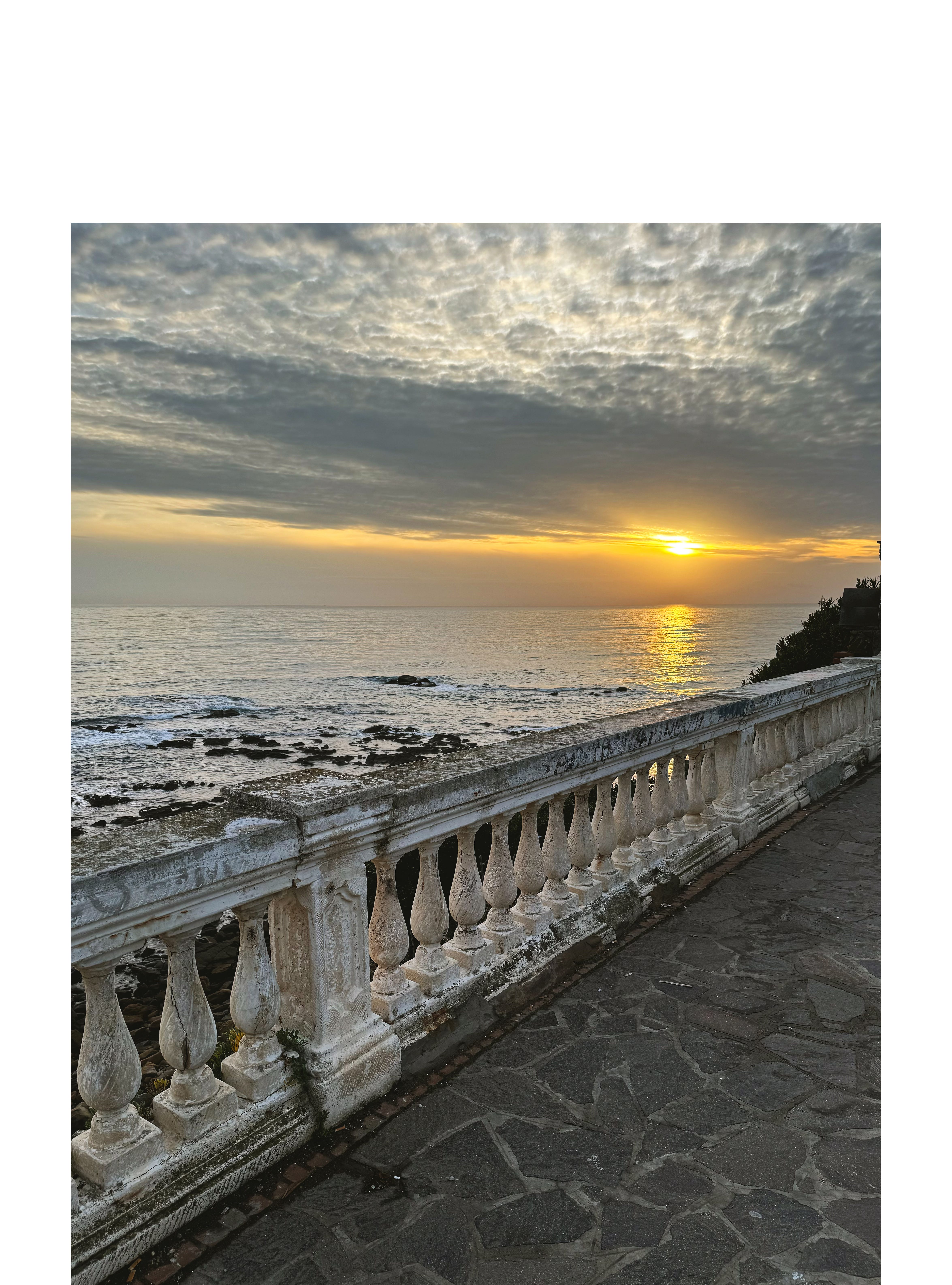
Frame the balustrade diagonally, I heard an instruction. I did, leaving generous space for the pavers in the foreground. Pay attention to the sun, a quiet voice suggested. I placed the dim sun near the upper-right corner. And the clouds? Yes - especially the woolly white pattern at the very top.
Suddenly, I could see the beauty in front of me and around me. I made a few quick adjustments and clicked, then hurried back to the station lest we miss the last train.
There are several other photos I could add here. But these two already illustrate what I learned during my Roman vacation.
First, I realized that taking a photograph involves three steps. Until then, I had been neglecting the most important one: the conversation.
Second, any photographic subject – even one whose beauty is immediately apparent - contains additional layers not visible at first glance. A photo becomes more impactful when those layers are gently unlocked. This can happen only through “a gentle touch”, as Omar Khayyám suggests, or through a gentle conversation as I have experienced.
Third, and perhaps unexpectedly, a successful artistic photo can preserve memory far more intensely than any simple memory photo. During this vacation, I took my share of memory photos as well. But the emotions they evoke pale in comparison to those stirred by the two photos above. Part of the reason is that a successful artistic photo captures not merely an object or a person, but a vibe.
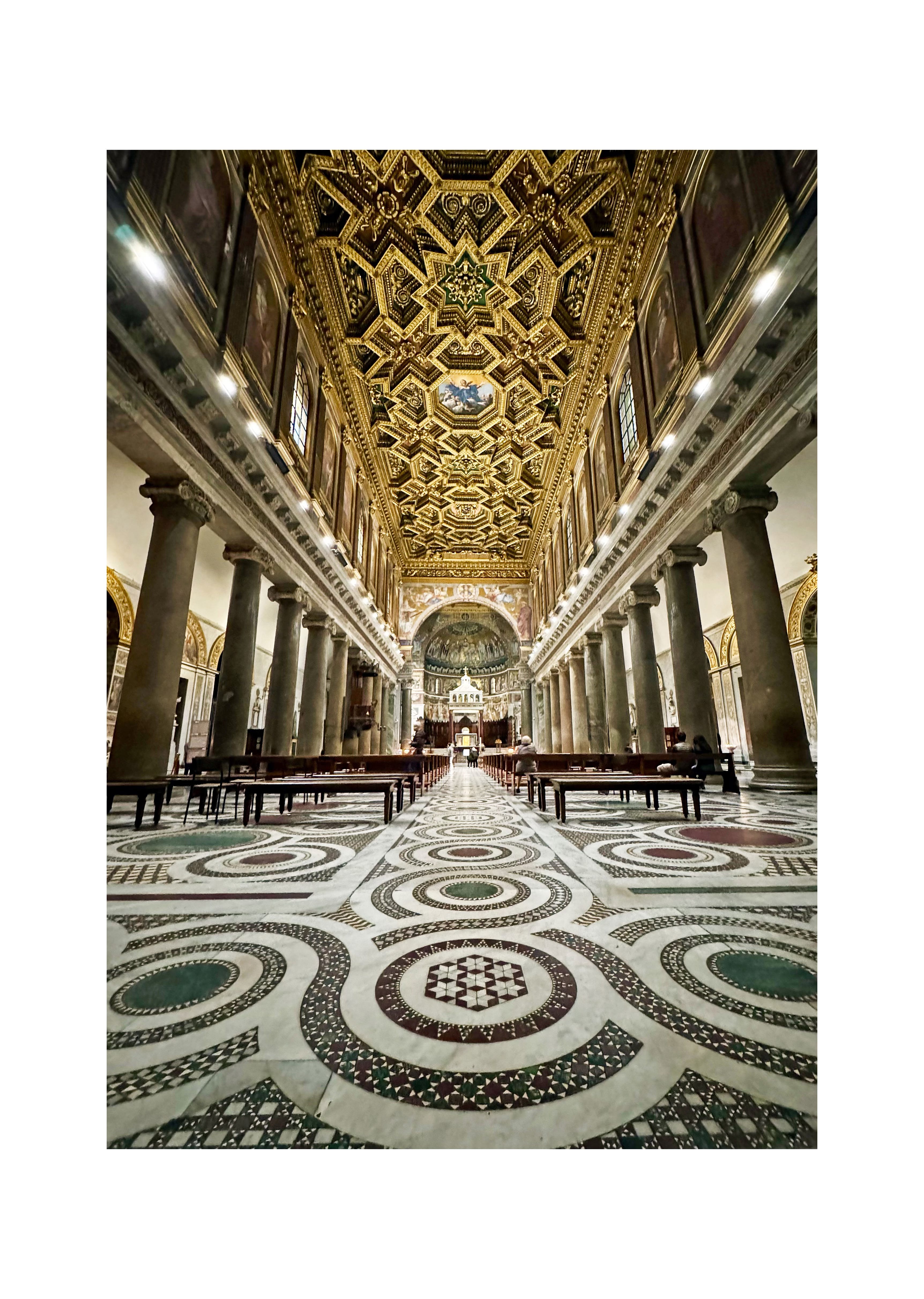
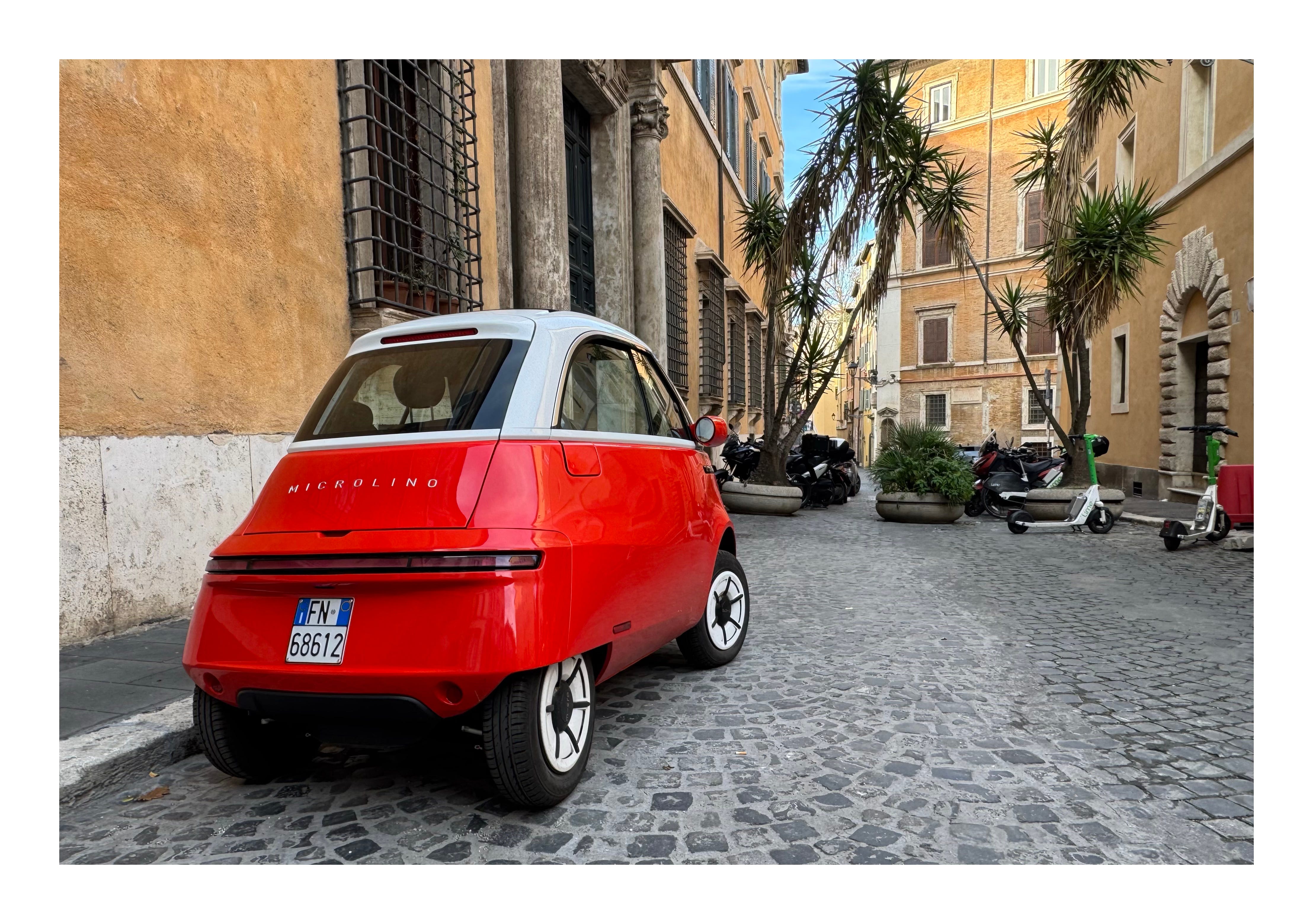
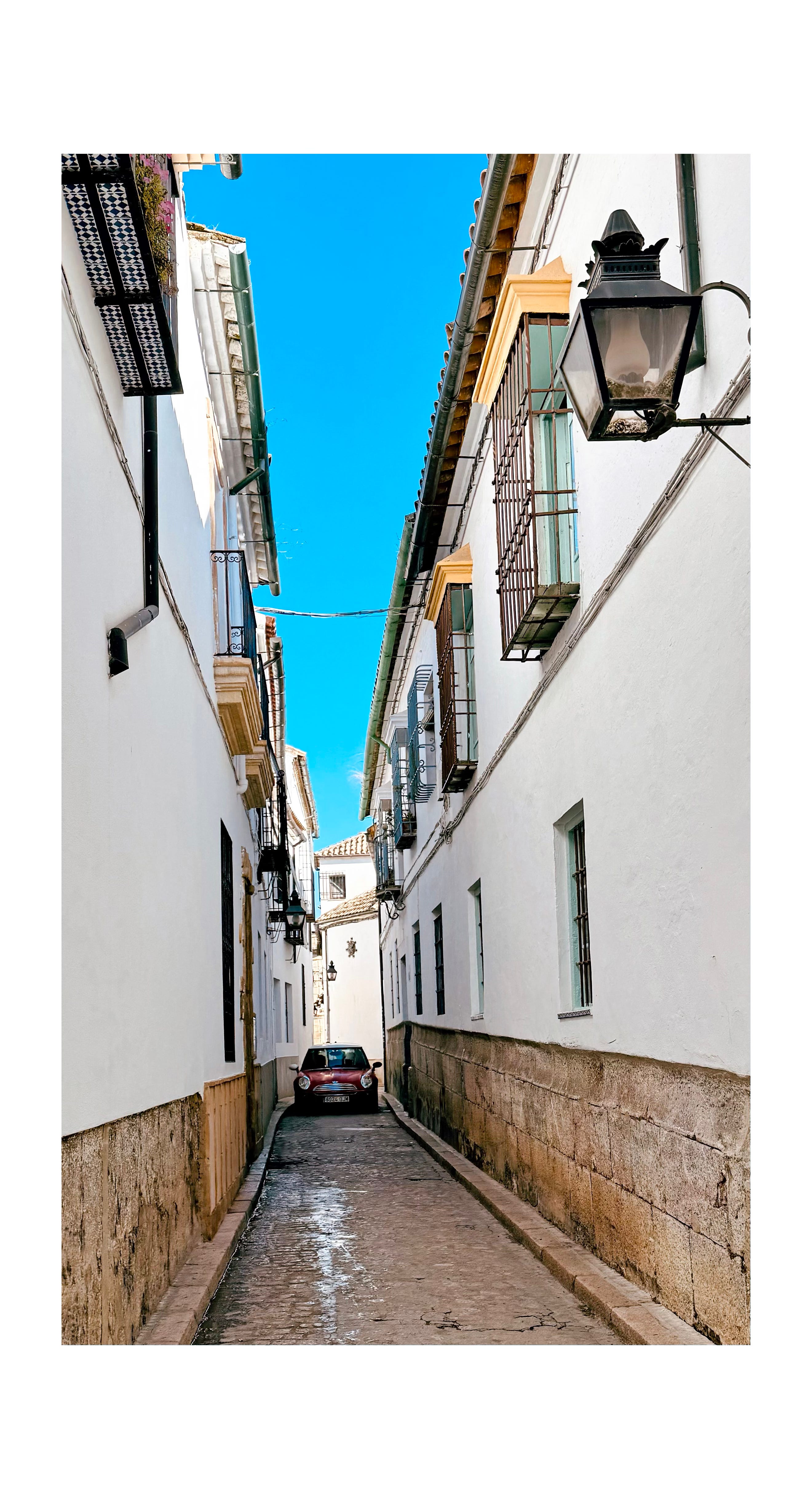
You may notice that I have said nothing about the technical act of taking a photograph, for example, the many parameters photographers often consider, such as aperture, shutter speed, ISO, focal length, white balance, or depth of field.
That is because I took these photos with my iPhone 15 Pro Max. Modern smartphone cameras are now sophisticated enough to make most of these decisions automatically - for better or worse.
Cell-phone cameras certainly have limitations compared to SLRs. Still, good photos can be taken with them. They will simply be different kinds of photos.
If you haven’t yet, check out my previous post on photography The Art of Photography.
New to this publication? Read here what it is all about: WELCOME to Outsights of a Conspecific
If you enjoyed this reflection, you might also like my earlier post about how William McKnight’s legacy built a legendary culture at 3M Company and how I was fortunate to be part of it A Gem in a Box of Chocolates (Part 2 of 4) .….. or a light-hearted look as why scientists and artists aren’t as different as they seem - until they are Science and Art are Different.
I write solely for the pleasure of writing. That pleasure is even greater when others enjoy reading.
If this piece resonated with you, feel free to subscribe (it’s free). I publish about once every three weeks, and you’ll get an email when something new is out.
And if you know someone else who might enjoy this kind of writing, please consider sharing it with them too.
No posts
Comments
Nothing yet. Say the first thing.
Sign in to join the conversation.