
Exactly one hundred years after Republican President Ulysses S. Grant established Yellowstone as the world’s first national park in 1872, the Republican Nixon administration was instrumental in initiating the “World Heritage Convention,” which was signed on November 23, 1972.
In fact, the United States was the first country to ratify this global treaty, which is officially called the “Convention Concerning the Protection of the World Cultural and Natural Heritage.”
“The World Heritage Convention,” the National Park Service explains, is “the most widely accepted international conservation treaty in human history.” In the realest possible sense, it “is the American national park idea being carried out worldwide.”
Today, no fewer than 196 countries have ratified the World Heritage Convention and 1,248 cultural and natural sites are protected because of their “outstanding universal value” to humanity
The United States currently has 26 UNESCO World Heritage Sites—which are the absolute pinnacle of cultural and natural significance on a global scale.
Similar to the concept of American public lands and waters, which belong to the American people as a whole, World Heritage Sites—by definition, through the international treaty they’re established under—“belong to all peoples of the world, irrespective of the territory on which they are located.”
For the United States, that effectively means that the people of the world—not just Americans—are stakeholders in such iconic places as the Grand Canyon, Everglades, Yellowstone, Yosemite, Mesa Verde, Great Smoky Mountains, Taos Pueblo, the Statue of Liberty, Independence Hall, the San Antonio Missions, the Redwood parks, and Glacier National Park.
Put otherwise, if a place like that gets diminished, damaged, or—God forbid—destroyed, it makes the world less complete.
However, it’s not because a certain site has been granted World Heritage status that it’s protected or safe forever. Everglades National Park, for example, has been on UNESCO’s “World Heritage in Danger” list since 2010, which I wrote about last year in July.
Another American UNESCO World Heritage Site that’s facing continued threats from development—and the main subject of this piece—is located in northern New Mexico: Chaco Culture National Historical Park.
The global importance of this national park site was recognized in 1987, when it gained prestigious World Heritage Status under the Republican Reagan administration.
Now, however, the Republican Trump administration—in a striking deviation from their Republican predecessors to whom they often like to compare themselves—is moving to reopen more than 336,000 acres surrounding Chaco Culture National Historical Park to new oil and gas development.
The proposal would revoke all or part of a 20-year mineral withdrawal established in 2023, potentially eliminating the 10-mile protective zone around the park. The Bureau of Land Management (BLM) is accepting public comments through July 29.
The BLM map below shows the location of Chaco Culture National Historical Park (in light purple) and the current 10-mile buffer zone (in blue stripes) where oil and gas developed has been banned for a 20-year period to protect archaeological resources that are or may be present in the area. The Trump administration’s BLM, led by Steve Pearce, wants to eliminate the entire buffer zone.
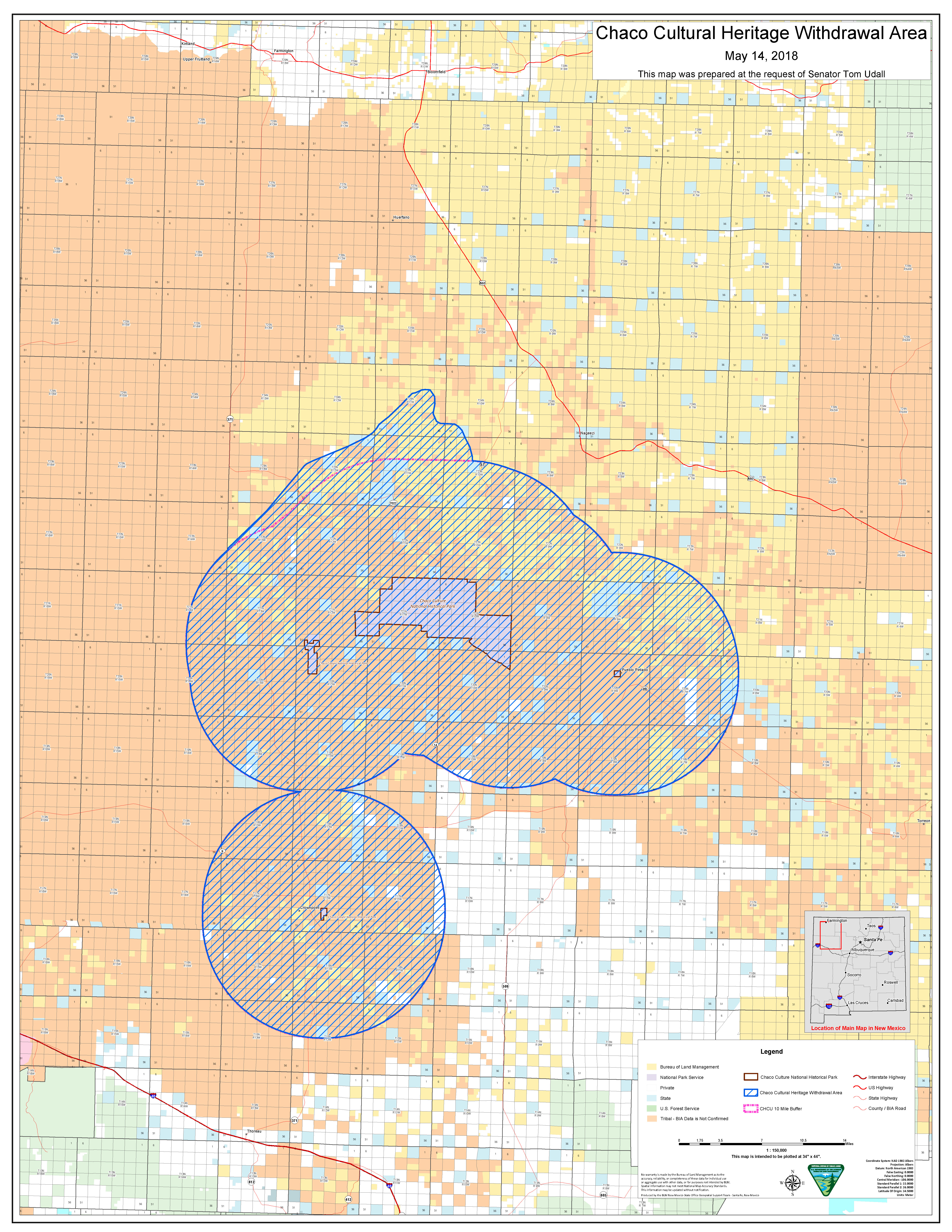
Calling these lands a “buffer,” however, understates what’s at stake here. The acreage outside Chaco’s boundaries is not merely empty space separating archaeological ruins from drilling rigs. It’s part of the ruins themselves—an interconnected cultural landscape of ancient roads, settlements, ceremonial structures, sacred places, and sightlines that cannot be understood in isolation.
Between roughly 850 and 1250, Chaco became the ceremonial, economic, and political center of a vast Indigenous world. Its builders raised monumental great houses with intricate masonry, engineered roads across the desert, and aligned structures with solar and lunar cycles.
The National Park Service estimates that dozens of great houses inside the canyon were connected with more than 150 others across the broader region. Chaco was not a single settlement. It was the heart of an extensive network stretching across much of the Four Corners, all the way to Mesa Verde, Aztec Ruins, and Bears Ears.
That scale helps explain why Chaco was designated a UNESCO World Heritage Site in 1987. Its monumental architecture and regional organization preserve evidence of one of the most sophisticated societies in precolonial North America. Chaco’s importance is not confined to archaeology alone, though. The landscape itself remains sacred to Pueblo peoples, the Hopi Tribe, the Utes, and Navajo communities whose histories, identities, and living traditions are tied to it.
Many of those connections survive outside the national park. Archaeological surveys have documented roughly 4,200 known cultural, archaeological, and historic sites across the larger 10-mile zone, including great-house communities, shrines, roads, and other features whose relationships are still being studied or haven’t even been excavated yet.
Industrial development can destroy more than individual artifacts: roads, well pads, pipelines, noise, dust, and nighttime lighting can fragment the landscape and sever the spatial relationships that give those places meaning.
It’s worth reiterating here that Chaco’s global importance lies precisely in its reach: the roads leading outward, the communities linked across immense distances, and the centuries-old Indigenous relationships with the land.
It’s not a stretch to say that, much like Rome in Europe a millennium earlier, in the North America of 850-1250, all roads led to Chaco. It was that important.
Reopening that landscape would effectively equate to protecting the museum artifact while simultaneously sacrificing its historical, cultural, and physical context.
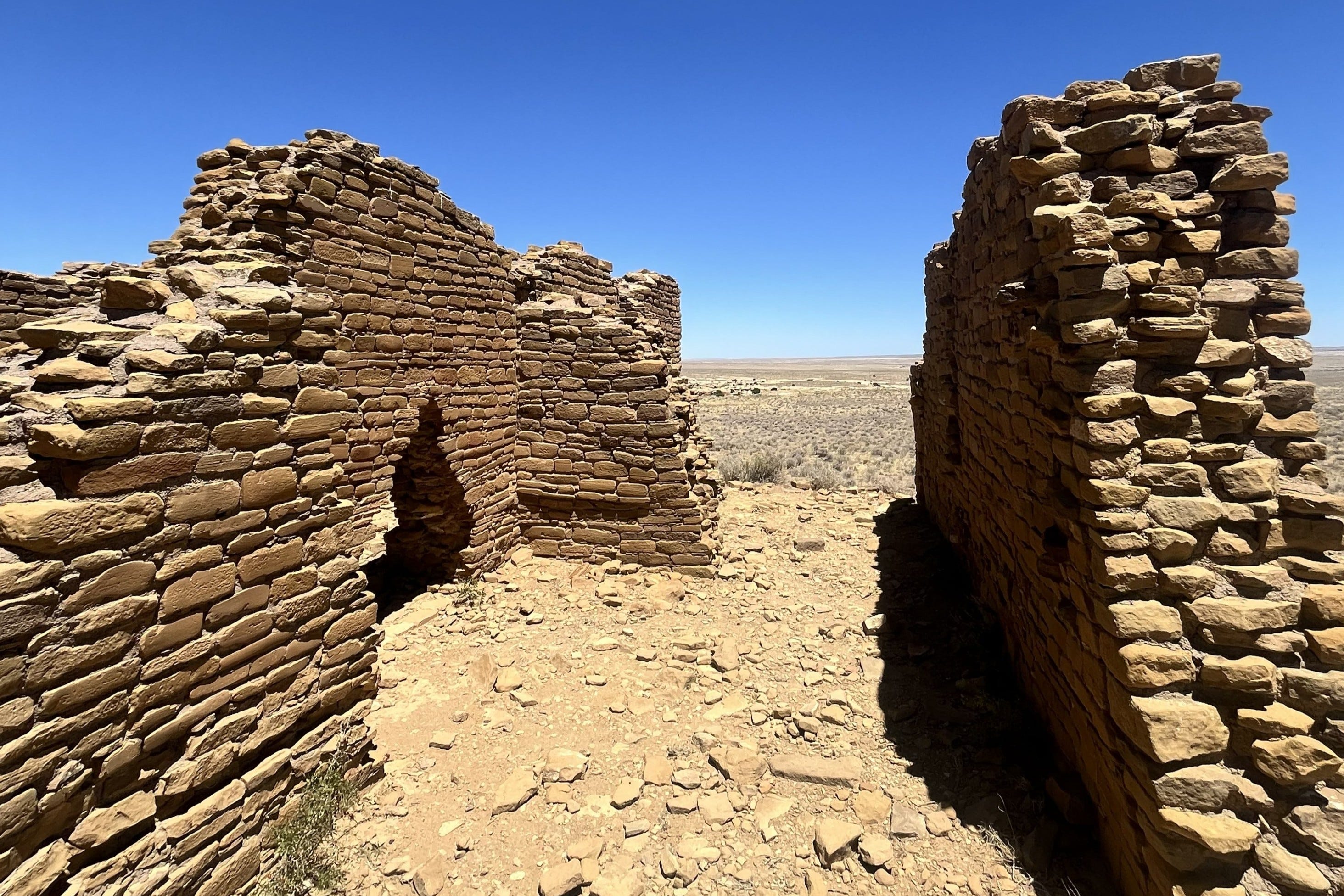
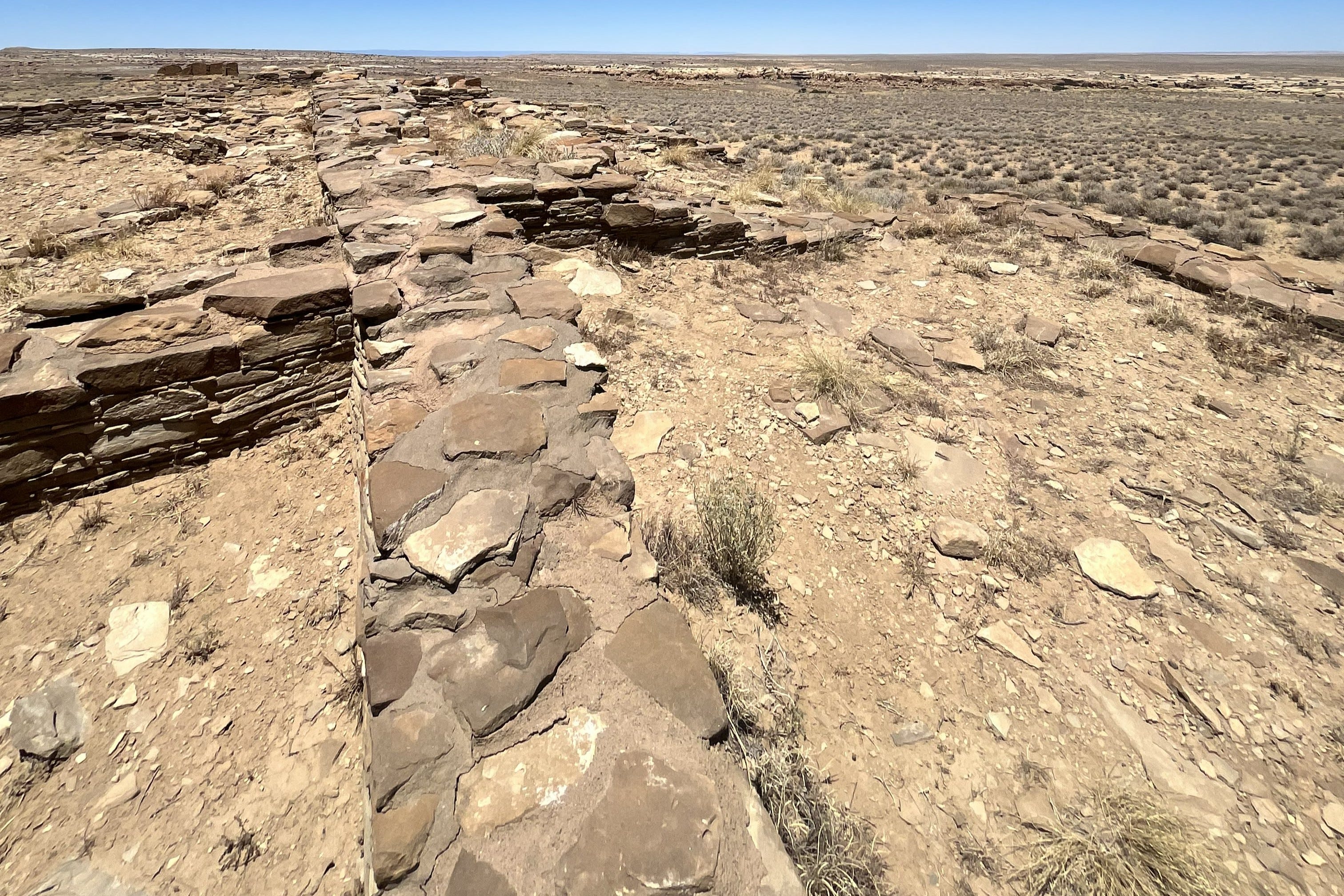
This images of Nuevo Alto (top) and Pueblo Alto (bottom) by Will C. De Man show a part of the buffer zone that the Trump administration wants to revoke so that the area can be opened to oil and gas development. If this were to happen, the viewshed from the park—let alone the precious archaeological sites and artifacts outside of it—would be destroyed.
The threats here are very real. In fact, earlier this year, on May 20, the National Trust for Historic Preservation put the Greater Chaco Cultural Landscape on its list of “America’s 11 Most Endangered Historic Places.”
I’m not exaggerating when I say that this move by the Trump administration would diminish one of humanity’s greatest-ever archaeological and living cultural treasures—a place so globally significant it’s one of only 26 UNESCO World Heritage Sites in the United States.
Any administration that’s forward-thinking, open-minded, and wants to project true leadership on a global stage should do everything in its power to provide more protections for places like these—not destroy their immediate surroundings by building drilling pads, oil wells, and industrial roads.
To answer that question, I asked for help from Will C. De Man, who runs the excellent Substack newsletter National Park History. (Highly recommend subscribing and supporting his great work.)
As a history teacher, Will has deep knowledge of historic places like Chaco—in fact, he was literally there earlier this month.
In response to this massive attack on the integrity of the greater Chaco Culture landscape, he’s written a great guide on how to help defend this World Heritage Site by submitting an effective, thoughtful public comment.
Because I couldn’t possibly write a better guide myself, I’ve republished Will’s guide below with his permission.
The public comment period ends on July 29, so you have a week to craft a personal comment opposing the opening of public land around Chaco to oil and gas development.
Take your time and think about what you want to say. Write down why Chaco matters to you, even if you haven’t been there yourself. In fact, especially if you haven’t been there yourself, this should matter to you.
Speak up this week if you’re ever planning on visiting this world-class American cultural landscape and want to see it intact.
Here’s Will’s Chaco Culture public comment guide.
Lesson 1: What Will My Comment Actually Do?
The public comment period democratizes how the federal government makes policy decisions. It’s a chance for you and I to make our voices heard on issues we care about. Public comments must be considered before the government—in this case, the Interior Department—can make a final policy decision.
“But how do I know the government will actually consider my comment?” In light of the current administration’s disposition, this is a very reasonable question. They are, after all, trying to overturn an action that already has significant support from both the public and notable stakeholders. It’s valuable to remember that this comment period is required by law, and the Interior Department is legally obligated to consider reasonable public concerns or else risk litigation that could overturn the final decision.
Beyond the legal requirements, there is a moral and philosophical argument to be made for standing up for Chaco, even if you think you’ll be ignored. In moments like these, scholar Timothy Snyder reminds us to never obey in advance. Don’t willingly stay silent, self-censoring because you think you lack the power to make a difference.
This is an opportunity for you to express your political agency. So let’s get to it.
Lesson 2: Crafting an Effective Comment
The current comment period gives us the opportunity to respond to the draft environmental assessment (EA). The purpose of an EA is to evaluate the potential environmental impacts of a proposed action. In this case, the proposed action is undoing the 2023 Chaco Buffer Zone. Once public comments are gathered and analyzed, there can be a few different results:
A Finding of No Significant Impact (FONSI). This is the result that the Trump administration is seeking in order to revoke the Chaco Buffer Zone.
The preparation of an environmental impact statement, if the EA shows that there are large potential environmental repercussions.
The drafting of a new environmental assessment if the original is shown to be flawed.
As advocates for the archeological resources and cultural heritage within the Chaco Buffer Zone, we want to see the latter two results. The current public comment period is specifically intended as an opportunity to point out blind spots and shortcomings in the EA.
Carla Chung Mattix, a former Interior Department attorney, told me that “if it can be shown later that [the government] did not take comments that point out flaws in the EA into account, that could be considered in any future litigation.”
After reviewing the EA myself, I believe that there are two key blindspots that we should focus our attention on.
Blindspot 1: Lack of Tribal Consultation
The 2023 withdrawal of the Chaco Buffer Zone took place after an extensive consultation with the tribes associated with Chaco. No such process has taken place with the Trump administration.
Table 4.1 in the EA details that the Bureau of Land Management only engaged with Tribes through informational meetings. According to a statement from Governor Charles Riley of the Pueblo of Acoma, this is entirely insufficient.
“Our leaders have reached out to Secretary Burgum. We have invited him to come to Chaco and stand on that ground with us. We have asked, repeatedly and formally, for consultation with the officials who will actually make this decision. Those requests have gone unanswered.”
He continues,
“Consultation is not a briefing. It is not a meeting where we are told what has already been decided. It is a government speaking with a government, before the decision is made, with the authority to be affected by what it hears. That has not happened.”
The All Pueblo Council of Governors, which represents the twenty sovereign Pueblos of New Mexico and Texas, said, “A field office cannot consult on a Secretary’s decision, and a briefing is not a consultation. Our governments are entitled to speak with the person who holds the pen, before the pen moves.”
According to Carla Chung Mattix, the lack of tribal consultation is a weak point we can exploit. “If the BLM did not fully engage with the Tribes, then critical information from them is lacking—this means the draft EA is flawed and the Secretary should not issue a final EA/FONSI.”
Blindspot 2: Insufficient Understanding of What Is At Risk
According to the EA, there are “approximately 7,552 known historic properties… within the 10-mile withdrawal area,” and this “only represents a fraction of the sites that exist, as large portions of the region have not been formally inventoried.”
In essence, this means that the Bureau of Land Management is not fully aware of what archeological and cultural resources exist in the Chaco Buffer Zone and thus cannot claim to know what will happen if this landscape is reopened to new development. Like the lack of tribal consultation, this is a flaw in the EA.
A landscape can be preserved while mysteries still remain, but protections should not be stripped without a full understanding of what could be lost.
Other Issues You Can Point to:
Abandoned Environmental Impact Statement. In 2014, the Interior Department began preparing an EIS for the Chaco region, but it was abandoned in part because of the 2023 buffer zone withdrawal. You can request that Interior finish this EIS so that we have a fuller understanding of what is at risk.
Heavily truncated timeline. Both of the comment opportunities that have been provided are unreasonably short. Usually, the opportunity to comment is open for thirty to ninety days. Aggressively shortening the timeline is an attempt to fast-track the process, hoping it’ll get by without advocates having the opportunity to make their case. It is especially burdensome to tribal members, many of whom may not have regular Internet access to submit comments.
Congressional requirement from FY2026. As I wrote about at the start of the year, Congress passed a moratorium on new oil and gas permitting within the Chaco Buffer Zone until a cultural resources investigation is completed. We can point out this stiff legal requirement in our comments.
Your Assignment: Put It All Together
Now that we understand the process we are in and the issues at hand, it’s time to write your comment. Here’s my rubric for getting an A+ on this.
Part 1—Introduce yourself
Who are you? Include any credentials you might have or your identity as a stakeholder.
If you have a personal story about the significance of Chaco, share it.
Remember the human element of this. The people reading these comments are probably just doing their jobs. Don’t take this as a chance to unleash all your frustrations with the Trump administration or outrage over Project 2025. Be cordial.
Part 2—The flaws in the environmental assessment
Write a section outlining the lack of tribal consultation. Compare it to the consultation process that took place before the 2023 withdrawal. You can read the statements quoted above and pick your own sections from them to include.
Write a section reminding the BLM of its own admitted lack of understanding of what is at risk.
You can refer to section 3.4.4.2 on pages 30-32 of the draft environmental assessment for more details.
Emphasize that the government does not entirely understand what is at risk because it has not fully surveyed the ten-mile area for archeological resources.
Part 3—Remind them to follow the rules
Plainly state that the EA is flawed. Request a renewed environmental impact statement. Remind the BLM that Congress requires a cultural resources investigation before any new development can occur in the Chaco Buffer Zone.
Put all that together in 5000 characters or less and submit by July 29. If there is a study or data you would like them to consider, you can submit an attachment. If you want a template to work from, check out this toolkit produced by a coalition of tribal organizations defending Chaco.
This isn’t something that needs to be done fast; it needs to be done soon. Take your time. Draft a comment. Have a break. Revise. Just make sure it’s submitted by July 29.
Follow this advice from Carla:
“Stay on point. If applicable, cite credible facts and data. One can be passionate but also concise and clear.”
You can submit your comment to the Bureau of Land Management via the button below.
SUBMIT YOUR COMMENT TO THE BLM
If you need extra help writing or reviewing your Chaco Culture comment, you can use the contact form on the National Park History website and Will himself will guide you through it.
A massive thanks, once again, to Will C. De Man for creating such a fantastic step-by-step guide. You can find all his articles on the National Park History Substack.
Thanks for helping to protect our public lands and waters!
See you out there,
Bram
Comments
Nothing yet. Say the first thing.
Sign in to join the conversation.