
If sanctions on Iran are lifted or meaningfully relaxed, Pakistan could be one of the biggest regional beneficiaries. For years, Pakistan has lived next door to one of the world’s largest oil and gas producers but has been unable to fully benefit from that geography because of U.S. sanctions, banking restrictions, insurance problems, and fear of secondary penalties. A sanctions opening would not solve Pakistan’s energy crisis overnight, but it could give Islamabad three major opportunities: cheaper oil, revived gas imports, and completion of the long-delayed Iran–Pakistan pipeline.
The first and most immediate benefit would be oil. Recent reports say the United States may allow Iran to resume oil and fuel sales, including the banking, shipping and insurance services needed for those sales. This matters because Iran has been selling crude at discounts under sanctions, mainly to China. If Pakistan can legally buy Iranian crude, it could negotiate discounted supply for its refineries and reduce pressure on its foreign exchange reserves.
Pakistan’s oil demand is roughly in the range of 425,000 to 480,000 barrels per day, while domestic crude production covers only a small share of demand. That means Pakistan is heavily exposed to imported crude and petroleum products. If Pakistan bought 150,000 to 250,000 barrels per day from Iran at a discount of $5 to $8 per barrel, annual savings could be around $274 million to $730 million. In a more aggressive case, if Pakistan bought 300,000 to 400,000 barrels per day at an $8 to $10 discount, savings could exceed $1 billion per year.
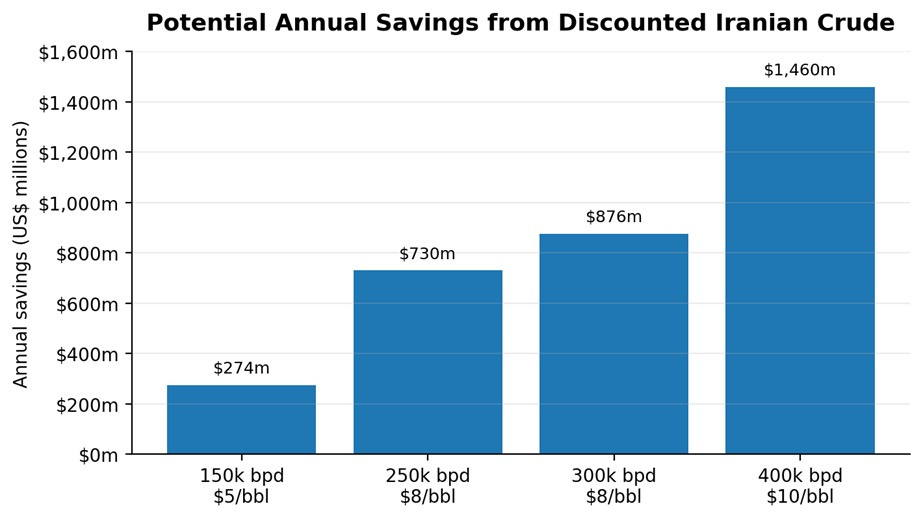
Chart 1: Estimated crude-oil savings based on the article’s purchase-volume and discount assumptions.
However, Pakistan cannot simply replace all imports with Iranian oil immediately. Local refineries would need to test crude compatibility, adjust supply contracts, arrange shipping and insurance, and secure banking channels. Iranian crude is broadly relevant for Pakistan’s refinery system because Pakistan already processes Middle Eastern crude from countries such as Saudi Arabia, the UAE and Kuwait. But the real benefit depends on refinery configuration, product yields, and whether Iranian barrels reduce the cost of petrol, diesel and furnace oil imports.
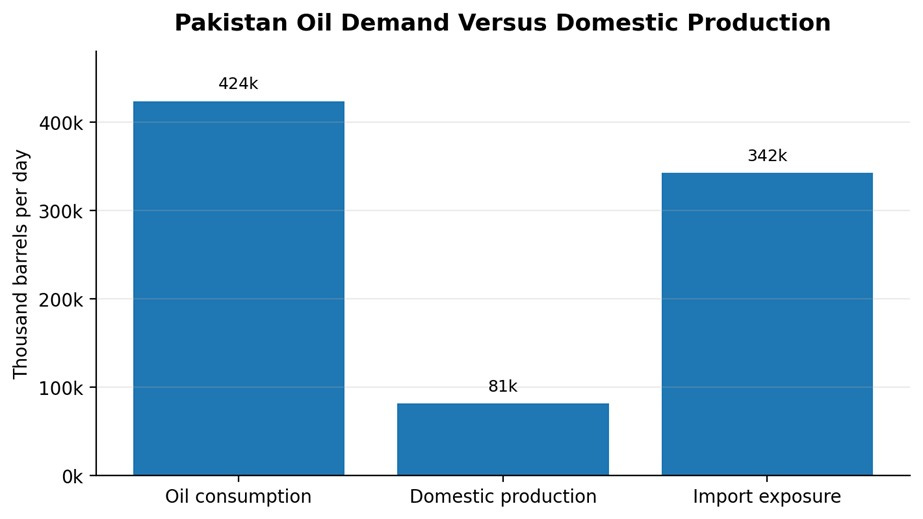
Chart 2: Pakistan’s oil consumption remains far above domestic production, leaving the country exposed to imports.
The second major opportunity is natural gas. Pakistan faces a chronic gas shortage. Domestic production has declined, LNG is expensive, and gas shortages hurt industry, power generation and households. Iranian gas could help fill this gap if it is priced below imported LNG or oil-based power generation. The original Iran–Pakistan pipeline was designed to supply roughly 750 million cubic feet per day of gas to Pakistan. In energy terms, that is equal to roughly 100,000 to 125,000 barrels of oil equivalent per day.
If Iranian gas saves Pakistan $2 per mmbtu compared with alternative fuels, the annual saving could be around $550 million. If the saving is $3 per mmbtu, annual benefit could rise to around $820 million. In a strong case, the gas pipeline alone could save close to $1 billion per year. This is why the pipeline may be even more strategically important than discounted crude: oil helps the import bill, but gas directly supports power, fertilizer, textiles, industry and households.
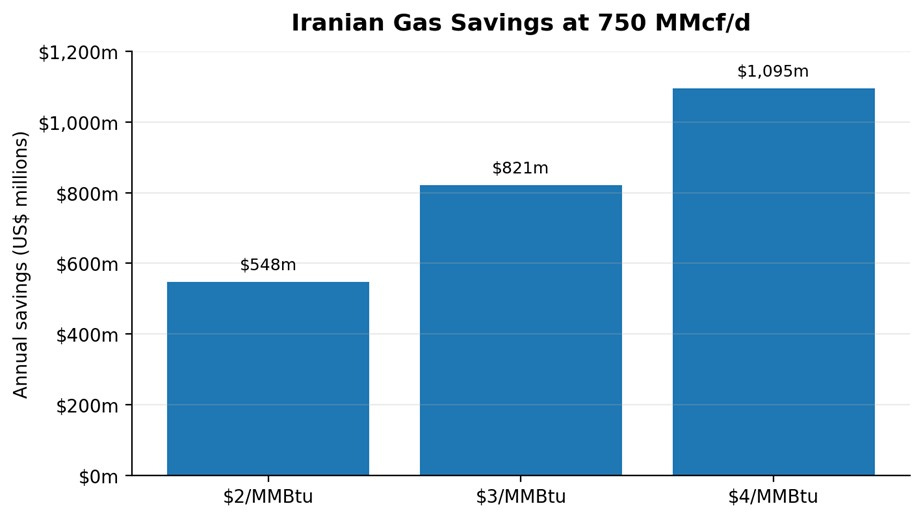
Chart 3: Annual savings from 750 MMcf/d of Iranian gas at different per-MMBtu savings assumptions.
The third and most important pending project is the Iran–Pakistan gas pipeline. Iran has already built most of its side. Pakistan has not. The project was signed in 2010 and was meant to bring gas from Iran’s South Pars field into Pakistan. The pipeline is about 1,900 km overall, with around 1,150 km in Iran and 781 km in Pakistan. Iran has reportedly invested about $2 billion in its section, while Pakistan has delayed construction because of sanctions risk.
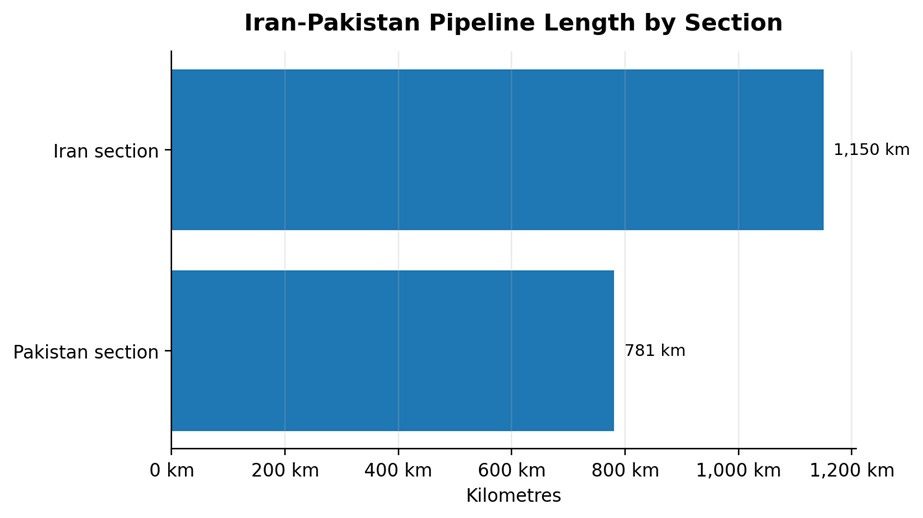
Chart 4: The Reuters-reported route is dominated by Iran’s completed portion, while Pakistan’s section remains the key gap.
Pakistan approved an 80 km first phase from the Iranian border to Gwadar in 2024. That section is estimated to cost about $158 million, or roughly Rs44–45 billion. The full Pakistani section to Nawabshah would likely cost around $1.5 billion to $2.0 billion. At around Rs280 per dollar, that means approximately Rs420 billion to Rs560 billion. In a higher-cost case, including security, imported equipment, delays and financing charges, the bill could exceed $2.2 billion.
On paper, the pipeline is financially attractive. If Pakistan spends $1.7 billion and saves $550 million per year, the payback period is just over three years. If savings are closer to $800 million or $1 billion per year, payback could be two years or less. But the obstacle is not only money. The bigger issue is legal clearance. Unless the United States explicitly grants a waiver for gas imports, pipeline construction, financing, insurance and payments, banks and contractors will remain cautious.
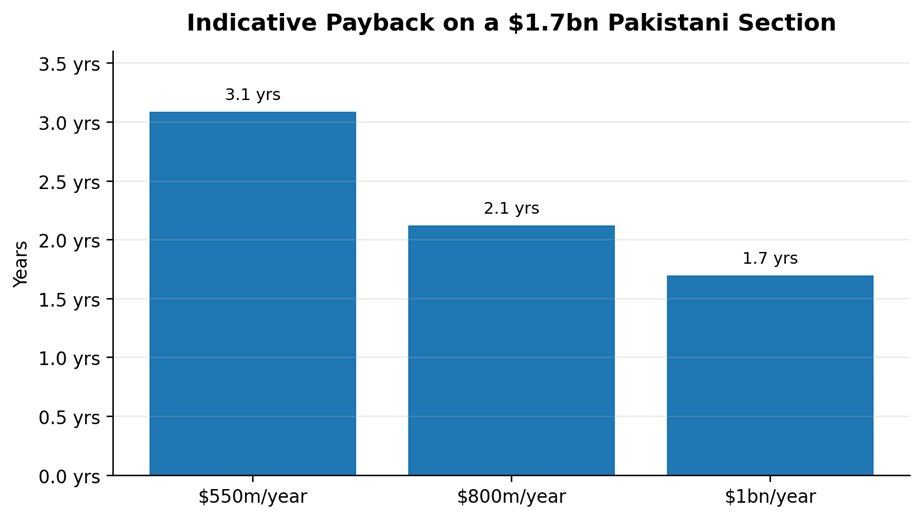
Chart 5: Indicative payback periods assuming a $1.7bn Pakistani construction cost and varying annual savings.
Pakistan also has to manage the penalty risk. Iran has repeatedly warned Pakistan over delays, and figures around $18 billion have been reported in connection with potential penalties. Pakistani officials have disputed claims that such a penalty has already been imposed, but the threat remains a diplomatic and legal pressure point. A sanctions opening would allow Pakistan to renegotiate the timeline, settle the dispute, and push for a revised commercial structure.
The best strategy for Pakistan would be to negotiate a complete energy package rather than treat each issue separately. Islamabad should seek discounted Iranian crude, a formal U.S. waiver for the pipeline, a revised gas price formula, a penalty standstill from Iran, and a safe payment mechanism. Payments could be arranged through approved banks, escrow accounts, barter, RMB settlement, or goods-for-energy trade if conventional dollar channels remain difficult.
Pakistan should also avoid overdependence on Iran. Even if sanctions are lifted, Iran will remain geopolitically sensitive. Pakistan must balance relations with the United States, Saudi Arabia, the UAE, Qatar and China. Iranian energy should be used as a bargaining tool and diversification option, not as a total replacement for existing suppliers. A smarter energy policy would combine Iranian crude, Iranian gas, Gulf supplies, LNG contracts, domestic exploration, renewables and refinery upgrades.
The biggest risk is that sanctions relief may be temporary or conditional. If Pakistan signs long-term contracts and the U.S.–Iran deal later collapses, banks, insurers and contractors could again withdraw. Therefore, Pakistan should insist on written sanctions comfort, phased construction, flexible payment terms and legal protection before committing fully.
In conclusion, Pakistan could benefit significantly if sanctions on Iran are lifted. Discounted oil could save hundreds of millions of dollars annually. Iranian gas could reduce LNG dependence and support industry. The Iran–Pakistan pipeline could become financially viable again and may save Pakistan up to $1 billion per year in a strong case. But the opportunity will only become real if Pakistan secures clear legal waivers, negotiates disciplined pricing, and builds the pipeline in phases. Geography gives Pakistan an advantage; sanctions relief would finally give it a chance to use that advantage.
No posts
Comments
Nothing yet. Say the first thing.
Sign in to join the conversation.