
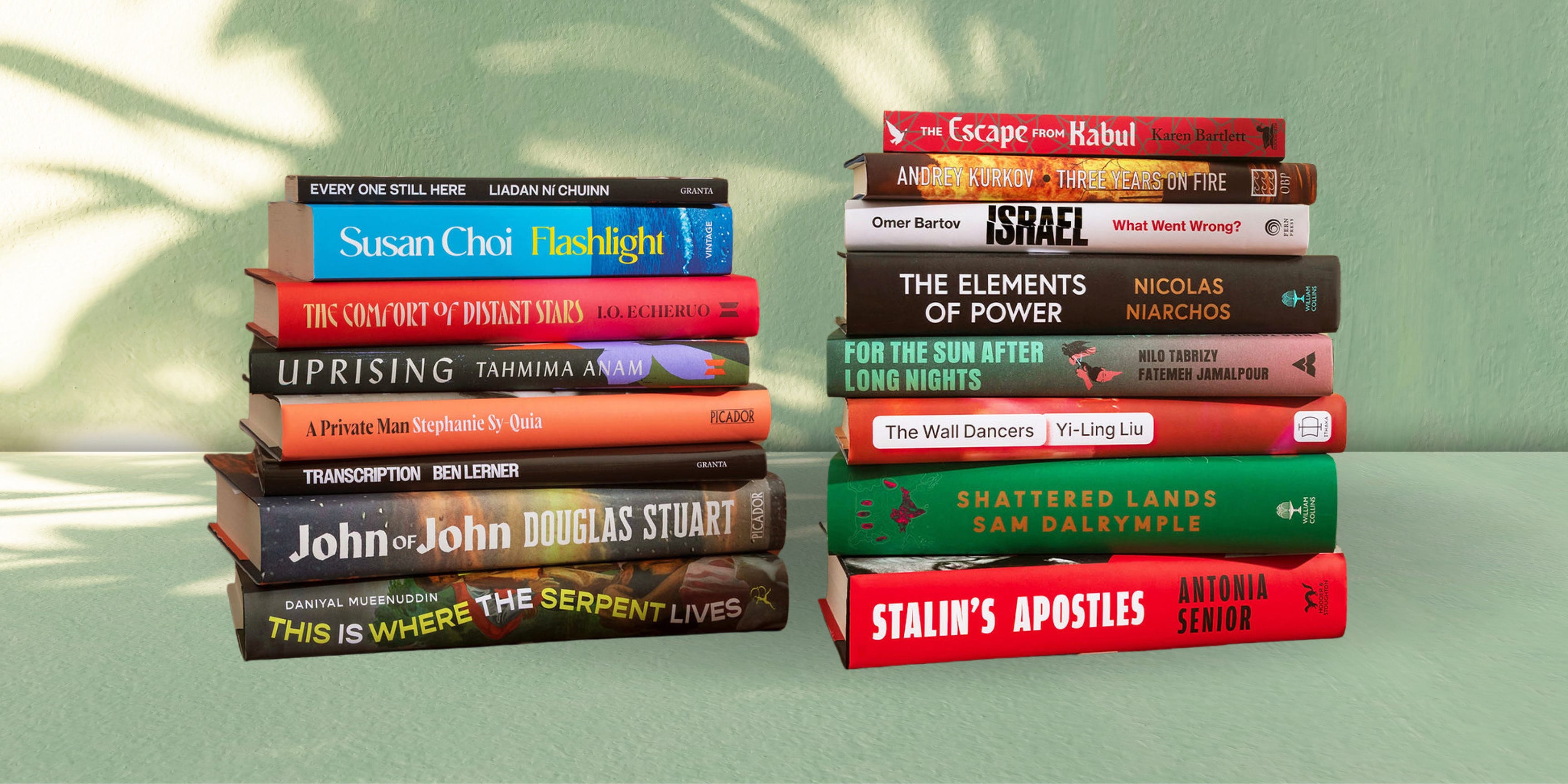
The winners of the 2026 Orwell Prizes will be announced tomorrow evening, Thursday 25 June, at University College London. Ahead of the announcements, we asked the finalists for the The Orwell Prize for Political Writing and The Orwell Prize for Political Fiction about the ‘political’ books which most affected them — and why.
Together, The Orwell Prize for Political Writing and The Orwell Prize for Political Fiction reward the fiction and non-fiction that best meets George Orwell’s own ambition ‘to make political writing into an art.' Across the shortlists, our judges are looking for the same qualities found in Orwell’s writing, from courage and independence of thought to political purpose and clarity of expression.
Browse this all year’s lists — including exclusive extracts and judges’ quotes — on The Orwell Foundation website here. Over at Bookshop.org, the finalists have compiled their own reading lists inspired by their books: you can browse those here.
Secretly reading an illegal copy Solzhenitsyn’s The Gulag Archipelago, when I was about 16, tore away the curtain of lies that I had been only vaguely aware of up to that point. I am still affected by it today, especially when I reflect on how the person who wrote it — and who lived through that horror — could foster ideas that gave rise to further inhumanity.
Andrey Kurkov, Three Years On Fire — Political Writing finalist 2026
I think all books are political whether or not they mean to be. Of the ones that mean to be, I would never be able to choose a favorite. A few that have made a big difference to me are Philip Roth’s The Plot Against America, Jenny Erpenbeck’s Visitation, Kamila Shamsie’s Home Fire and of course Orwell’s Animal Farm, Nineteen Eighty-Four, and Down and Out in Paris and London. All of these books make visible the political forces that shape human lives and they all do so while taking a clear and courageous position.
Susan Choi, Flashlight — Political Fiction finalist 2026
Writing The Escape from Kabul I returned often to Mountains Beyond Mountains: One Doctor’s Quest to Heal the World by Tracy Kidder. It’s a fantastic example of how to tell narrative fiction, and make complex subjects, like international healthcare, politics and social systems, both human and thrilling.
In my life, however, nothing has touched and inspired me like I Know Why the Caged Bird Sings by Maya Angelou. It is not only supremely brilliant - but deeply political, awakening a whole generation to racism, and misogyny. As Maya Angelou said, “I write about being a Black American woman, however, I am always talking about what it’s like to be a human being.”
Karen Bartlett, The Escape from Kabul — Political Writing finalist 2026
I believe the moral impulse is essential for a novel — I cannot enjoy one without it. However, it has to work as a novel. The moral/political purpose is nothing without beauty. A novel that does this spectacularly well — possibly better than anyone, ever — is Toni Morrison's Beloved. At no point can you deny that this is a book that is driven by a deep desire to tell an important, politically urgent story. And yet, it is miracle after miracle of perfect sentences, characters that will burrow themselves in your heart, and a story you can't stop reading.
Tahmima Anam, Uprising — Political Fiction finalist 2026
I’ve been rereading Turgenev’s Sportsman’s Sketches for many years now and am fascinated by its subtle political force – the effect it has now and the effect it had when it was written. Just as in czarist Russia the governing powers had little understanding of the lives of the people over whom they ruled, so in Pakistan there are many in the ruling elite who know nothing of the interiority of peasants’ lives in the countryside, or even of the retainers who serve their dinners and raise their children. The Sportsman’s Sketches helped create the moral climate that shaped Czar Alexander II’s decision to emancipate the Russian serfs, because it obliged the Russian aristocracy to concede that these were living humans quite like themselves — and not merely chattel. Similarly, I hope that my book humanizes my readers' political understanding and enables them more deeply to empathize with the poor and powerless, whether in Pakistan or abroad.
Daniyal Mueenuddin, This is Where the Serpent Lives — Political Fiction finalist 2026
One “political” book that has greatly affected me is Elsa Morante’s 1974 novel History (La Storia), which tells the story of the half-Jewish schoolteacher Ida and her two children, one of whom was born as a result of her rape by a German soldier during World War II. The novel juxtaposes the events of the war with the lives of ordinary people, demonstrating how History with a capital H must also be told as the stories of individuals subjected to it, to comprehend the devastation wrought on humanity by political leaders and inhumane ideologies such as fascism.
Omer Bartov, Israel: What Went Wrong? — Political Writing finalist 2026
I love and return to anything by Angela Davis, but especially her classic works If They Come In The Morning, published first in 1971, and Women, Race & Class, published in 1981.
Liadan Ní Chuinn, Every One Still Here — Political Fiction finalist 2026
The Power of the Powerless by Václav Havel. I read it during the Woman, Life, Freedom protests in Iran, when the cost of telling the truth felt unbearably high. Havel helped me understand how people living under a totalitarian and ideological state can still choose to live “within the truth”, even when the state demands obedience and lies.
Around that time, the political prisoner Farhad Meysami appeared in a photograph after months on hunger strike, holding three books, his body reduced almost to bone. The image stayed with me like a compass: a reminder that even the powerless have power when they refuse to serve the lie.
Fatemeh Jamalpour, For the Sun After Long Nights — Political Writing finalist 2026
All books are political. Some just more obviously so. George Orwell’s Nineteen Eighty-Four and Aleksandr Solzhenitsyn’s One Day in the Life of Ivan Denisovich immediately come to mind. A book that has found its way into virtually everything I’ve written is Chinua Achebe’s Arrow of God. Of all Achebe’s work, I believe it most explicitly confronts power and the way it shaped the reality into which I was born:
“When I was in Okperi I saw a young white man who was able to write his book with the left hand. From his actions I could see that he had very little sense. But he had power; he could shout in my face; he could do what he liked. Why? Because he could write with his left hand. That is why I have called you. I want you to learn and master this man’s knowledge so much that if you are suddenly woken up from sleep and asked what it is you will reply. You must learn it until you can write it with your left hand. That is all I want to tell you.”
I.O. Echeruo, The Comfort of Distant Stars — Political Fiction finalist 2026
Jozef Czapski’s Inhuman Land. Czapski was a painter who was mobilised into the Polish army in 1939 and captured by the Red Army. In 1941, he was released and joined the army of General Anders, enduring great hardship. In Inhuman Land, he travels through the Soviet Union looking for 10,000 lost Polish officers, unaware that they have been massacred in the forests of Katyn. On his travels, Czapski concludes that the ultimate good is truth, and that truth alone offers the possibility of virtue and redemption for humanity. Czapski’s insights, and his remarkable generosity of spirit, are endlessly inspiring.
Antonia Senior, Stalin’s Apostles — Political Writing finalist 2026
For me, Family Lexicon by Natalia Ginzburg was incredibly influential. She lived through a pivotal moment in history and wrote about her family dynamics as they shifted throughout this time. This passage from the afterword by Peg Boyer stuck with me and was my compass during my writing process:
“In the essay “Childhood” Ginzburg says about her family ‘We were nothing, neither rich nor poor, neither Catholic nor Jewish.’ In that essay she characterizes her girlish apprehension of not fitting into any available category as a source of anguish. Though in later years, she came to prize this nothingness as a positive force. Noting in her education a certain incoherence, the absence of any defining or comprehensive ideology. She was forced to fling herself into the task of clarifying for herself and her readers every issue that came her way [...] No ideology, no handy prefabricated formulas to consult. She starts at zero, sees what is before her and gets to work.”
When I read Persepolis by Marjane Satrapi in elementary school, I noticed that my experience was vastly different; I did not come from a political family like Satrapi. Stories of torture and imprisonment that Satrapi wrote about did not exist in my world. I used to wonder if I had the right to write about Iran given my background. But in reading Ginzburg’s work, I saw myself in her. I too had to start from zero and clarify my country’s issues for myself. Ginzburg gave me the permission to take up space and get to work.
Nilo Tabrizy, For the Sun After Long Nights — Political Writing finalist 2026
Comments
Nothing yet. Say the first thing.
Sign in to join the conversation.