
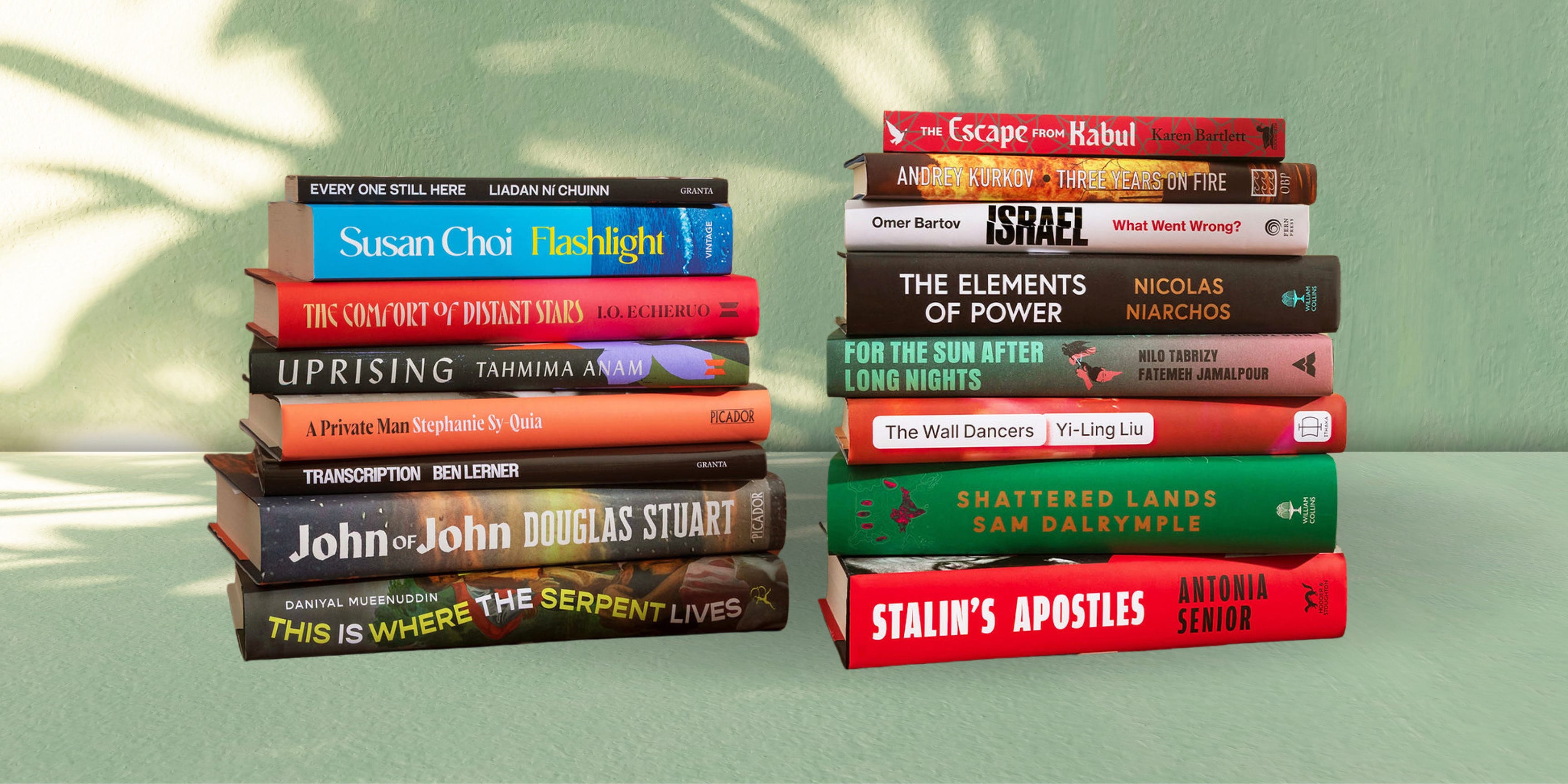
In his essay ‘Why I Write’, George Orwell claimed that prose writers have four ‘great motivations’ (putting aside the need to earn a living) — sheer egoism; aesthetic enthusiasm; historical impulse; and political purpose. We put that same question to ten of the finalists for the 2026 Orwell Book Prizes — why do they write?
Together, The Orwell Prize for Political Writing and The Orwell Prize for Political Fiction reward the fiction and non-fiction that best meets George Orwell’s own ambition ‘to make political writing into an art.' This year’s winners will be announced next week, on Thursday 25 June in London.
Across the shortlists, our judges are looking for the same qualities found in Orwell’s writing — from courage and independence of thought to political purpose and clarity of expression. Read on to find out what the finalists had to say, and browse both shortlists — including extracts and judges’ quotes — on our website here.
Meanwhile, over on Bookshop.org, the finalists have compiled their own reading lists inspired by their shortlisted books. Browse those here.
All of the above, I’m sure. All my books have a historical impulse, but without political purpose I’d never start and without enthusiasm I’d never finish. Most of my books are about people fighting for justice - although not usually in the strictly legal sense we find in The Escape from Kabul. We all know that human beings can be terrible, but I am always motivated to write about those who are also turn out to be amazingly brave and heroic.
Karen Bartlett, The Escape from Kabul — Political Writing finalist 2026
Orwell’s ‘aesthetic enthusiasm’ probably comes closest to explaining why I do something that I so often find so difficult. I love words and I love to read. When I put words together in a way that makes other people want to read them, it’s very satisfying.
Susan Choi, Flashlight — Political Fiction finalist 2026
I write to make people feel deeply, and in feeling deeply, perhaps get them to change their minds.
Tahmima Anam, Uprising — Political Fiction finalist 2026
I have to own up to the first thing on Orwell’s list – my choice of career was definitely influenced by the realization that, as a writer, I would not have to go out to work every day. However, I also love writing, and the reason for that involves all the other points on the list. My early novels were an attempt create an image of Soviet Mentality by tracing its development. The desire to expose what lies behind the absurdities of Soviet and post-Soviet life has always been important.
Andrey Kurkov, Three Years On Fire — Political Writing finalist 2026
Like other writers, I have many motivations – all the above and more. Somewhere at the core of my project, however, is a deep need to bring the two parts of my experience, in Pakistan and in the West, into harmony. Born to a Pakistani father and an American mother, I was raised in Pakistan, later schooled in America, then as a grown man lived for long stretches on my family’s farm in Pakistan’s South Punjab, retreating abroad when my soul wearied of the struggle, moving back and forth, transient. My stories are written in English, about my Pakistani experiences and perceptions, for an audience largely in the West. By conceiving and publishing these tales, I create a harmony, bringing together the parts of my experience within the covers of a book. I long to understand my divided life according to a single key, and these stories help me to achieve that.
Daniyal Mueenuddin, This is Where the Serpent Lives — Political Fiction finalist 2026
I write to make sense of the world and my life. And in thrall to this motive comes the aesthetic compulsion to create beauty with the material of life; the political desire to influence the ideas and views of my fellow humans; and the historical urge to mark this place and time with a scribble that says: “I was also here and this is what I saw.”
I.O. Echeruo, The Comfort of Distant Stars — Political Fiction finalist 2026
Every word I write is a battle against hubris, rather than a reflection of egoism. I recognise the other three great Orwellian impulses, however. Good sentences have a rhythm which is almost mystical in quality, and there is an aesthetic joy in chancing on the one word which makes a phrase vibrate. I abhor convenient lies, and perhaps this is why I write about totalitarianism, particularly communism. Communists have created political systems which rest on performative complicity with obvious lies. As a writer, this is what propels me to overcome the hubris: the desire to understand how power can rest on such rickety foundations.
Antonia Senior, Stalin’s Apostles — Political Writing finalist 2026
In this book I seek to clear the fog of ignorance, obfuscation, and propaganda surrounding debates over Israel and Palestine, while Israel aims to eliminate Palestinian presence and perpetuate Jewish control from the river to the sea. In my previous scholarship I sought to expose the legend of the “clean Wehrmacht” in World War II and document its Nazification and criminality; in this book I wanted to show that reasonable and well-informed criticism of Zionism and Israel is not motivated by antisemitism but by objective analysis, even as the Holocaust has been abused by Israel as a license for violence.
Omer Bartov, Israel: What Went Wrong? — Political Writing finalist 2026
When I began writing this book, I had been banned from journalism in Iran. Interrogators from the Ministry of Intelligence told me I was not allowed to produce any kind of content. I told them: you cannot turn off my mind. I began by writing down my interrogations.
A month later, the Woman, Life, Freedom uprising began. Many of my journalist friends and colleagues were arrested. I felt a responsibility: if they were in prison, I had to report from the streets of Tehran, to watch and write.
For me, writing has a political purpose. As a feminist, I know the personal is political. But writing under dictatorship is also a historical impulse. My reporting may not change events immediately, but it documents them for the future — so that one day people will know the long and painful road we travelled toward freedom.
Fatemeh Jamalpour, For the Sun After Long Nights — Political Writing finalist 2026
I think the stories come from wanting to be understood, and from wanting to understand.
Liadan Ní Chuinn, Every One Still Here — Political Fiction finalist 2026
Comments
Nothing yet. Say the first thing.
Sign in to join the conversation.