
Editor’s Note: The story about Witek the Pole was weaved together from several different letters on the subject. He sometimes referred to this narrative to drive home a theme common to many of his letters, expressed in a haunting postscript: his disappointment in the behavior of fellow Jews. He categorically rejected betraying another Jew to a Nazi to save oneself. One letter was addressed to The Jewish Journal, presumably The Jewish Journal of Los Angeles, for whom I would later contribute as a journalist.
January 19, 1990
For your information about human character and behavior in the law of the jungle in Nazi Germany, the scum of humanity; the Jewish character; and the human nature to stay alive–and especially for us Jews.
My personal opinion was that, in fighting to stay alive, it was good to seek outside help from the Poles–but not by denouncing Jews to Germans. The Poles were very much afraid of the Jews—of being denounced by Jews more so than by the Poles. The Poles were very seldom denounced by other Poles, maybe never. Denouncing Poles and Jews was a tragic wrong! Because it cut off the help and the sources where help could be derived: from Poles! Only!
Remember, help in the camp could only be derived from Poles coming into the work plant from the outside and going home to their families. My personal desire was to be in contact with the Poles who came to work for the Germans from the outside.
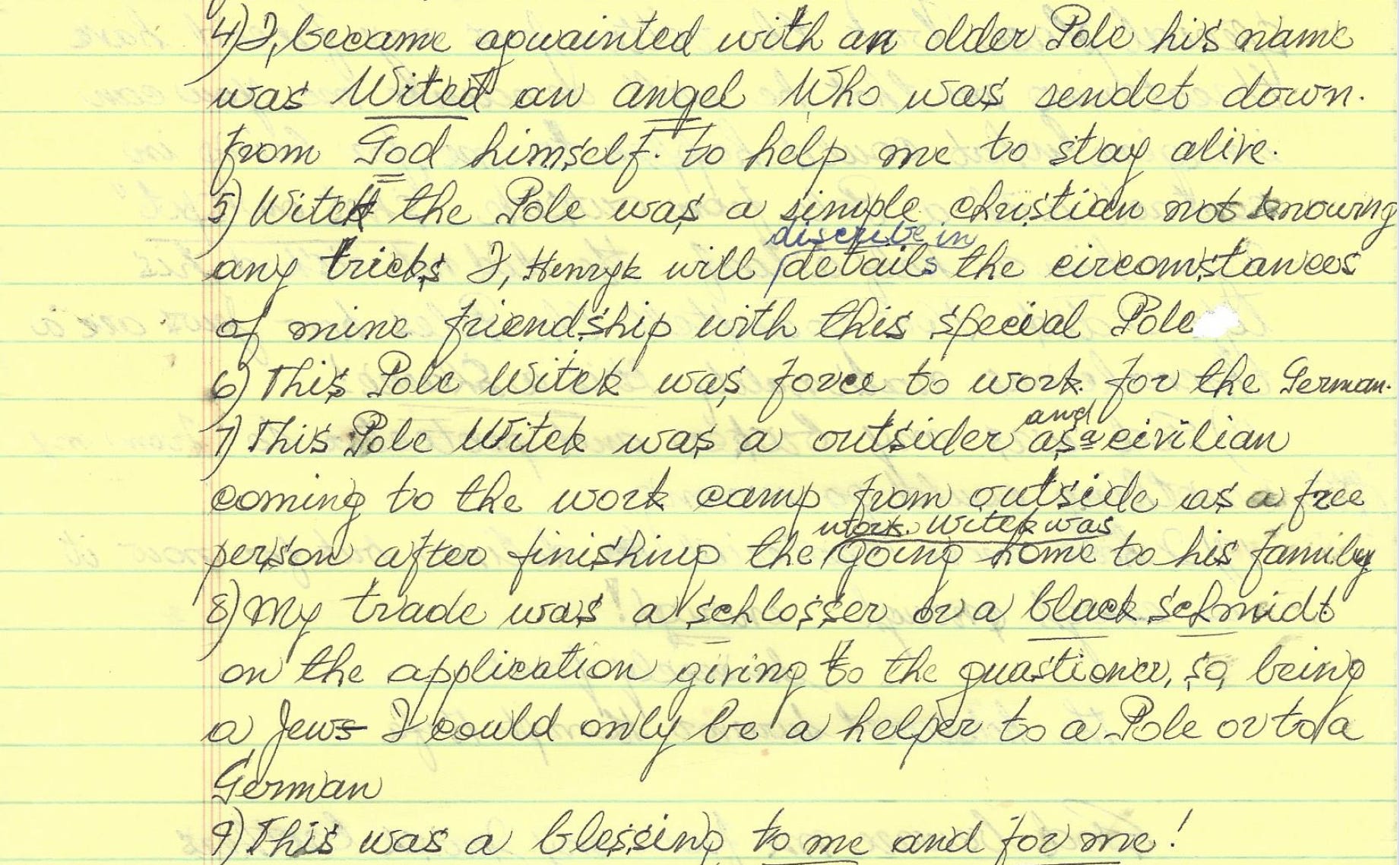
I became acquainted with an older Pole. His name was Witek, an angel sent down from God himself to help me to stay alive. Witek the Pole was a simple Christian, not knowing any tricks. I, Henryk, will detail the circumstances of my friendship with this special Pole.
Witek the Pole was forced to work for the Germans. He was an outsider, coming to the work camp from outside as a free person. After finishing work, he went home to his family. Witek the Pole was in charge of operating the tool shop. He was a Silesian, which means half-German and half-Pole, so I could communicate with him in German and in Polish.
My trade was a schlosser, or a blacksmith, as it was given on the application to the questioner. At the Jaworzno-Lager,1 I was assigned to be a helper in a black Schmidt workshop with Poles and Germans. Being a Jew, I could only be a helper to a German or a Pole. My duty was to help bring tools from the tool shop to my master and to return these tools to the tool shop. I was like a “bus boy,” bringing and taking tools back to the tool room. This was a real blessing for me!
It looked as if I was a “something” but really I was a “nothing”—a dispatcher, bringing and returning tools to the tool place.
I took the tools but never brought them back.
In a conversation with my master, Witek the Pole, I asked him about the situation and condition for buying tools outside. He said: “No, you cannot buy tiny tools outside.”
I struck an exchange with my master, Witek the Pole: a loaf of bread for a hammer; some cigarettes for a screwdriver; and so on. I could never bring back all the tools that I took out. It was a very risky business but somehow I managed. Inmates were hanged if they were caught. God was protecting me.
Witek was an honest Christian. He brought me what he had promised.
It was a very scary business for my master, Witek the Pole.
Now the question was how to avoid being denounced by my Jewish brothers to the Germans.
My fellow co-worker, a Jew, wanted to denounce me to the Germans if I would not give half a loaf of the bread that Witek the Pole had brought me. The bread was hidden in a special place, but the rotten Jew, “my friend,” threatened to denounce me. You can imagine what could happen to me for being in contact with a Pole from outside: “Shot on spot.”
I gave him a half a loaf. He did not risk his life. I did not go and tell the Poles how Jews are a treacherous nationality. It is a shame!
God was my broker and protector.
Sincerely Yours,
The Holocaust survivor Henryk Arfa
PS. God beware me from my Jewish brothers’ heads and the Christian hands.
Jaworzno was a forced-labor subcamp of Auschwitz, located about 12 miles northeast of the main camp.
Comments
Nothing yet. Say the first thing.
Sign in to join the conversation.