
Editor’s Note: This letter survived only in fragments, which I pieced together as best I could, though the ending was not always clear. I have edited the text lightly for narrative consistency and clarity.
In various letters, my grandfather ended with one-line reflections that drove home a particular idea. Sometimes these reflections appeared on their own, unattached to any specific letter. I have matched them, where appropriate, to the themes of the letters and included them as postscripts.
March 15, 1988
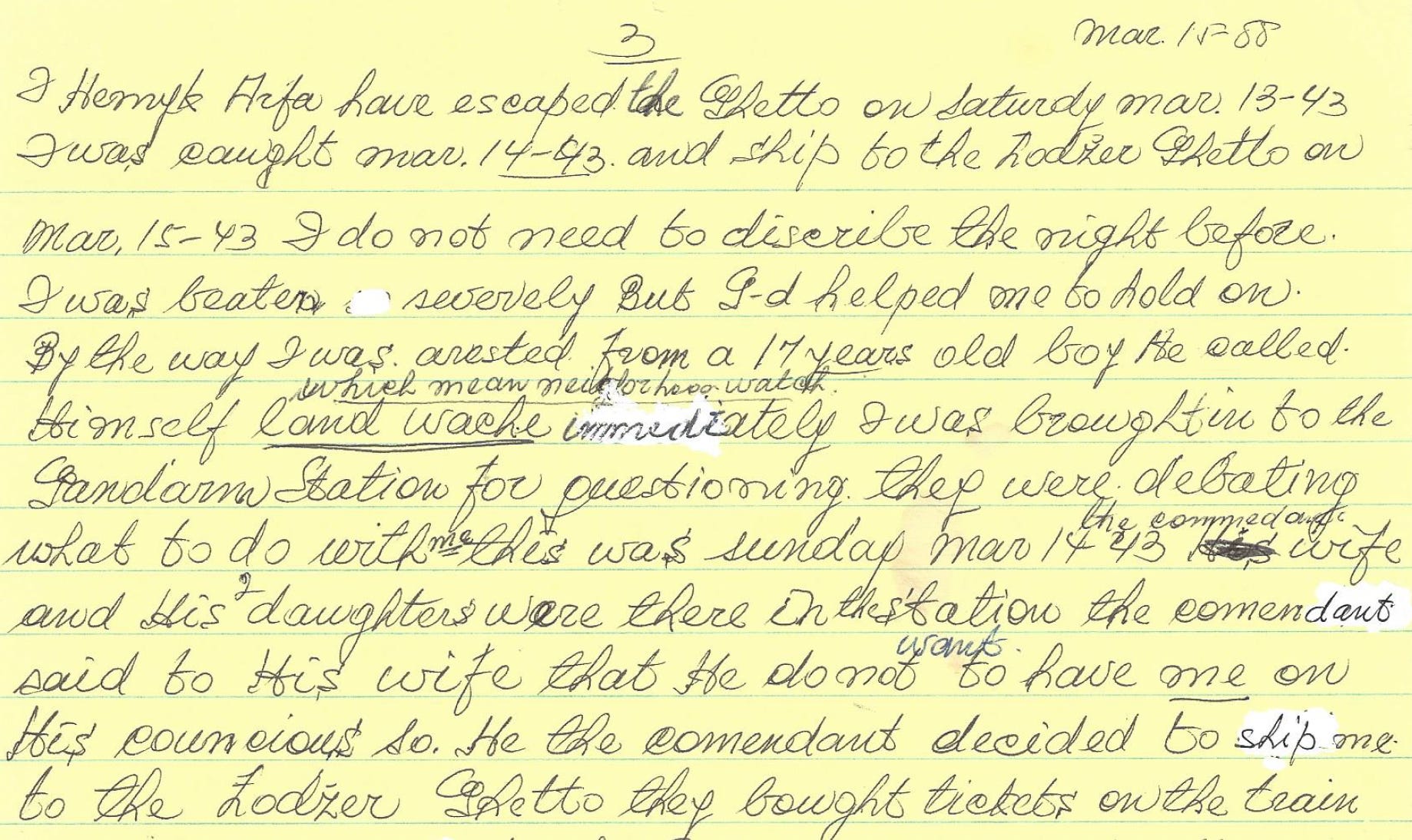
I escaped the Ghetto on Saturday March 13, 1943 and was caught on March 14 then shipped to the Lodzer Ghetto on Sunday, March 15. I don’t need to describe the night before. I was beaten severely, but God helped me hold on. By the way, I was arrested by a 17-year-old-boy. He called himself “Landwache” which means “Neighborhood Watch.”
I was brought into the Gendarm Station1 for questioning on March 15. They were debating what to do with me. The commandant’s wife and daughters were there at the station. The commandant told his wife that he does not want to have me on his conscience so he decided to send me to the Lodzer Ghetto. They bought tickets at the train station.
I was cuffed to the Gendarm’s arm and together we walked to the station, which was only five to six miles from the Ghetto. I don’t need to describe this event in more detail.
At about 9 or 10 in the morning, I was brought into Cripo criminal Polizei2 which was making a report for the higher authorities about me. You can imagine that treatment I received. This was probably Etzba Elokim, God’s finger. Nothing else.
Now, I’m sitting across from a civilian German national which means [ineligible] in Poland.3 His name was Goligowski, a real Polish name. He was writing a report about me and was dictating the report to himself and also reading this report to me. The reason why I left the Ghetto was that I, Henryk Arfa, wanted to be with my father and sister together and work for the German government.
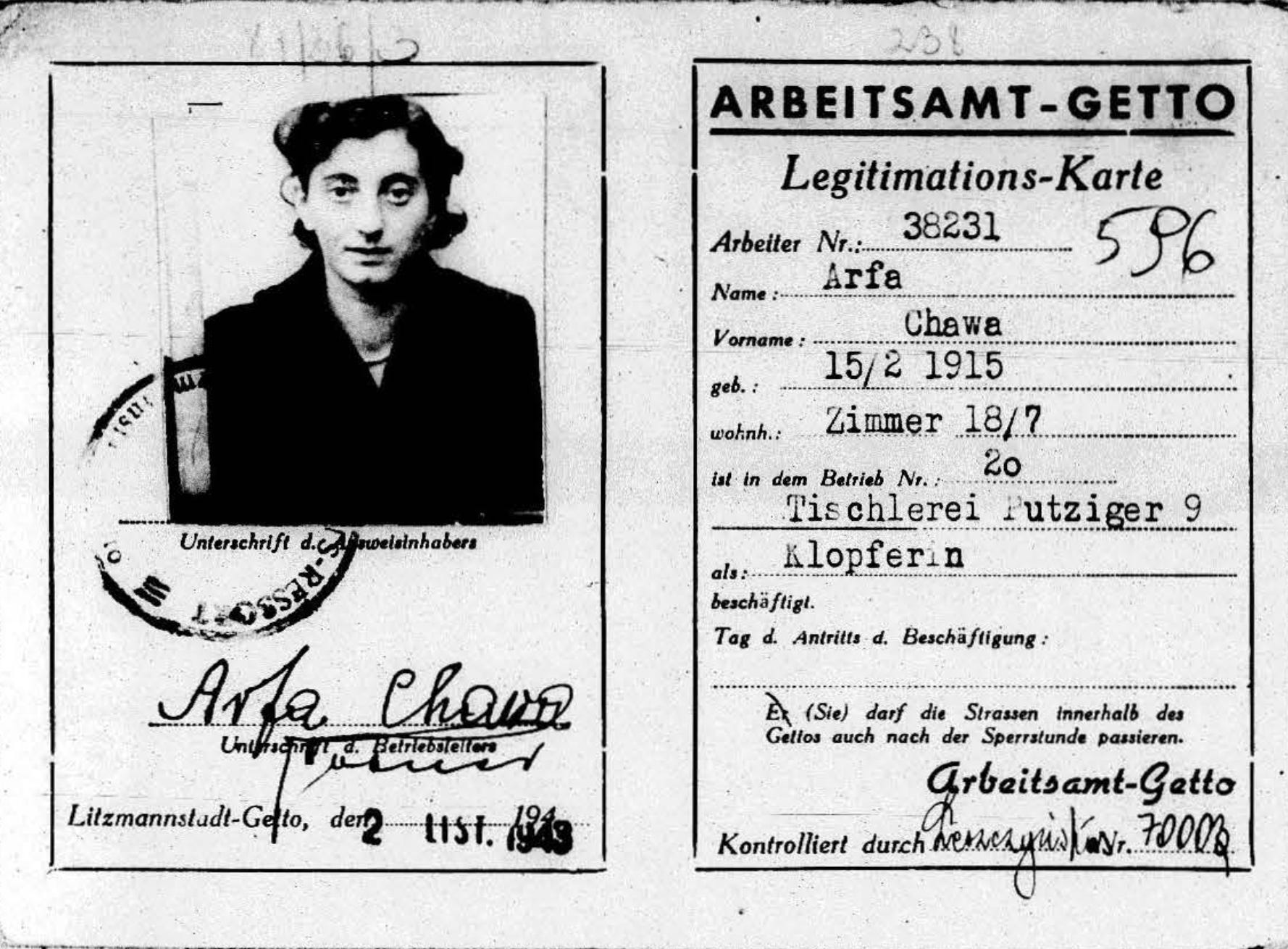
But this did not help me too much, and I was sentenced in absentia to be hanged publicly in a marketplace to discourage others from escaping the Ghetto. It would be performed by Jews. The German came with the hanging order and announced to the leader of the Lodzer Ghetto, Chaim Rumkowski, a Litvak,4 to prepare the gallows for hanging Henryk Arfa.
Now guess what happened?
It was March 1943, after the disastrous defeat of the Nazi German army in Stalingrad. Chaim Rumkowski said to the Germans: “The time is a bit late for hanging. I have about one thousand Jews in the Ghetto: sick, crazy, undernourished, and unfit to work, and also crazy, law-breakers disturbing the peace and disobedient like Henryk Arfa and others. How to get rid of them? I’m going to put Henryk Arfa on the transport to Birkenau-Auschwitz.”
He, Chaim Rumbowski, knew what was going to happen to me and to the other Jews: the gas chamber.
The German said: “You know, that’s a good idea.”
Again, God protected me and God will again protect, forever. He [God] stopped and said, “I’m the decision maker.”
Out of the 972 Jews about to be gas chambered, God picked 278 Jews to stay alive for the time being. Henryk Arfa was among the lucky ones!
Exactly at that time, 50,000 Greek Jews from Saloniki were shipped to Birkenau-Auschwitz to be gas-chambered, but the Greek Jews could not speak German, so that could create a problem for the Germans in bringing all the Greek Jews to Birkenau-Auschwitz for liquidation because it could create a bloodshed before gassing.
We, the 278, were pushed in a block, or in other wards in barracks for 30 days. The commander of that barrack was a Jew. His name was [cut off]
Sincerely yours,
The holocaust survivor Henryk Arfa
PS. I’m going to be alive and give a generation to the Jewish world.
He is likely referring to the German Gendarmerie, the rural police force operating in Nazi-occupied Poland.
He likely meant Kriminalpolizei, the German criminal police.
The exact status of Goligowski is unclear. Henryk describes him as a "German national" but emphasizes that "Goligowski" was "a real Polish name." This suggests he may have been a local Polish-born civilian working for the German occupation authorities.
“Litvak” refers to a Jew whose family origins were in the historic Lithuanian Jewish communities of Eastern Europe.
Comments
Nothing yet. Say the first thing.
Sign in to join the conversation.