
This piece contains spoilers.
On January 1, 2026, New York City Mayor Zohran Mamdani aroused a viral flurry of criticism over an excerpt from a public speech in which he said: “We will replace the frigidity of rugged individualism with the warmth of collectivism.” Critics accused him of naïveté at best, arguing that such rhetoric disregards the historical ravages of communism and socialism on human well-being and prosperity. Recently, he’s been likewise criticized for a July 4 message interpreted as an ode to Communism and an attack on American individualism.
It’s no wonder that Mamdani’s critics often invoked the thinker Ayn Rand, who had been a vocal critic of Marxist influence in Hollywood. As an author and screenwriter in her own right, Rand developed a philosophy of individualism and portrayed free-thinking heroes and heroines—creators, businessmen, industrialists—who bucked society’s trends to realize their personal vision, a vision critics routinely labeled “selfish.”
In one of her early works, the novella Anthem, Rand envisions a world in which the word “I” is lost to humanity because people have become a cooperating collective of nameless individuals, suppressing their individuality for the so-called “common good.” One man, however, discovers the forbidden word. With the Biblical force of Abraham, he sets out to build a new world where people can discover and realize their own “I.”
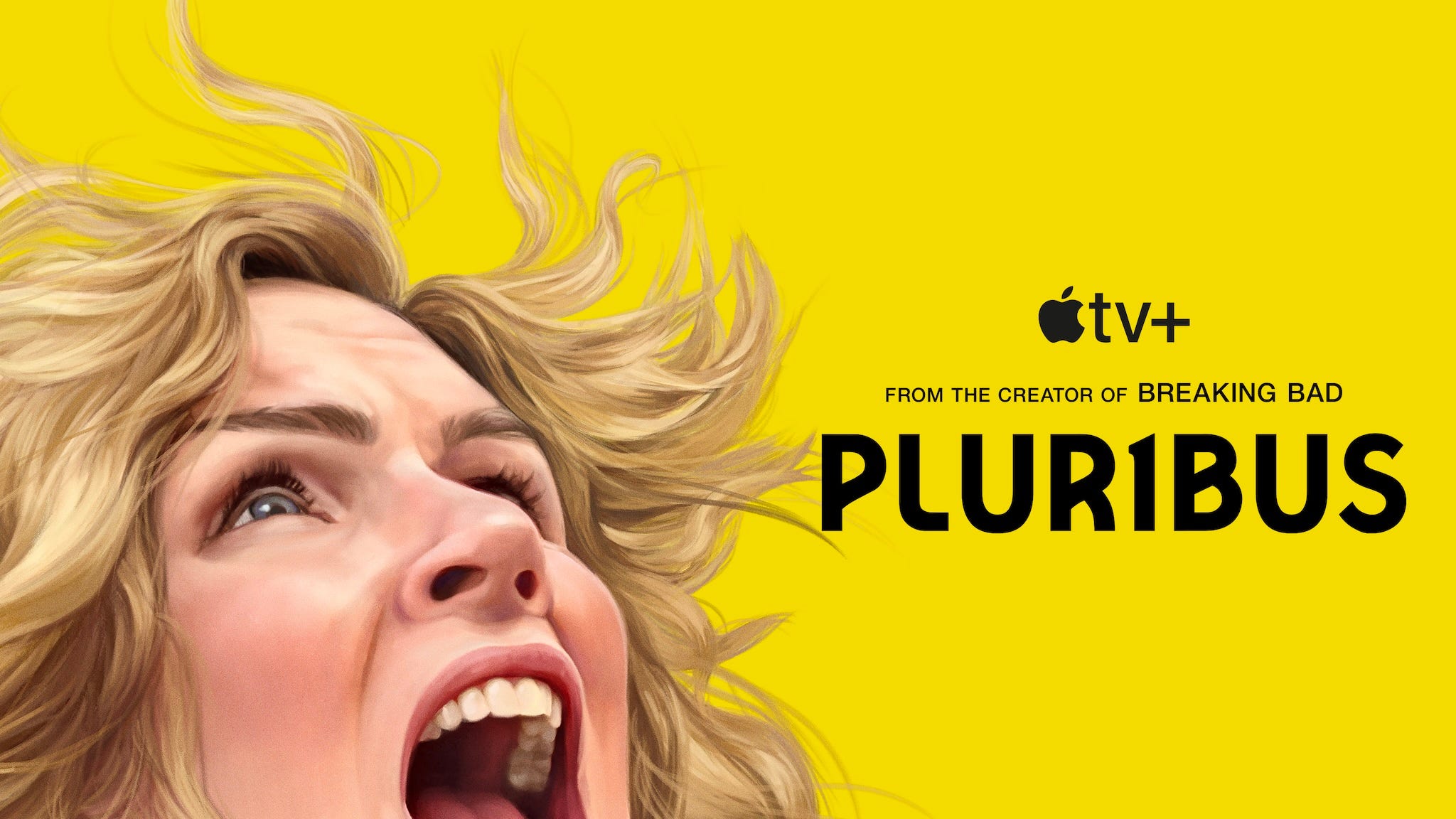
It is a vision that televisionary Vince Gilligan, of Breaking Bad fame, seems to reformulate—or perhaps knowingly echo—in his Apple TV+ series Pluribus, which imagines a world in which people have lost their individuality altogether and no longer use the word “I.”
This world is introduced by an all-knowing, chatbot-like, suave, smiling “government official,” tasked—like a good worker bee—to explain the new order to the heroine, Carol Sturka, a bestselling novelist from suburban Albuquerque.
“Why is everybody suddenly ‘we’?” Carol asks. “Who is “we”?
“We is ‘us.’ Just ‘us,’” the official answers, polite and sweet. An alien signal, he explains, had provided the recipe for an RNA sequence that produced a virus—“a psychic glue capable of binding us all together”—so that humanity acts in unison. Since Gilligan began developing Pluribus around the time of the COVID pandemic, one can’t help but wonder whether the show questions the collective mindset inspired by mRNA vaccines, which entire countries were pressured to inject as a near-panacea.
Drawing on his science-fiction and X-Files roots, Gilligan creates an apocalyptic world in which nearly all humans—save for exactly a dozen—merge into a single biological repository of all human knowledge and memory. It’s like ChatGPT in human form. They are all so kind, so helpful, so sycophantic, and above all…warm.
The “Joiners,” as they are called, are biologically wired to believe that the world they inhabit is the happiest on earth, and they are driven by biological imperative to convert the remaining “Others.” They do so by becoming their veritable servants, catering to every whim, even if that means flying holdouts around on Air Force One. Yes, the world of the Joiners is often tempting. One “Other” enjoys the luxuries so much that he refuses to give up this constant state of wish fulfillment—even after discovering that survival requires a form of anthropophagy (cannibalism). To prevent food shortages, Joiners eat protein derived from dead people since they are forbidden from purposefully killing any living organism—a subtle critique, perhaps, of extreme environmentalism?
A middle-aged, wry, grouchy, cynical curmudgeon—and yes, “frigid” lesbian—Carol Sturka resists this world. This almost-ordinary suburban Albuquerque writer becomes a reluctant anti-hero, almost single-handedly carrying the mantle of individualism. Carol’s rousing monologues against this new world order serve as both a beautiful tribute to individualism and a damning indictment of collectivism. In seeking to convince the remaining Others to join her fight, she says:
“Now I realize some of you think the world might be better off this way, with all the new ‘peace,’ ‘love,’ and ‘understanding.’ Enjoy that opinion. Relish it. Because it may be the last one you ever possess. And when the day comes that ‘peace’ and ‘love’ are forced upon you—who knows?—maybe in that last fleeting moment, you’ll realize that what you treasured most was your individuality.”
She inspires a potential partner-in-anti-collectivism: Manousos, a “frigid” storage-facility owner in Paraguay. He refuses to cooperate with the Joiners even if it means literally eating dog food to survive. Since the Joiners believe all property belongs to everyone, he refuses their food and insists on paying the long-lost owners for anything he consumes. He rejects his newly kind, newly “warm” mother—herself a Joiner—telling her: “Don’t call me ‘son.’ I’m not your son. My mother was a bitch.” And in a surprisingly moving, if perhaps unintentional, nod to religion’s power to sanctify the individual, Manousos kisses an image of Jesus and Mary as he embarks on a long road trip to join Carol and help break the spell of enforced togetherness.
What is so striking about Pluribus is its insistence that real heroes in the fight against collectivism need not be warriors or tycoons, but ordinary, abrasive people: a writer and a storage-facility owner. They are difficult, unpleasant, even unfriendly. But sometimes the pursuit of the good does not arrive in fake smiles, comforting affirmations, or scientific facts that sound as if they were generated by ChatGPT. Pluribus may be teaching us that world salvation arrives in the form of…frigid individualism.
Comments
Nothing yet. Say the first thing.
Sign in to join the conversation.