
A few weeks ago, we introduced a radical special issue on AI tools to make research better, and I also mentioned we had a second special issue coming that was more theory-driven. Well, we’re releasing that call now, and I’ll go into detail on that later in the post. But first, we continue to document the robot uprising in research publishing. . .
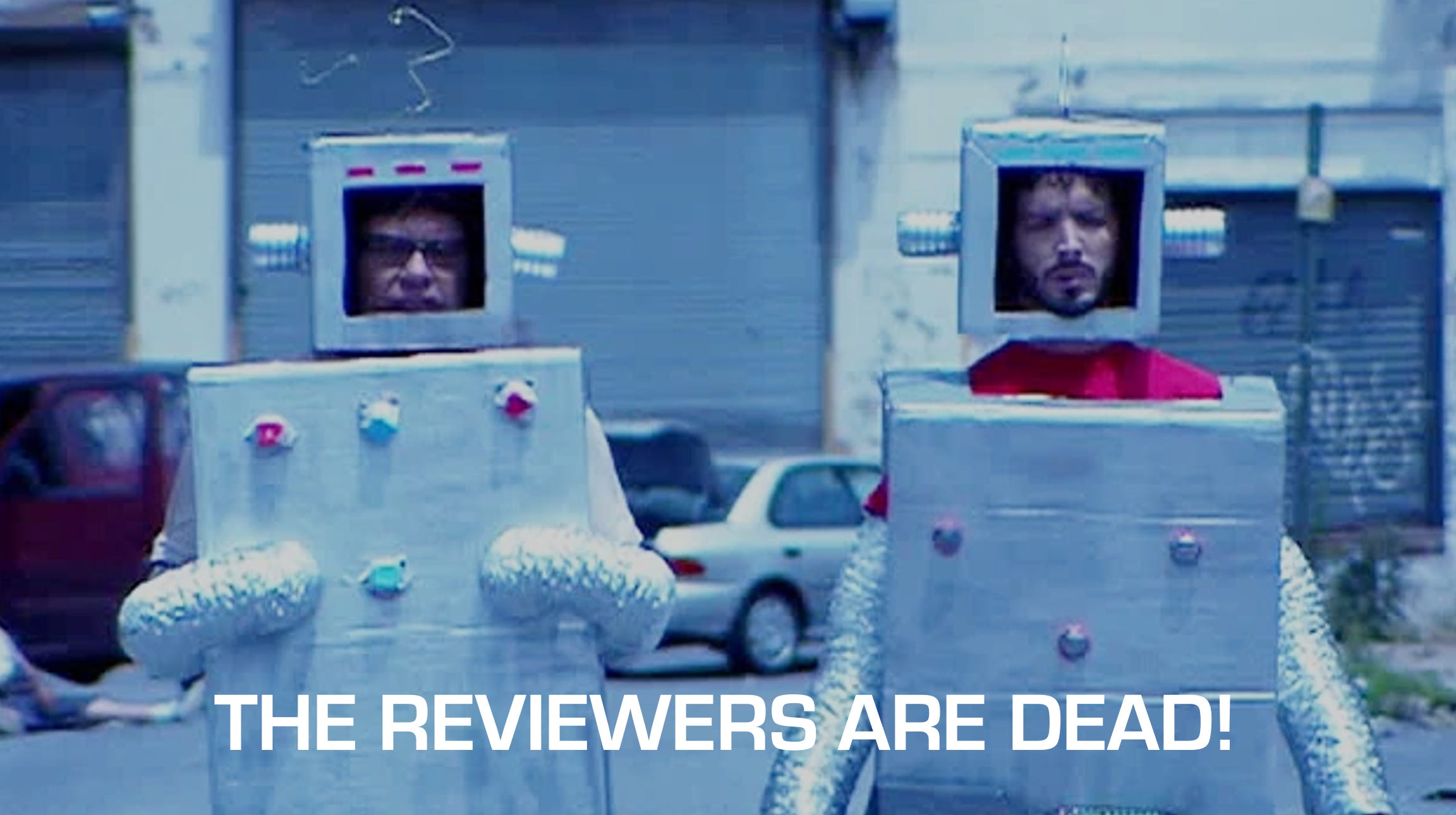
INFORMS sent all the EICs the journal dashboards through Q2 (June) last week, and oh boy. . . Organization Science has 1350 first round submissions through June—a 54% year-over-year increase. This does not include resubmissions so the pace implies close to 3,000 2026 submissions. I’d love to make an argument that is is due to editorial awesomeness, but I’m not exactly oozing overconfidence right now. So our great hope that everyone would read our editorial and think “oh, excellent point. . . we shouldn’t flood the portal with a bunch of mid1 papers” has evidently not been realized. If only we had some theories to predict collective action problems. If it wasn’t clear in the editorial, it certainly is now—the system as we know it is rapidly becoming unsustainable. I know many of you are reviewing too many papers, even with us desk rejecting more and more. When I started here, I viewed submission growth as a true KPI. Not anymore! It’s a very similar trend at the other big INFORMS journals. MSOM is up 70%, OR 30%, MarkSci 20%, ISR 80%. But Management Science? Only 2%. I’ll let you all work out some conjectures on why that might be. Maybe the brilliant Kiwi2 group Flight of the Conchords were right about the robotic uprising.3 Maybe every submission will no longer say yes, but instead say “affirmative.”
The problem has become so big that even Butterburger has quiet-quitted on the journal, focusing instead on his two great non-food activities of watching football and defending the porch from vicious predators like this toothless baby garter snake (who eventually fled unharmed).


I’m looking forward to seeing some of you at the Conference on Field Experiments in Strategy and at AOM. I’m sad that many don’t feel safe coming due to the continued xenophobia and destruction of science coming from the White House. So I’ll see the rest next year in Vienna for Sachertorte PDWs and AOM parties featuring performances of Pierrot Lunaire—just of few of my favorite things.4
We have some great new forthcoming articles I’ll share in few days, but first I wanted to introduce the second of two special issues on artificial intelligence that we’re posting. The first one, announced two weeks ago, focuses on tools and technologies for how AI might create (or fail to create) better rather than more research. This was always meant as a response to the editorial, and as we noted, an exploration of possibilities. . . not a statement of journal position or a comprehensive coverage of AI in research.
The special issue we’re introducing today takes a very different tack, and focuses on one of the most fundamental questions regarding AI for theory about people and organizations across fields and disciplines—how should we think about agency in an age of artificial intelligence? The concept of agency, and theories around it, is central to the fields that make up our community: psychology, organizational behavior, economics, org theory, strategy, ect. Many of the ways we design organizations are based on these theories, and one of our great challenges moving forward is to build theory on what organizations look like when traditional human agency is combined with AI agents. I wish I knew the answer, but fortunately for me, this exceptional group of editors and our many submitting authors will figure this out.
The special issue is led by editors representing different fields and methods as well as those with extensive experience spanning academia and industry: Paul Leonardi (UCSB), Alex Murray (Oregon), Frank Nagle (Microsoft/MIT), Nelson Phillips (UCSB), Juliana Schroeder (UC Berkeley), Paula Ungureaunu (Modena and Reggio Emilia), and Elisa Villani (Bologna). Submissions aren’t due until February 1.
I’m going to let their call for papers speak more to this below, but I want to reiterate that I think the (rather messy) introduction of artificial intelligence into organizations has presented a crucial opportunity, and responsibility, for us to build and remake theory about organizations. For as much as AI scares and excites me, it makes what we do more important. The companies I work with are struggling heavily with organizing around changing production technology, and what is missing is theory. I’m excited to see what comes out of this special issue. We’ve published many of the most important papers in the field on AI in organizations over the past five years, from across fields and methods, and I’m excited to see this continue in the near future, whether those be technologies for making research better, theories on new forms of organizing, or qualitative studies that only humans can do.
Guest Editors:
Paul Leonardi, University of California Santa Barbara, leonardi@ucsb.edu
Alex Murray, University of Oregon, anm16@uoregon.edu
Frank Nagle, Microsoft & Massachusetts Institute of Technology, fnagle@mit.edu
Nelson Phillips, University of California Santa Barbara, nelson_phillips@ucsb.edu
Juliana Schroeder, University of California Berkeley, jschroeder@haas.berkeley.edu
Paula Ungureanu, University of Modena and Reggio Emilia, paula.ungureanu@unimore.it
Elisa Villani, University of Bologna, e.villani@unibo.it
Few concepts are as central to the organizational sciences as agency, and few are as hotly debated. Across organizational behavior, organization theory, strategy, economic sociology, entrepreneurship, information systems, psychology, and sociology, research on agency emphasizes assumptions about who can act, what acting requires, and what follows once action has occurred. Theories of motivation, leadership, decision making, control, value creation, careers, institutions, and technological change all depend on a prior view of where action comes from and who is answerable for it. These views largely took shape before intelligent technologies began to take part in action, and the age of AI now puts them in question, raising anew who exercises agency and how. Yet our fields rarely agree on what agency is, who or what has it or where it is produces, or what it does.
In organizational behavior and psychology, agency typically refers to the human capacity for intentional, forethoughtful, and self-regulated action, a capacity studied through self-efficacy, motivation, proactivity, and self-determination (Bandura, 2001). Consequently, an important area of organizational research revolves around how people perceive and attribute agency, including to machines, with implications for anthropomorphism, trust, and reliance (Schroeder & Epley, 2016; Waytz, Heafner, & Epley, 2014; Logg, Minson, & Moore, 2019). In economic accounts of organizational control, agency lies at the heart of the relationship between principals and the self-interested actors who seek to optimize under incentives and constraints (Ross, 1973; Jensen & Meckling, 1976; Holmström, 1979; Grossman & Hart, 1983; Eisenhardt, 1989). In sociology, agency is the source of the long argument over structure and action, from the duality of structure in structuration theory (Giddens, 1984; Sewell, 1992) to the reconstruction of agency as a temporal and relational interplay of habit, imagination, and judgment (Emirbayer & Mische, 1998). In strategy, agency appears as strategic choice and managerial discretion set against environmental determinism (Child, 1972). Economic sociology stresses how action is embedded in social relations and how models and market devices shape what actors do (Granovetter, 1985). Entrepreneurship casts the actor as a source of novelty who recognizes or creates opportunities and brings new ventures into being (Kirzner, 1973; Shane & Venkataraman, 2000; Sarasvathy, 2001). Technology use and sociomaterial scholarship locate agency either in human capacities enacted through technology (Orlikowski, 2000; Boudreau & Robey, 2005) or in the materialization of agencies in practice (Leonardi, 2023; Scott & Orlikowski, 2025), and a growing body of work asks what agency becomes when humans and machines act together, theorizing conjoined and human-AI forms of agency (Murray, Rhymer, & Sirmon, 2021; Raisch & Krakowski, 2021; Krakowski, 2025). Organization theory, for its part, wrestles with the paradox of embedded agency, asking how actors shaped by institutions can nonetheless reshape them (Battilana, Leca, & Boxenbaum, 2009), and it is now beginning to ask how intelligent technologies reshape institutions and fields (Grodal, Ha, Hood & Rajunov, 2026; Phillips, 2026).
These traditions diverge on important points. Is agency a property of individuals or a relational accomplishment? Is it located in minds, in practices, or in configurations of people and things? Does it require intention and awareness, or only consequential action? Is it best treated as a capacity, a process, or something that observers confer after the fact? What unites the organizational sciences is a shared stake in these questions rather than a shared answer to them.
These long-running debates now show new urgency. We have entered an age in which artificial intelligence of many kinds takes part in organizational action, and the conditions under which action is produced are changing in front of us. The systems now reshaping organizational action come in several forms, and the differences among them matter for agency. These include, but are not limited to:
Analytic AI: Systems that learn patterns from data in order to classify, score, forecast, and recommend. Trained on historical examples, they map inputs to outputs, flagging a transaction as fraudulent, ranking a set of candidates, or predicting demand, and so insert machine judgment directly into the decisions organizations make. Such systems rarely act on the world on their own. Their force comes instead from the weight their outputs carry, as judgments that inform, constrain, or trigger the choices of the people who rely on them.
Generative AI: Systems built on large models trained on broad corpora of text, images, and code that produce new content in response to prompts. Rather than scoring or classifying what already exists, they compose new artifacts, drafting an analysis, writing software, designing an image, or proposing an argument. Their outputs are frequently the very artifacts that once stood as evidence of human authorship, which makes them participants in the production of work rather than instruments that merely support it. What they do not do on their own is decide when to act or carry a task forward without being asked.
Agentic AI: Computational systems that pursue goals and take consequential action in an environment with limited and intermittent human direction. Typically built on large language models that can interpret language, reason, plan, and use software tools, these systems perceive a situation, choose among courses of action, act on other systems and on the world, and adjust as they receive feedback over extended sequences of activity. What sets them apart from earlier technologies is that they do not wait for instruction at each step. They initiate, sequence, and complete work, often in coordination with other systems and other people.
The consequences of these types of AI in and around organizations are already becoming visible. Analytic systems generate recommendations that carry the weight of expert judgment, automated protocols execute decisions without human intervention, robotic systems operate independently in physical settings, and data infrastructures increasingly define what counts as reasonable action. Across a widening range of organizational settings, technological systems no longer simply support work; they also perform it (Leonardi, 2025). These dynamics are most pronounced in the current diffusion of generative and agentic AI, yet they extend to a broader class of intelligent and algorithmic technologies, including predictive analytics, algorithmic management systems, automated infrastructures, and decentralized protocols, that likewise reconfigure how action is carried out and how responsibility is assigned (Alaimo & Kallinikos, 2022; Kellogg et al., 2020; Murray, Kuban, Josefy, & Anderson, 2021; Sergeeva et al., 2020; Ungureanu, Bellesia, & Cochis, 2025).
These systems are already reshaping the nature of work (Hoffmann et al., 2025), the way value is created and captured across organizational boundaries (Villani, Greco, & Phillips, 2017), and even the economic structure of the AI industry that supplies them (Nagle & Yue, 2025).
Whatever position a scholar holds on what agency is, one fact is now unavoidable: Technologies increasingly act autonomously inside organizations, and their reach continues to widen. Yet such growth is not likely to be smooth. The economics of computation, the costs of energy and infrastructure, and rising public concern about the ways that centralized AI platforms secure consumer buy-in and then raise costs and/or lower model quality, all temper the pace of adoption, even as the broader direction shows little sign of reversing. When agency is produced by configurations of people and systems in which intention, execution, and consequence are spread across actors and across time, much of what we take for granted about organizing comes into question. For example, AI is likely to change:
How people experience their own competence and effectiveness. When a system drafts the analysis, proposes the diagnosis, or makes the call, individuals have to work out whether they are the authors of an outcome or the validators of one produced elsewhere, and that reckoning reshapes expertise, learning, professional identity, and a person’s sense of what they contribute.
Who and what we manage. Managers increasingly direct not only people but also systems that act, and they must coordinate ensembles in which the human and computational contributions to an outcome are difficult to separate.
Accountability. When an automated decision causes harm, an AI-assisted diagnosis later proves wrong, or a model produces a flawed analysis that an organization acts upon, it becomes hard to say who acted. Responsibility is frequently re-centered on human and organizational actors who did not fully control how the action was produced, so that intention, action, and accountability no longer line up.
Control. The familiar mechanisms of supervision, evaluation, and coordination assume a human actor whose behavior can be observed and directed. Autonomous and algorithmic systems unsettle that assumption, creating new instruments of control and, at the same time, new blind spots.
How firms compete and how value is created. When the capacity to act can be bought, rented, or built into a model, the sources of competitive advantage move. Capabilities that once took years to accumulate inside a firm can now be acquired through general-purpose systems that rivals can buy too, which can compress the differences between competitors even as it opens fresh ways to recombine human and machine work. The economics of production shift in step, raising pointed questions about who captures the value that autonomous systems help create, where returns accumulate across the stack of models, data, and applications, and how the boundaries of the firm are redrawn when so much capability now sits outside it.
These technologies strain our accounts of agency, and they do so in different ways. Analytic and predictive systems insert machine judgment into decisions, so that a score or a recommendation can carry the weight of a choice while the human role narrows to ratification, unsettling who can be said to author an outcome. Generative systems produce the very content, the analyses, designs, and arguments, that once stood as evidence of human authorship, blurring the line between acting and editing. Agentic systems go further, initiating and sequencing action with limited human direction, so that the locus of action is no longer settled in advance and the production of action is distributed across actors and moments in ways our concepts were not built to capture. Across all of these forms, intention, execution, and consequence, long assumed to reside in a single human actor, come apart, and with them our settled sense of who exercises agency.
This Special Issue seeks contributions that help scholars in the organizational sciences rethink agency for this new context. We are not looking for general commentary on digital transformation or broad appeals for more AI research. We invite theoretically ambitious work, whether conceptual or empirically grounded, that takes the changing production of action as its starting point. We organize the call around two complementary aims. The first is to reconsider agency itself. The second is to understand how the changing nature of agency reshapes the questions our fields care about and the way organizations are managed.
As technologies come to participate in action, our foundational concepts deserve fresh scrutiny. We welcome work that asks what agency is, where it resides, and how it operates when action is co-produced by people and machines. Questions in this vein include the following.
• What does agency mean when action is produced by configurations of humans and machines rather than by either on its own, and which existing conceptions of agency carry over to this setting and which others break down?
• Where is agency located when intention, execution, and consequence are distributed across people, systems, and points in time?
• How does agency operate as a process, and how is it claimed, delegated, exercised, and withdrawn among human and computational actors?
• When, if ever, should autonomous systems be theorized as agents in their own right, and what does that do to our explanations of action and responsibility?
• How do observers come to attribute mind and agency to people, systems, and their interaction, how does anthropomorphism shape those attributions, and how do they shape reliance, intervention, credit, and blame?
The shift in agency is rippling through the phenomena that organizational scholars study. We are especially eager for work that traces these effects across fields. Questions in this vein include the following.
• Organizational behavior and careers. How does sustained collaboration with agentic systems reshape motivation, expertise, learning trajectories, professional identity, and the experience of authorship at work, how is the nature of work itself changing as generative systems take on more of it, and when do people defer to or discount algorithmic judgment?
• Management and control. How do managers coordinate, supervise, and hold to account ensembles of people and autonomous systems, and what new roles and capabilities does this kind of oversight demand?
• Strategy and the digital economy. How does delegating decisions to autonomous systems alter managerial discretion and strategic choice, how does the diffusion of AI reshape firm productivity and the open and distributed production of digital value, and when does it compress strategic heterogeneity across firms rather than open new sources of advantage?
• Entrepreneurship and innovation. How are authorship, ownership, and value defined when opportunities are recognized and outputs are produced jointly by people and machines, who captures value when work is co-produced across organizational boundaries, and what new organizational forms, such as decentralized autonomous organizations, emerge when coordination is delegated to autonomous protocols?
• Organization theory and institutions. How are accountability, liability, and competence reassigned when action is distributed and outcomes are contested, which arrangements become institutionalized as responsible use and to whose benefit, and how does institutional work reshape fields as intelligent technologies diffuse?
• Sociology of work. How do autonomous systems reconfigure control, consent, skill, and worker agency on the job, and how do workers contest, absorb, or repurpose these systems?
• Information systems. How do the design and architecture of agentic systems shape the distribution of action, and how do organizations rebuild work practices around systems that initiate action rather than await it?
• Economic sociology. How do models, metrics, and data infrastructures define what counts as reasonable action, and with what effects on markets, valuation, and economic order?
• Professions and governance. What new (human and non-human) actors and intermediaries, such as auditors, certifiers, and evaluators, arise to govern autonomous action, and how do they acquire authority (either formal or informal)?
Given the rapid changes in agentic technologies, we will follow an accelerated review process so that the papers in this special issue appear in a timely way. The timeline is as follows.
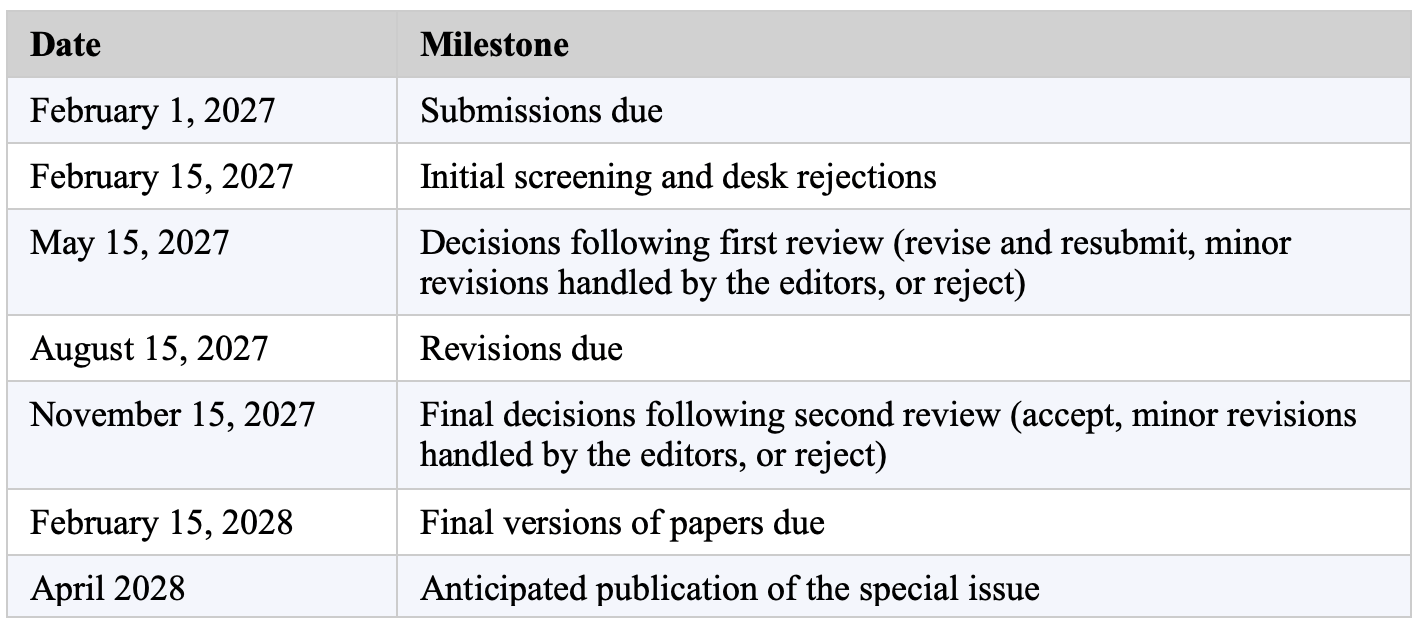
To hold to this accelerated timeline, we anticipate a higher than usual number of desk rejections at the initial screening as we identify submissions with the potential to be accepted after a single revision. In addition, we will not grant extensions to resubmission deadlines.
We welcome submissions from across the organizational sciences and from neighboring disciplines in sociology, economics, psychology, and the philosophy of action. Above all, we hope to publish work that treats the arrival of AI as an occasion to sharpen, and where necessary remake, our theories of agency and of the organized action that depends on it.
Alaimo, C., & Kallinikos, J. (2022). Organizations decentered: Data objects, technology, and knowledge. Organization Science, 33(1), 19-37.
Bandura, A. (2001). Social cognitive theory: An agentic perspective. Annual Review of Psychology, 52, 1-26.
Battilana, J., Leca, B., & Boxenbaum, E. (2009). How actors change institutions: Towards a theory of institutional entrepreneurship. Academy of Management Annals, 3(1), 65-107.
Boudreau, M.-C., & Robey, D. (2005). Enacting integrated information technology: A human agency perspective. Organization Science, 16(1), 3-18.
Child, J. (1972). Organizational structure, environment and performance: The role of strategic choice. Sociology, 6(1), 1-22.
Eisenhardt, K. M. (1989). Agency theory: An assessment and review. Academy of Management Review, 14(1), 57-74.
Emirbayer, M., & Mische, A. (1998). What is agency? American Journal of Sociology, 103(4), 962-1023.
Giddens, A. (1984). The constitution of society: Outline of the theory of structuration. Polity Press.
Granovetter, M. (1985). Economic action and social structure: The problem of embeddedness. American Journal of Sociology, 91(3), 481-510.
Grodal, S., Ha, J., Hood, E., & Rajunov, M. (2024). Between Humans and Machines: The social construction of the generative AI category. Organization Theory, 5(3), 1-10.
Grossman, S. J., & Hart, O. D. (1983). An analysis of the principal-agent problem. Econometrica, 51(1), 7-45.
Hoffmann, M., Boysel, S., Nagle, F., Peng, S., & Xu, K. (2025). Generative AI and the nature of work. Harvard Business School Working Paper No. 25-021.
Holmström, B. (1979). Moral hazard and observability. The Bell Journal of Economics, 10(1), 74-91.
Jensen, M. C., & Meckling, W. H. (1976). Theory of the firm: Managerial behavior, agency costs and ownership structure. Journal of Financial Economics, 3(4), 305-360.
Kellogg, K. C., Valentine, M. A., & Christin, A. (2020). Algorithms at work: The new contested terrain of control. Academy of Management Annals, 14(1), 366-410.
Kirzner, I. M. (1973). Competition and entrepreneurship. University of Chicago Press.
Krakowski, S. (2025). Human-AI agency in the age of generative AI. Information and Organization, 35, 100560.
Leonardi, P. M. (2023). Affordances and agency: A clarification and integration of fractured concepts. MIS Quarterly, 47(4), ix-xx.
Leonardi, P. M. (2025). Homo agenticus in the age of agentic AI: Agency loops, power displacement, and the circulation of responsibility. Information and Organization, 35(3), 100582.
Logg, J. M., Minson, J. A., & Moore, D. A. (2019). Algorithm appreciation: People prefer algorithmic to human judgment. Organizational Behavior and Human Decision Processes, 151, 90-103.
Murray, A., Kuban, S., Josefy, M., & Anderson, J. (2021). Contracting in the smart era: The implications of blockchain and decentralized autonomous organizations for contracting and corporate governance. Academy of Management Perspectives, 35(4), 622-641.
Murray, A., Rhymer, J., & Sirmon, D. G. (2021). Humans and technology: Forms of conjoined agency in organizations. Academy of Management Review, 46(3), 552-571.
Nagle, F., & Yue, D. (2025). The latent role of open models in the AI economy. Working paper, Massachusetts Institute of Technology.
Orlikowski, W. J. (2000). Using technology and constituting structures: A practice lens for studying technology in organizations. Organization Science, 11(4), 404-428.
Phillips, N. (2026). Fading into insignificance: Why mainstream OT scholars “missed the boat” on intelligent technologies and what we can do about it. Strategic Organization.
Raisch, S., & Krakowski, S. (2021). Artificial intelligence and management: The automation-augmentation paradox. Academy of Management Review, 46(1), 192-210.
Ross, S. A. (1973). The economic theory of agency: The principal’s problem. American Economic Review, 63(2), 134-139.
Sarasvathy, S. D. (2001). Causation and effectuation: Toward a theoretical shift from economic inevitability to entrepreneurial contingency. Academy of Management Review, 26(2), 243-263.
Schroeder, J., & Epley, N. (2016). Mistaking minds and machines: How speech affects dehumanization and anthropomorphism. Journal of Experimental Psychology: General, 145(11), 1427-1437.
Scott, S. V., & Orlikowski, W. J. (2025). Exploring AI-in-the-making: Sociomaterial genealogies of AI performativity. Information and Organization, 35(1), 100558.
Sergeeva, A. V., Faraj, S., & Huysman, M. (2020). Losing touch: An embodiment perspective on coordination in robotic surgery. Organization Science, 31(5), 1248-1271.
Sewell, W. H., Jr. (1992). A theory of structure: Duality, agency, and transformation. American Journal of Sociology, 98(1), 1-29.
Shane, S., & Venkataraman, S. (2000). The promise of entrepreneurship as a field of research. Academy of Management Review, 25(1), 217-226.
Ungureanu, P., Bellesia, F., & Cochis, C. (2025). Dealing with blame in digital ecosystems: The DAO failure in the Ethereum blockchain. Technological Forecasting and Social Change, 215, 124096.
Vanneste, B. S., & Puranam, P. (2024). Artificial intelligence, trust, and perceptions of agency. Academy of Management Review (in press).
Villani, E., Greco, L., & Phillips, N. (2017). Understanding value creation in public-private partnerships: A comparative case study. Journal of Management Studies, 54(6), 876-905.
Waytz, A., Heafner, J., & Epley, N. (2014). The mind in the machine: Anthropomorphism increases trust in an autonomous vehicle. Journal of Experimental Social Psychology, 52, 113-117.
My 12-year-old hates my attempts to adopt Gen-Alpha lingo.
I’m sure many of you boiling in Europe right now wish you could spend August down under.
This ranks second on my “favorite things from New Zealand” list, topped only by David Teece funding me when I couldn’t get a job.
But seriously. . . isn’t Julie Andrews great?
Comments
Nothing yet. Say the first thing.
Sign in to join the conversation.