

Last week Anthropic released a new product called “Claude Science”, and when I loaded it up and got to work I had two thoughts. First, I was amazed at what it could do. I haven’t done deep dives into what’s behind it, but it appears to have brought together a suite of tools and specialized agents for the tasks and projects used in science. It’s targeted toward hard sciences (that’s where the money is), but I’ve been experimenting with it and it seems to work great for social science. I’ve already used it to build an author-facing tool for editor recommendations, which is starting alpha testing today. Sure, the first version kept recommending one of the micro OB editors handle my new economics paper, but we fixed that quickly and it’s clear what the potential is.
My second thought was “oh crap, this could be used as the equivalent of an AI trebuchet1 rapid-launching bad papers at us like animals (or carcasses) in a siege.”2 More papers, and not better papers. But I managed to exorcise my inner Brave Sir Robin and focus on the potential for advanced tools and capabilities to push the scientific frontier. And in the spirit of that we’re launching a radical special issue focused on exploration in tools, technologies, and capabilities through which AI can help advance the scientific frontier.
This is a weird special issue. Not as weird as four of nine US Supreme Court Justices thinking the text of the 14th Amendment didn’t constitutionally give citizenship to all persons born in the United States, though.3 Ours is weird in a good (and not illogical) way. As you’ll see below, we’re looking for contributions that enable and enhance our research in the spirit of public goods. These will be short Science- or Nature-format papers based on substantial research technology and ideas. I’ll let the call below speak for itself, but if we can’t precise define what we want, then that’s the point. Be creative, explore, experiment. Shake up and advance research. Jim March’s (1991) remarkable paper emphasized that “both exploration and exploitation are essential for organizations.” This special issue is an attempt to honor the original founding vision of Ari Lewin, to “break out of the normal science straitjacket.” And if our weird special issue is completely unappealing, we’ll continue to welcome the full-length and more traditional submissions that we always have. And some of those will involve AI as well.
We’ll provide more details on submissions in the coming weeks and post the call next week on the official website, but you can see it now below or find it here (assuming WordPress is working). While you’re there, check out the cool image Sharique tracked down of the cover of the first issue of our journal in 1990, back when our current editor-in-chief was busy getting repeated concussed (mostly unsuccessfully) running the triple-option4 and evidently watching way too much Monty Python.
I’ll be back then with lots of other things, so enjoy your peace and quiet until that arrives in your inbox. And for those of you in the States, from experience (in college), I can strongly recommend not using construction cones to launch your leftover bottle rockets out your window, twelve at a time. It’s not quite as dangerous as scattering tacks on tile floors, but almost.
-Lamar
Claudine Gartenberg (Wharton), Sharique Hasan (Duke), Lamar Pierce (Washington University in St. Louis), Christopher Bail (Duke), Hengchen Dai (UCLA), Oliver Hauser (Cambridge), Hatim Rahman (Northwestern), and Dennis Zhang (Washington University in St. Louis)
Our editorial last month (Gartenberg, Hasan, Murray and Pierce, 2026) prompted scholars across fields to ask a fundamental question about artificial intelligence and social science: do we want it to produce faster, cheaper versions of what we already do, or do we want fundamentally new science? This special issue is our attempt to reimagine the organizational and social science research of tomorrow.
Organization Science was founded as a bet on escaping the constraints of local search and incrementalism. In the journal’s 1990 inaugural article, Daft and Lewin urged us to break out of the “normal science straitjacket.” Over the last 35 years, Organization Science has published new and often weird ideas that have radically shaped our thinking about organizational phenomena and how to study them.
This special issue thus returns to the founding mission of Organization Science to seek what March (1991) expressed as “the exploration of new possibilities.” We want to shift our focus to how AI is changing the production of science and how it can expand our knowledge, rather than merely increasing the number of papers through efficiency and reduced labor.
Current evidence, both from our editorial and subsequent studies across fields suggests that AI is driving us to produce more, and in many cases, worse papers. It is obvious that the key question for us is not “how do we write 14 papers in a year?” but, rather, what kinds of knowledge can we create when the tools of inquiry themselves change?
For this special issue, we are looking for contributions that reimagine what social science research looks like in an AI-enabled world. We encourage researchers to experiment with wild ideas and radical innovation rather than obvious incremental improvements. As Girotra, Terwiesch, and Ulrich (2010) argue, good ideas come not only from a high volume of high-quality ideas, but also from a high variance and our ability to spot the exceptional ones.
We are open to a wide range of contribution types, all of which will be considered of equivalent status and value as traditional full-length articles. These include but are not limited to the following:
AI-enabled research loops under human direction: Submissions may develop systems that support end-to-end or partial scientific workflows. It is unclear when these loops produce valid social science versus Potemkin villages of slop, but it is important to test what we can do with them.
Reusable research infrastructure: Submissions can create other research infrastructure for social science, including custom models, multi-agent workflows, simulation environments, etc., that can be used by others.
New forms of measurement: Submissions may use AI to measure constructs in text, audio, or video that were previously difficult or impossible to observe at scale.
AI-enabled qualitative and theory-building work: Submissions may use AI systems to generate or extend qualitative work or theory. The key criterion is not whether AI was used, but whether the work advances theory in a way that is important and insightful.
Synthetic social systems: Submissions may build or evaluate synthetic communities that allow social scientists to explore social dynamics in new ways.
New approaches to established research designs: Submissions may use AI to improve established research, such as methods of causal identification and mechanism exploration. Such work should improve what can be credibly inferred, and not merely speed up analyses.
Critical or boundary-setting work: We also invite submissions that identify the limits of AI-enabled social science. Contributions may explore where AI systems drift, obscure judgment, or otherwise undermine the validity of knowledge. Cautionary contributions are welcome when they improve the field’s ability to use AI rigorously.
This list is not exhaustive. We hope to see submissions on things we have not considered. While the specifics of what we are looking for are less clear, what we do not want is more obvious: conventional full-length papers with AI-related content or typical application. Nor are we looking for “AI slop,” including submission with minimal author engagement. For authors with conventional full-length papers created through unique and radical applications of AI technology, we want the applications, not the full-length paper. The full-length paper can be submitted elsewhere (or as a separate submission at our journal) without concern for overlap.
In an effort to encourage submissions that push boundaries in innovative ways, we are running a three-stage process:
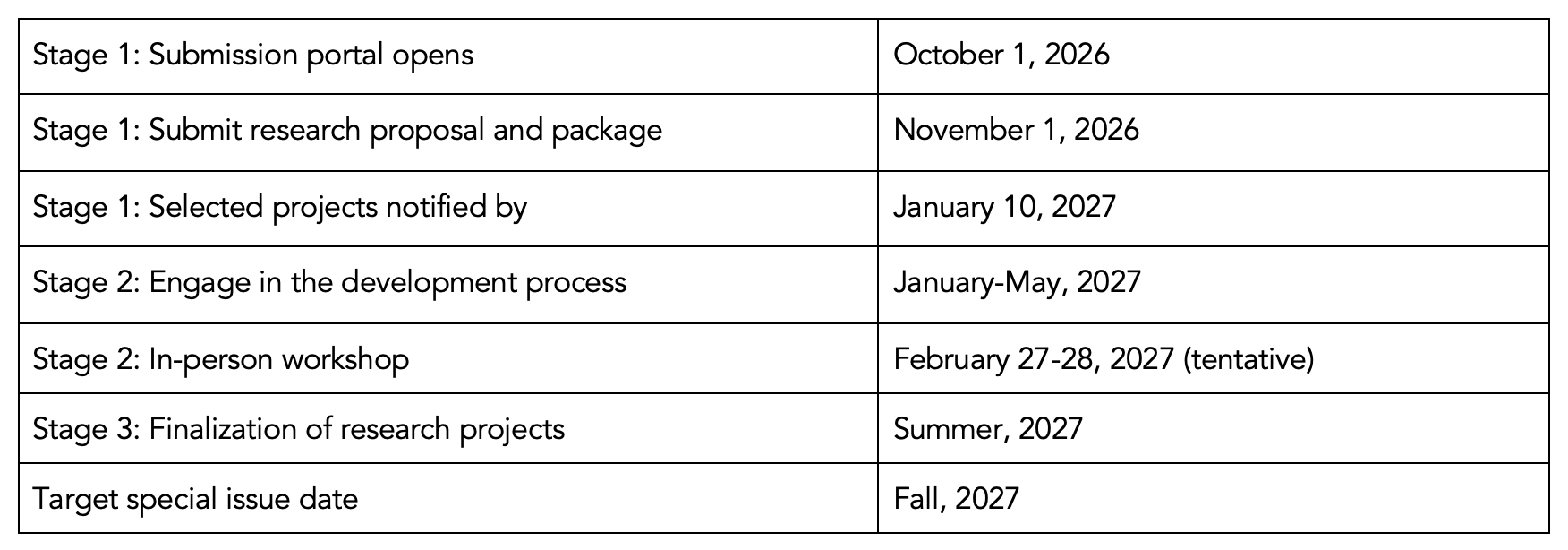
Stage 1: Submit research proposal and package (Deadline: November 1, 2026):
A short proposal: approximately 3-5 pages / 1,500–2,000 words plus references, which should describe the core intended scientific contribution. This should include a description of what you have done, what you hope to do, the key risks you face in fully executing your vision, and how organizational and social science would change if you are successful.
Technical appendix or supplement: The technical appendix should provide the details needed to evaluate and understand the work.
Research artifact: prototype and repository. Authors should provide a Git repository or equivalent artifact that includes a prototype or proof of concept for the work.
We would prefer submissions of boundary-pushing prototypes rather than polished papers.
After receiving submissions, we will convene the Special Issue editors to select a small number of submissions for further development. We see this as a hard filter and narrow gate: once proposals make it through this initial gate, the aim is for them to have a place in the issue (with rare removal at editorial discretion due to ethical or unusual circumstances).
Submissions will be evaluated on a number of criteria that include but are not limited to:
• Novelty
• Feasibility
• Auditability
• Ethicality
• Reproducibility
• Scalability
• Potential use and adoption
• Potential to expand the research frontier through new or better research.
Stage 2: Engage in development process (January-May, 2027):
Selected proposals will undergo a development process to build and refine the final project deliverables. The development process will be both offline and in-person, with a workshop over two days (we are currently aiming for February 27-28, 2027, although this date may change), where participants will convene to collaboratively develop their projects and brainstorm how to improve the peer review process for this type of research. Workshop attendance by at least one author is expected, although exceptions and accommodations for financial, visa, health, and family reasons will be considered.
Stage 3: Finalization of research projects (Summer, 2027):
The final product is a special issue featuring a mix of two publication types. The most developed contributions will appear as ~five-page Science/Nature-style articles presenting the main insights from the research, along with a detailed technical appendix and either a public GitHub repository or, equivalently, an accessible research object.
For attempts that did not develop as far, we will provide a “letters” format: short one- or two-page contributions that distill the key learnings so the field can benefit from the work. In both cases, the bar is similar: did we learn something that advances organizational research through AI-driven innovation in research process?
We emphasize that Organization Science will treat these contributions as true peer-reviewed articles. The value of the scientific contribution is not dependent on the written length of an article, as journals such as Science and Nature have long attested. Published articles in the special issue should be considered equivalent to more traditional full-length articles in a scholar’s research record, with shorter “letters” more equivalent to a research note.
We welcome submissions from scholars across the social sciences and adjacent fields, so long as they address organizational or managerial implications, broadly interpreted. Relevant areas include, but are not limited to:
• Management and organizations;
• Strategy;
• Entrepreneurship and innovation;
• Organizational behavior;
• Operations;
• Economics;
• Sociology;
• Psychology;
• Computational social science;
• Political science;
• Computer science, when the contribution is directed toward social science.
Timeline:
FAQ
Can I submit a traditional empirical paper that used AI at some point in the workflow?
We’re not looking for traditional empirical papers, but the innovative use or application of AI in the workflow could constitute a submission in and of itself. A shorter submission with AI core to the scientific contribution would not preclude you from submitting or having submitted the full paper elsewhere so long as the focus is different.
Can the contribution be qualitative?
Yes, we welcome qualitative and mixed-method contributions.
Can this be theoretical?
Yes, we welcome work that uses AI to build theory, provided the process is transparent and the theoretical contribution is clear.
Can I submit something that later supports a longer paper elsewhere?
Yes, provided the submitted contribution is itself publishable as a research artifact and does not create copyright or duplicate-publication conflicts.
What if my data cannot be shared?
Since the aim of this issue is to disseminate insights on AI-enabled social sciences, the research must be reproducible by others. Projects that cannot share sufficient data to be reproduced are unlikely to be a good fit for this issue. Synthetic data may be an appropriate substitute if the insights can be reproduced on a case-by-case basis.
What if my workflow depends on proprietary AI models?
Authors should select infrastructure that other researchers have a reasonable chance of accessing.
Are negative results or cautionary studies welcome?
Yes. Work that identifies failures or limits of AI-enabled social science can make an important contribution.
Who should I contact if I have questions?
Authors can contact Claudine (cgart@wharton.upenn.edu) or Sharique (sharique.hasan@duke.edu) with any questions.
Submission portal: mc.manuscriptcentral.com/orgsci
Daft, R. L., & Lewin, A. Y. (1990). Can organization studies begin to break out of the normal science straitjacket? An editorial essay. Organization Science, 1(1), 1-9.
Gartenberg, C., Hasan, S., Murray, A., & Pierce, L. (2026). More versus better: Artificial intelligence, incentives, and the emerging crisis in peer review. Organization Science, 37(3), 795-812.
Girotra, K., Terwiesch, C., & Ulrich, K. T. (2010). Idea generation and the quality of the best idea. Management Science, 56(4), 591-605.
March, J. G. (1991). Exploration and exploitation in organizational learning. Organization Science, 2(1), 71-87.
Trebuchet is my word of the month, as Claudine can attest to.
Indeed, one tactic in siege warfare was to launch animal and human corpses over fortress walls to introduce disease such as bubonic plague. I once lobbed a formal theory paper to an econ journal that may have metaphorically represented a plague corpse.
“Weird” isn’t the right word here, I guess. Is “not-in-good-faith” a word if I add all the hyphens in there?
I imagine 2,000 readers immediately thinking: “So much is clear now!” This is why your kids should play soccer. . . well, I guess that has concussions too.
Comments
Nothing yet. Say the first thing.
Sign in to join the conversation.