
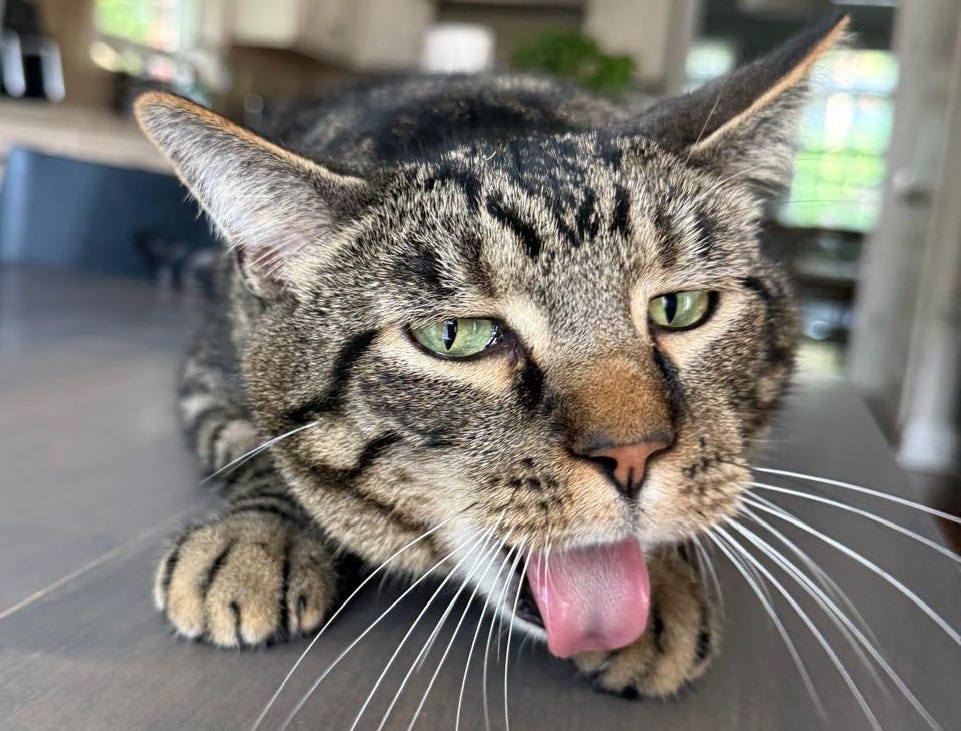
The rains came heavy from the North here in Boundary County, Idaho—the first rain in well over a month. There’s this incredible scent that comes with the first rain in a forest, the raindrops hitting the dirt and moss and trees. It’s probably my favorite scent in the world. It is not great for editorial productivity. It’s been smokey here from all the fires, but blessedly cool. The high today in the mountains was 65f (18c), with nights in the low 40s. Meanwhile, back on the homefront, Butterburger got his annual editorial fitness exam today at the vet, and he is 4 lbs (about 2 kilos) overweight and now has arthritis. Time for a diet. Butterburger has thoughts. . .
Getting older is hard. I packed my parents up Tuesday and got them out the door to the airport at 5am yesterday. I’ll continue to try to catch up on journal things over the next few days as we close up the cabin for the winter. My son has been busy chopping wood and doing legos amidst my bouncing from laptop to pick-mattock. It’s easy to dream about a day when I might ignore my computer for a month. I’m probably too romantic, but I’m thinking a lot about Wendell Berry these days—the joy of technological simplicity and hand-written em-dashes. To “be like the fox who makes more tracks than necessary, some in the wrong direction.”
AOM was a bit of a rush for me this year, bookended by the CFXS conference and the flight to Spokane to help the parentals.1 But it was a productive few days: great one-on-one meetings, art, and an all-too important editorial meeting. As I’ve noted, we’re getting hammered with submissions, and we are not alone, so a key point of discussion was how to address this in a sustainable way. We’re definitely going to be introducing some changes soon, once our editors fully weigh in on what to do. So we need fewer total submissions for sustainability, and that needs to be achieved in a way that improves equity (like. . . actual equity) and preserves opportunity for scholars trying to produce better (not more) research. And we don’t want to cut off the right tail. It’s a complicated mechanism design problem that is also socially embedded. And any time you have to combine economics and sociology, look out. We had a lot of fun with throwing pilfered sodium from the chem lab into the river back in the day, but I’m a bit too old to dodge explosions effectively now so hopefully we’ll come up with some good solutions. Stay tuned. In the meanwhile, we’d love to see your best work.
Before I move on to the new issue, let me request one more thing from all the scholars out there. Please don’t try to bribe our editors. I’m really touched by how much someone evidently valued an Org Science publication, but just please don’t. Some of us grew up watching Miami Vice, and came away with two big realizations: 1) white suits and Testarossas are the ultimate combination of cool, and 2) nothing good ever comes from mysterious stacks of cash. Except maybe white suits and Testarossas, but that’s not exactly apropos to the academic world.
Until next week. . .
Lamar
We have a new issue out for July/August and I am really pumped by the great papers therein. It feels like maybe it’s my job to enthusiastically pitch our papers, but I really do love them. What a strange brew of fields and methods we have. Our editors and reviewers are just great. I only handled two of these papers directly, and I’ll let you guess which ones those are (hint: it’s not the lead article). Because you have nothing better to do.
The Cybernetic Teammate: A Field Experiment on Generative AI and Teamwork by Fabrizio Dell’Acqua, Charles Ayoubi, Hila Lifshitz, Raffaella Sadun, Ethan Mollick, Lilach Mollick, Yi Han, Jeff Goldman, Hari Nair, Stew Taub, Karim R. Lakhani
This preregistered field experiment with 791 professionals at Procter & Gamble shows that AI can meaningfully enhance collaborative work: individuals using AI performed as well as two-person teams without AI, produced more balanced ideas across technical and commercial domains, and reported more positive emotional responses. The findings suggest that AI can replicate some benefits of human collaboration while also complementing it, especially by improving idea generation, bridging functional silos, and reshaping how expertise and social engagement appear in knowledge work.
Newborn Gender and Technology Adoption Among Rural Entrepreneurs in Ethiopian Family Firms by Salvatore Di Falco, Luisa Gagliardi, Valerio Pelucco
Family structure can shape whether small family businesses invest in new technologies: using panel data from rural Ethiopia, the authors find that the arrival of a son significantly increases farmers’ adoption of agricultural innovations compared with the arrival of a daughter. The findings point to the powerful role of gendered succession norms and expectations about future involvement in the family business, with broader implications for how bias in inheritance and leadership norms can shape long-term investment and business sustainability.
Stylistic Differentiation in Cultural Markets: The Benefits of Conspicuous Category Spanning by Abraham Oshotse
This research shows that innovation in cultural markets succeeds not just by borrowing across categories, but by borrowing in ways audiences can recognize and interpret. Analyzing nearly 6,000 films, the study finds that products benefit most when they incorporate familiar features from less crowded categories, offering a clearer path for differentiation without triggering the penalties often associated with category spanning.
Culture as a Toolkit for Robust Action: Tackling Grand Challenges with Cultural Entrepreneurship by Logan Crace
This paper challenges the view of culture as mainly a barrier to tackling grand challenges, arguing instead that culture can serve as a practical toolkit actors use to mobilize action and solve complex social problems. By integrating cultural entrepreneurship with the robust action model, the study offers a richer account of how efforts to address issues like climate change, poverty, displacement, and exploitation can get started, gain traction, and continue over time.
Internal Versus Market Pay References in Knowledge-Intensive Firms by Claudine Gartenberg and Elaine Pak
Using confidential compensation data on 19 million U.S. employees across 479 firms, this study shows that knowledge-intensive firms set pay less by external market benchmarks and more by internal comparisons among skill-equivalent peers, especially for high-skilled employees in collaborative, problem-solving roles. The findings suggest that internal pay alignment can support cohesion and innovation, with more internally aligned firms generating more patents—including breakthrough inventions—and alignment increasing after CEO transitions that prioritize innovation.
Where Sentence Is Served: Entrepreneurship and Socioeconomic Mobility Among Ex-Offenders by Vera Rocha and Stefanie Sayuri Sunao
This study challenges the idea that entrepreneurship is always a reliable path to reintegration for people with criminal records. Using three decades of Danish registry data, the authors find that incarceration pushes many ex-offenders into entrepreneurship when stable wage jobs are hard to access—but this path is associated with lower long-term income and higher reoffending than regular employment, underscoring the need for better job access and targeted support.
Behind Closed Doors: The Uncommunal Feminine Stereotype by Ashley E. Martin and Francis J. Flynn
This paper broadens workplace gender inequality theory by identifying an “uncommunal” feminine stereotype: the belief that women may appear warm and communal in public while being seen as conniving or self-serving in private. By showing how this stereotype can coexist with traditional views of women as caring, the paper helps explain why successful women are often distrusted, why their unethical behavior may be scrutinized more harshly, and why backlash against women leaders can persist.
Tertius Dolens: Interalter Conflict and Its Negative Impact on Broker Performance by Adam Tatarynowicz and Thomas Keil
This study challenges the classic view of network brokers as “the benefiting third,” showing that when a firm bridges two partners in active conflict, brokerage can become a liability that reduces innovation by disrupting knowledge exchange, raising coordination costs, and harming reputation. Using longitudinal data on 2,735 biopharmaceutical firms and their alliances, the paper shows when this “suffering third” problem emerges—and how it can be mitigated through higher status, conflict-free network opportunities, and stronger relational commitments.
Positioning in Digital Markets: A Demand-Side View by Amy Zhao-Ding and Vibha Gaba
This study shows how new entrants in digital markets use customer feedback on existing products to decide where—and how—to compete. Drawing on Photo & Video apps in the Apple App Store, the paper finds that customer dissatisfaction pushes entrants to focus more sharply on core functions and differentiate their peripheral features, while disagreement among customer evaluations leads entrants to broaden their offerings and imitate more—highlighting how market feedback shapes product positioning under uncertainty.
Other People’s Children: How Diversity Without Inclusion Impacts Community Support for Public Schools by Farzam Boroomand and Aseem Kaul
This study shows that community support for public-interest organizations depends not simply on racial diversity, but on whether diverse communities are meaningfully inclusive. Using U.S. public schools, the authors find that diversity is linked to lower support only in less inclusive, more segregated communities—while inclusive communities with cross-group ties, shared values, and racially representative schools can sustain strong public support.
Through the Lens of Clarity: Perceived Organizational Tightness Boosts Creativity for Men, but Not for Womenby Grace J. H. Lim and Roy Y. J. Chua
Can strong organizational norms actually help creativity rather than suppress it? Across four studies, this research shows that perceived cultural tightness can increase creativity by clarifying how creative work will be evaluated, boosting creative self-efficacy—though this benefit appears stronger for men than for women, highlighting important gendered dynamics in how employees interpret and respond to organizational cultures.
Playing to the Audiences: How Creative Producers Manage and Reconcile Different and Copresent Valuation Standards by Patrick Reilly
How do creative professionals succeed when they must appeal to casual audiences, peers, and gatekeepers all at the same time? Drawing on a multiyear study of stand-up comedy in Los Angeles, this paper introduces “practical annealing” to show how performers read, orchestrate, and reconcile multiple audience expectations in real time—and how those moments on stage can shape longer-term career paths, market position, and visibility.
A Platform Rating System and Vulnerable Workers: Evidence from Field Experiments in Singapore by Vanessa C. Burbano, Wesley W. Koo, Jiao Luo
Can platform rating systems backfire when one side holds much more power than the other? In two field experiments with a Singapore-based domestic work platform, this study finds that a proposed employer-rating system failed to win over employers and led workers to disengage entirely—showing that tools designed to empower vulnerable participants may be rejected when power imbalances shape how they are perceived.
What Is the Price of Spanning Domain Boundaries? Distant Recombination and the Market Valuations of Firm Inventions by Sai Yayavaram and Yuan Shi
Do investors fully recognize the value of breakthrough recombination across distant knowledge domains? Analyzing more than 1.5 million firm patents, this study finds that inventions combining distant knowledge often generate greater long-term technological impact, yet receive lower market valuation than more locally recombined inventions—highlighting a key gap between innovation’s private returns and its broader technological importance.
CEO Succession Under Anticipatory Awareness Misalignment by Arnaldo Camuffo, Miguel Espinosa, Alfonso Gambardella, Andrea Pignataro
How do hidden disagreements between boards and CEOs shape succession, pay, and dismissal? This paper develops a dynamic model showing that when boards and CEOs hold misaligned beliefs about a firm’s strategic potential, incentive contracts become less efficient, fixed pay rises, signaling becomes more important, and CEOs face a higher likelihood of early dismissal—offering testable predictions for executive compensation, retention, and succession outcomes.
When Certification Backfires: Negative Spillovers on Noncertified Offerings in Airbnb Plus by Heeyon Kim, Qian Wang, Martina Montauti
Can certification programs designed to build trust end up creating new disadvantages for those left outside the certified group? Using the launch of Airbnb Plus, this study shows that certification can produce negative spillovers: noncertified listings in the launch market saw lower revenues, especially when they lacked alternative quality signals or were highly comparable to certified offerings.
Outshining Your Rival: Interpersonal Rivalry and Its Effects on Organizational Contributions by Arne Thomas, Henning Piezunka, Linus Dahlander
What happens when employees focus on outshining a rival outside their own organization? Using NBA data, this study shows that rivalry can increase highly visible individual contributions while reducing overall contributions to the organization, as employees take more risks and organizations become more reliant on them—revealing how rivalry can boost individual spotlight moments at the organization’s expense.
The Mutual Shaping of Boundaries and Boundary Organizations by Aron Lindberg and Natalia Levina
Drawing on an eight-year study of the boundary organization created around EVE Online, this research shows how firms and communities mutually reshape one another through boundary tensions, renegotiation practices, and boundary-spanning work—revealing why effective community governance is not a one-time design choice, but an ongoing, adaptive process with powerful and sometimes unintended consequences.
This is not a real word, similar to my brother and my other teenage linguistic contributions such as “dorkatron”, “dorknob”, and “spanktastic”. And yes, I played D&D and was a swipe left in middle school and most of high school.
Comments
Nothing yet. Say the first thing.
Sign in to join the conversation.