
The last article showed the Epic Fury air fleet was approximately 25% the size of the Desert Storm air fleet. It had proportionately more multi-role fighters and tankers, at the expense of bombers, ground attack aircraft and attack helicopters.
This article will compare the volume of sorties, strikes and targets on Epic Fury verses Desert Storm, as well as consider the role of precision munitions in these statistics.
Some understanding of the terminology is necessary to understand the Desert Storm statistics, and parse out what the Pentagon has claimed about Epic Fury.
The Desert Storm Airpower Survey uses standardised and precise military definitions. As mentioned in the last article, the Pentagon and CENTCOM have used narratively compelling language, rather than precise language, during Epic Fury briefings. They are using a mixture of colloquial terms and standardised military terms. The military terms can be understood more precisely, but these briefings have used terms with very different meaning synonymously.
The US military has an official dictionary, the Joint Publication 1-02 “Department of Defence Dictionary of Military and Associated Terms”1 It is 777 pages of the driest reading imaginable. Here are all the terms relevant to analysing the Pentagon’s claims about Epic Fury:
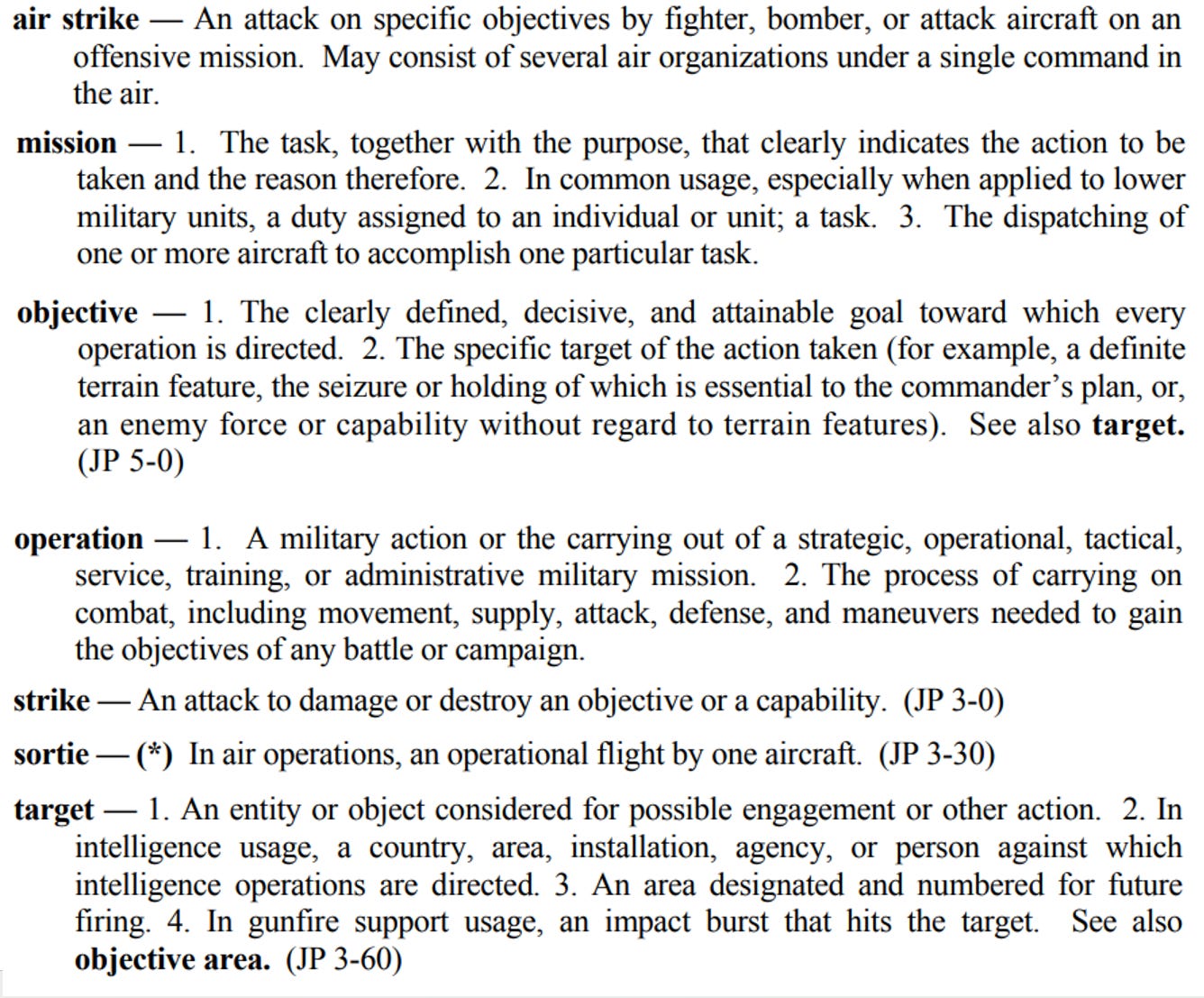
Interestingly, there is no approved definition of “Combat” or “Combat Mission”. There also isn’t a definition of “Battle”, making Ralphie’s question from the Simpsons a legitimate thing to ask in the military.2
Given that’s all very confusing, let’s use an example to show how these terms work.
In the diagram below:
The Objective is an enemy airfield that is preventing our gaining air superiority.
The Mission is to destroy the airfield (the task) to set condictiones for gaining air superiority (purpose).
The planners identify 3 targets that need to be destroyed for the airfield (objective) to be destroyed. In this case:
Target 1: an air defence battery protecting the airfield;
Target 2: the runway; and
Target 3: fuel storage tanks.
A 2 phase plan is developed:
Phase 1: A warship launches 6 cruise missiles at the air defence battery and the runway (strikes). They will not destroy these targets, but it will prevent the enemy from launching SAMs or scrambling fighters for at least an hour.
Phase 2: A fighter takes off and refuels from a tanker aircraft 200 km from the airfield. The fighter then drops 4 guided bombs (strikes) on the airfield and the fuel tanks (targets), completing the destruction of the airfield (the objective). This accomplishes the Mission.
This 2 phase plan is called the Operation.
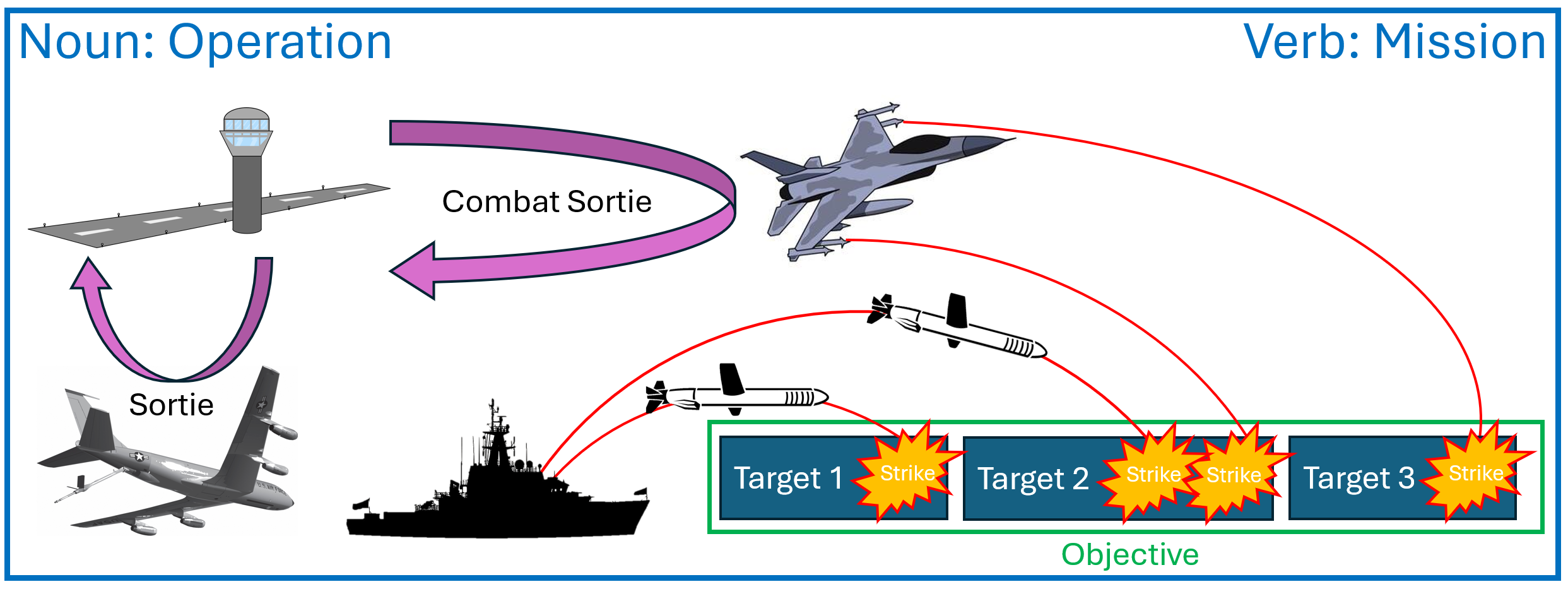
In terms of the numbers, for this Operation, there was:
1 operation, 1 mission and 1 objective; (the plan to destroy the airfield to help gain air superiority)
3 targets; (specific things to be blown up to destroy the airfield)
4 strikes, involving 10 munitions; (the warship and fighter both launched munitions at 2 targets)
2 sorties; (the fighter and tanker aircraft making a round trip) and
1 combat sortie (unlike the tanker aircraft, the fighter’s sortie intentionally involved combat with the enemy)
The table below shows the types of sorties flown by each nation and service branch during Operation Desert Storm.3
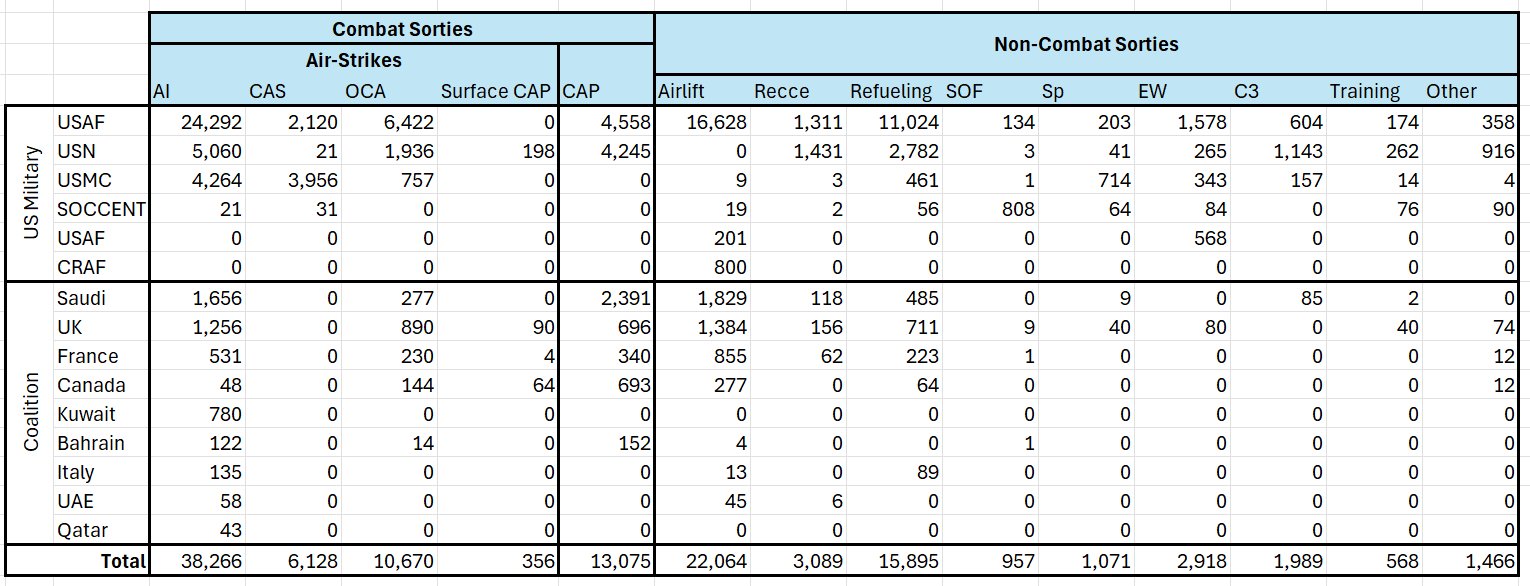
This is a little hard to digest, so here are the total sorties, sorties per day and sorties per fixed wing combat aircraft:

As a reminder from the last article, the Desert Storm air fleet consisted of 1,596 fixed wing attack and 389 fixed wing support aircraft (mostly tankers and electronic warfare aircraft). This doesn’t include the aircraft making up the 22,064 airlift sorties. The important number for future comparison is the 1,596 combat aircraft flying 68,495 combat sorties. Over the 41 day campaign each aircraft averaged about 43 sorties.
Combat sorties include combat air patrol (CAP), that is sweeping the battlespace hunting for enemy aircraft. CAP only made up 19.1% of combat sorties, which lines up with historical experience. During WW2 when there was air parity about 30% of sorties CAP, but once air superiority was achieved CAP sorties declined to 10-20% of sorties.
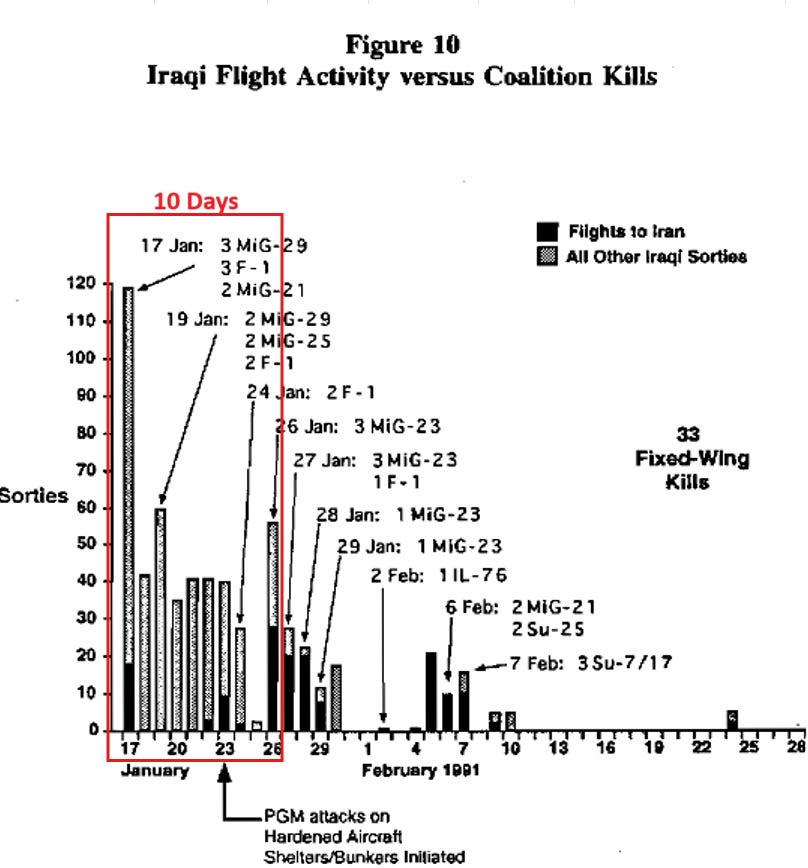
During Desert Storm the coalition spent the first 10 days establishing air superiority. After day 10 almost all Iraqi sorties were flights to Iran, where they applied for sanctuary and turned over their aircraft.
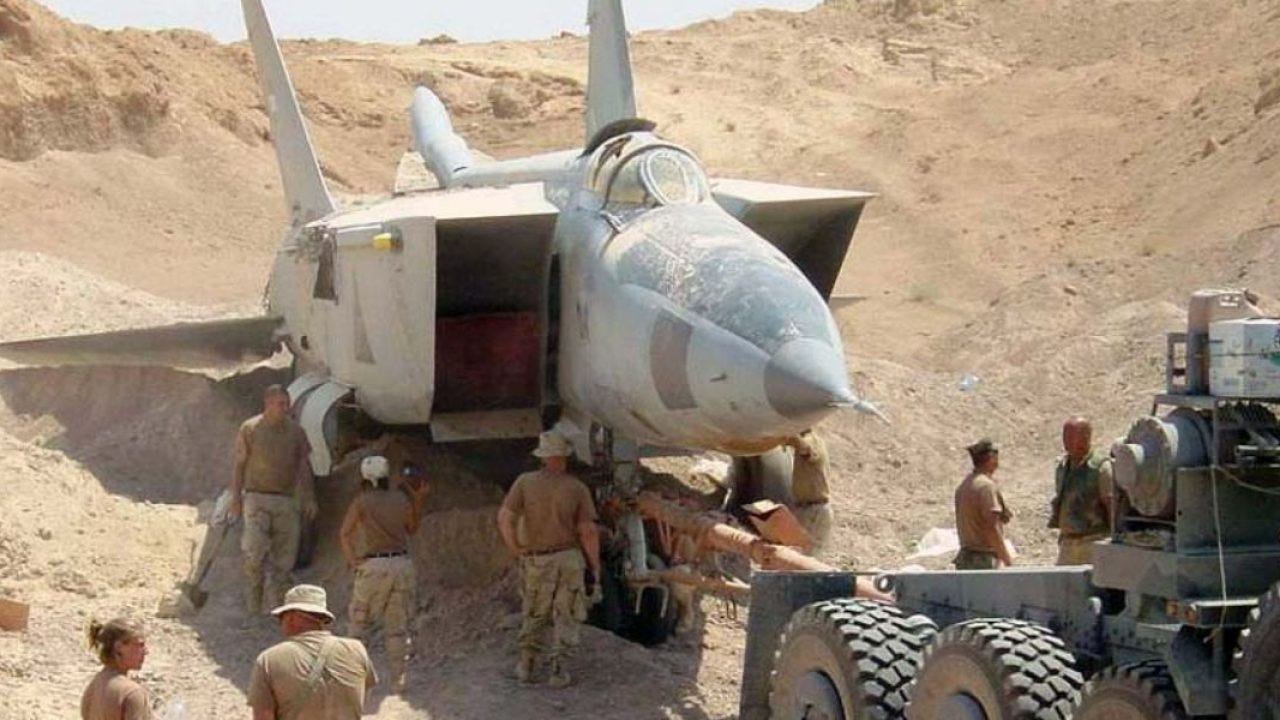
Given the 41 day air campaign, based on WW2 data we would expect 10 days of 30% CAP sorties followed by 31 days of 15% CAP sorties. This averages to 18.7% CAP sorites overall, which is shockingly close to the 19.1% CAP sorties actually flown.4
To summarise, during Desert Storm:
An air fleet of 1,596 fixed wing combat aircraft flew slightly more than 1 sortie per day;
It took 10 days to establish air superiority, during which about 1/3rd of sorties were CAP; and
Afterwards CAP sorties diminished to about 15%, with the remainder being for air-strikes on ground targets.
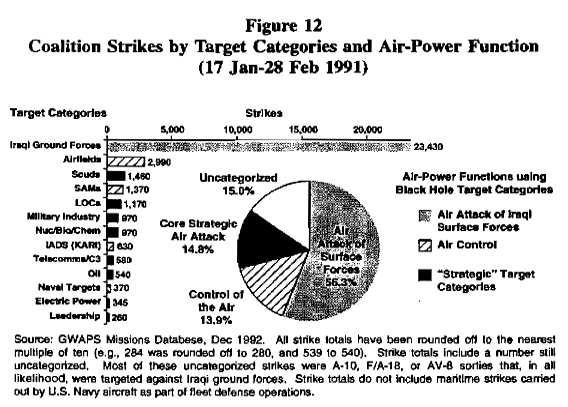
The airpower survey also provides in depth data about the types of targets struck. From the graphic below it’s clear the majority of targets were ground forces.
Breaking these numbers into a table:
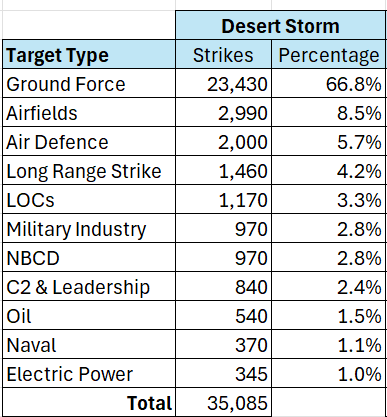
66.8% of all targets were Iraqi ground forces, that is the manoeuvre units of the Iraqi Army and Republican National Guard.
Targets in support of gaining air superiority (airfields and air defences) are the next largest group of targets at 14.2%.
Industrial targets (Lines of Communications, meaning transportation infrastructure, military industry, oil and electric power) accounted for 8.6% of targets.
Iraq’s unconventional retaliation measures (long range strike, which in this case meant Scud missiles, and chemical weapons or NBCD) accounted for 7% of targets.
Strikes on communications and leadership only accounted for 2.4% of targets, and the paltry Iraqi navy accounted for 1%.
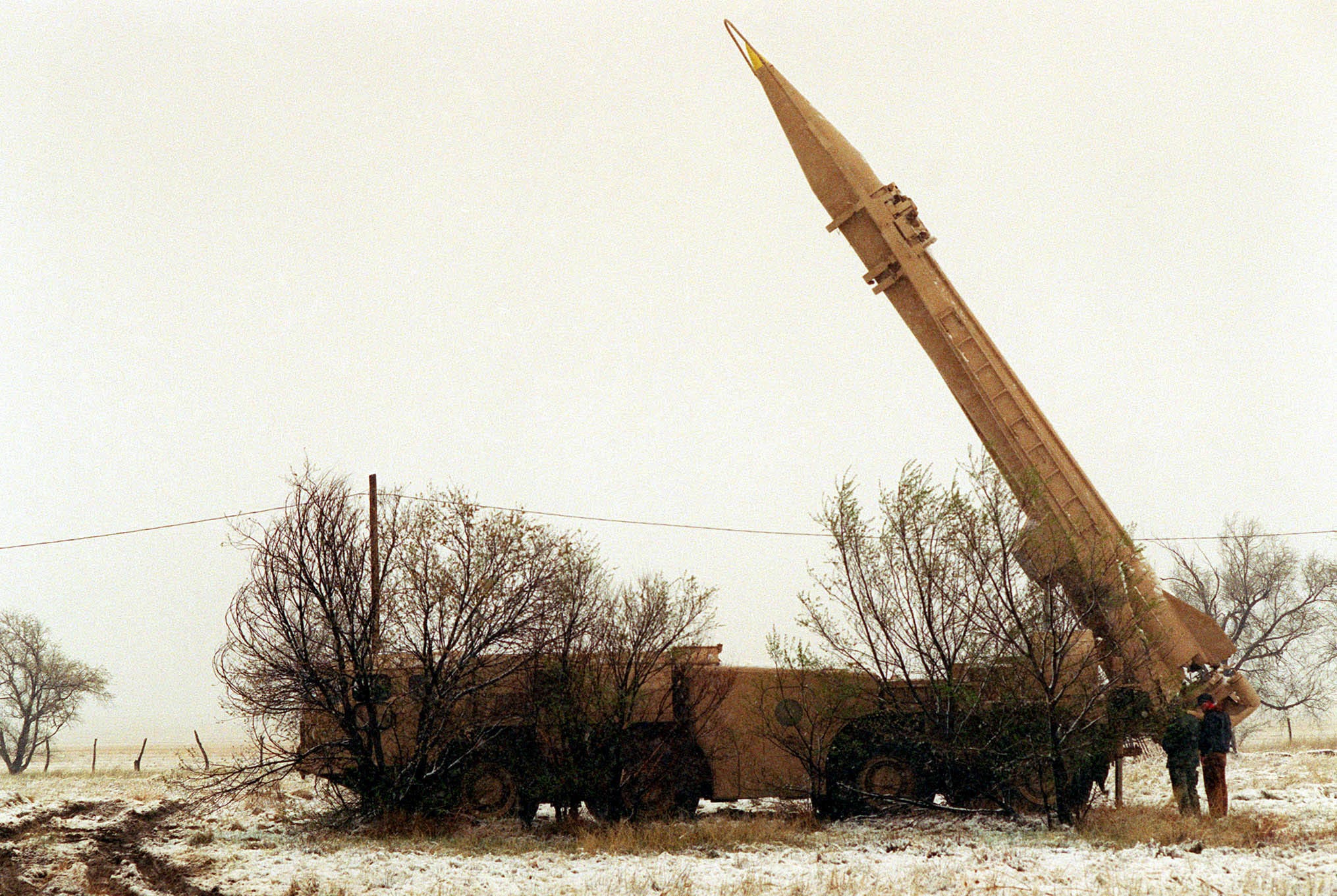
Scud hunting and strikes on chemical weapons were a reactive, rather than a planned part of the air campaign. Saddam Husain reacted to the air campaign beginning by launching long range missiles (Scuds) against Israel, and threatening to arm them with chemical weapons. The goal was to bring Israel into the war, which would fracture the coalition in the believe that as Arab states like Saudi Arabia would not remain in an alliance that included Israel. This sounds similar to Iran’s missile and drone swarm strategy. However, Iraq’s Scud war was on a much smaller scale. They fired less than 100 Scuds, less than 50 of which targeted Israel.
So the Desert Storm air campaign had a narrow focused scope. During the first 10 days they established air superiority. During this period the majority of ground targets were in aid of gaining air superiority (on airfields and the air defence network). Once air superiority was achieved the priority switched to destroying the field units of the Iraqi Army and Republican National Guard.
This shift can be seen in the number and percentage of Close Air Support sorties flown by day. I have picked this metric because Close Air Support is a mission that is only used to destroy enemy ground forces. The other major air-strike mission type (AI or Air Interdiction) can be used on any type of target.
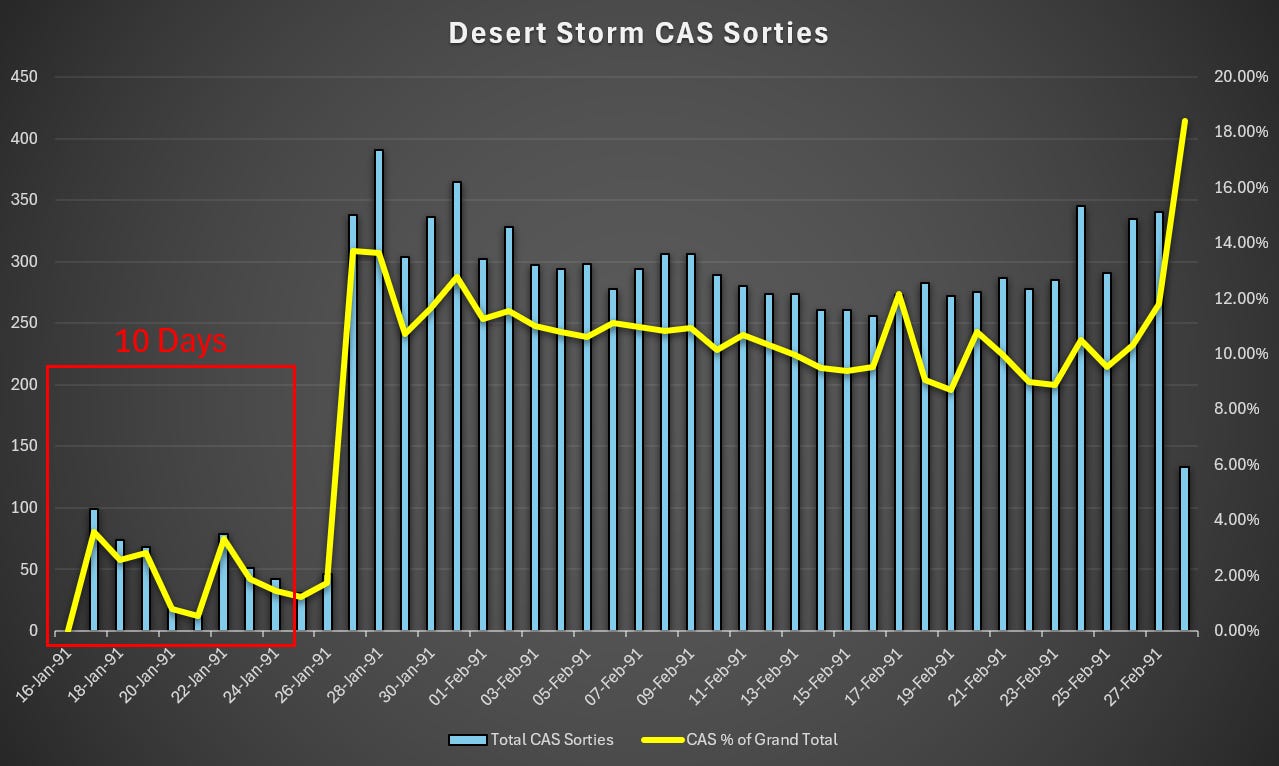
As you can see, there were 50-100 CAS sorties per day, totalling under 4% of overall sorties during the initial 10 days of establishing air superiority. After air superiority was established there were 255-390 CAS sorties per day, totaling 8-18% of overall sorties.
There were also significant efforts directed at industrial targets (14.2%) and Iraq’s ability to use unconventional means to break the coalition (8.2% of targets being Scud hunting or against chemical weapons). However, targets to gain air superiority and then soften up the Iraqi ground forces for the eventual ground campaign made up 81% of all targets struck during Desert Storm.
Desert Storm is popularly known as the “video game war” or the “laser guided war”, due to General Schwarzkopf showing video clips of precision bomb strikes on pinpoint targets during his famous press briefings.
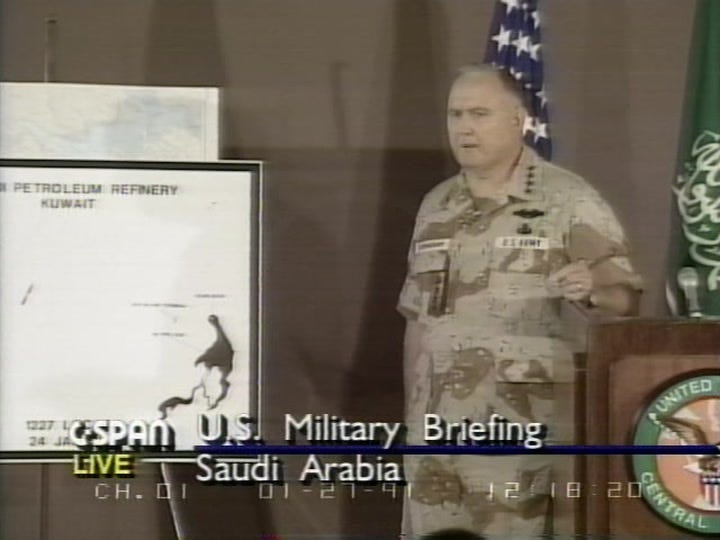
This was part of the a narrative that the US military had learned from the mistakes of Vietnam, embracing a more effective form of warfighting. While the narrative was true, it had little to do with an increased use of precision weapons during the Gulf War.
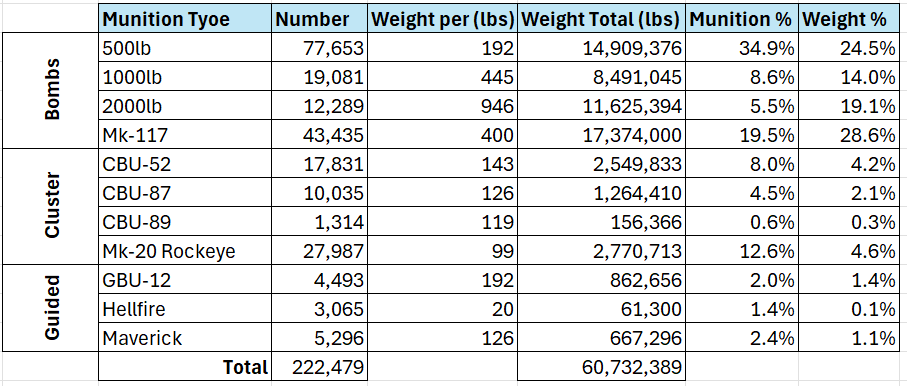
The table below shows the type and number of munitions used by the US military during Desert Storm.
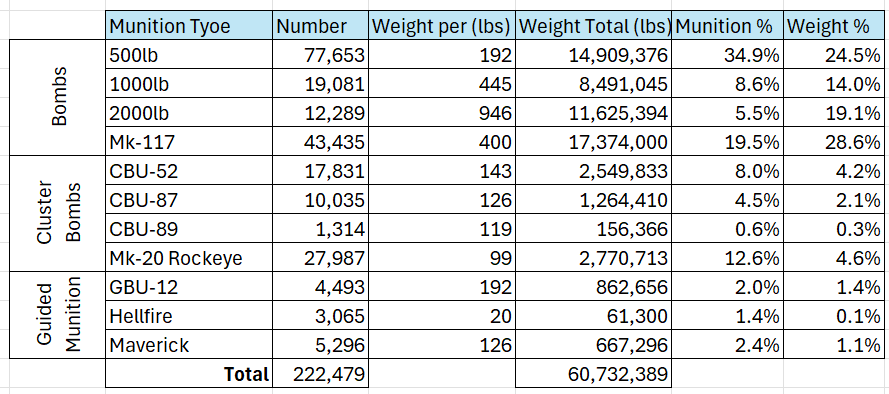
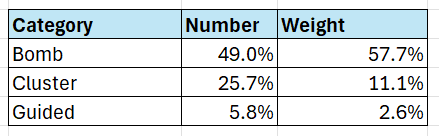
Breaking them down into categories, only 5.8% of all air munitions were guided. Most of them were guided anti-tank missiles like the Maverick. Consequently, by weight of the warhead only 2.6% of Desert Storm’s explosives were guided.
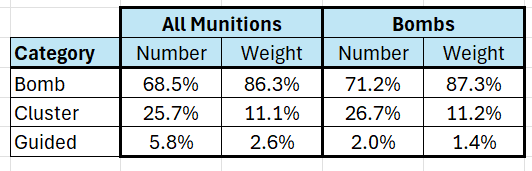
If we exclude guided missiles, which is a fair comparison for Vietnam since they had more rudimentary equivalents, we find only 2% of bombs dropped during Desert Storm were guided.
As a comparison to the Vietnam war, 0.8% of bombs dropped were guided. However, guided bombs were not introduced until 1968, when US involvement in the war was winding down. By Operation Linebacker I and II in 1972 about 2% of all bombs dropped were guided.
So in terms of munitions used Desert Storm was not a high tech break from the dumb bomb era of the Vietnam War. Over 94% of air munitions and 98% of all bombs were unguided. These percentages are close to those found in the late stages of the Vietnam war. However, as we will see in a later section, the unguided munitions were more effective due to other technological developments.
For Epic Fury we have considerably less data, and that data is less reliable. This isn’t an attack on the US military. All wartime reporting of this type is spotty and unreliable. There are good operational security and PR reasons for this. If I had to analyse Desert Storm using only General Schwartzkop’s press briefings I would be in a similar situation.
That out of the way, CENTCOM and the Pentagon have made the following claims about the volume of firepower used against Iran during Epic Fury:

These claims do not make sense on their face. To begin with, in these press releases CENTCOM and the Pentagon used the terms targets struck, targets destroyed, strikes and sorties synonymously. These terms have very different meanings. Secondly, they report an equal number of combat sorties and targets struck. It would be an unbelievable coincidence if these numbers were similar, as they track totally different things.
There were also some interesting details about the types of targets, and their purported effect.
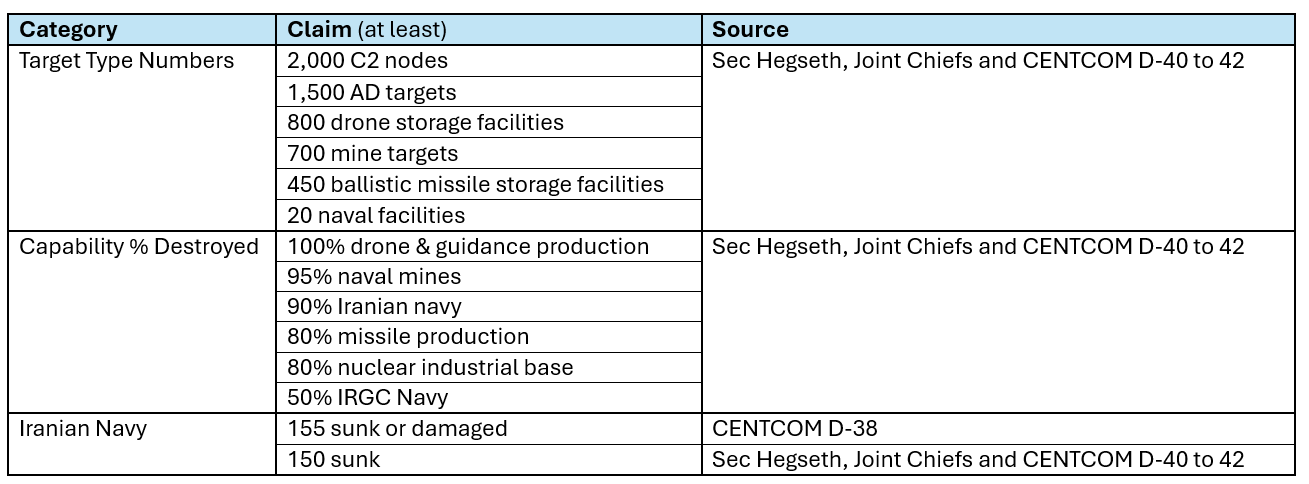
The numbers for the naval targets do not hold water. They claim to have destroyed 90% of the Iranian Navy, 50% of the IRGC Navy while sinking or damaging 155 ships. They also claimed to have sunk 150 ships, so they appear to be using damaged and sunk as synonyms, but I digress.
Prior to Epic Fury, Iranian ship numbers were as follows:
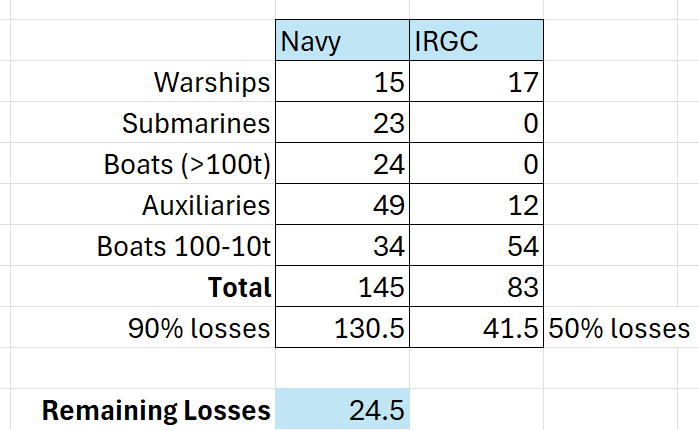
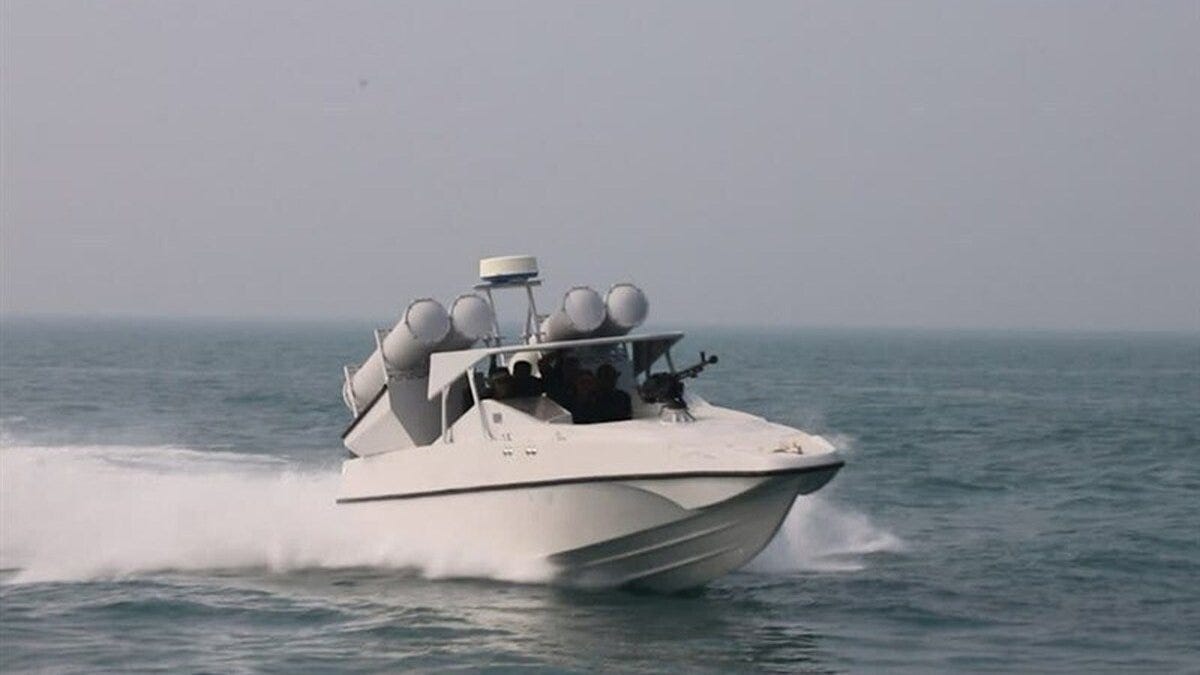
For the Iranian Navy to have suffered over 90% losses and the IRGC to have suffered over 50% losses the US needed to have sunk 172 ships. But the US only claims to have sunk 150 ships, or maybe to have damaged 155 ships. These numbers also do not include missile, torpedo and mine speedboats under 10 tons controlled by the IRGC. These are probably the most dangerous type of vessel Iran has for operations in the Straits of Hormuz. Pre-war estimates put the numbers of these vessels in the 500-3,000 range. So the claimed naval losses seem to exclude Iran’s most important types of boats, and even then they appear to have juiced the numbers a bit.
Israel also contributed significantly to the air campaign, which they called operation Roaring Lion. Israel has provided a lot less information about it’s air campaign. However, they claim to have conducted 10,800 strikes on 4,000 targets, during the course of which they dropped 18,000 bombs. They are also believed to have used a small percentage of unguided munitions (maybe 2-5%).
Strikes are the only category where we have comparable numbers from Desert Storm, Epic Fury and Raging Lion. Even here the data suggests something is wrong.
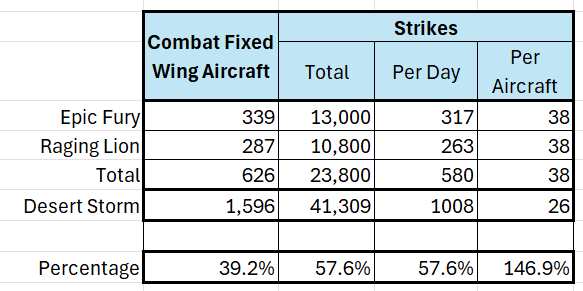
With 39.2% as many aircraft the US and Israel claim to have conducted 57.6% as many strikes as on Desert Storm. This would have been accomplished by having each wing combat aircraft deliver 147% as many strikes in the same timeframe. This seems unlikely. While we don’t have the Israeli sortie numbers, we know that US aircraft 2026 claim to have flown slightly more sorties (38 per aircraft) than in 1991 (36 per aircraft).
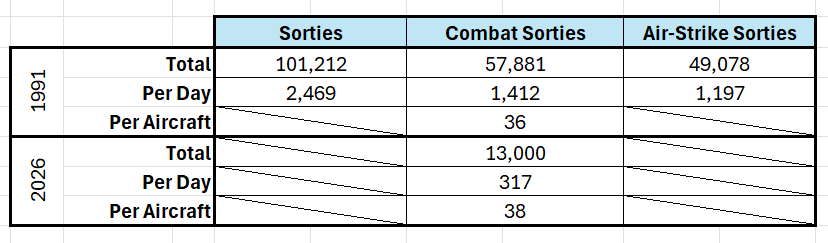
Along with about 1,500 tomahawk strikes this could explain a slightly higher strikes per aircraft rate, but not 147%. Even the 38 strikes per aircraft explanation does not make sense, due to the much longer sortie distances. In 1991 most US aircraft were within 500km of their targets. In 2026 most US aircraft were at least 1,800 km from their targets. Between 1991 aircraft got slower, not faster, and their serviceability rate has not improved, so Epic Fury should feature less strikes per combat fixed wing aircraft. I therefore conclude that CENTCOM and the IDF are inflating the numbers for claimed strikes in the 2026 air campaign.
The US has provided comprehensive data for the types of targets attacked in Desert Storm, and partial data on Epic Fury. Israel has not provided any of this detail, but it has been reported they focused heavily on Iran’s leadership and other national level targets around Tehran.
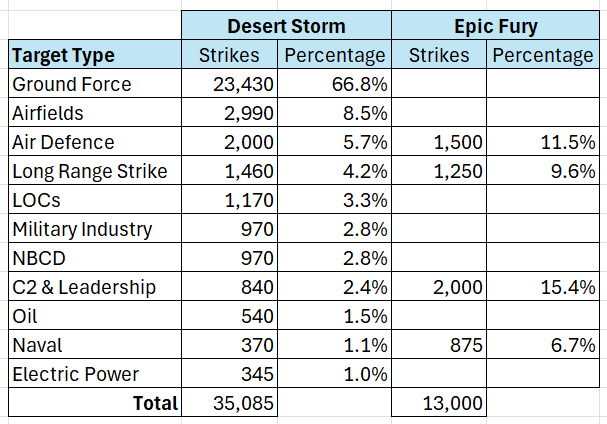
Looking at the US data, during Desert Storm 14.2% of strikes were to gain air superiority (airfields and air defences). We only have strike numbers for air defences at 11.5% on Epic Fury, but it appears this was a bigger priority than in 1991. In 2026 there were about 6.5x as many strikes on leadership and naval targets as in 1991. Strikes on long range strike capabilities (in Iraq’s case Scud missiles, in Iran’s case ballistic missiles and drones) about doubled. Given how critical long range strikes were to Iran’s war strategy this is less of a priority than I expected.
It is also clear that Epic Fury lacks the concentration of effort found in Desert Storm’s air campaign. We only have target categories for 43.2% of all strikes during Epic Fury.
As discussed in the previous article, governments have defended the decline in the size of air forces by pointing to the increased effectiveness of each individual aircraft. This is partially justified by the increase in multi-role aircraft, but more so due to the increased use of precision guided munitions. How much of a correction should we make for these guided munitions when comparing the amount of ordinance dropped in Desert Storm versus Epic Fury?
We have detailed statistics about the munitions used on Desert Storm, summarised in the table below:
As this summary shows, Desert Storm was sold as the smart bomb war, but guided munitions accounted for just 5.8% of all ordinance used during the air campaign.
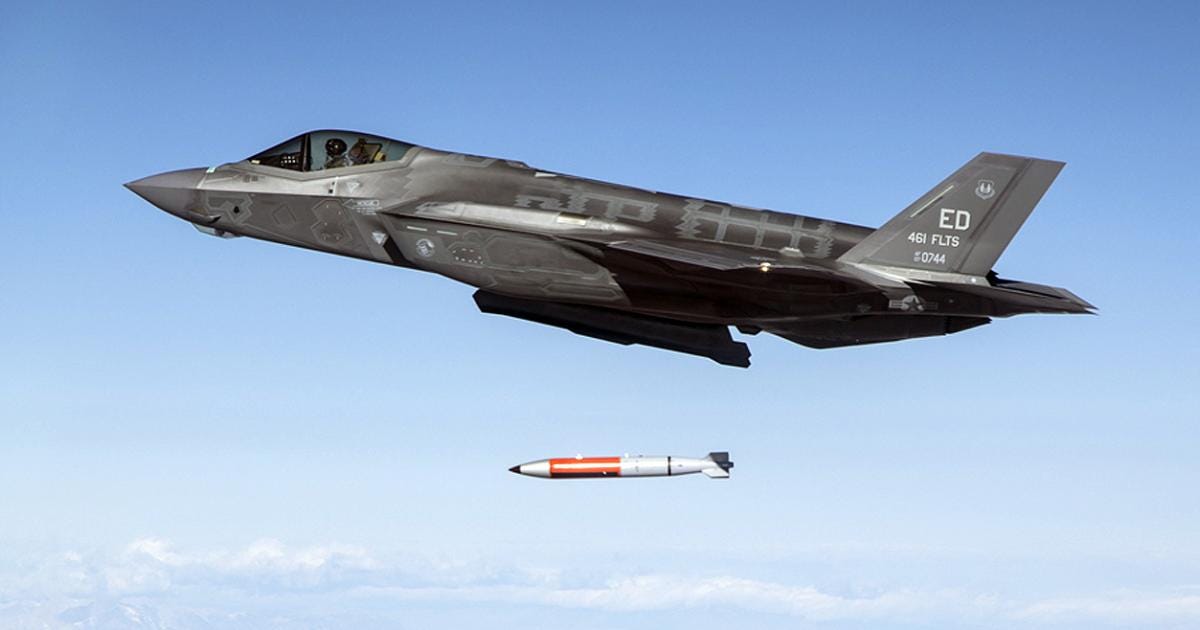
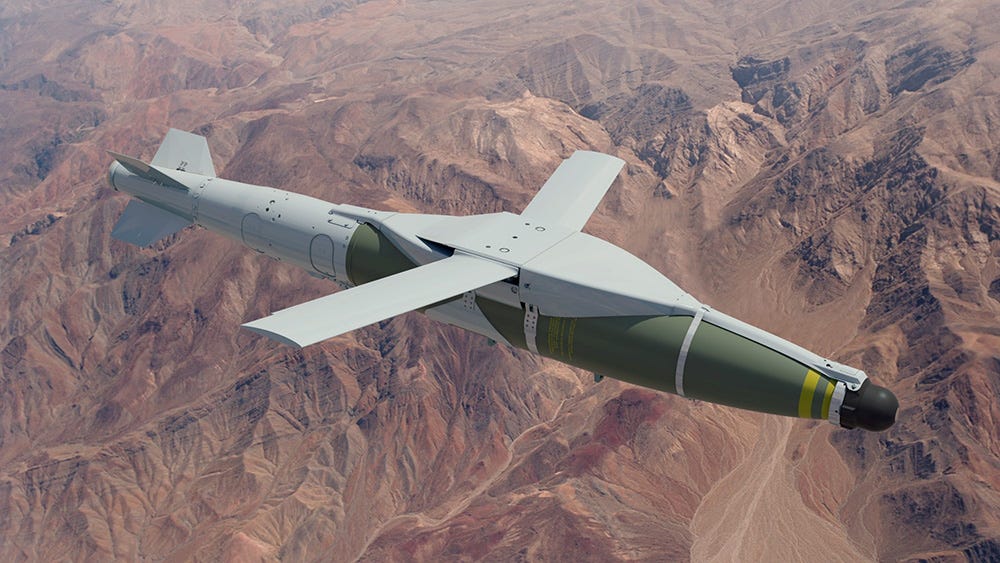
We do not have any statistics for Epic Fury, but from images of aircraft taking off it appears the overwhelming majority of munitions expended were guided.
We also do not know the number of munitions used on Epic Fury. I have seen estimates of anywhere from 500 to 2,000 tomahawk cruise missiles fired. With smart weapons you typically don’t need multiple munitions for each strike. So the best way to roughly estimate the Epic Fury munition use is to assume 1.2 to 1.5 munitions per target struck. This equates to about 16,000 to 20,000 munitions used on each strike in Iran.
With major caveats about the quality of the data, here is a table comparing the number of munitions and munitions per aircraft used:
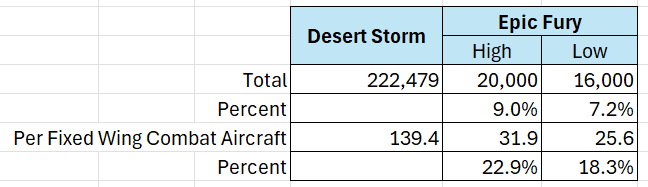
The imbalance in the number of munitions dropped is stark. As a point of comparison, on Desert Storm only 298 cruise missiles were fired from ships and 5.8% of air delivered munitions were guided. This totals about 13,152 guided munitions used for strikes on Iraqi targets. This small fraction Desert Storm’s munitions still totals 66-82% of the total munitions I’ve estimated were used on Epic Fury.
Therefore to be as effective per aircraft, each smart munition used in Epic Fury needs to be 4-6x as effective as the unguided munitions used on Desert Storm. To be as effective as Desert Storm overall, each Epic Fury guided munition needs to be 11-14x as effective as the unguided munitions used on Desert Storm.
The table below shows the rough percentage of bombs that struck their target from WW2 through to the 1999 Kosovo NATO air campaign, both as percentages and ratios. The ratio shows how many of that munition would be needed to have the same effect as one laser guided bomb (in this case specifically by a B-2) in the Kosovo campaign.
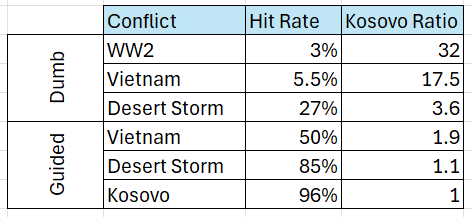
Although guided (smart) munitions are clearly superior, there was also a major jump in the accuracy of unguided (dumb) munitions between Vietnam and Desert Storm. This is because by Desert Storm the munition may not have been guided, but the bomb was dropped by a very sophisticated computer guidance system on the aircraft.
For example, the A-10 had two computer controlled systems. Continuously Computed Release Point worked by designating a target location. The pilot then flies over the target and the computer automatically releases the bomb at the right time to hit the target. Continuously Computed Impact Point puts a marker on the heads up display showing the pilot where the bomb would land if it were released at that moment. Systems like these allowed a jump in hit rate from 5.5% to 27%, which is about a 5x increase. In comparison, the jump to laser guided bombs in Kosovo is only a 3.6x increase in hit percentage.
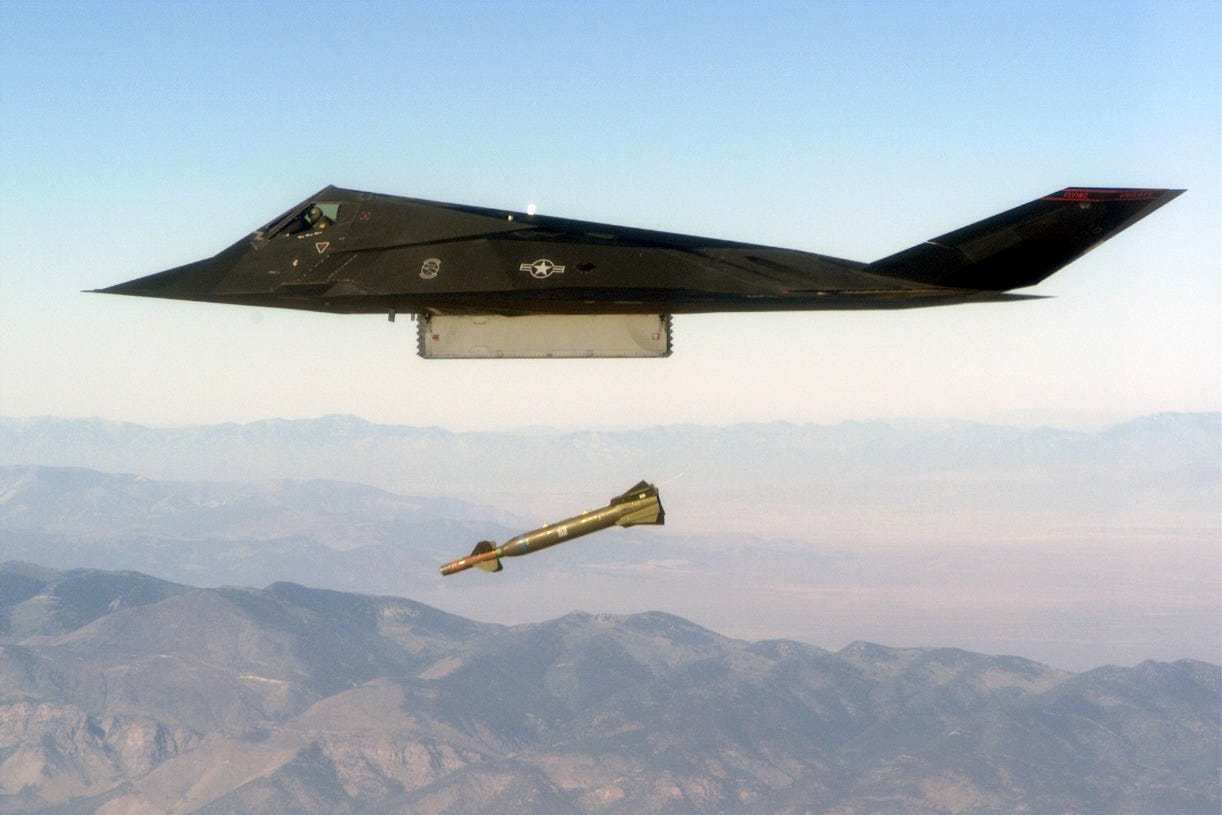
This means we can take adjust the guided and unguided munitions for both Desert Storm and Iran, to arrive at an equivalent in effectiveness for guided munitions across each air campaign. That math works out to the munitions used in Iran having 37.1% of the effect of the Desert Storm munitions.
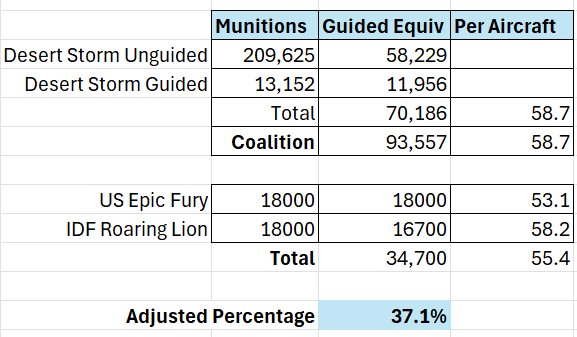
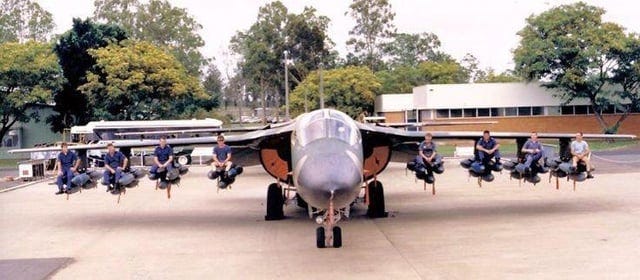
Interestingly, the rate of precision equivalent munitions dropped per aircraft is very similar, with it still being a bit higher for Desert Storm at 58.7 vs 55.4. This makes sense when you consider that an F-35 can only carry two of long range guided bombs in its internal weapons bay. They can only carry more munitions if they are willing to forgo their stealth advantage. The dedicated strike and CAS aircraft used in Desert Storm carried considerably more munitions. There also would have been a higher sortie per day rate, given the shorter distances from Coalition airfields to their targets.
This article examined the volume of strikes, choice of targets and relative effectiveness of the Desert Storm vs. Epic Fury air campaigns. This is difficult as the only statistics about Epic Fury is unreliable. A lot of this unreliability is due to both the normal PR spin that everyone does during a war. However, CENTCOM and the Pentagon have also been using a number of very different terms synonymously in press briefings.
Desert Storm consisted of a 10 day campaign to suppress Iraqi air defences, after which the overwhelming majority of strikes were on the military capabilities of Iraqi ground forces. These two goals account for 81% of all air targets struck during Desert Storm. In comparison, the two top target categories on Epic Fury were air defences and leadership, jointly accounting for just 26.9% of targets struck. So Epic Fury did not have the same concentration of effort as Desert Storm.
According to the US military, Epic Fury had 22% as many sorties as Desert Storm, but in the process destroyed 57.6% as many targets. This was accomplished through each aircraft performing about 1.5x as many strikes. I do not believe this data, as given the different conditions at play in Epic Fury the number of strikes per aircraft should be lower than on Desert Storm, not higher.
Each sortie and strike on Epic Fury would have been more effective than on Desert Storm, due to a jump from about 5.8% precision munitions to nearly 100%. However, precision munitions had less of an impact than you would expect. There were so many more munitions used during Desert Storm, that even though only 5.8% of munitions were guided, the total guided munitions used were around 13,000 on Desert Storm vs. about 18,000 on Epic Fury. After adjusting for the higher precision munition use, Epic Fury can be expected to have about approximately 37% the number of hits on target as on Desert Storm.
Epic Fury was therefore a less focused air campaign than Desert Storm, with its two top target types accounting for 26.9% of all targets, versus 81% on Desert Storm. Desert Storm focused on gaining air superiority and then destroying Iraqi ground forces. Epic Fury gained air superiority and then focused more on leadership than other targets, but overall tried to do a little bit of everything. The higher use of precision munitions on Epic Fury somewhat counteracts it involving much less aircraft than Desert Storm. However, even if we accept the likely inflated claims of Epic Fury, it only unleashed roughly 37% as much destructive power as Desert Storm; and this on a much less focused list of targets.
The final article in this series will compare the battlespace and loss rates on Epic Fury verses Desert Storm.
The NATO terminology database is similarly silent on these terms.
There’s probably 5 hours of work behind this table. Please clap.
It’s shocking how often WW2 operational data predicts the data for later wars within a few percentage points. Most of the 1944-45 Northwest Europe statistics for US tank units (type of loss, crew casualties, rate of loss, rate of destroyed vehicles that can be restored to service) could have predicted losses in the 1973 Yom Kippur war within 1-3 percentage points.
Comments
Nothing yet. Say the first thing.
Sign in to join the conversation.