
Yesterday was the 41st day of Operation Epic Fury, and the beginning of the ceasefire. That is also the exact the same length as Operation Desert Storm’s air campaign (January 17 to February 28, 1991).
This is a good milestone to examine the two air campaigns, to see whether this tells us anything about US performance during Epic Fury. To begin with we will compare the air fleets used on Desert Storm and Epic Fury.
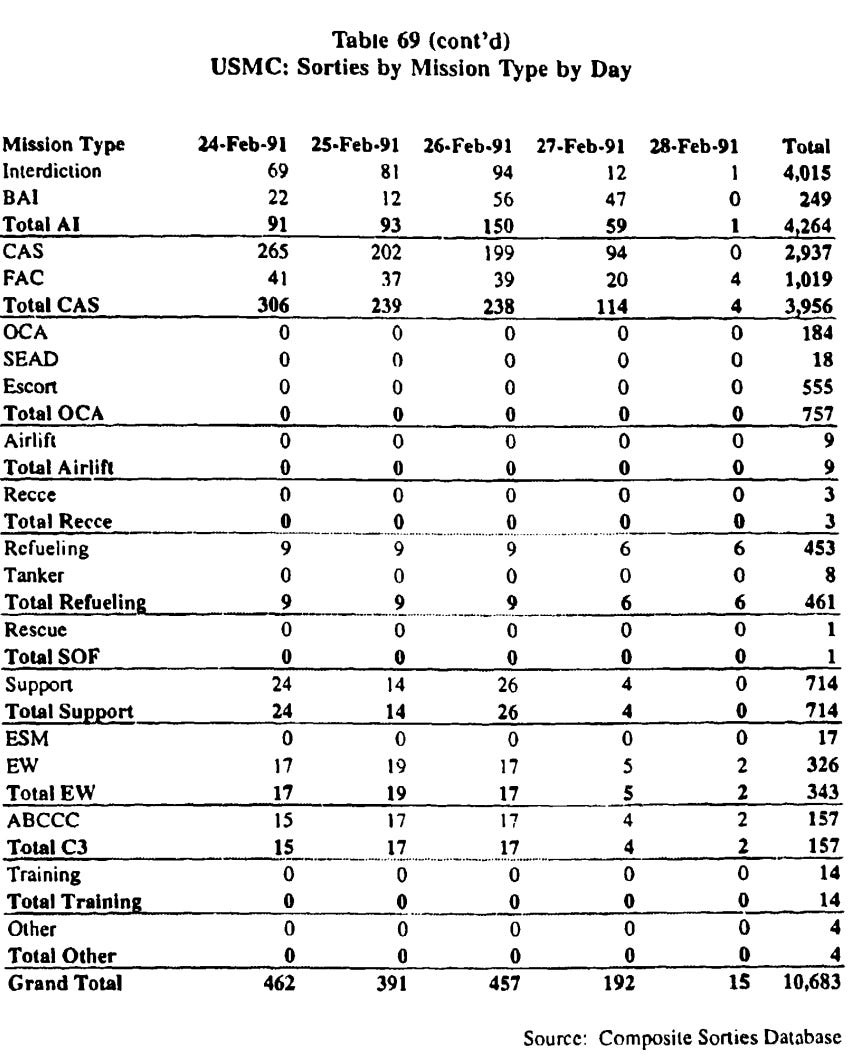
For Desert Storm there is almost an embarrassment of data for fixed wing aircraft. The US Air Force commissioned the Gulf War Air Power Survey. It was released in 1993 and was nearly 4,000 pages, including a volume with the underlying database tables.1

For instance, I can report that the 114th air attrition event during Desert Storm was a RAF Tornado GR-1 flown by No 15 Squadron. On February 14, 1991 it was flying an Offensive Counter Air mission 45 miles North-West of Baghdad, when it was destroyed by a radar guided Surface to Air Missile. I can also report that on day 6 A-10s flew 66 sorties, 6 of which were Scud hinting, but by day 11 there were 104 A-10 sorties, 44 of which were for Scud hunting.
For Epic Fury I am relying on press releases from CENTCOM and OSINT pages. Both of these sources have significant issues. There are a lot of claims about CENTCOM lying. I’m sure they are, only because every military lies during briefings about every war. However, the main issue is that as part of a PR campaign they are using narratively compelling language, rather than technical terminology, during briefings. This means terms with very different meanings (Eg Strikes, Missions, Sorties and Attacks) end up being used a synonyms.
I’m well known for my scepticism of OSINT wartime reporting during the Ukraine war. At least with that conflict thousands of soldiers seemed to have an addiction to live streaming the war on Telegram. During Epic Fury Iran has been under nearly internet blackout conditions, and the US kinetic action has all been from the air. Furthermore, the US government has pressured commercial satellite companies to not release imagery from after the war started.2 This means the only OSINT imagery we have comes from the Iranian and US militaries. Iranian footage has mostly consisted of obvious AI fakes. US footage tends to show well below 5% of the airstrikes they claim to have undertaken.

The first thing to note is that air forces have gotten a lot smaller since Desert Storm. The table below shows the active duty3 USAF’s decline in fixed wing airframes to 35-43% of 1990s numbers, depending on how you count them.
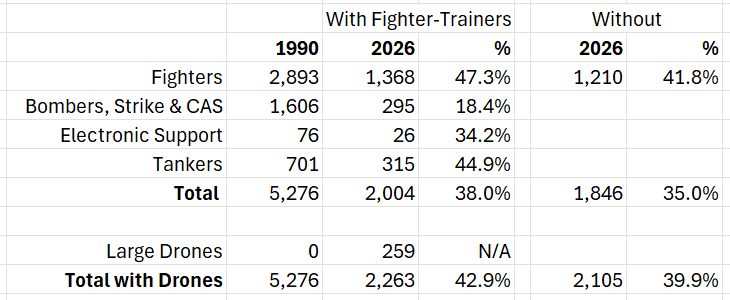
The with vs without columns is because the USAF now uses a number of obsolete (not obsolescent) fighters as advanced trainers. There are arguments for and against counting these towards fighter strength.
The table also shows how the USAF has moved from a fleet of fighters supported by specialist combat aircraft (bombers, strike, CAS and electronic warfare) to a fleet of multi-role fighters.
This decline in numbers is not at all unique to the USAF. Over the same period the RAF went from 463 combat aircraft to 172, which is 37% of their 1990 strength.
Comparing the air fleets actually deployed on Desert Storm vs Epic Fury matches this decline in the number of airframes held by air forces since 1990.
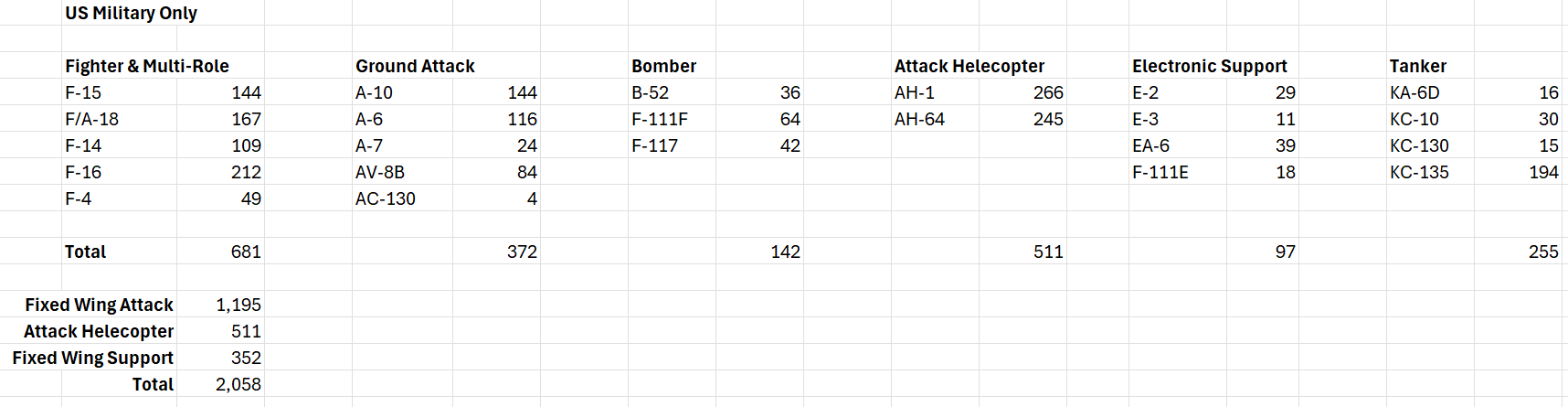
For Desert Storm the US military deployed 2,058 combat aircraft. In this case combat aircraft essentially excludes transports, SAR, reconnaissance and medevac aircraft.
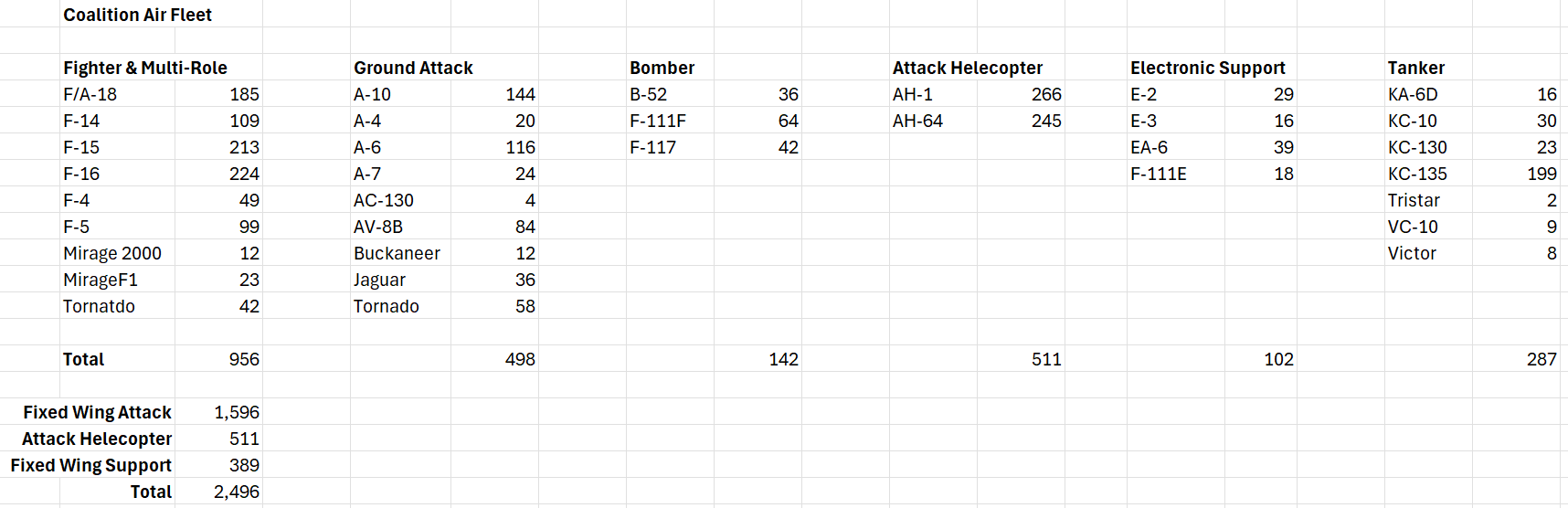
However, with coalition aircraft included the airframe numbers jump by about 25% to 2,496.
The highest viable estimates I could find for the same categories of aircraft on Epic Fury had the US air fleet at 339 fixed wing combat aircraft, 34 attack helicopters, 199 fixed wing support aircraft and an unknown number of large drones capable of ground attack.4
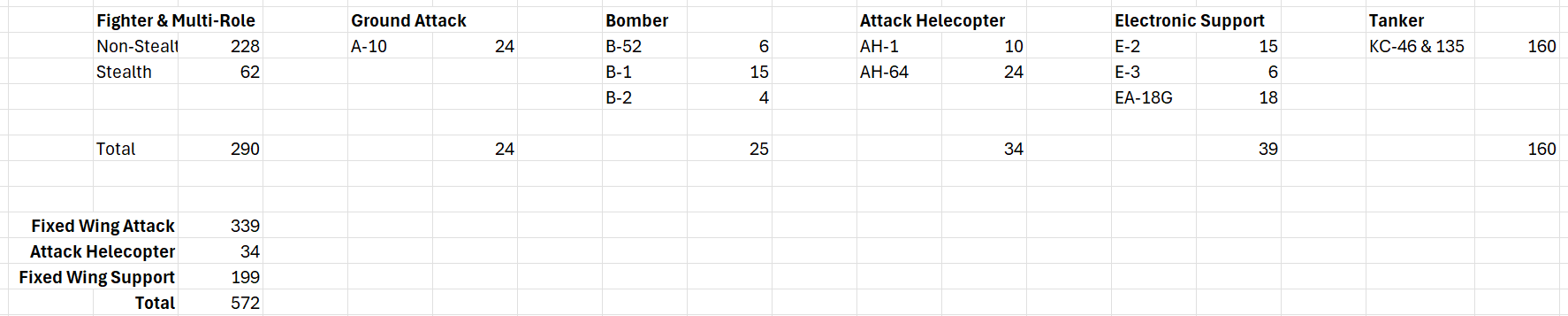
This means the US has deployed 25% as many combat aircraft on Epic Fury as were used in Desert Storm.
The status of allied aircraft is a bit more difficult to calculate. Kuwait, Saudi Arabia, the UAE and Qatar have limited themselves (along with their 428 fighters and 40 AH-64 attack helicopters) to defensive missions of defending against Iranian Shahed drones. There wasn’t really an equivalent to this during the Gulf War, so I have ignored these air forces for the sake of comparing the air fleets.
Israel also has had to allocate a lot of its air power to home defence, but excluding them entirely from the numbers also is not a fair measure. If the IDF air force is added the Epic Fury air fleet raises to 626 fixed wing and 82 attack helicopters, which is 19% of Desert Storm’s coalition numbers.
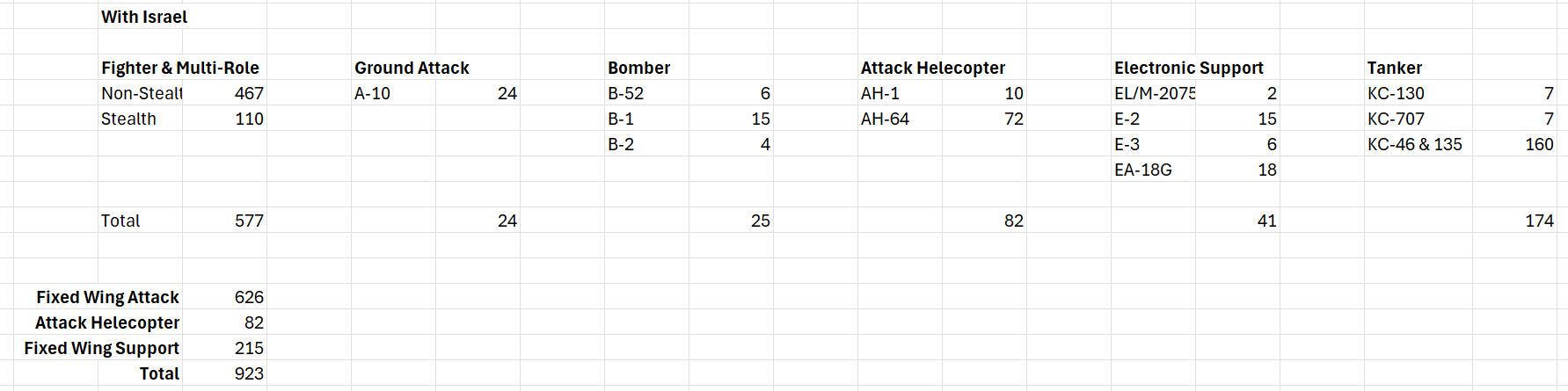
Therefor the US deployed 28% as many aircraft on Epic Fury as on Desert Storm. The larger coalition, however, is only 19% the size of Desert Storm’s air fleet.
It’s also clear that the types of aircraft have shifted between Desert Storm and Epic Fury. The table below shows the following major changes:
The proportion of fighters increased, at the expense of Ground Attack and Bomber aircraft;
About 1/2 to 1/4 the proportion of ground attack helicopters have been deployed;
Electronic support aircraft are remarkably stable; and
The proportion of the tanker fleet has about doubled.
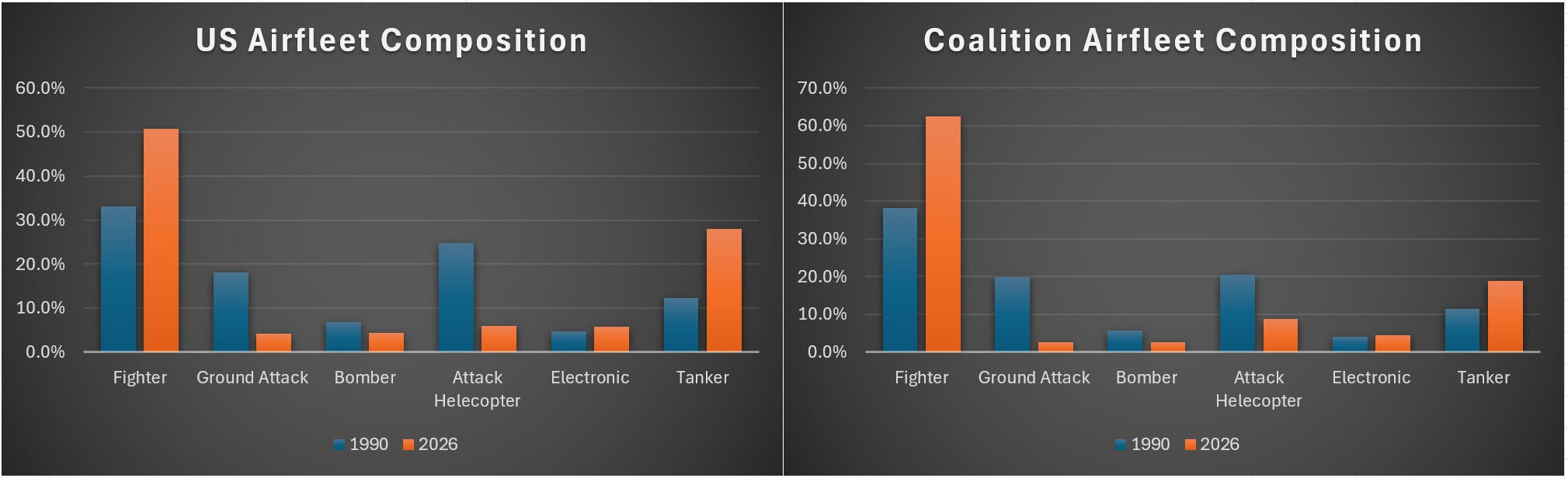
These differences are due to shifts in aircraft roles, the lack of a ground element and to counter Iran’s capabilities.
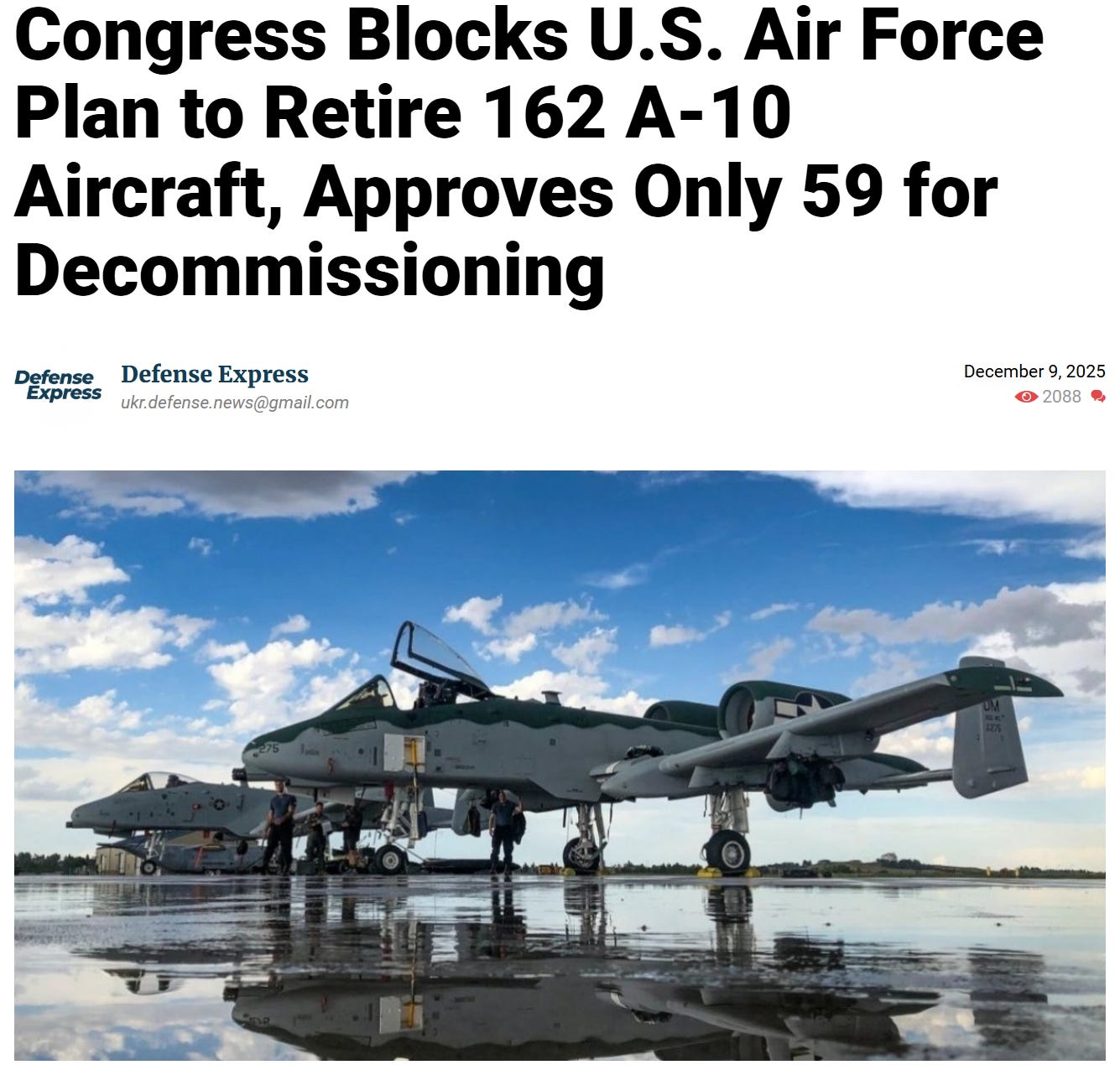
The number of ground attack type aircraft (strike, CAS and bombers) fell off a cliff by both measures. This reflects the decline of these types across the USAF. Since 1990 the USAF went from 1,606 of these types to 295, a mere 18% of the 1990 numbers. This is the largest decline of any category. If the USAF had its way this decline would be even greater. Almost 60% of these aircraft are the A-10, which the USAF has been begging congress to allow them to scrap for over a decade.
The smaller number of airframes has accompanied a shift from aircraft optimized for a specific role (like the F-15 for air superiority and the A-10 for ground attack) over to multi-role aircraft that can do everything decently well. Legislatures the world over have justified reducing the number of aircraft because they are more multi-role. Multi-role aircraft are also more expensive, so they encourage purchasing smaller numbers.
In 1990 the USAF’s single most numerous aircraft was the F-16, arguably the platonic ideal of a multi-role aircraft. For active duty fighter strength it was 55% multi-role, 31% air superiority and 13% wild weasel.5 Today the USAF is 84% multi-role and 16% air superiority fighters.
The much lower percentage of attack helicopters is just a function of the limited ground forces deployed. Both in 1990 and today most US Army divisions have about 40-48 attack helicopters. During Desert Storm the US deployed 7 army and 2 marine divisions. The helicopters organic to these divisions would have held about 400 of the 511 attack helicopters. This means in Desert Storm there were only about 100 additional attack helicopters, in this case held in Corps level aviation units.
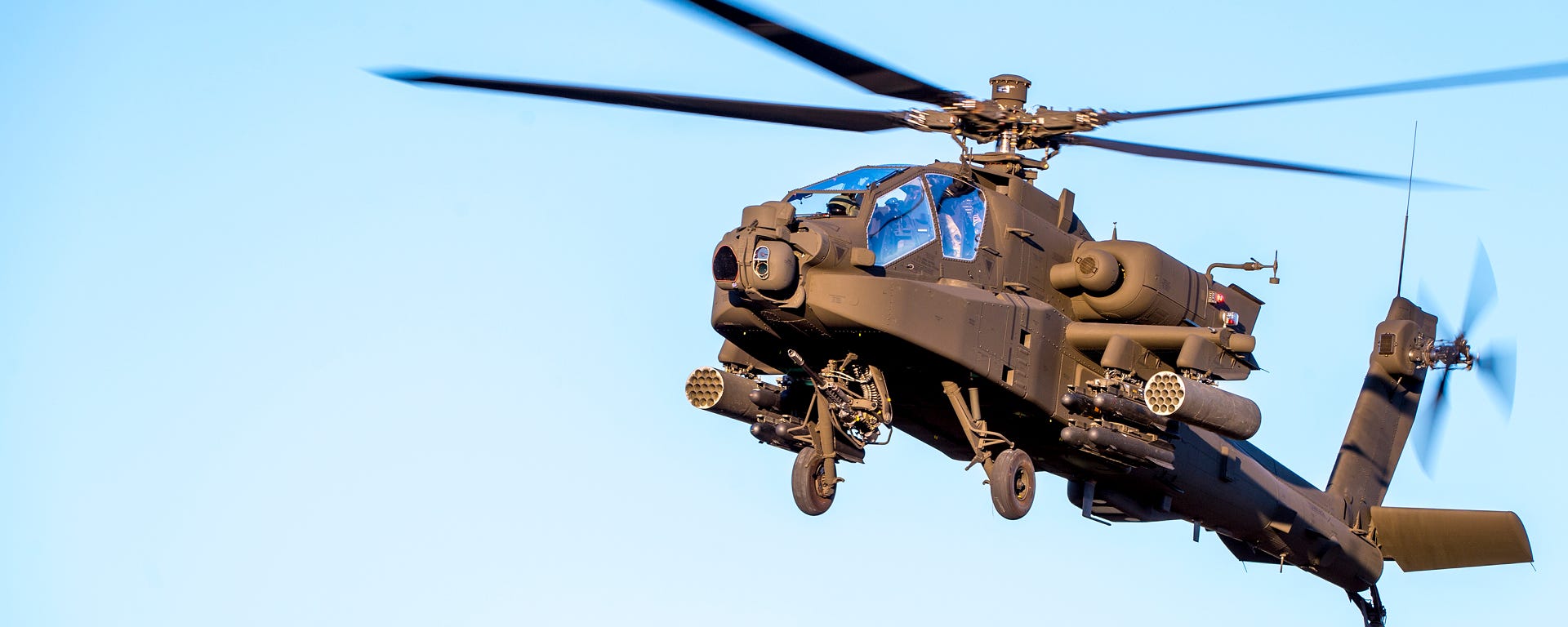
On Epic Fury the deployed ground units only organically held 10 helicopters, but the US Army specifically brought in 24 AH-64 Apache’s for counter-drone operations. So if we ignore attack helicopters organic to deployed ground units, Epic Fury had about 24% as many attack helicopters as Desert Storm, which is about the same smaller scale as every other category of aircraft.
The other category to increase in percentage is tankers. Unlike fighters, the USAF has not seen an increase in tankers for the overall fleet since 1990. Current USAF active duty tanker holdings are 44.9% of 1990 numbers, which is very close to the overall airframe number decline to 38-43%.
This is because the high tanker numbers are driven by the specific operation needs of Epic Fury. The images below show the airfield location, types and distances involved in Desert Storm.
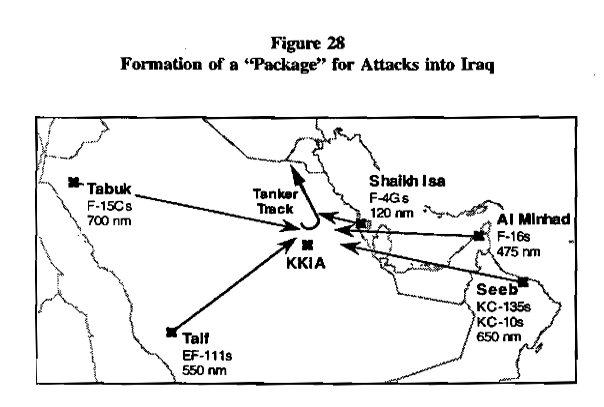
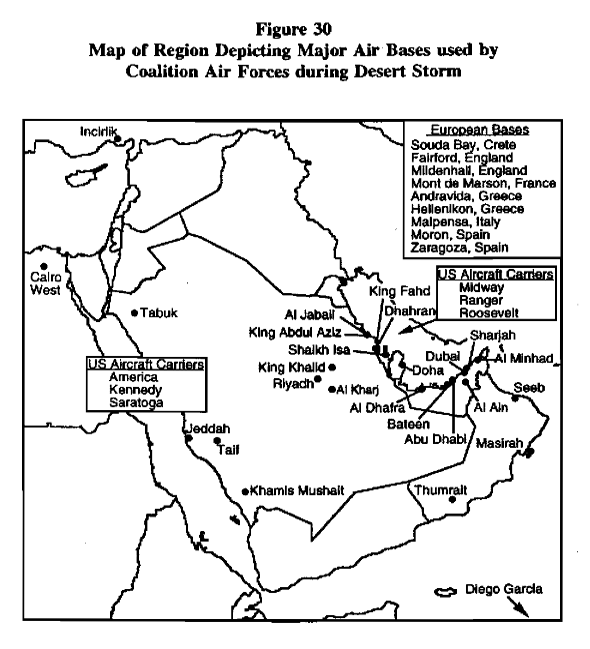
All the shorter range aircraft (like fighters) were stationed at airbases along the southern edge of the Persian Gulf. Most of the airstrikes by these shorter range aircraft were within Kuwait. Consequently these shorter range aircraft had a strait line flight distance of up to 900 km to their targets, but typically it was under 500km.
During Epic Fury those airbases on the southern side of the Persian Gulf have been largely unusable due to Iranian missile and drone strikes. Bombers, and even reportedly some fighters have been flying missions in from Europe. The distance from the major US airbase in Jordan to Tehran is over 1,800 km. Therefore it’s not surprising the only aircraft type to increase in proportion compared to the overall air fleet is tanker aircraft. The ranges the US is operating from makes an over-representation of tankers a vital necessity.
One other type of aircraft is over-represented in the Epic Fury Air Fleet, the E-11A Battlefield Airborne Communications Node (BACN). The USAF only has about 8 of these, but purportedly nearly all of them are currently deployed under CENTCOM.
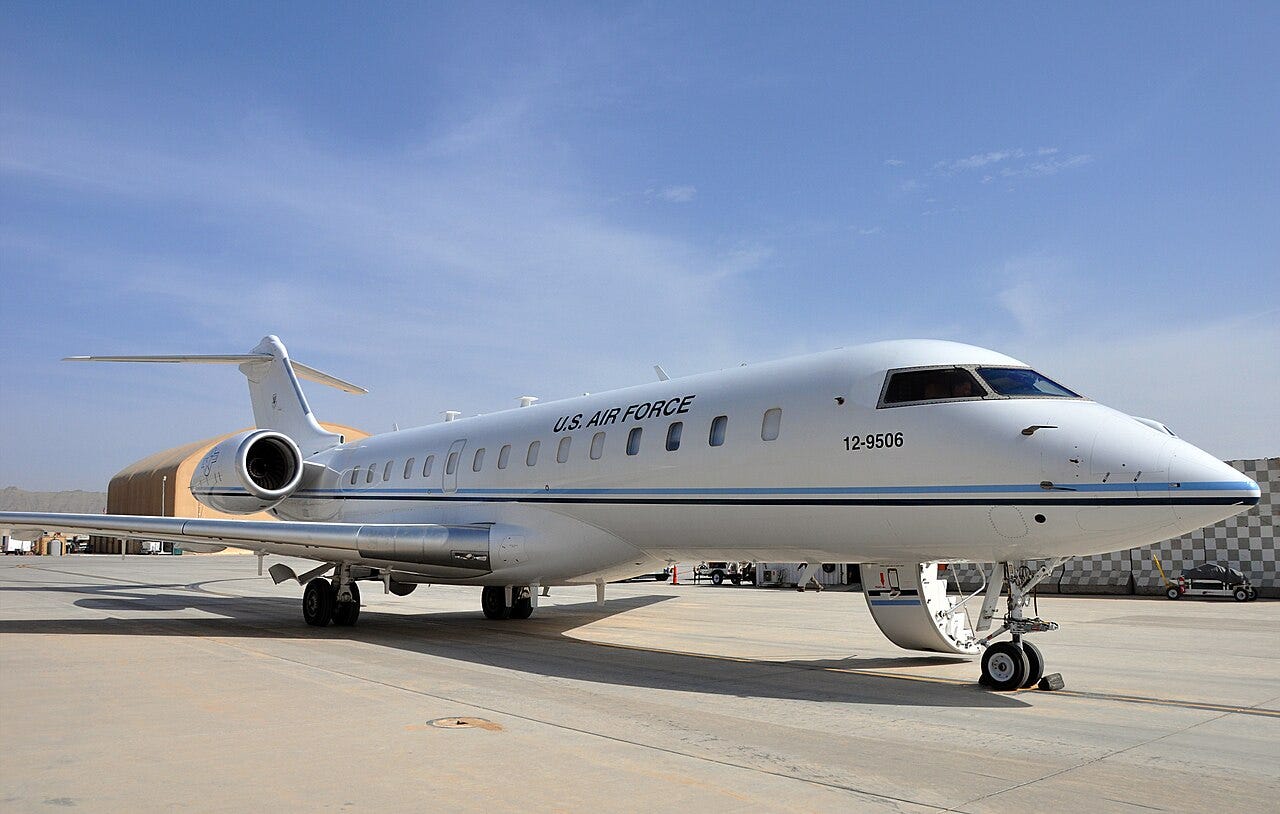
BACN aircraft are usually described as a wifi hub in the sky that allows aircraft to communicate effectively, but that isn’t a very good description. It’s more like a translator between dissimilar electronic systems, like using a Linux server to pass data between Mac and PC terminals.
Exactly what ‘Mac vs PC’ issues needed to be solved for Epic Fury would be highly classified, but the most likely options are:
Allowing US Army air defence systems like Patriot to integrate with US Navy and USAF systems;
Integrating Israeli aircraft into the USAF’s network (the Israeli’s famously ordered the F-35s with their own domestically developed electronics); or
Allowing USAF aircraft with 4th Gen electronic suites (like some of the F-16s) to communicate with 5th Gen aircraft like the F-35.
The Air Fleet used in Desert Storm was much larger than on Epic Fury. The US deployed 28% as many airframes and the coalition as a whole has 19% as many airframes.
Much of this decrease can be explained by the overall shrinking of the size of air forces since 1990. The USAF has 38-43% of it’s 1990 number of airframes. This rate of decline is fairly typical globally. However, even accounting for the decline in airframes the 2026 US deployed is on a somewhat smaller scale than 1990. Desert Storm represented 29% of the USAF’s active duty fixed wing aircraft. Epic Fury represented 25%.6
Comparing the composition of the two air fleets, we see a shift towards more multi-role aircraft (versus dedicated fighters, ground attack, strike and bomber aircraft). This mirrors the changes in the USAF overall. Epic Fury also has an increased share of tanker aircraft. Unlike the rise of the multi-role aircraft, this is not reflecting a trend in the USAF’s composition. Rather, Iran’s drone and missile capability meant most aircraft had to travel at least twice the distance from airfield to target as on Desert Storm.
Besides the general peace dividend, the decline in airframe numbers since the end of the Cold War in 1991 has been sold as viable due to multi-role aircraft replacing several airframes each, and the increased effectiveness of precision munitions. The next article will look at whether this promise was accurate, as well as comparing the relative effectiveness of the two air campaigns.
This is purportedly for operational security, to prevent it being used by Iran. However, it’s well reported that China and Russia are supplying Iran with military grade satellite imagery, so the audience they are trying to secure against is pretty clearly the general public.
In both 1990 and 2026 Air National Guard and Air Reserve units made up 25% of USAF airframes.
The only information I could get is that 10 are usually operating in Iran at any given time, and that 17 have been shot down so far.
A specialised fighter for suppressing enemy air defences. Arguably it belonged in the ground attack category, but they used modified F-4 Phantoms, which previously had been air superiority fighters.
This isn’t a direct comparison, as both operations included a lot of USN and USMC aircraft. However, it does illustrate that, even account for the smaller air fleet, the US deployed less aircraft on Epic Fury.
Comments
Nothing yet. Say the first thing.
Sign in to join the conversation.