
I was kindly reminded by events in the news that I need to finish up my article series on comparing the Epic Fury to Desert Storm.
Previous articles:
This article will compare the size of the Area of Operations (AO) for both air campaigns, and the density of airpower brought to bare against those AOs.
The size of the AO matters because striking targets in a confined area, creates greater Shock Action. Shock Action is the use of speed, surprise and firepower to break the enemy’s will to fight. For a campaign like Epic Fury, where there was no ground element and the goal was to extract diplomatic concessions, Shock Action was particularly critical.
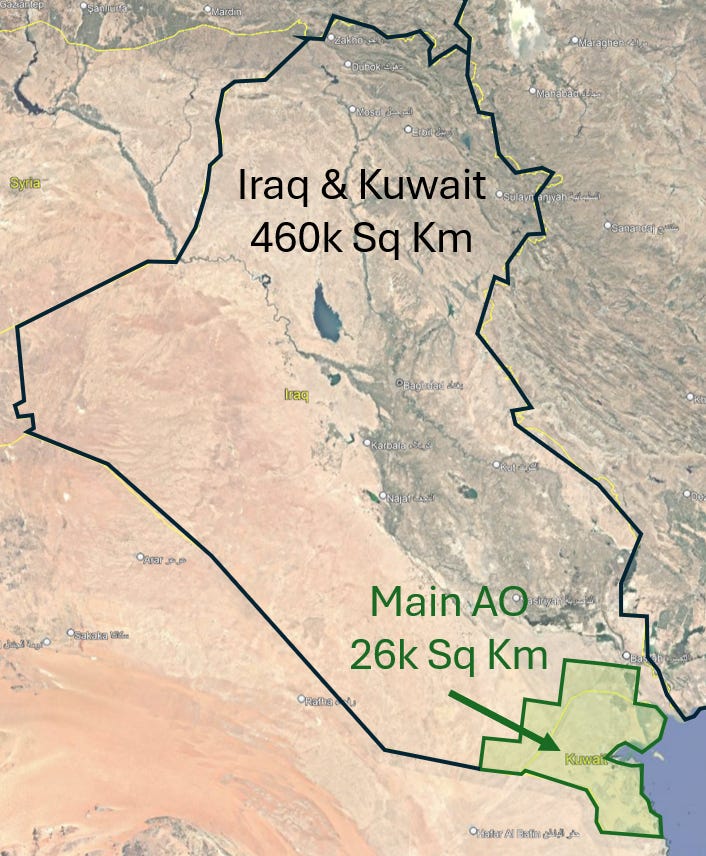
The Desert Storm Air Campaign consisted of airstrikes in Iraq and Iraqi occupied Kuwait. The combined surface area of Iraq and Kuwait is 456,135 square kilometres. This is a fairly large AO. For context, California is 93% the size of Iraq and Kuwait combined.
However, we do have data showing where airstrikes occurred, as the Gulf War Air Power Survey divided the countries into “kill boxes”.
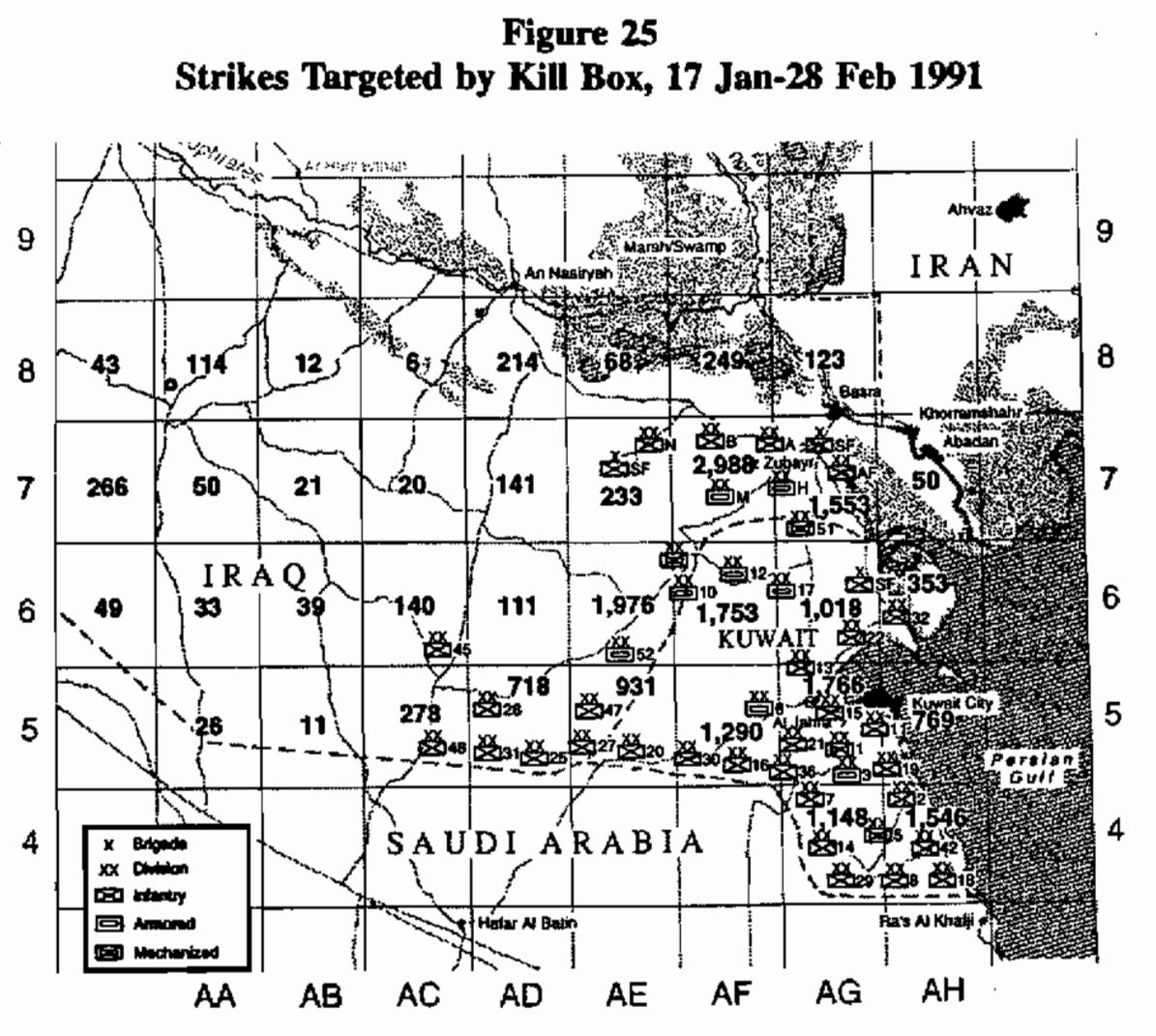
This map shows a strong concentration of strikes against targets in Kuwait and the kill boxes immediately on the border with Kuwait.
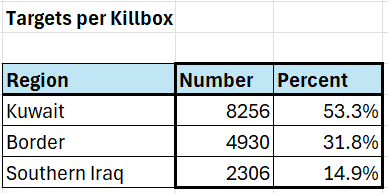
The Main AO of Kuwait and the kill boxes on the Kuwaiti border total just over 26,000 square kilometres. This means an area making up just 5.8% of Iraq and Kuwait received 85.1% of the Coalition air strikes. This is a much smaller AO. For comparison, it is slightly larger than Vermont.
This strong concentration of force matches the Desert Storm Air Campaign, which focused heavily on attriting Iraqi field army in Kuwait and on the Saudi border. With some minor assumptions1 we can state 85.1% of ground attack strikes during Desert Storm equates were within the Main AO, which equates to 1.61 strikes per sq km. As I will explain later, measured by month, this was by far the most intense concentration of airstrikes in US history.
Iran as a whole is much larger than Iraq and Kuwait, at 1,648,195 square kilometres.
Like Desert Storm, airstrikes during Epic Fury were concentrated in a smaller area, though to a much lesser extent. The briefing slide below shows where CENTCOM claims airstrikes took place in the first 10 days. It shows the north-east of Iran was largely ignored in terms of air strikes. This was likely due to a mixture of limited targets (that area is nearly uninhabited) and the longer ranges involved.
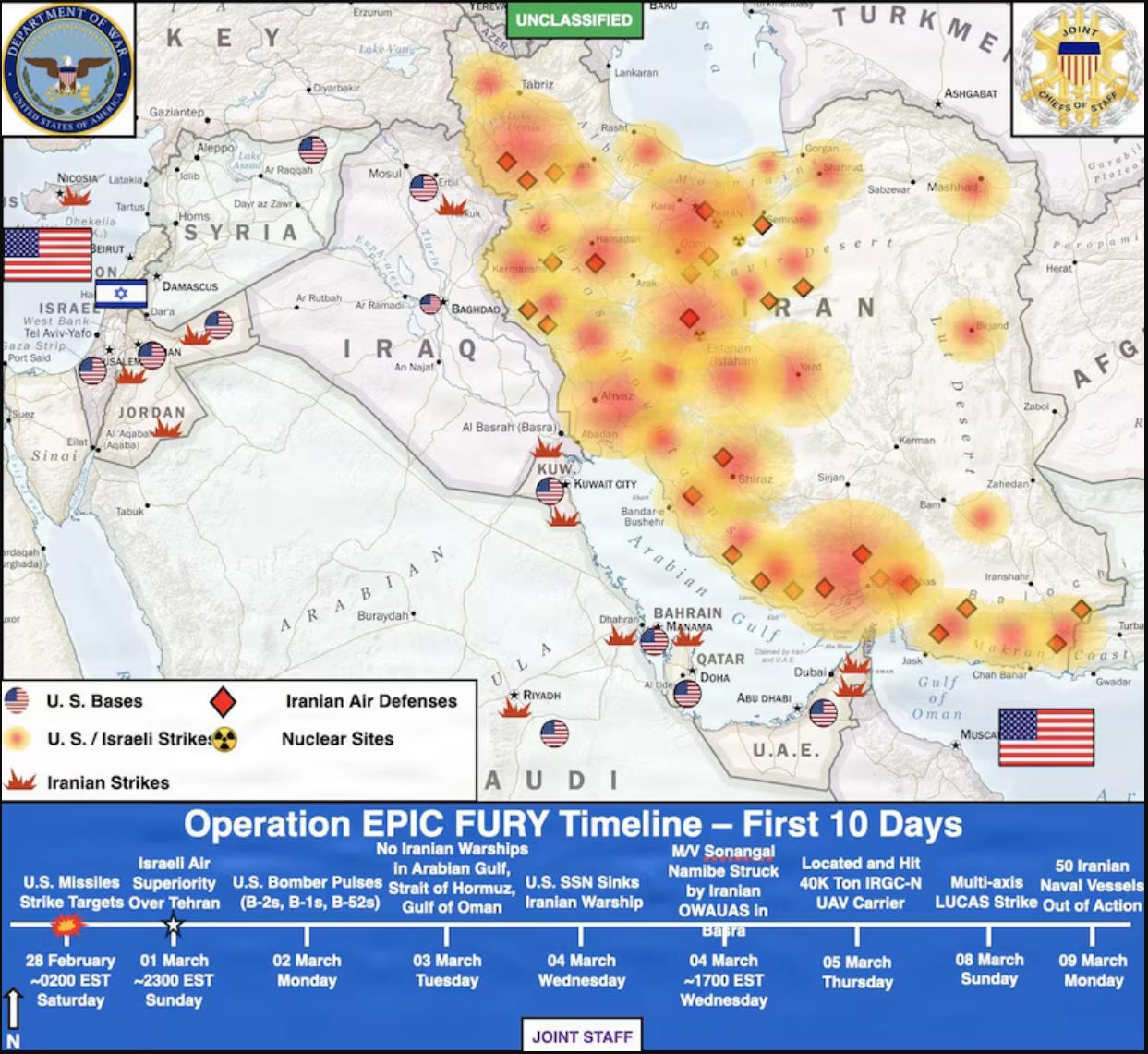
This pattern generally matches all the trustworthy reporting I’ve seen about the location of airstrikes. It equates to 65.8% of Iran’s landmass, meaning the main Area of Operations was about 1.1 million square kilometres. Although this reduces the main area of operations somewhat, it is nothing like the concentration of force seen in Desert Storm.
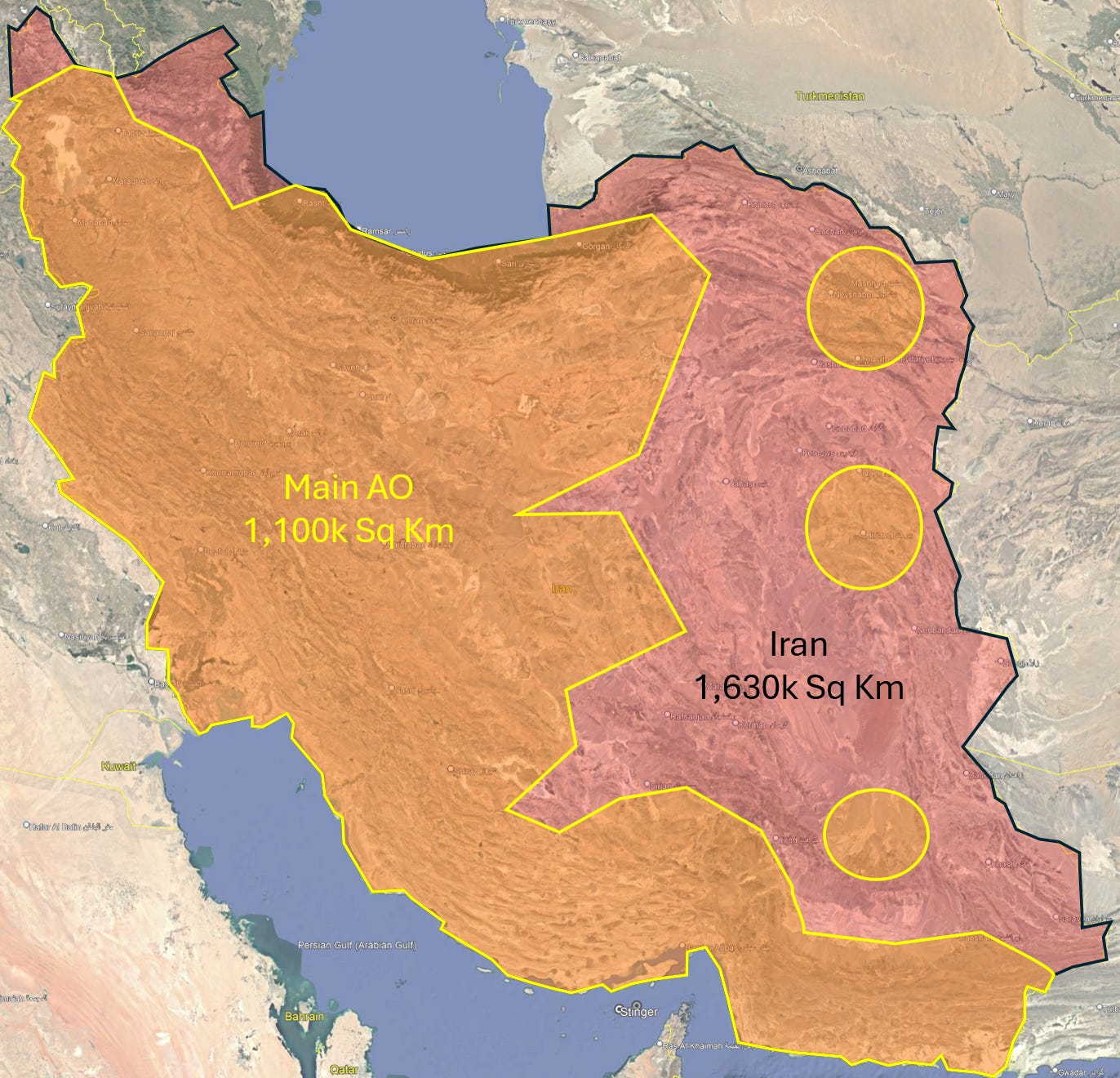
Going by the surface area of the countries targeted, Epic Fury took on strikes against an area 3.5x the size of the target countries for Desert Storm.
However, Desert Storm concentrated 85.1% of its targets against Kuwait and the surrounding border regions. Epic Fury did not attempt to bomb the entire country, but the main AO made up about 65% of the country.
The map below outlines the size of the countries and the main AOs for the two air campaigns:
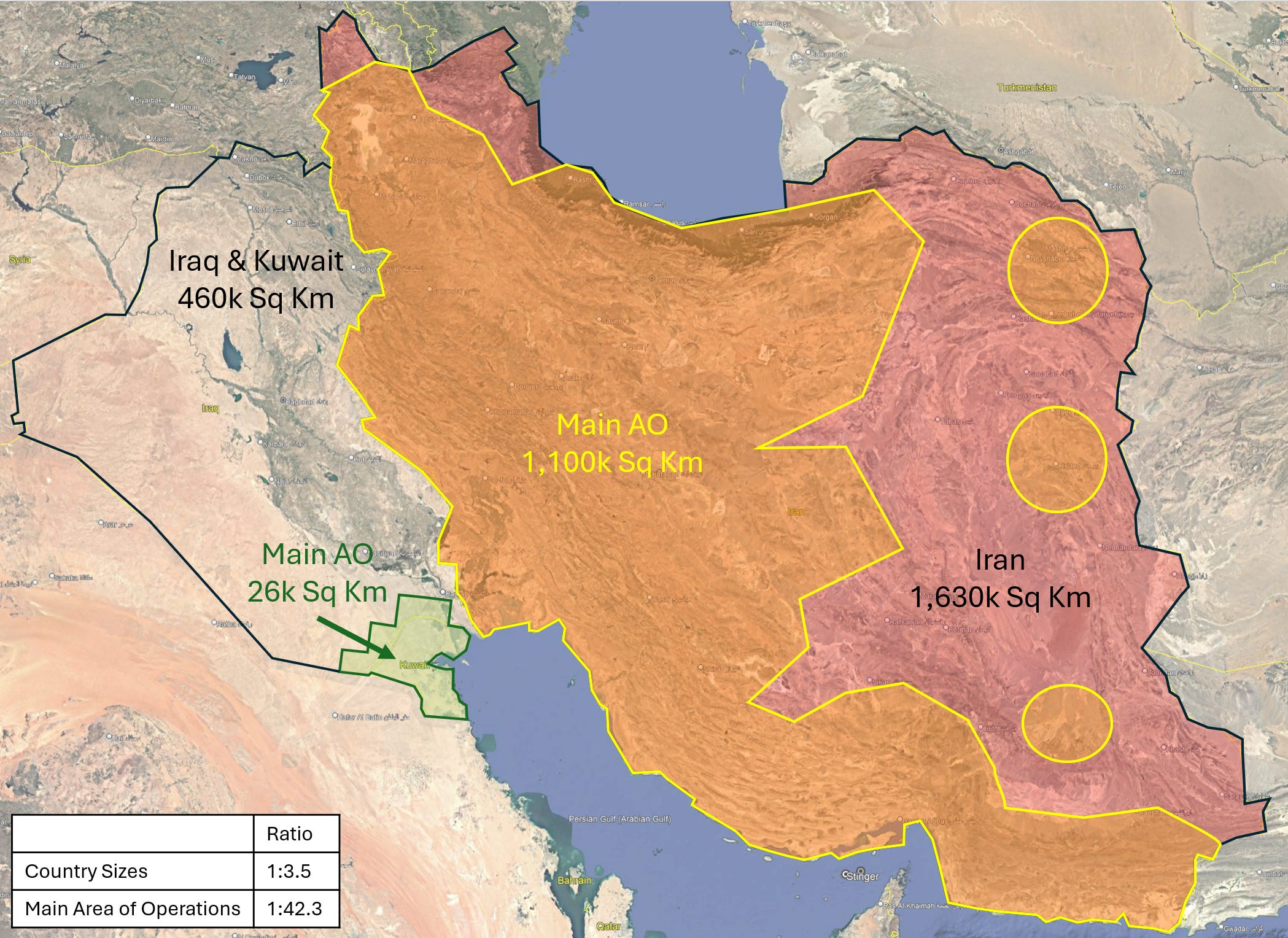
I conclude that Epic Fury’s main AO was 42.3x the size of the main AO for Desert Storm.
To put this in more familiar terms, the map below compares the AO sizes to US states. Iraq and Kuwait combined are slightly larger than California (red), but the main AO for the Desert Storm air campaign was only about the size of Vermont (green). Iran is about the size of Texas and five of its northern neighbours (blue). The AO for Epic Fury was smaller, but still about the size of New Mexico, Arizona, Colorado and Utah (yellow).
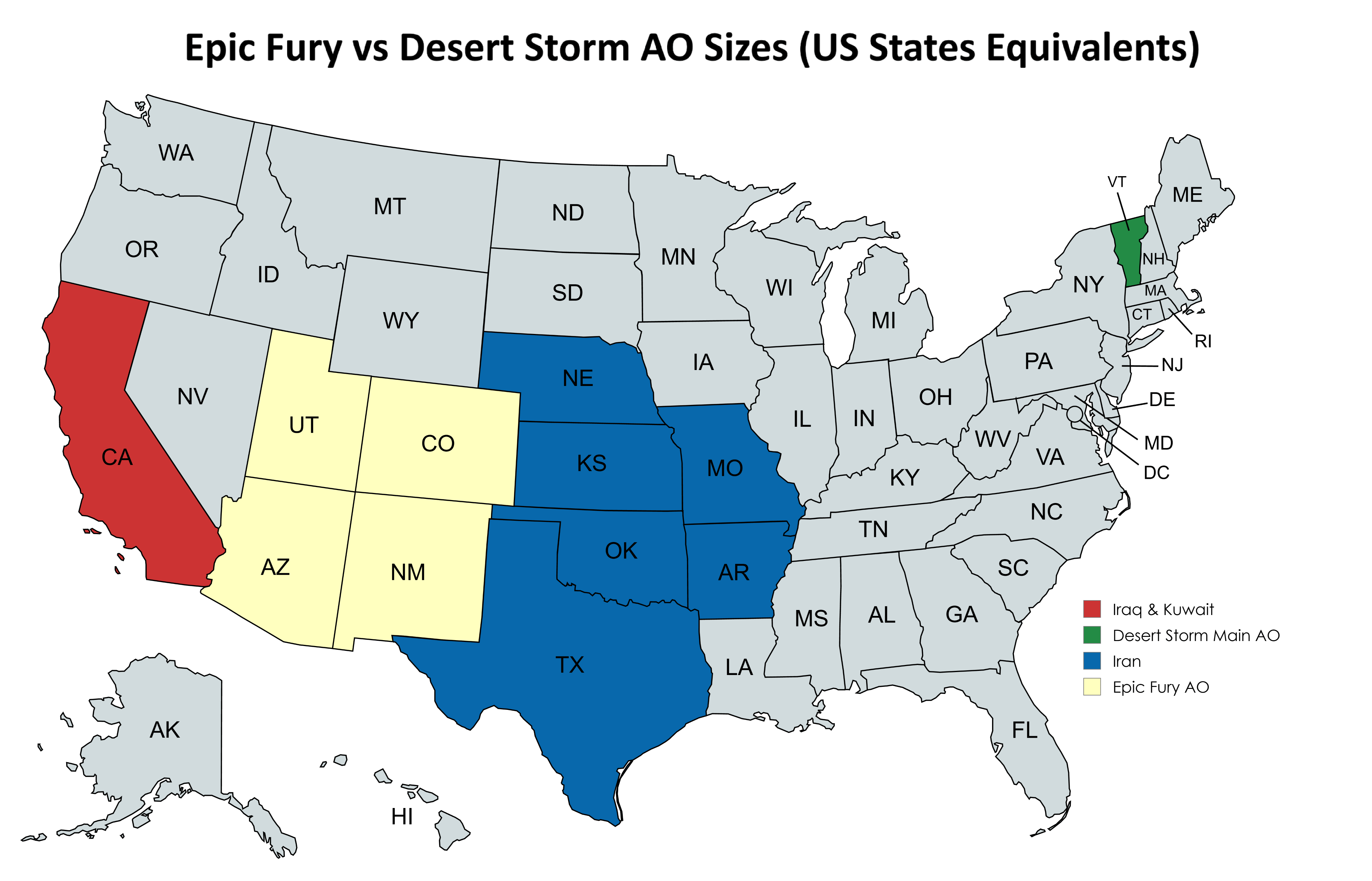
Earlier I concluded that, even giving a generous interpretation of CENTCOM’s statistics and accounting for the higher effectiveness of increased precision munition use, Epic Fury had about 37% as many munitions hitting targets as Desert Storm. If these two estimates are correct then the density of targets hit by area was 114x higher on Desert Storm as on Epic Fury. Using the framework of US states, Epic Fury was the equivalent of attempting to repeat an earlier bombing campaign against Vermont, but while attacking Utah, Colorado, Arizona and New Mexico with 1/3rd as much firepower.
This certainly isn’t to say that Desert Storm Air Campaign was 114x as effective as Epic Fury. In 1991, the Iraqi army concentrated itself in a small area. Iran’s targets were much more spread out, across a country that has an awful lot of barely inhabited mountains and deserts. However, this is a good measure of the Shock Action effect of the two air campaigns.
Having established that the Shock Action effect of Epic Fury was dwarfed by Desert Storm there remains the question of how Epic Fury compares to other US involved air campaigns.
Any comparison if this kind needs to be taken with a large grain of salt. It involves very different kinds of technology fighting very different kinds of wars. However, the trends you’ll see below are strong enough that the large margin of error is immaterial.
I have compared the number of airstrikes and the weight of munitions dropped in the WW2 strategic bombing of Germany, the Korean War, the Vietnam War (separated into North and South as they were very different air campaigns), Desert Storm and Epic Fury. The table below shows the strikes or munitions weight per square kilometre (in total and per month of the war).
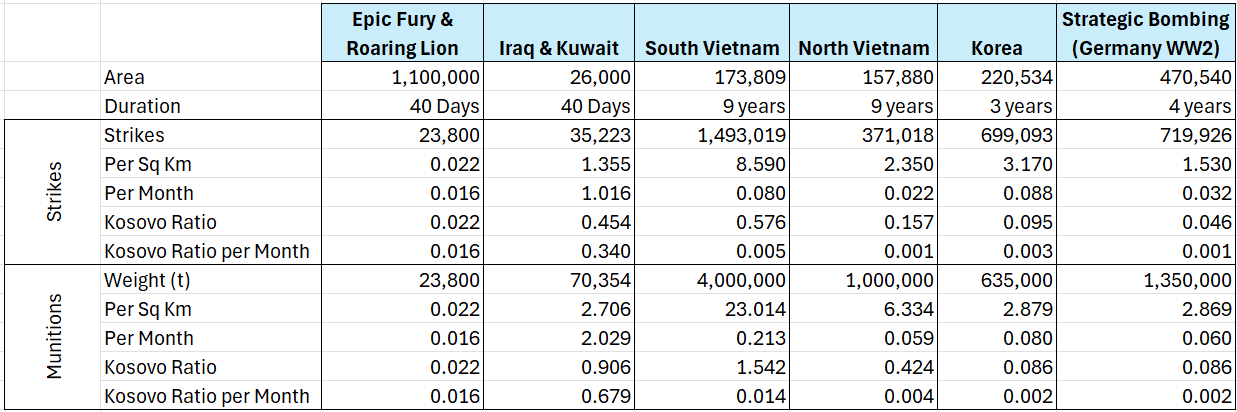
The same numbers are then run through the Kosovo Ratio; a metric I developed in the last article to adjust for the lesser effectiveness of unguided munitions. The table below shows the percentage of guided vs unguided munitions that hit their target in various conflicts.
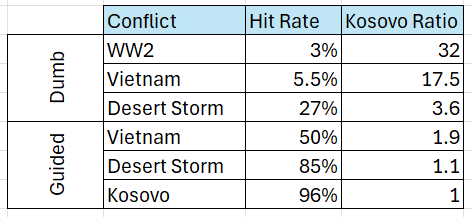
When measuring the Shock Action effect the higher hit rate of precision munitions is relevant, but not on a 1 to 1 basis. A B-52 carpet bombing a defensive position with dumb bombs may require 17.5x as many bombs to hit the same number of targets as a B-2 dropping lazer guided bombs. However, Shock Action effect per bomb is a lot less than 17.5 to 1. On the other hand, the Shock Effect eventually wears off when soldiers come under repeated bombardment from inaccurate munitions. The eventual indifference of soldiers to rocket attacks during the GWOT being a good example. So the B-52s Shock Action effect per bomb is not 1 for 1 with the B-2’s. I’ve included both metrics as the truth is somewhere in the middle.
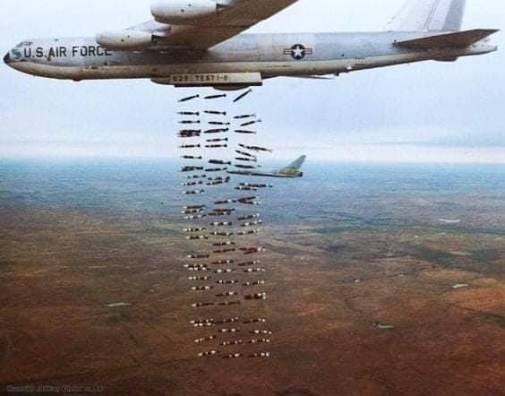
Shock Action is also about the rapid intensity of firepower, so the per month metrics are the best for measuring Shock Action. The best illustration of this is the air campaign in South Vietnam. The US dropped over 57x the weight of munitions at a 8.5x the density per square kilometre as on Desert Storm. In Vietnam this took 9 years (about 108 months), whereas Desert Storm only lasted 40 days.
The graph below shows the number of strikes per square kilometres per month, both raw and adjusted for precision munitions. The Shock Action effect of Desert Storm is simply in another realm. The closest competitors are Korea and South Vietnam, where Desert Storm still outperforms them by 9-42x depending on the metric used.
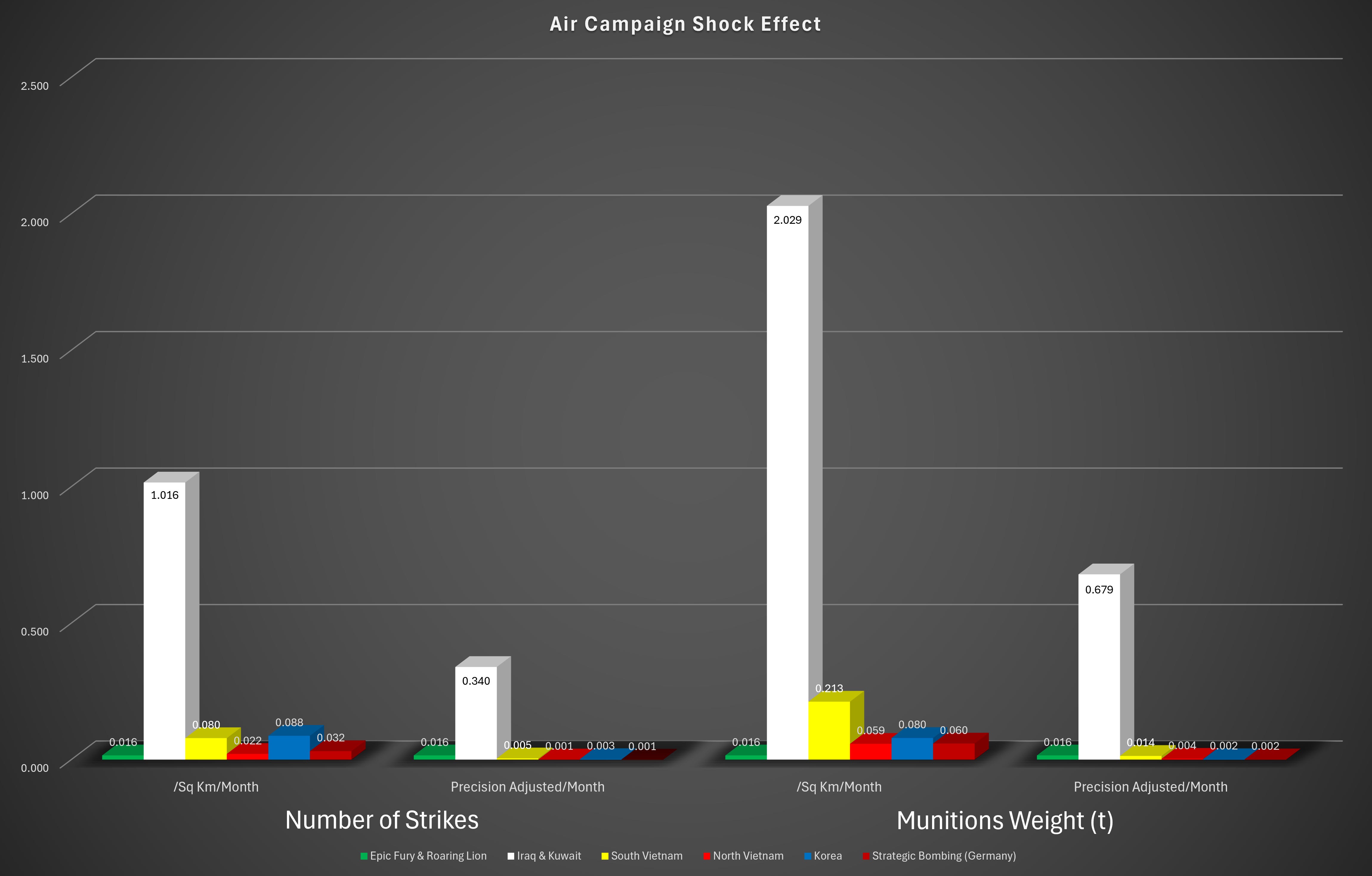
Desert Storm is such an outlier that it makes comparing Epic Fury to the other air campaigns on this graph impossible. That will happen when the entire western (and most of the middle eastern) world comes together to bomb an area the size of Vermont.
The graph below removes Desert Storm, so we can better compare Epic Fury to America’s remaining 20th Century air campaigns.
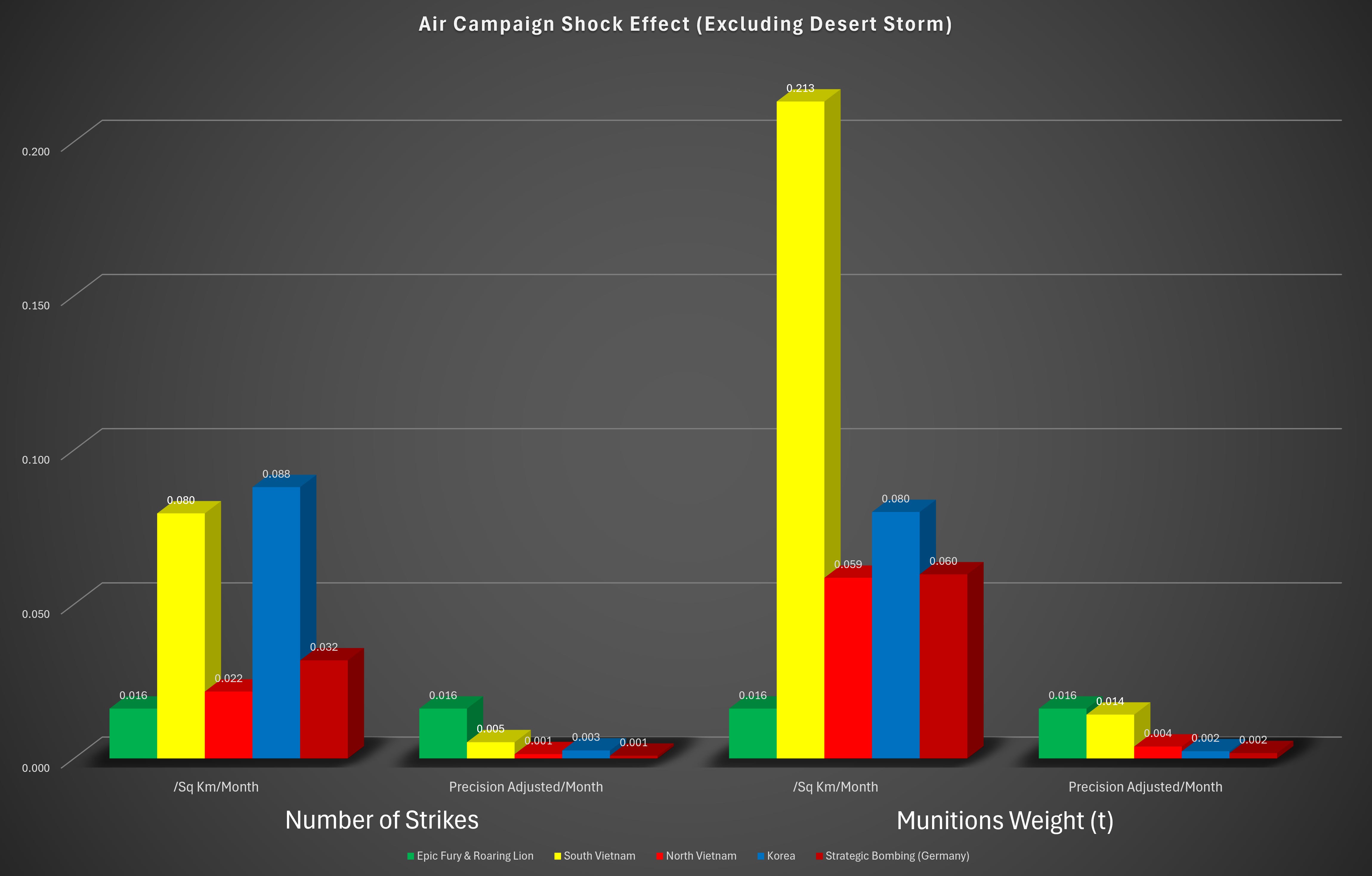
By raw numbers Epic Fury is either in last place, or tied for last. This is to be expected, as F-35s dropping two JDAMs will always result in less munitions dropped than B-17s and B-52s on carpet bombing missions. When adjusted for precision munitions Epic Fury is the most effective air campaign. By strikes Epic Fury had 3x the Shock Action factor as South Vietnam and 5x as much as Korea. By weight of munitions it has a slight edge on South Vietnam (0.016 vs 0.014) and is at least 4x as powerful as the other air campaigns.
As already explained, the true measure of Shock Action is something in between the raw figures and as adjusted for the effects of precision munitions. Exactly how you weigh these two sets of statistics is difficult and highly subjective. In this case, we can probably state that the combined Shock Action effect of Epic Fury and Roaring Lion was either:
Similar to that of the US air campaigns against South Vietnam and in the Korean War; or
Slightly more effective than those two air campaigns.
The US wars in Korea and South Vietnam were both conflicts the US largely won on a tactical level, due to overwhelming air power supporting a substantial ground force. On the operational and strategic levels it’s probably fair to say the United States had a minor victory in Korea and lost the campaign in South Vietnam.
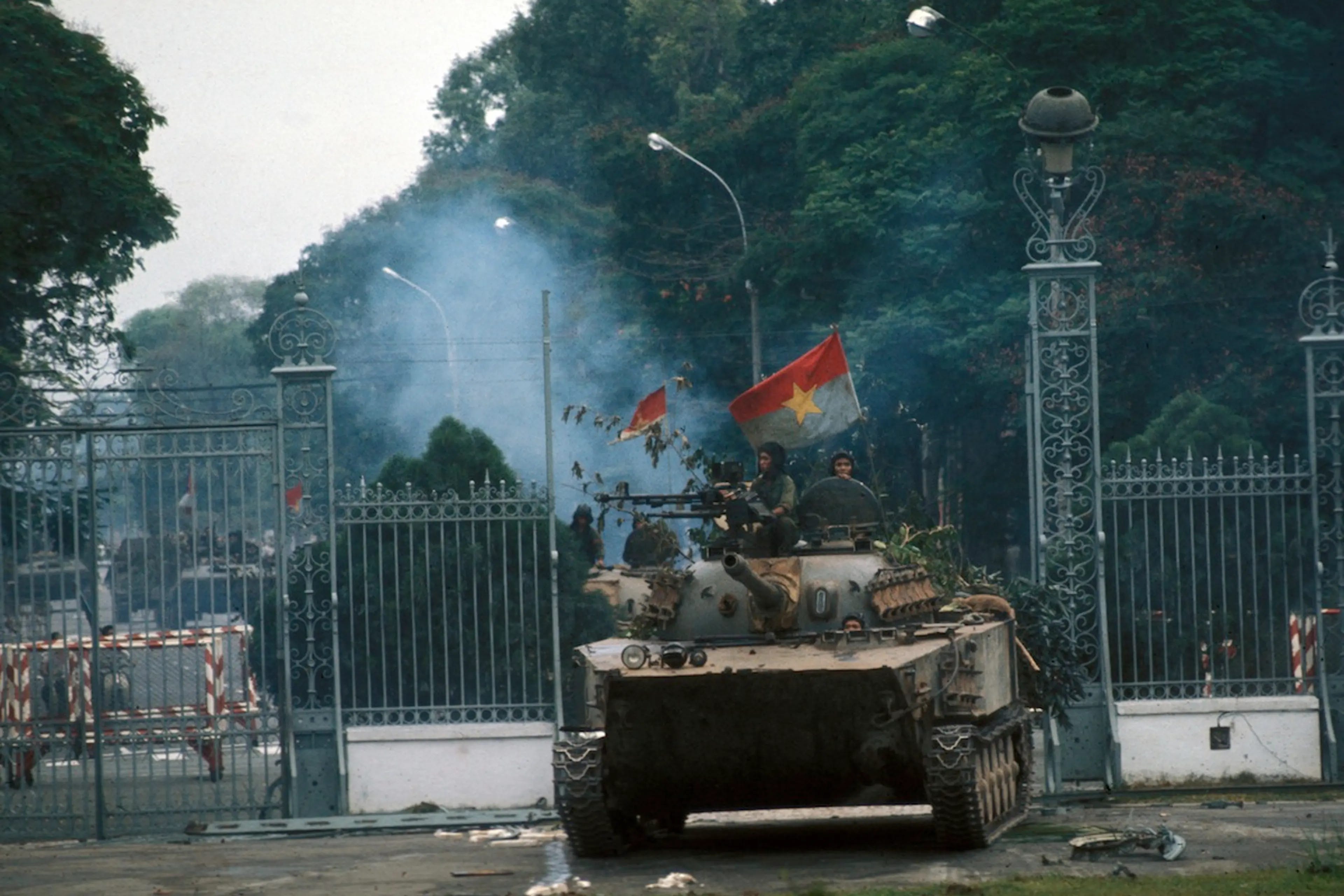
What certainly did not occur in either Korea or South Vietnam was a decisive surrender of the enemy due to the Shock Action of air power alone. This suggests Epic Fury had little chance of forcing major concessions out of Iran, so long as it was conducted as only an air campaign.
One key element of US strategy is not really captured within these metrics: the decapitation strikes that began the operation.
The United States and Israel began Epic Fury slash Roaring Lion with airstrikes that killed 40-50 senior officials in the Iranian government, including:
Ayatollah Ali Khamenei: Supreme Leader of Iran
General Hossein Salami: Commander-in-Chief of the Islamic Revolutionary Guard Corps (IRGC)
Brigadier General Aziz Nasirzadeh: Defense Minister
Major General Abdolrahim Mousavi: Chief of Staff of the Armed Forces
Ali Shamkhani: the Ayatollah’s Senior Security Advisor
Brigadier General Mohammad Pakpour: Commander of the IRGC Ground Forces
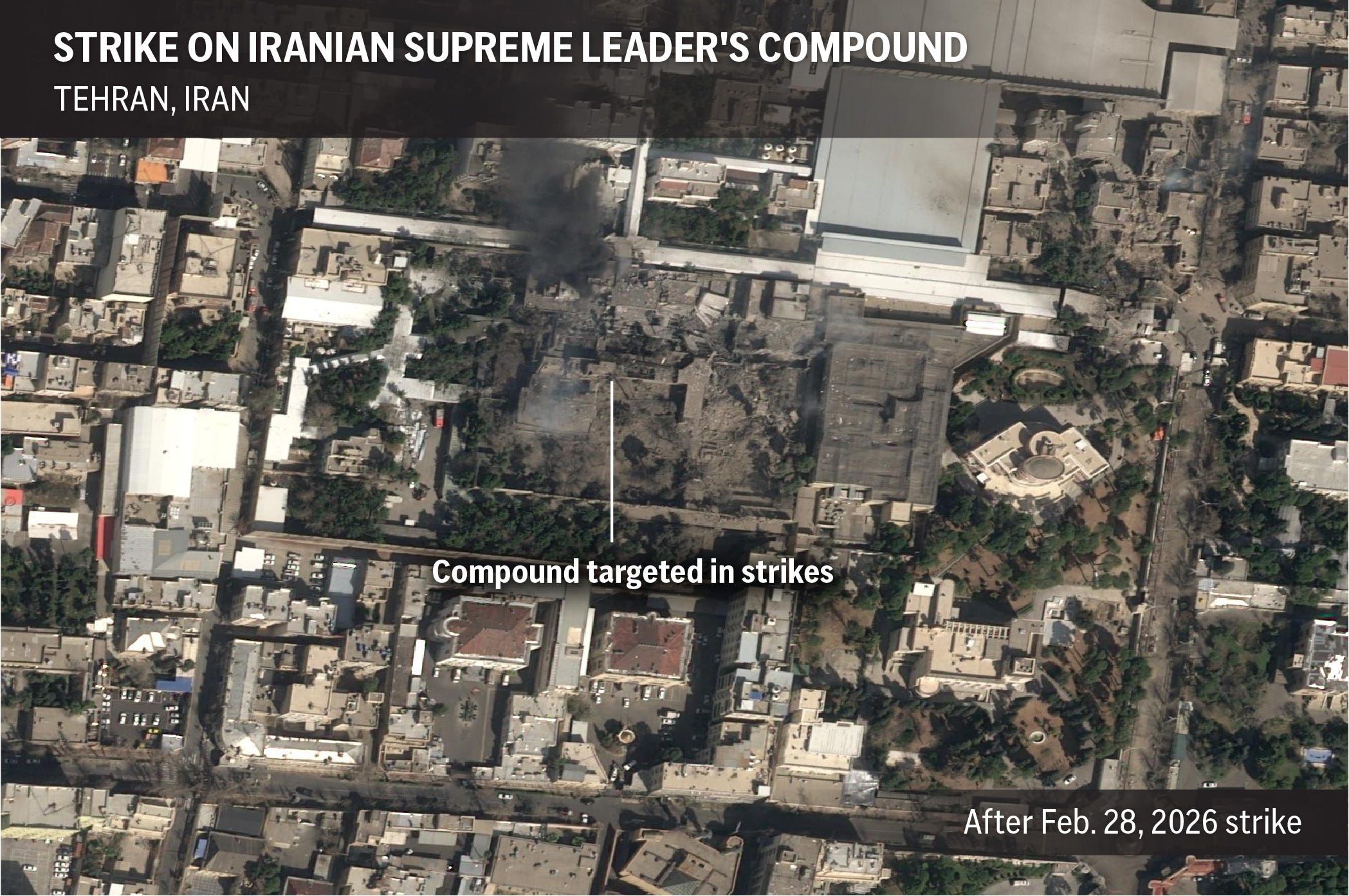
Throughout the rest of the air campaign, there was also a greater emphasis on attacking Iran’s leadership. During Desert Storm, only 2% of strikes were against leadership or command and control. On Epic Fury, leadership targets accounted for 15% of strikes.
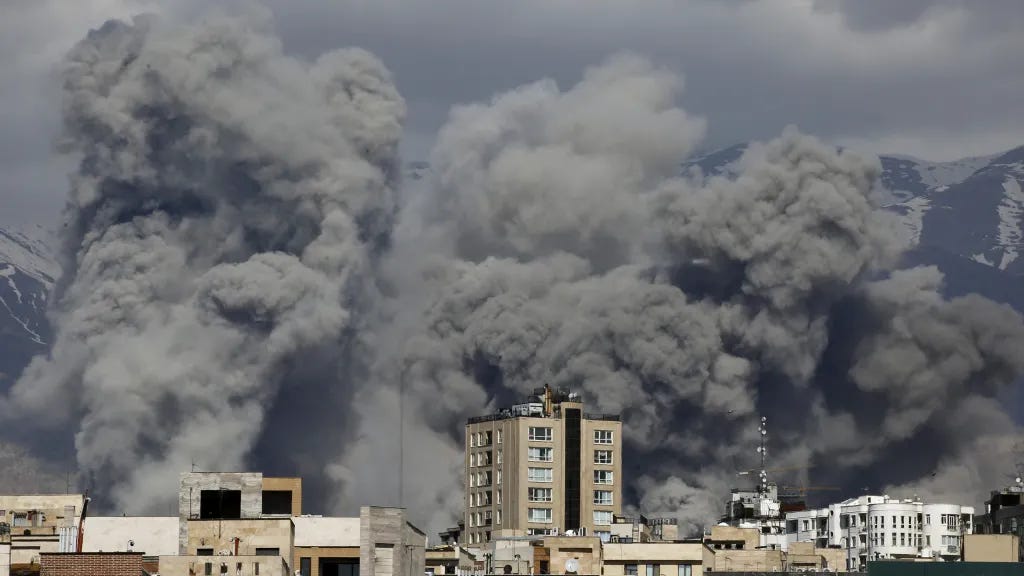
Killing an enemy’s senior leadership has a disproportionate Shock Action effect. However, this impact can be mitigated through a decentralized decision making process, which it appears Iran implemented prior to this war. The shock action effect of killing leadership is also more temporary than the larger volume destruction of an enemy’s warfighting capacity.
There’s a period of time where a decapitated regime is rudderless and less effective. This rudderlessness can create windows of opportunity for regime change. However, when this window closes a surviving regime almost always has considerably more resolve.
Anyone who is going to assume a major leadership position following a decapitation attack is already too high up in the regime to have their will to fight collapse. The new leader is already in too deep and will have to go down swinging. The enemy has also just illustrated what will happen to the new leader if they are unsuccessful.
The kind of shock action that typically causes a state to collapse is directed much more at the lowest levels. The ground campaign during Desert Storm is an excellent example of this. After five weeks of being bombed night and day the rank and file of the Iraqi army was generally well motivated to surrender.
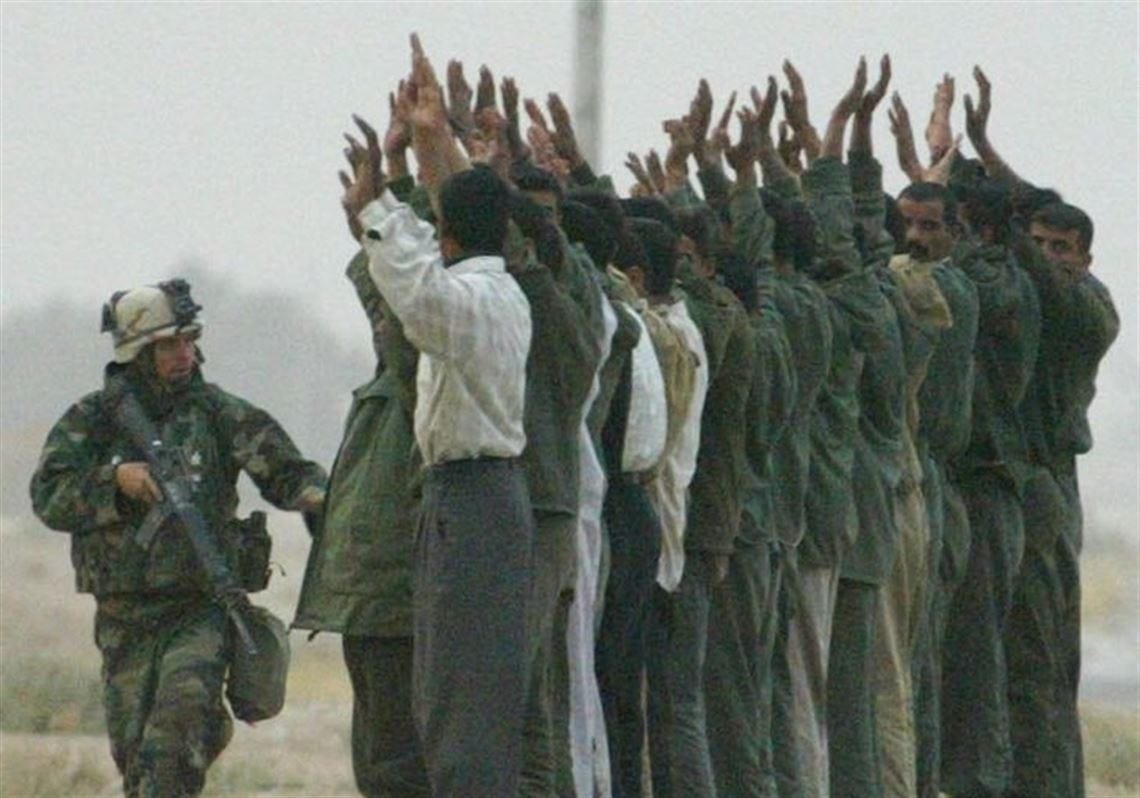
So decapitation strikes do have a Shock Action effect that’s grossly disproportionate to the number of strikes or quantity of munitions dropped. It creates a window of opportunity lasting perhaps a few days where the regime can be internally weak and rudderless. Once that window of opportunity passes, the long lasting Shock Action effect is minimal and perhaps even counterproductive.
The US strategy during Epic Fury was to conduct an air campaign unsupported by a ground force with sufficient shock action to pressure Iran into a peace deal on favourable terms.
Desert Storm certainly had nothing comparable to the decapitation of leadership that occurred in the first wave of Epic Fury. However, after this admittedly phenomenal accomplishment, Epic Fury saw much less violence inflicted on the enemy over a much less concentrated set of targets (both by type of target and by physical space).
It’s not surprising that once Iran recovered from the Shock Action effect of the leadership strikes, US air power seemed less and less effective at bending the Iranians to America’s will.
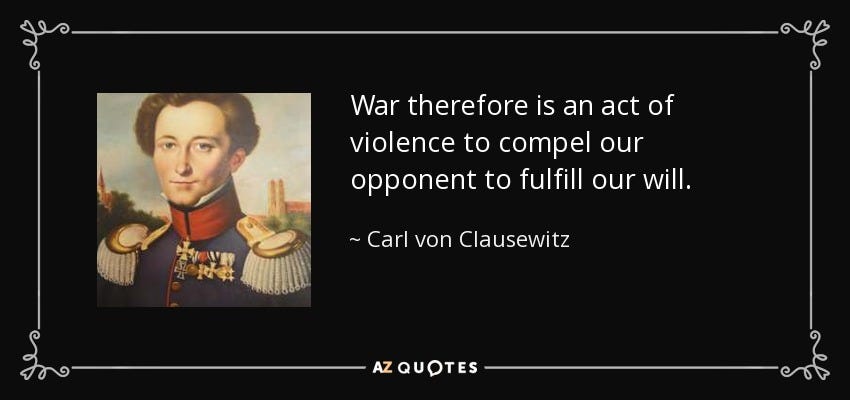
Clausewitz would not be impressed:
Slightly over half of all airstrike were reported using the kill box method (21,974 vs 19,336 which did not). Only 2,900 of the kill box reported strikes were outside the Main AO areas (where the 85.1% figure comes from. The air power survey considered the kill box reports to be representative of the non-kill box reports. So the rest of this analysis applies 85.1% to the total airstrikes (41,309).
Comments
Nothing yet. Say the first thing.
Sign in to join the conversation.