
In the previous articles we looked at how the British faced and overcame enormous challenges to achieve victory in the Falklands war. The second post explained how these difficulties largely stemmed from the military of 1982 being a continental force focused almost exclusively on NATO operations in Europe, rather than their traditional role of global expeditionary warfare.
This article will look at why the British military had so thoroughly de-prioritised expeditionary warfare by 1982, and how this de-prioritisation had ripple effects throughout the Falklands War.
Although not mentioned directly, “Logistics in the Falklands War: A Case Study in Expeditionary Warfare” indirectly shows how defence policy decisions made in 1966 made Britain’s armed forces shockingly ill prepared and equipped for the Falklands war by abandoning its historic role of global power projection.
This is because the 1966 Defence White Paper, declared the British military would not fight a war above battalion level outside of a NATO led conflict in Europe. It is a case study in how high level policy trickles down over time into every decision made by the military regarding procurement, training and force structure. It is also a case study for the danger of building defence capabilities that are narrower than the country’s critical national interests.
The previous post explained that following the Falklands conflict, the British military rebuilt itself as a global expeditionary military. They did this despite falling defense budgets and personnel by abandoning its continental style military capable of fighting the European conventional war on a large scale in Europe.
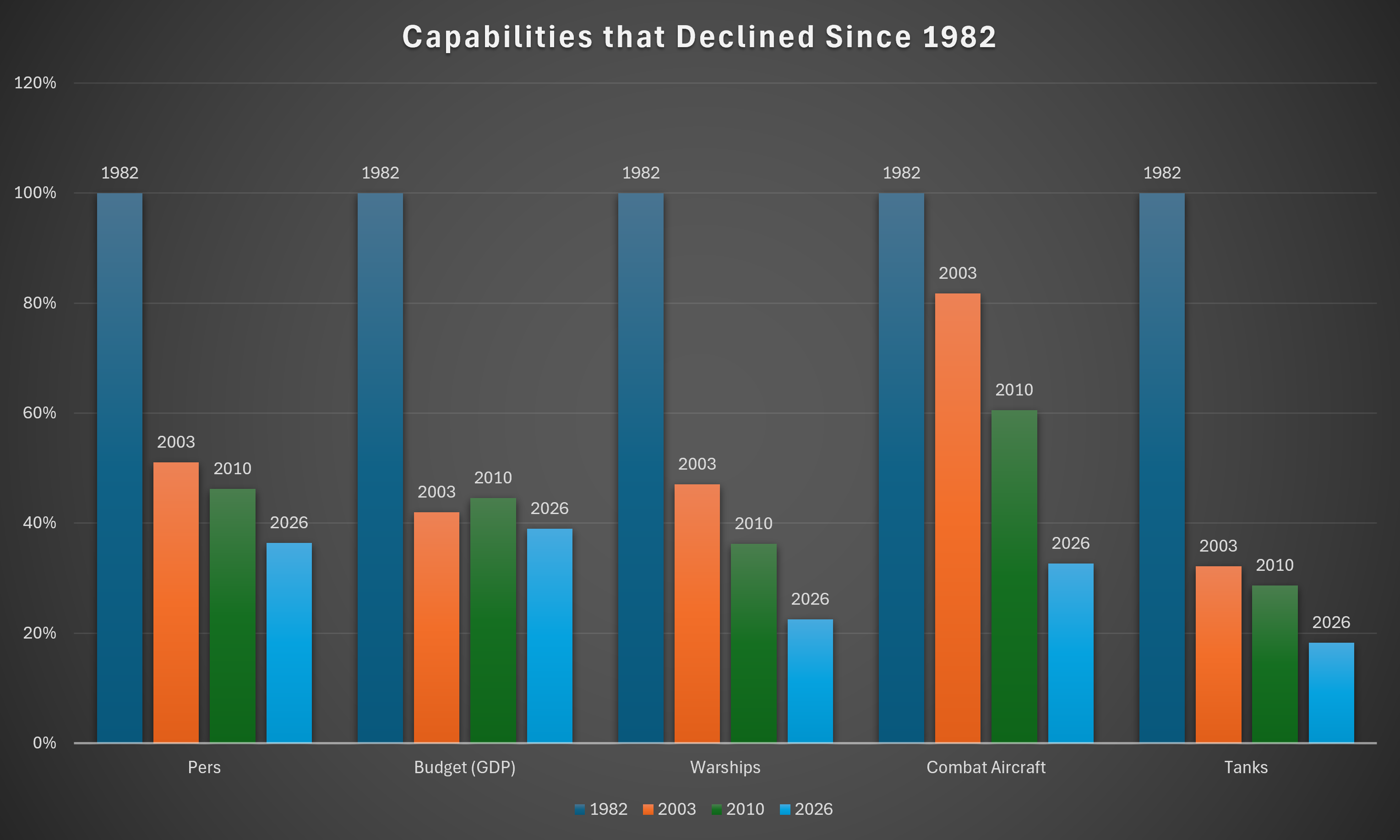
To visualise this a bit better, I looked at several key statistics for 1982 (when the Falklands War occurred), 2003 (the post WW2 high water mark of British global expeditionary deployments), 2010 (the last year before the current decline began) and 2026. Following 1982, there was a more than 60% decline in the capabilities tied to large scale near-peer warfare. Specifically the defence budget fell (as a percentage of GDP) and there was a greater than 60% decrease in the number of personnel, warships, combat aircraft and tanks.
Despite this decline in the budget and size of the British military, the capabilities that support global expeditionary warfare all increased. There was a peak in capabilities around 2003 to 2010, but as of 2026 the numbers are still above 1982 levels. The tonnage of amphibious support ships increased by over 5x, and is still over twice 1982 levels today. Airlift capacity rose somewhat, but this due to the decreased size of the armed forces the capacity per service member is nearly 4x that of 1982. The scale of global force projection peaked at 4x of 1982 capabilities, and is still about 2.5x that of 1982.
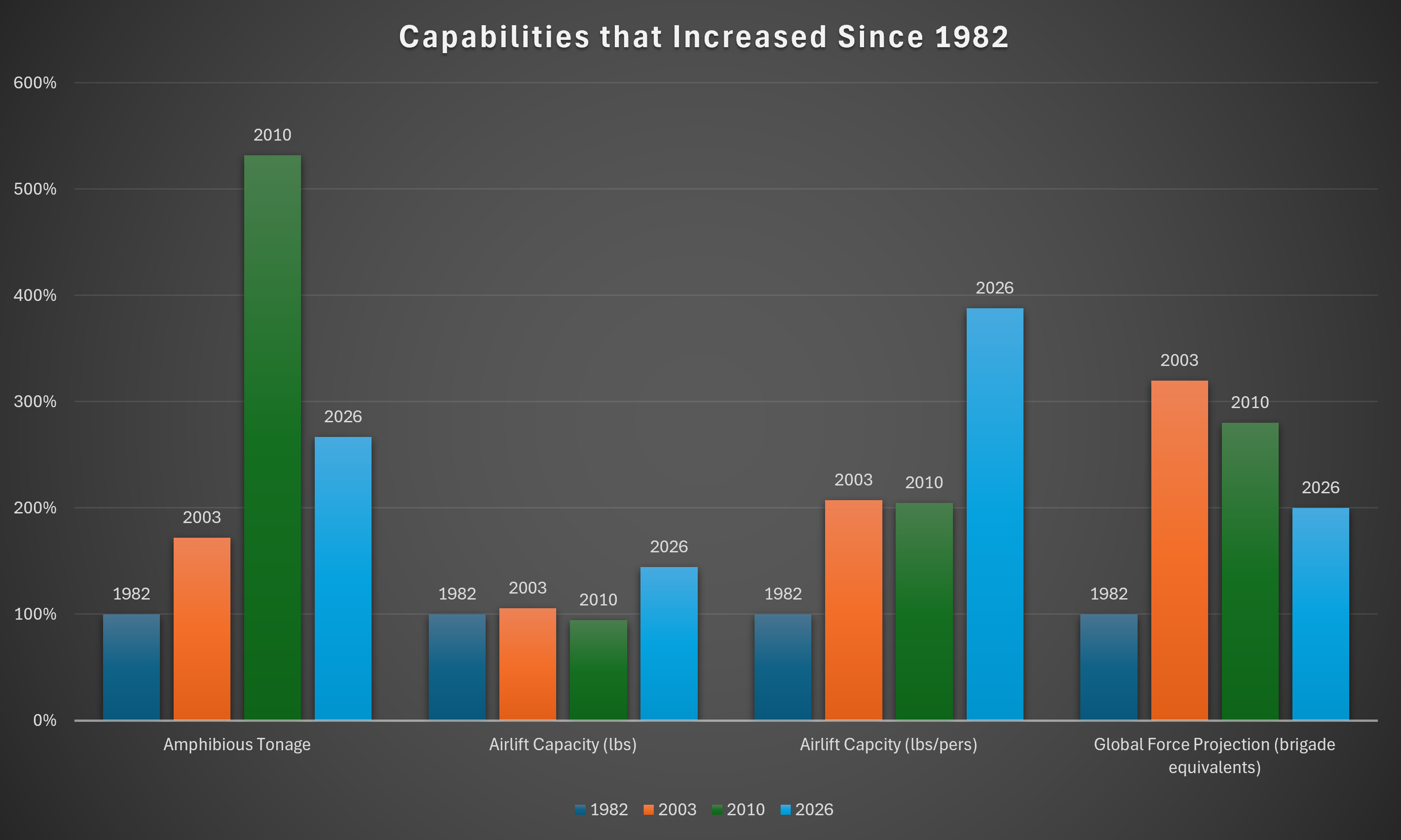
As a note: for brigade equivalents I am counting manoeuvre brigades and support brigades. Details found here.1
This data visualisation shows that from the end of the cold war until 2010 Britain abandoned its continental military capabilities and to rebuild its global expeditionary power projection capabilities, despite losing over half its budget and personnel during that period. Since 2010 that global power projection capability has been eroded, but it still exceeds 1982 levels. However, in 2026 the UK no longer has anything like the continental warfighting capabilities of the 1982 BAOR.
After WW2 the British Empire was finished as an economic entity. Prior to WW2 there was something akin to free trade within the British Empire through something called Imperial Preference. The British Isles received a market for manufactured goods. In exchange the members of the Empire had free trade to sell their commodities to Britain. The resulting trade network was then protected by the Royal Navy.
Britain was likely too broke at the end of World War Two to maintain this system. However, in 1947 the predecessor to the WTO forced the abolition of Imperial Preference via the General Agreement on Tariffs and Trade. Although the British Empire remained intact (minus the Indian sub-continent achieving independence the same year) Britain lost most of the economic benefits.
Still, Britain was a major commercial maritime power and therefore had to continue as a major military maritime power. Additionally, Britain still controlled key choke points of maritime trade (like Gibraltar, Aden on the Red Sea and the Suez Canal) which were vital to Britain’s power and interests.
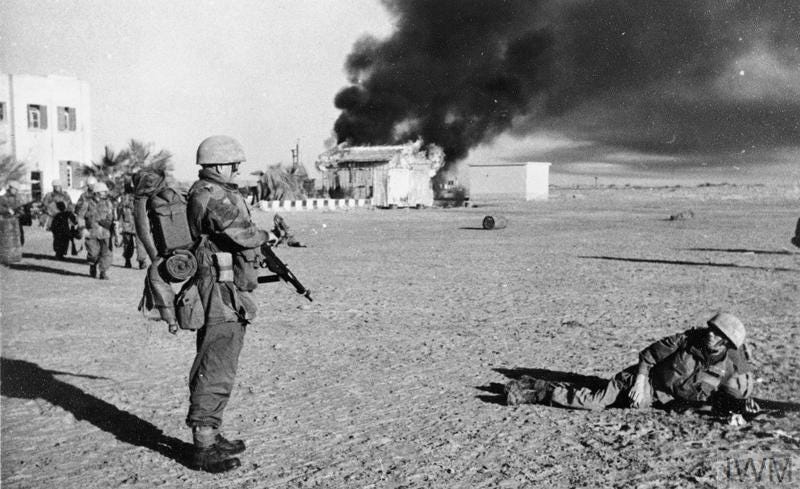
In 1956 Egypt seized the Suez Canal from its Anglo-French corporate owners. They used their control of the canal to blockade Israeli access to the Red Sea. Britain, France, and Israel reacted according to standard pre WW2 rules and invaded the Sinai desert (which contains the Suez Canal). America reacted by forcing a humiliating withdrawal, using the threat of calling in loans owed by Britain and France.
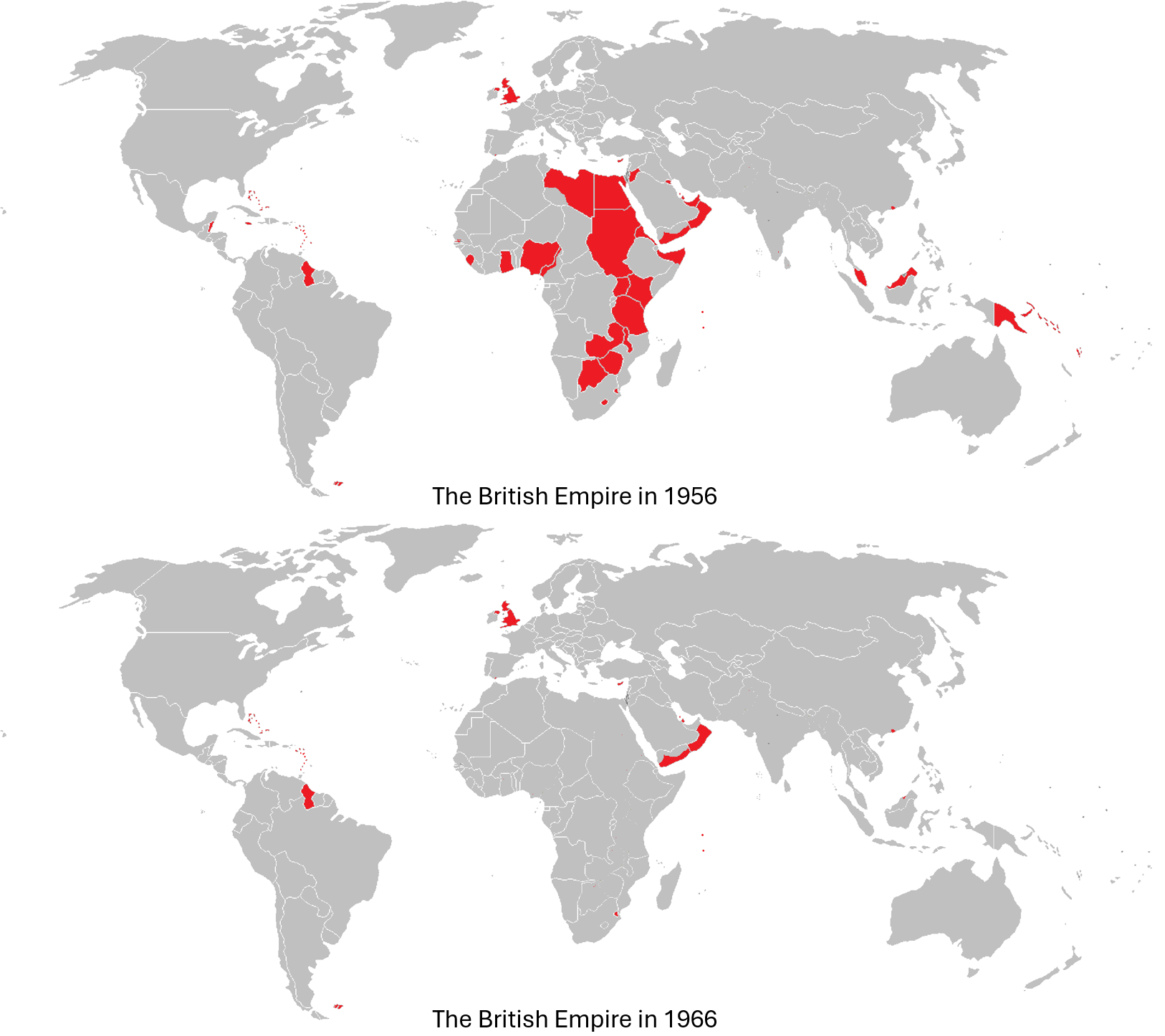
Over the next 10 years Britain granted independence to nearly every imperial possession. By 1966 the British Empire had withdrawn from, or was planning to soon withdraw from every imperial possession except Hong Kong, Gibraltar and a few small islands.
In 1966 Britain was in an economic crisis, driven by the a collapse in manufacturing, inability to make debt payments, the collapse of the pound and of Britain's gold reserves.
In this climate Britain's Labour government, under Harold Wilson, released the 1966 Defence White Paper announcing a wide range of defence cuts to help his secure his landslide victory in that year’s election.
A Defence White Paper is a high level policy document outlining the role of the armed forces. Harold Wilson implemented the 1966 Defence White Paper because he was suspicious of empire and needed defence cuts. It stated the armed forces:
Would not undertake any major military operations alone. Major operations would always be as a member of a coalition;
Top priority was supporting NATO; and
Would not conduct warfighting Operations outside of Europe at all. There were exceptions for a few remaining imperial commitments, all of which wound up by 1970. All other operations outside of Europe would be at less intensity than warfighting and not above the battalion level.
TLDR: The British Empire is over. We are now a NATO contributor and the armed forces only exist to fight in Europe.
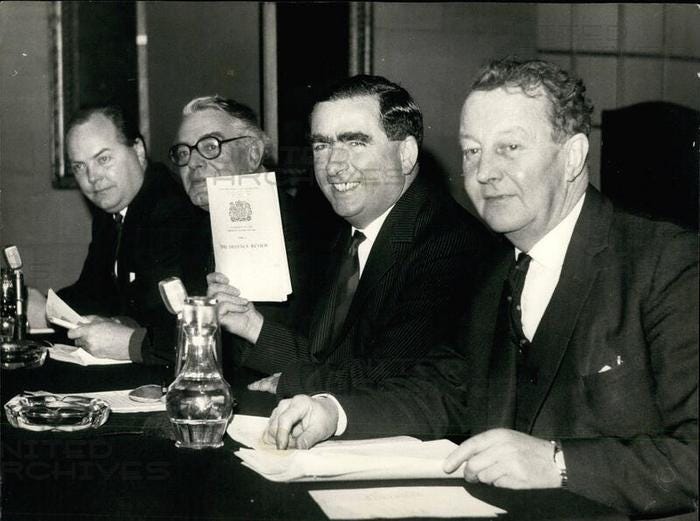
Within the next three years the new fleet carrier program was scrapped as part of a general downsizing of the Royal Navy, there was a strategic withdrawal (nothing remaining beyond minimal local garrisons) of British military presence east of Suez, new aircraft programs were cancelled and the RAF was downsized.
Here’s Sir Max Hastings summarising the 1968 withdrawal from east of Suez better than I ever could:
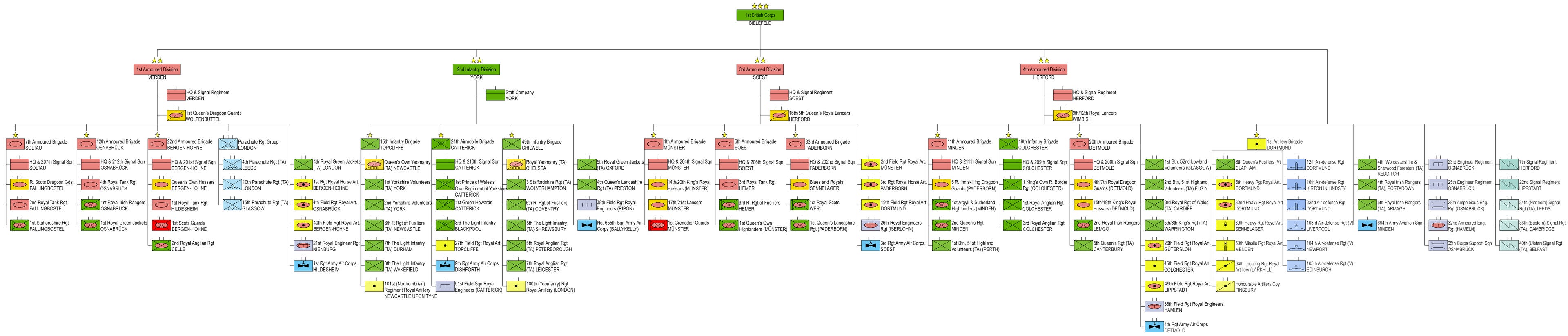
The role of the British Army was home defence and providing a Corps to fight the Warsaw Pact in West Germany (The British Army of the Rhine or “BAOR”). The role of the RAF was home defence and supporting the BAOR. The Role of the Royal Navy was keeping NATO’s shipping lanes in the North Atlantic open (to supply the homeland the the BAOR) and operating missile submarines for nuclear deterrence. In 1972 the role of the Royal Marines became deploying a brigade to reinforce northern Norway in the event of war with the Soviet Union.
The 1966 Defence White Paper had two primary flaws. First, it defined the role of the military as confined to Europe when Britain still had global interests and possessions. Second, it remained in place right up to the eve of the Falklands War.
None of the roles for the service branches involved power projection and its incumbent logistic support outside of Europe. This meant over the next 16 years any capability for power projection further than Norway or Germany would not receive funding.
The rule that all major operations would be fought in a coalition meant any capability that supported operational and strategic level command outside the NATO structure would similarly whither on the vine from lack of funding.
This would have been acceptable if Britain only maintained regional interests, but she retained global interests (a large portion of her economy relying on global maritime trade). She also retained some global possessions (such as the Falklands, but also non-European outposts like Hong Kong and Diego Garcia). This meant British military capabilities were geographically smaller than the scope of threats against her core interests.
![British soldiers of the Welsh Regiment, 1st Battalion in Hong Kong (1967) [850x1316] : r/MilitaryPorn](https://substackcdn.com/image/fetch/$s_!LTm8!,f_auto,q_auto:good,fl_progressive:steep/https%3A%2F%2Fsubstack-post-media.s3.amazonaws.com%2Fpublic%2Fimages%2Fef743aa6-3d72-456a-9f66-5575268e16c1_850x825.png "British soldiers of the Welsh Regiment, 1st Battalion in Hong Kong (1967) [850x1316] : r/MilitaryPorn")
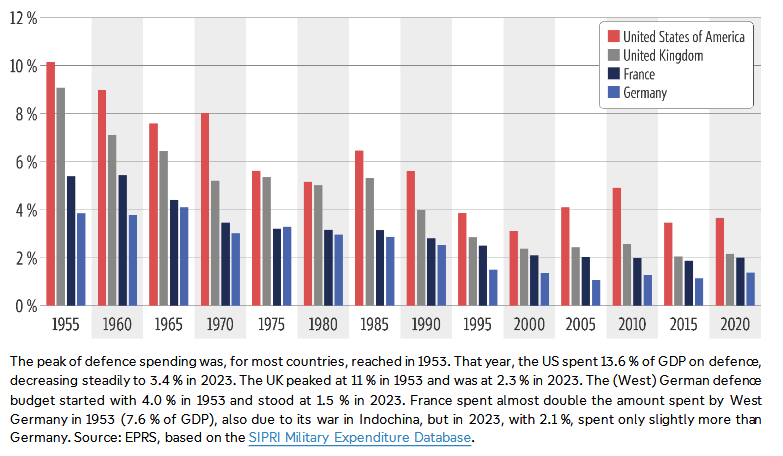
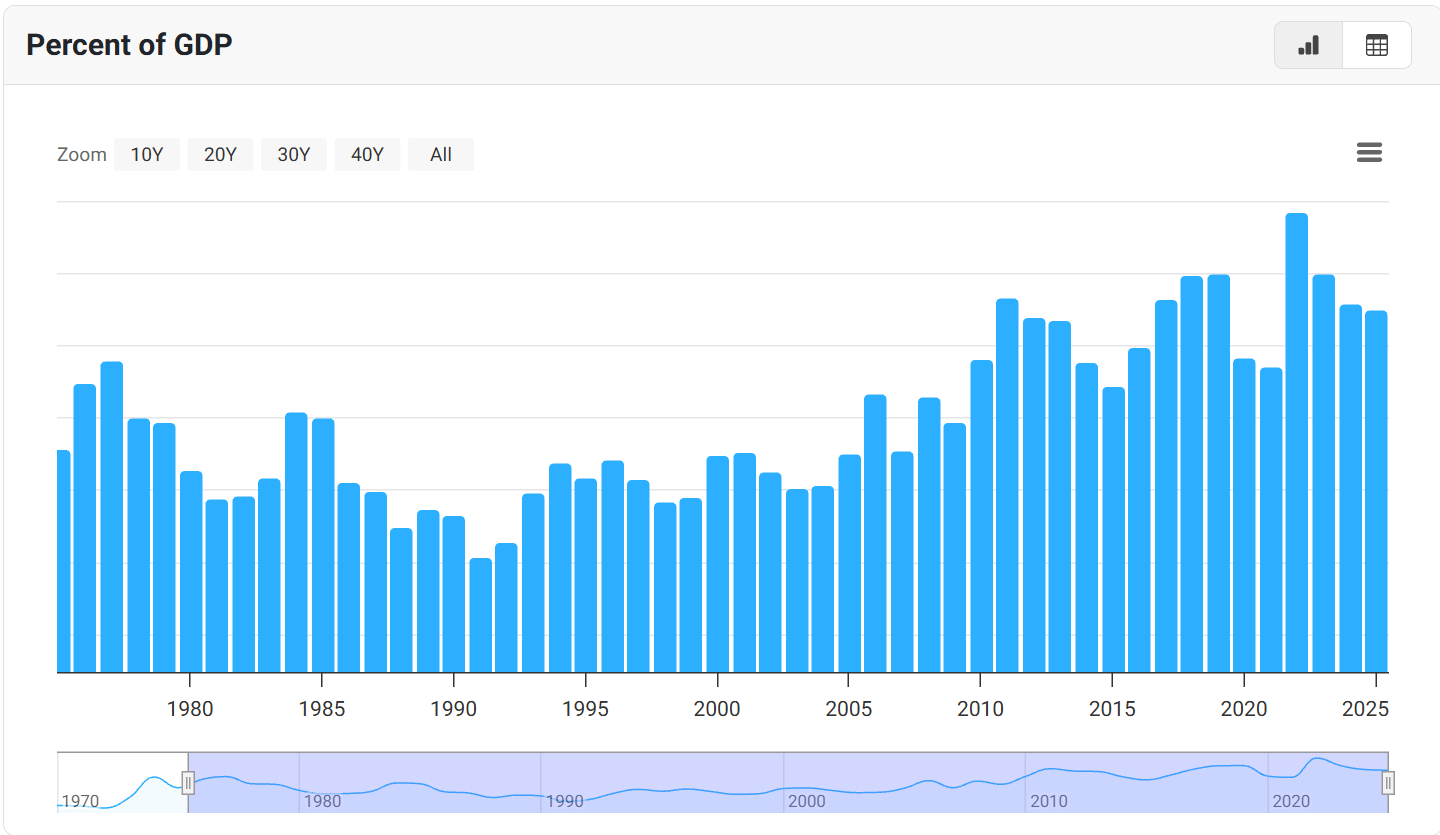
The issue wasn’t simply a lack of defence spending. As you can see from the graph below, British defence spending fell from 7 to about 5% of GDP between 1960 to 1970, but it was then stable around 5% for the 1970s and 1980s. In the decade leading up to the Falklands war by GDP British defence spending was equal to the United States and significantly higher than France and Germany. The issue was were defence spending was allocated, and after 1966 it wasn’t allocated to global power projection.
This mismatch of resources to threats to national interests would not have caused much damage if it was corrected quickly. Since WW2 the UK has generally published a defence white paper every 5-10 years. Prior to WW2 they didn’t have the term, but British national level military strategy was certainly debated and updated at the government level at least every decade. Despite this trend, 1966 White Paper lasted 16 years.
The next white paper was not published until 1981. This would have seen Britain’s carrier and amphibious capability scrapped or sold off in 1982-83. Fortunately implementation had not quite started when Argentina invaded, and it was effectively scrapped in the wake of the Falklands War.
Sixteen years is long enough for a military to retain some institutional memory of global power projection, but little else. Almost all the equipment still in service would have been procured with the European NATO mission in mind and little thought to global commitments. Very senior leadership would vaguely recall doing certain power projection tasks and operations earlier in their career. However, no one junior enough to still be doing hands on work would have experience with those tasks and operations.
This caused no end of problems for the British during the Falklands War. It can be seen in a thousand large through little problems that are well outside the scope of this article. However, I will give three illustrative examples of how 1966 White Paper led to issues in the Falklands War.
Given the lack of global power projection spending in 1966-81, here are three anecdotes from “Logistics in the Falklands” that show what the British were up against in the Falkland’s War.
The RAF had Hercules transport aircraft, but their role was to support NATO commitments in Germany and Norway. The longest trip for this role was 782 miles (1,258 km). The Hercules had an unmodified round trip range 1,380 miles (2,220 km), so there was no need for an air-to-air refueling capability. They didn’t have the equipment installed and the transport pilots hadn’t trained to conduct air-to-air refueling.
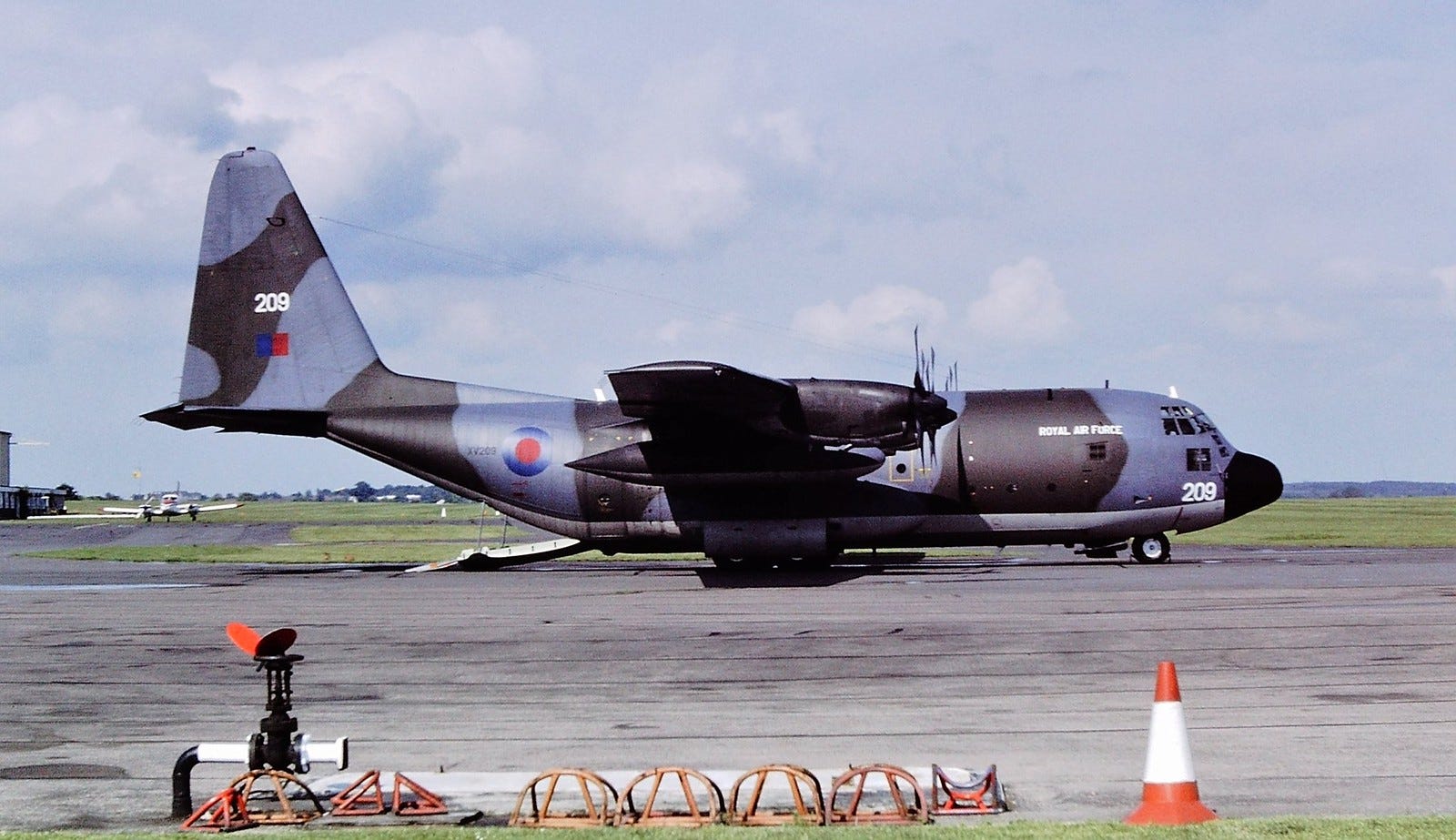
Once the Falklands war started the RAF needed to fly emergency resupply 3,939 miles (6,338 km) from Ascension Island to the Falklands (Ascension Island was a small British possession off the coast of Africa that was about half way between Britain and the Falklands). Within a few days the RAF converted almost the entire cargo area into an additional gas tank and kludged together improvised air-to-air refueling equipment.
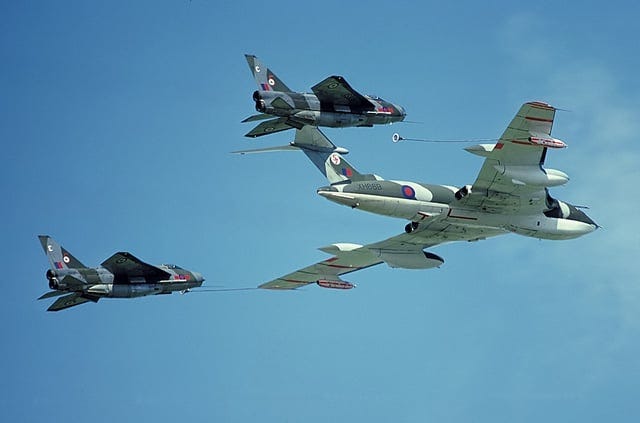
However, the UK’s air tanker fleet was also procured assuming they only needed to be used by fighters. They were built on a repurposed super-sonic bomber called the Handley Page Victor. The stall speed of a Victor tanker was above the maximum speed of a Hercules.
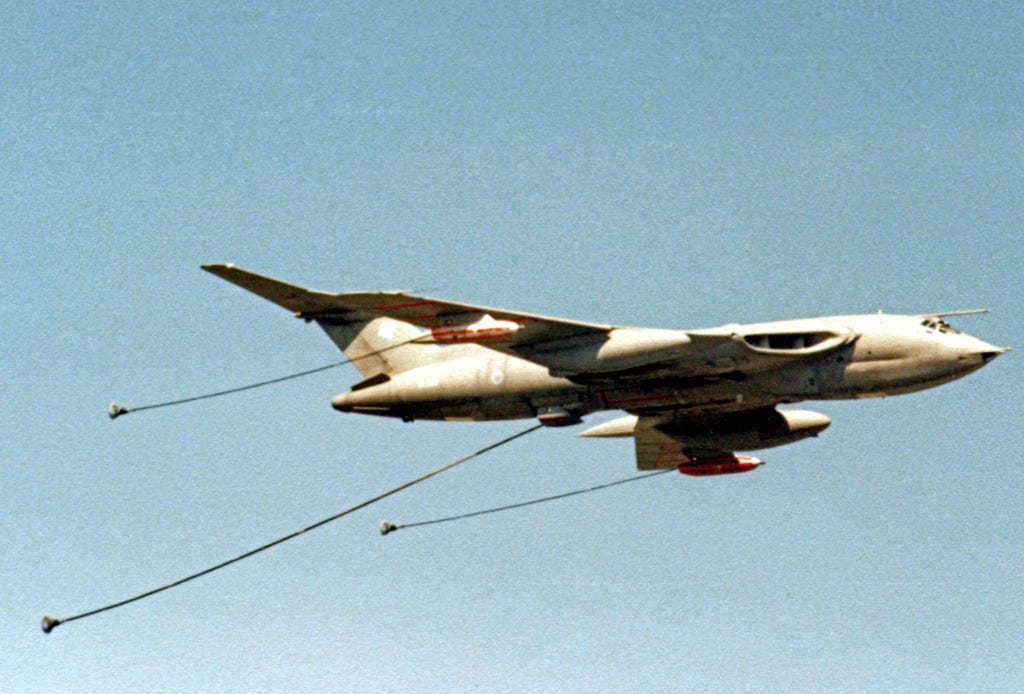
The solution was for the Hercules to refuel while in a dive starting at 23,000 feet. If everything went well they would complete refuelling at 8,000 feet, though they often had to break off as low as 2,000 feet. I cannot describe how insane that is as a plan, but it worked.
Using this system the RAF was able to deliver an average of 6,900 lbs of supplies per aircraft in a flight lasting 24-28 hours. For context, that was about 1/6th of a Hercules’ normal cargo load, amounting to a few pallets strapped to the back ramp. The rest of the plane was a huge gas can.
Similarly there was the famous black buck raids, where the RAF used Vulcan bombers designed at the end of WW2 to bomb Port Stanley Airfield.
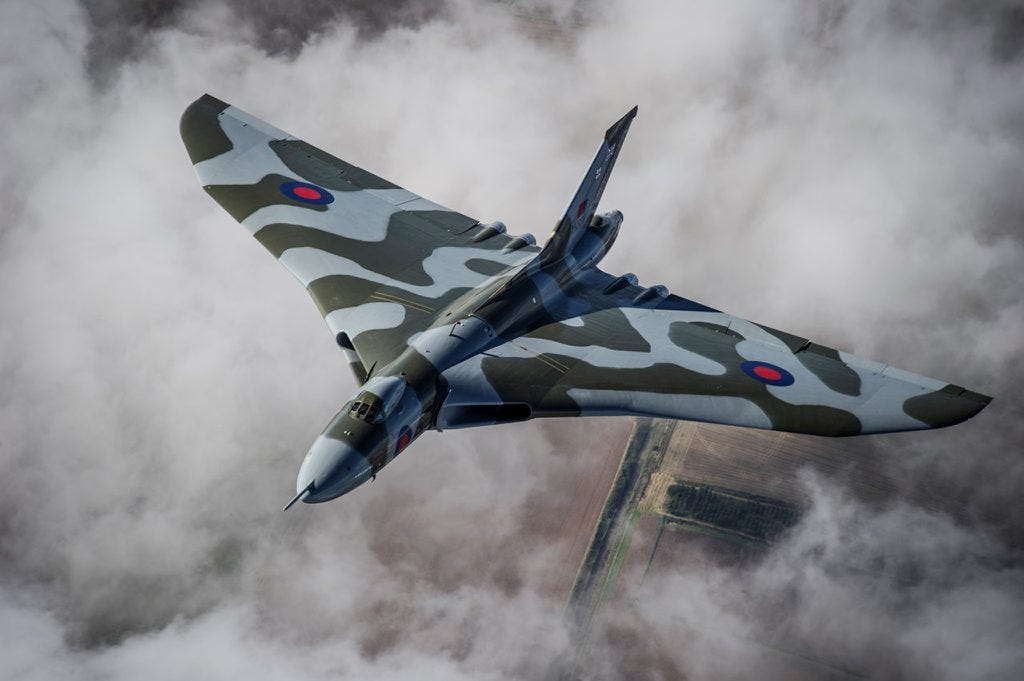
They accomplished this by:
Stripping refuelling rigs for the bombers out of scrap heaps and museums (they had been removed after the 1966 White Paper because they didn’t need to drop bombs outside Europe, which was within their normal range);
Kludging on the electronic jammer pods from another craft called the Buccaneer;
Teaching crews how to conduct air-to-air refuelling and conventional bombing raids in 13 days. Prior to 1966 skills had been taught over a 6-9 month period, but the White Paper dictated the Vulcan bombers only role was nuclear strikes in Eastern Europe; and
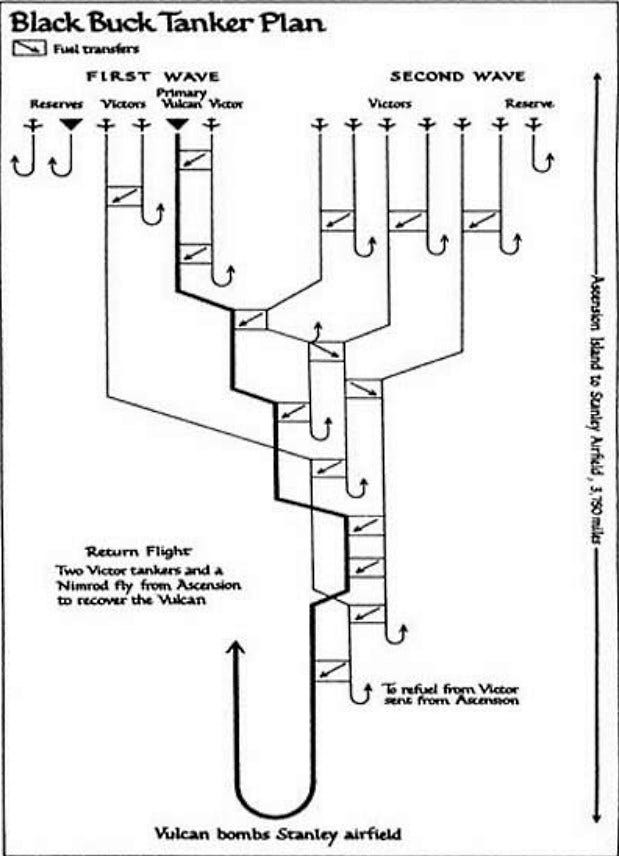
Having 9 tankers refuel 1 bomber and each other in order to have enough fuel to make it from Ascension Island to the Falklands.
Had the RAF been still had a global power projection task they likely would have maintained the Vulcan’s air-to-air refuelling and conventional bombing capabilities. More importantly, the RAF would have had a better air-to-air refuelling aircraft than the Victors.
The Victor had started out in the same supersonic nuclear bomber role as the Vulcan. However, developments in surface to air missiles soon meant these bombers had to fly at low level, which the Victor was unable to do without shaking itself apart. The Victor was not a good candidate for conversion to a tanker aircraft. It used drogue refuelling, was not fuel efficient and could only hold 75,000 lbs of fuel. Drogue refuelling is only really suitable for maneuverable aircraft like fighters and 75,000 lbs isn’t good for much more than giving a bit more range to small aircraft like fighters.
However, under the 1966 White Paper’s priorities the RAF’s only air-to-air refuelling needs were to help fighters move from the British Isles to Western or Central Europe, so the Victor was good enough.
At the same time the USAF (with its global power projection mandate) used KC-135 tankers. These carried 200,000 pounds of fuel which was delivered by a flying rigid boom system. For drogue refuelling, the aircraft has to fly into the refuelling probe. For rigid boom refuelling the aircraft ‘hovers’ near the tanker and the refuelling probe is guided into the receiving aircraft’s fuel port. The KC-135 was also much more fuel efficient.
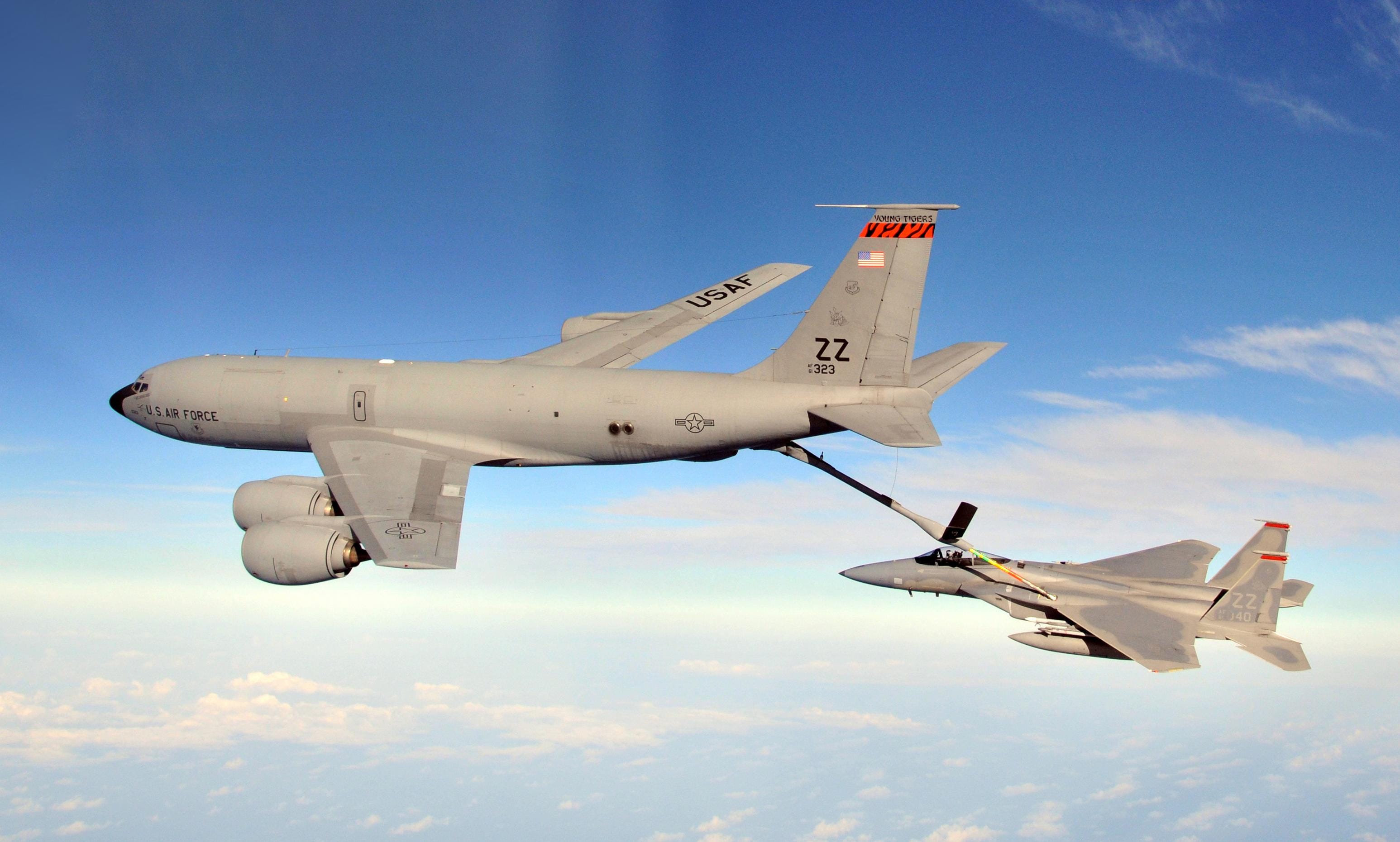
Consequently, while 9 Victor tankers were able to support 1 Vulcan bomber dropping bombs on the Falklands, 9 KC-135s would have been able to support 7-8 Vulcan bombers. That’s the difference between procuring tanker aircraft that are good enough to help fighters get to Eastern Europe, and procuring tanker aircraft for global expeditionary warfare.
The current RAF tanker aircraft still used drogue refuelling, but it has a fuel capacity of 245,000 lbs.
The mission assigned to the amphibious task force was unlike what had been envisioned for support to NATO missions. The British had to do many tasks that hadn’t been exercised in over a decade. Consequently, a lot things were done for the first time while in the combat zone.
Since 1972 the Royal Marines’ task was reinforcing Norway. They became experts in cold weather operations, which was certainly a large advantage in the near Antarctic Falkland Islands. However, this task was really made them ocean mobile infantry rather than amphibious assault infantry. Their training was to rapidly pack onto ships in England, offload from a pier at a Norwegian port (which was still under Norwegian control), reorganise after offloading and rapidly join the battle inland. This is a difficult skill, but it is very different from an opposed amphibious landing on a beach without existing harbour infrastructure.
Starting with leadership, the overall commander was Admiral Fieldhouse. However, he didn’t exercise operational control as his headquarters was located at Northwood in England. Within the operational theatre the carrier battle group was commanded by Rear Admiral Woodward. the amphibious task group (containing the amphibious support ships and their escorts) ships were commander by Commadore Clapp and the landing force was commanded by Brigadier General Thompson, the commander of the marine commando brigade. Under British doctrine the Amphibious task group commander was in charge of the landing force until it was offloaded ashore with sufficient supplies to break out from the landing area.
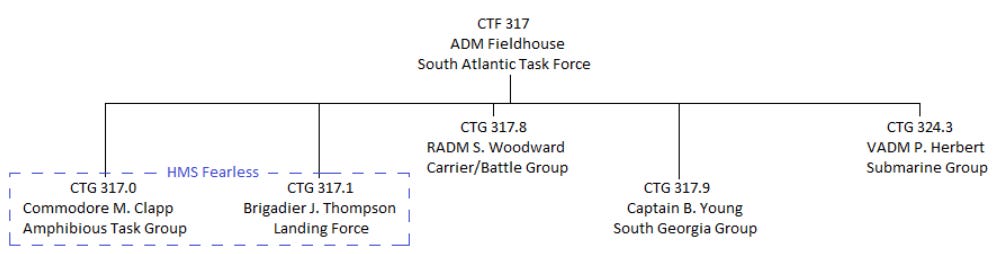
These were all very experienced senior officers who are regarded to have done an excellent job during the Falklands War. However, they were not experienced when it came to conducting opposed amphibious operations.
In 1982 Admiral Fieldhouse had a distinguished 38 year career; as a submariner. He was posted to submarine related roles from 1947 to 1981 he only had 3 years of postings outside of submarine related roles. He had never conducted an amphibious operation, either in war or in training.
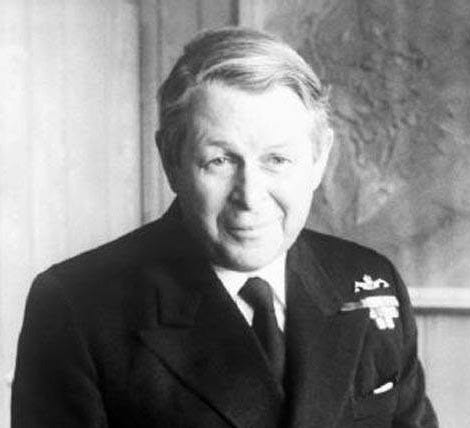
Rear Admiral Sandy Woodward was also a submariner. All his postings were submarine related from 1954 to 1978. He then spent 2 years as commander of an air defence destroyer2 and 2 years as a planning officer at the Ministry of Defence. In 1982 he was appointed because he happened to be commanding the carrier task force on exercise in the Mediterranean that was reinforced to become the Carrier Battle Group used in the war. Rear Admiral Woodward also had never conducted an amphibious landing, either on operations or as a peacetime exercise.
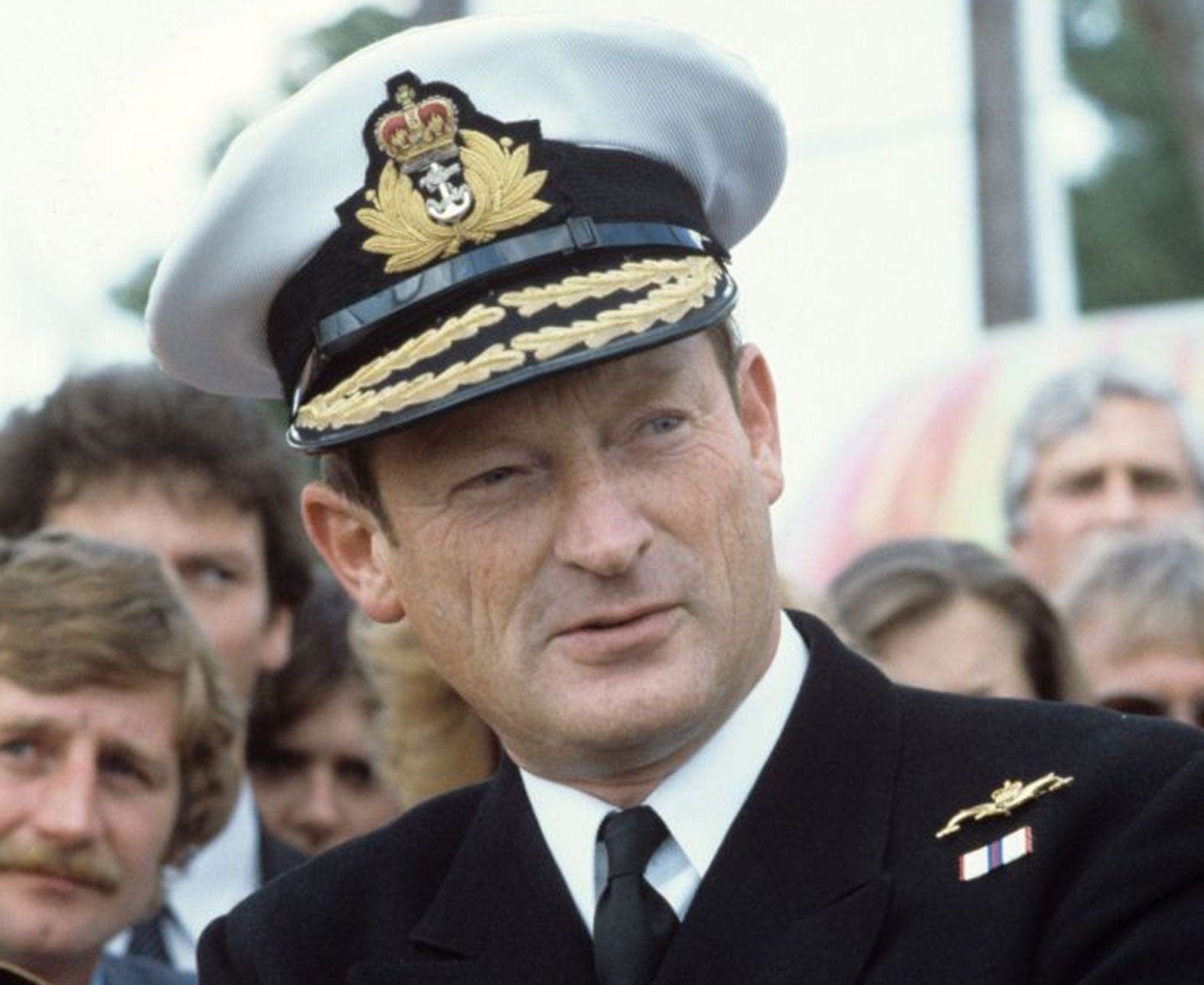
Commadore Clapp was one of the most experienced amphibious warfare officers in the Royal Navy. However, this experience was primarily in planning and developing doctrine. During the Malaysian counter-insurgency he inserted Ghurkha landing parties while commanding a minesweeper. He had been the naval director of the Joint Maritime Operational Training Staff, which worked on the kind of inter-service cooperation exercises that were critical to tasks like amphibious landings. In 1981 he was appointed the head of Amphibious Warfare for the Royal Navy. However, the landings at San Carlos were the first time he conducted an amphibious landing.
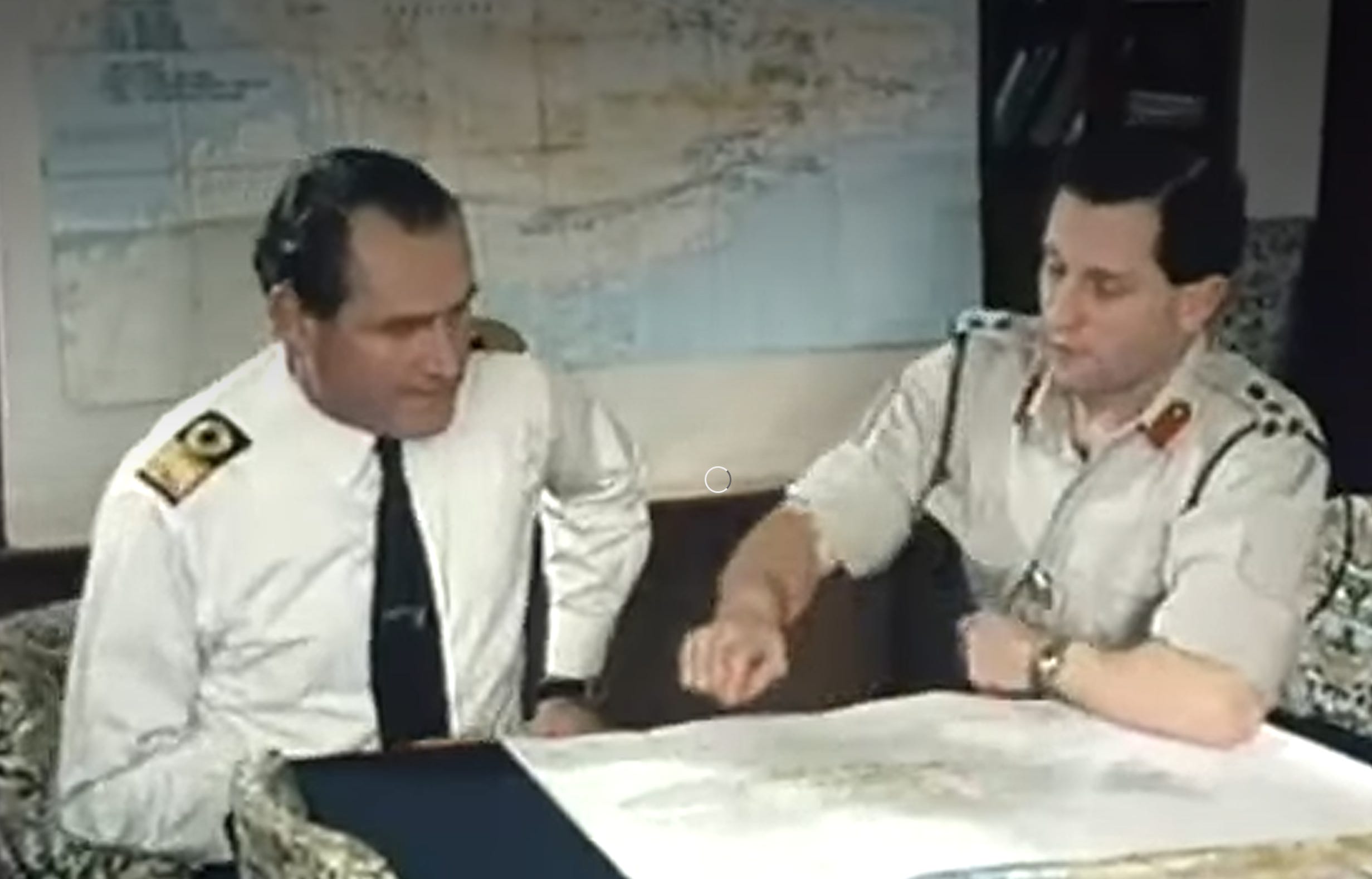
Brigadier General Julian Thompson was very experienced when it came to amphibious operations. In 1982 he had spent 30 years in the Royal Marines. He commanded a battalion within the commander brigade for three years and had been in command of the commando brigade for a year when the Falklands war broke out.
However, he had not exercised a Brigade level opposed amphibious landing as a battalion of brigade commander, since during these command postings the Royal Marine’s role was to reinforce Norway through landing at friendly controlled ports.
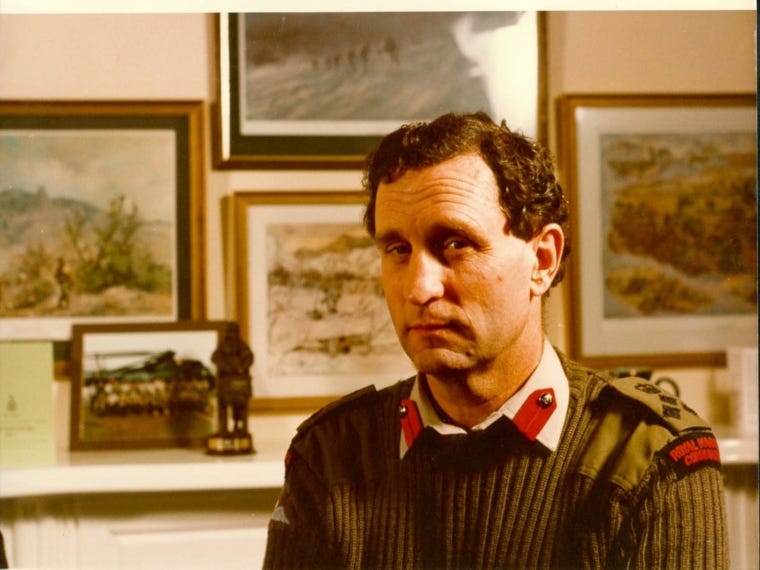
BGen Thompson estimated there were about 4 people in the Marine Commando brigade who had participated in the Suez landing in 1956, which was their entire hands on experience with wartime amphibious operations.
Almost all the Royal Marines in the manoeuvre battalions had never practiced an assault landing at the brigade level. To address this experience gap, Clapp and Thompson planned on conducting brigade level landing rehearsals at Ascension Island. On arrival, they discovered the beaches on that island were only suitable for company level rehearsals. They changed the rehearsal location to South Georgia Island (which had recently been recaptured from Argentina). This rehearsal was scrubbed due to lack of time before the winter storm season by the time the amphibious task force arrived in theatre.
This means there was no brigade level amphibious landing rehearsal. So for the majority of the Royal Marines their first ‘rehearsal’ of this type of complex operation was the actual landings at San Carlos.
During the San Carlos landings two of the five manoeuvre battalions were paratroopers with no amphibious assault experience. Several boat loads of paratroopers didn’t react when hearing “down ramp, out troops” (the command to disembark the landing craft). The landing craft operators discovered they got the appropriate reaction by shouting “jump” (the command for a paratrooper chalk to exit the aircraft during a paradrop).
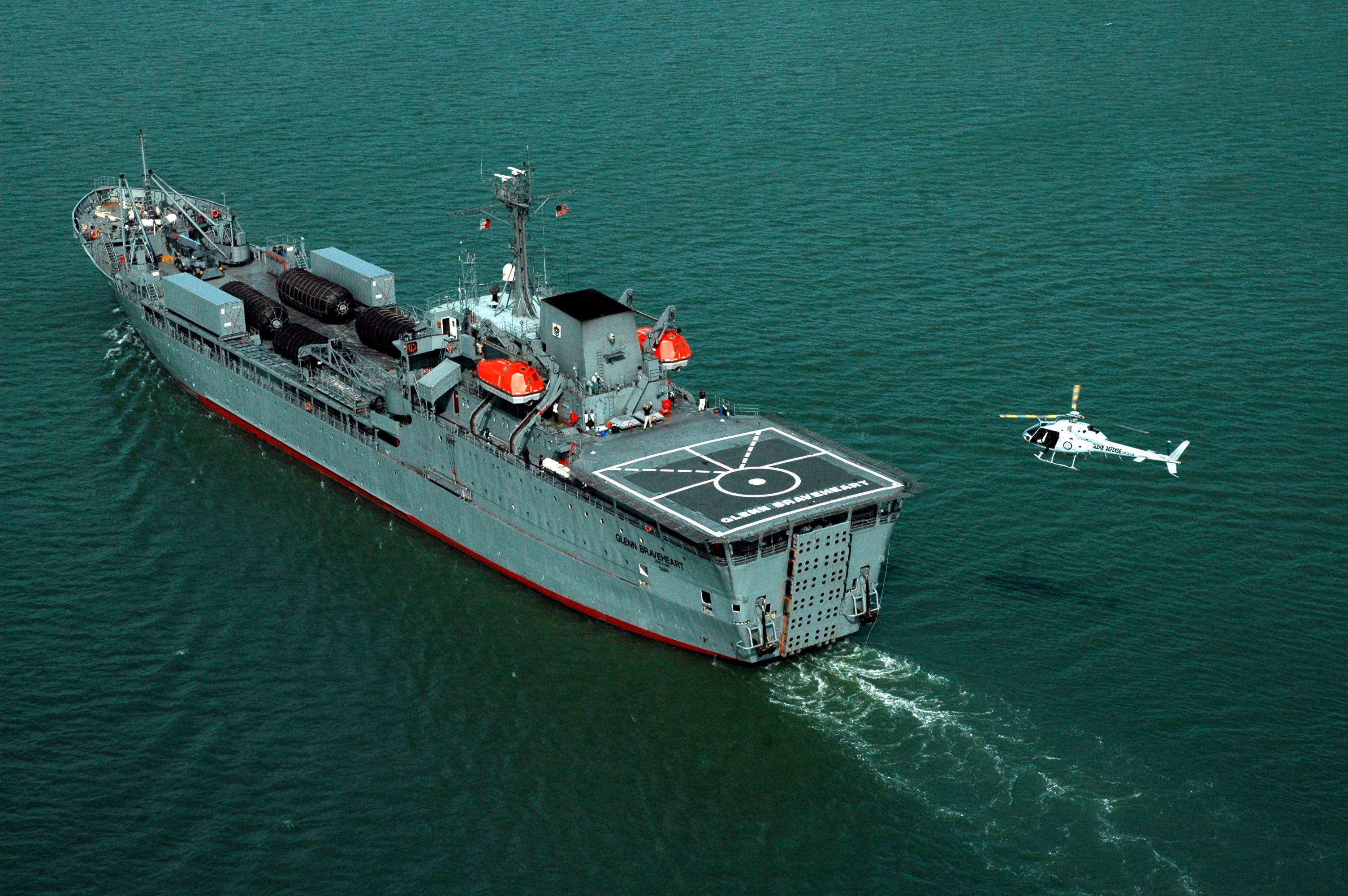
The critical logistics link from the logistics loitering area to the beachhead at San Carlos was the Landing Ship Logistics of the Roundtable Class. They had a welldeck aft (a floodable compartment with a ramp for launching landing craft) and clamshell doors at the bow. The clamshell doors were designed so the LSL could beach itself and have vehicles drive directly onto the beach. I’ve used a World War II photo of a landing ship tank to illustrate this capability, because I can’t find a photos of a roundtable class using it’s bow doors to offload vehicles.
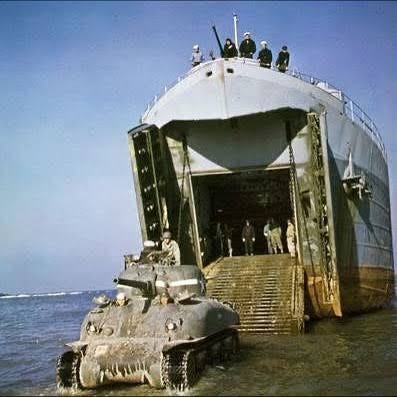
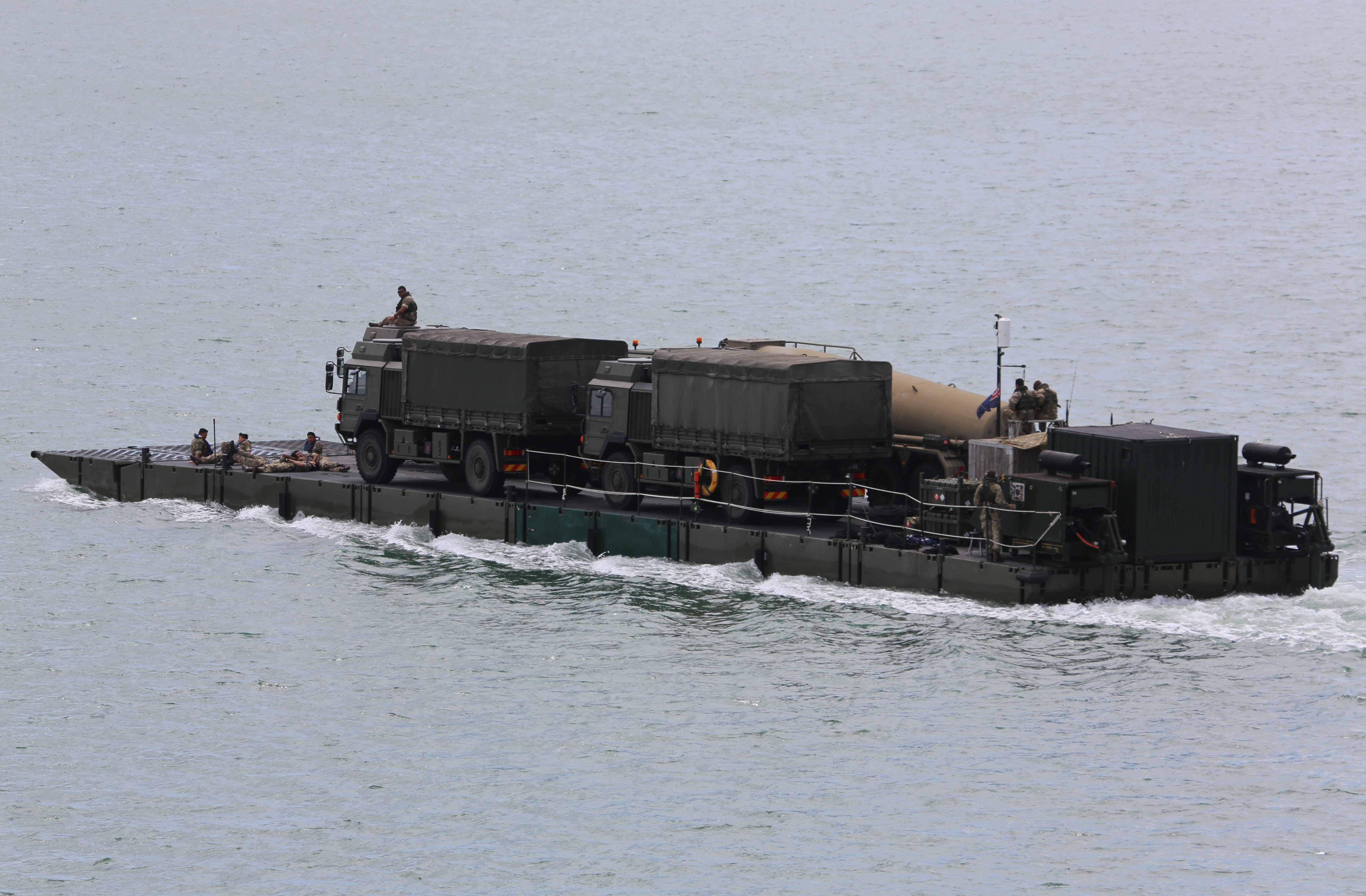
This is because the LSL crews didn’t practice or exercise beaching their vessels in the decade leading up to the Falklands War. It is a difficult maneuver to exercise properly, as there is a significant risk. The ship will become lodged aground, be damaged by the seabed, or will cause significant environmental damage. The round table class was ordered in 1961, prior to the 1966 Defence White Paper. They were designed with a bow launching capability that is critical for amphibious landings away from friendly control ports. However, after the 1966 Defense White Paper, there was no policy priority to justify the potential expense of damaging the LSLs practicing this capability. Therefore it atrophied from lack of training and rehearsal. Instead, offloading the LSLs was done by transferring supplies to barges called Mexeflote’s. This took considerably more time, but it was preferable to the risk of an LSL being permanently beached or seriously damaged due to that atrophied skill.
Here we come to one anecdote that isn’t directly a result of the 1966 Defence White Paper, though even here I find it partially to blame.
Within days of the Argentine invasion the British military went from peacetime operations to departing for the Falklands at a dizzying speed. Argentina invaded on April 2. A carrier task force (which included the Marine Commando Brigade’s headquarters and advance party) departed Portsmouth on April 5 (within 3 days). The rest of the brigade and its supplies were loaded onto a mixture of Royal Fleet Auxiliary ships and requisitioned civilian vessels. These various vessels departed Britain between April 4-9 (2 - 7 days after the invasion).
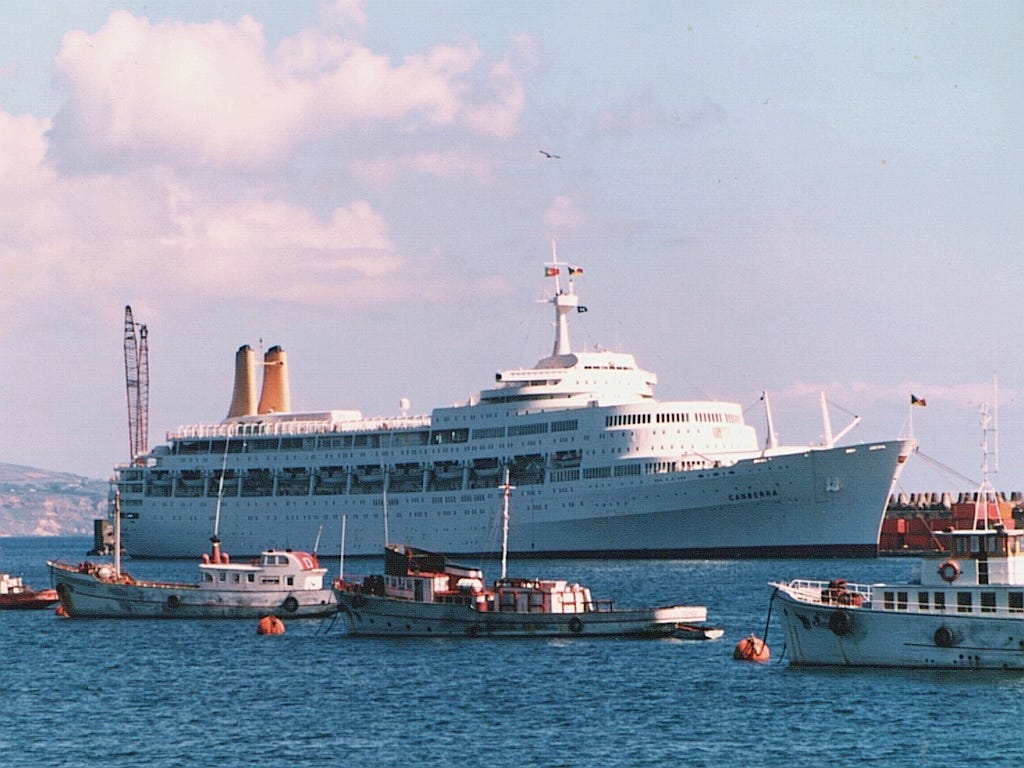
Pulling this off was an astounding feat. However, it meant the planning for what supplies the landing force needed to fight the war occurred while they were at sea. The supplies hurriedly packed onto ships in the 2-7 days after the Argentine invasion were a guess made at a time when the planners didn’t know where they were landing, their mission after the landing, the composition of Argentine forces on the Falklands, the eventual size and composition of the British land force. They didn’t even have military maps of the Falklands until they were half way to Ascension Island.
The British therefore organised a second waive of supply ships to carry all the additional items they identified as necessary during that at sea planning process. Most of these supplies were on a container ship called the Atlantic Conveyor.
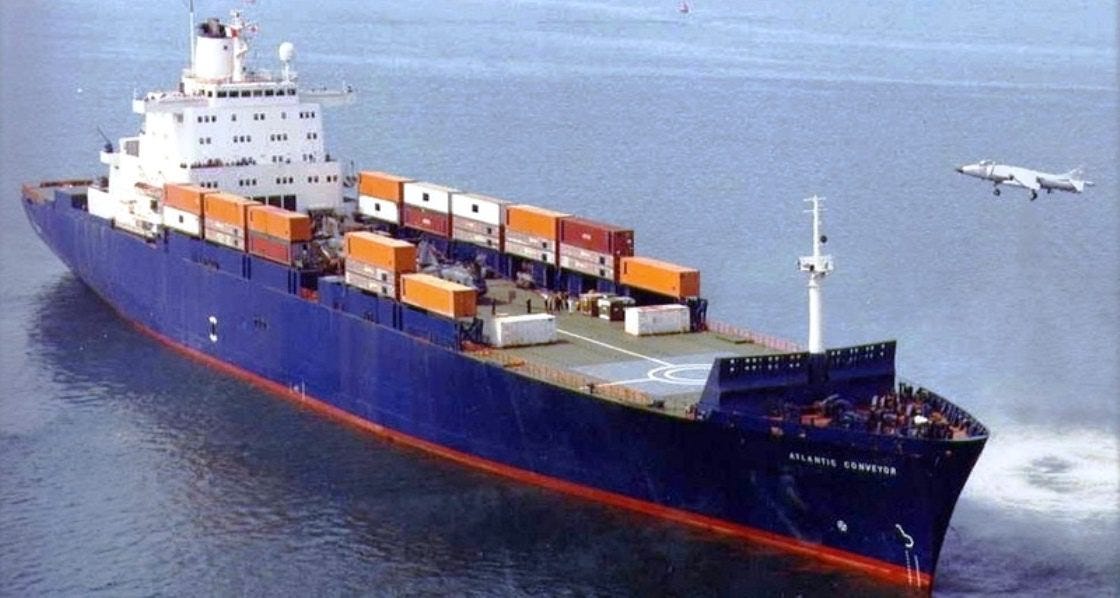
As the Atlantic Conveyor approached the Falkland Islands it was struck by two Exocet anti-ship missiles, caught fire and sank.
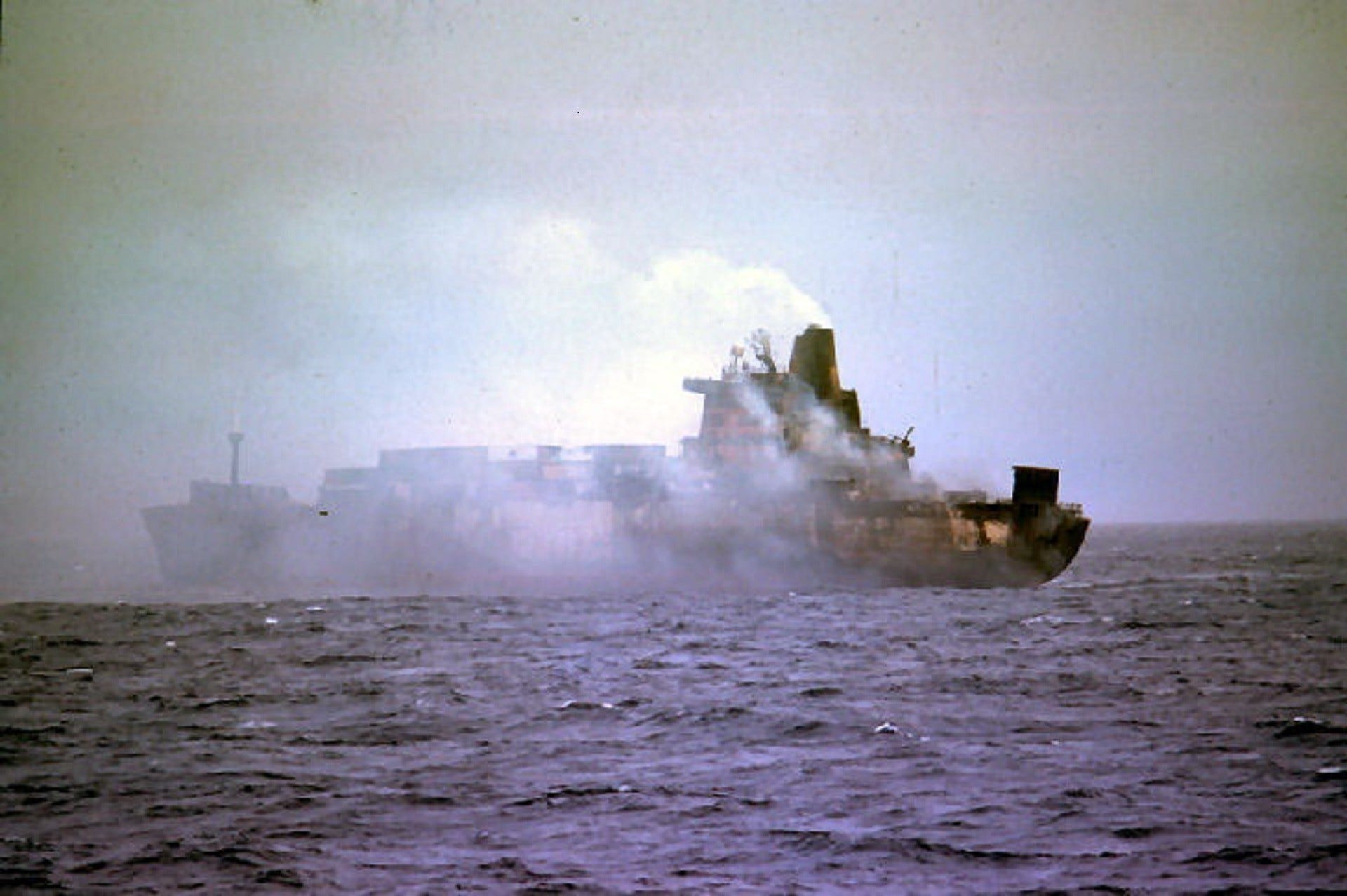
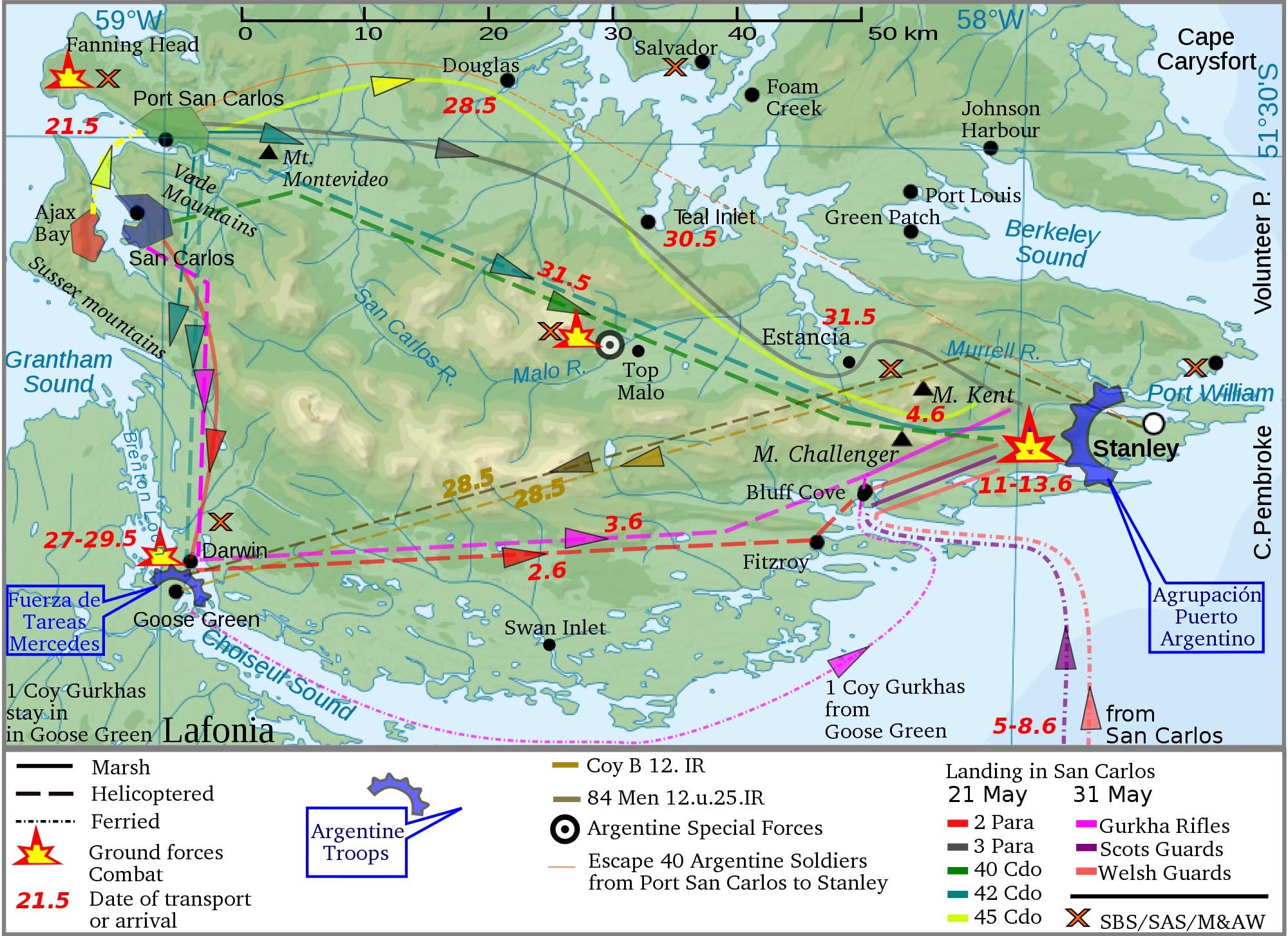
Most histories of the Falklands War state that the Atlantic Conveyor went down with 3 of the 4 Chinook helicopters that were the backbone of the logistics chain from the landing site in Port San Carlos to the assault positions outside Port Stanley. Consequently, almost all the British troops had to march (Yomp or Tab in Marine and Para slang) the approximately 56 mile (90 km) distance over rough terrain.
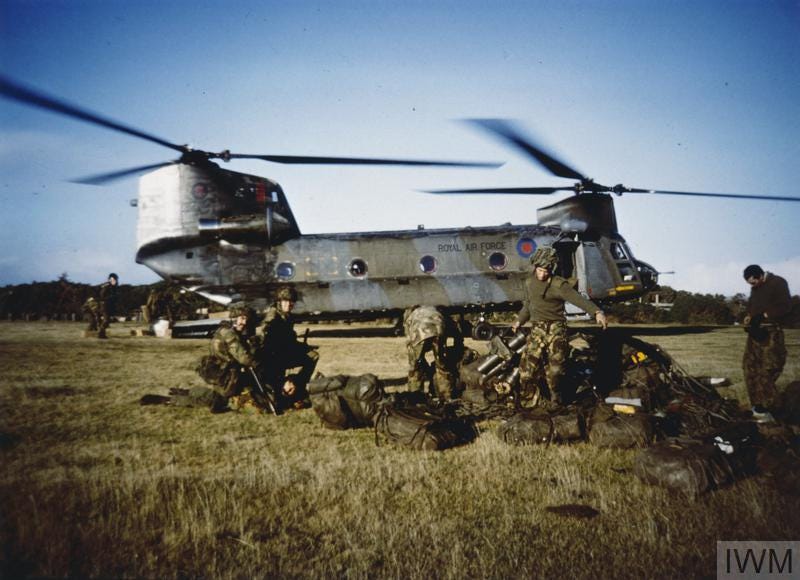
This common narrative is true, but it massively understates the seriousness of the loss of the Atlantic Conveyor.
Here’s a more detailed list of the important stores that went down with the Atlantic Conveyer:
Tents for 10,000 soldiers;
Aluminium matting to create a Harrier runway ashore;
Small patrol boats;
Fuel handling equipment;
Water desalination equipment;
Electrical generators;
6x Wessex light/medium lift helicopters;
3 of the 4 Chinook heavy lift helicopters; and
All the spare parts and tools for keeping the Chinook helicopters flying.
Item #9 is particularly important as most accounts of the war point out that one the the Chinooks was in the air when the Atlantic Conveyor sank, so at least the British had a quarter of their heavy lift helicopters. However, without any spare parts that Chinook was one mechanical fault away from being grounded. If you know how often helicopters break down you’ll understand how precarious that made this salvaged asset.
Despite this the land force still successfully conducted the final assault on the hills surrounding Port Stanley. This assault consisted of two reinforced brigades supplied from a divisional supply area 70 miles (130 km) to the rear, over terrain that literally had no roads. They then advanced across open ground with no cover from fire to defeat an enemy with superiority in numbers and firepower that had spent 6 weeks digging into a series of hills and mountains.
So how can I blame the sinking of the Atlantic Conveyer on the 1966 Defence White Paper? I can’t; but I can blame the cargo manifest of the Atlantic Conveyer on the White Paper.
The Atlantic Conveyor essentially contained everything the British land force realised was critical to conducting their mission after they had a chance to conduct some planning. This was only necessary because there were no contingency plans for a short notice combat deployment outside the framework of a European NATO task. Had the British military been given a mandate commiserate with their global risk exposure, the majority of the supplies on the Atlantic Conveyer would have been identified earlier and been loaded distributed across the ships that departed in early April.
The disadvantages facing the British armed forces were not just the result of a lack of funding. In 1982 defence spending was 5% of GDP, which is more than enough to globally deploy and sustain a division (-). In fact, the British military had this capability from the end of the Cold War until about 2015, during which defence spending was about 3.5 - 2.5% of GDP.
These disadvantages were driven by the defence priorities of the 1966 Defence White Paper, which made the military’s task NATO commitments in Europe and little else. Equipment had not been procured with global power projection in mind. Training and exercises were organised around those NATO tasks. Consequently, to give one example among dozens, most British Marines and Paratroopers went ashore at San Carlos having never practiced a brigade level amphibious assault.
The lesson that’s usually drawn from the Falklands War is the superiority of a professional military made up of long service volunteers, operating from within a system that rewards improvisation. This is true, and it is why the British defeated Argentina’s military force of frankly poorly led conscripts.
However, there is another lesson that is just as salient: Government strategic defence policy must be aligned with the real threats to a nation’s vital interests. In 1966 the British government pretended all its national interest could be protected through NATO contributions. But at that time Britain’s economy depended on global maritime trade and she still held significant territory outside Europe. In the game of geopolitics you must not constrain your reach without similarly constraining your vulnerabilities.
The British economy still depends on global trade. In fact, according to World Bank data, the portion of the British economy tied to global trade has increased from 49.6% in 1982 to 62.5% in 2026.
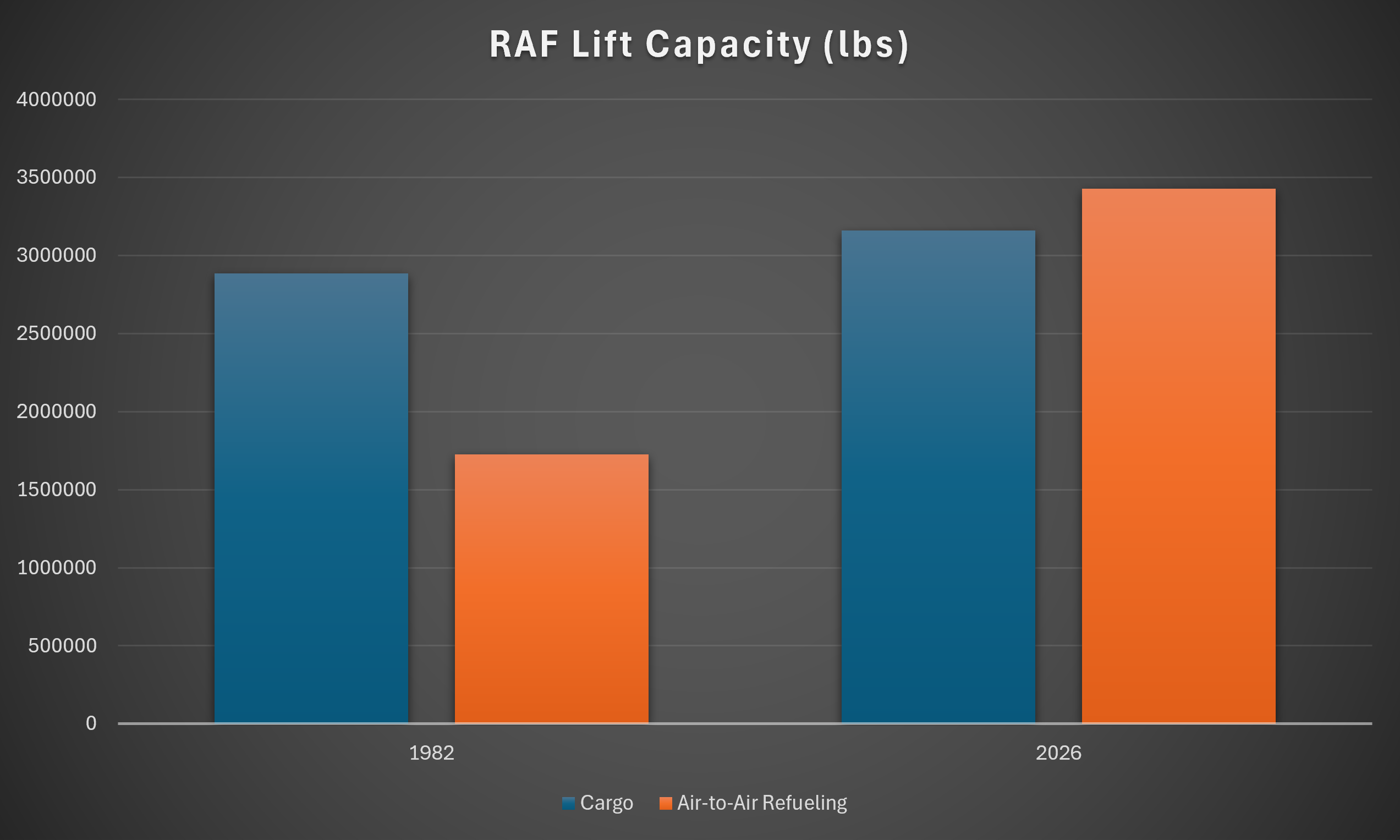
It is true that since the end of the Cold War the British military has prioritised global power projection over European NATO commitments. Even today, at what’s generally acknowledge to be a crisis in British defence capabilities, the RAF has slightly more cargo capacity, and over twice as much air-to-air refueling capacity if measured in pounds. Measured by distance there’s no comparison, as the current RAF aircraft are about 50% faster and have twice the range of their 1982 counterparts.
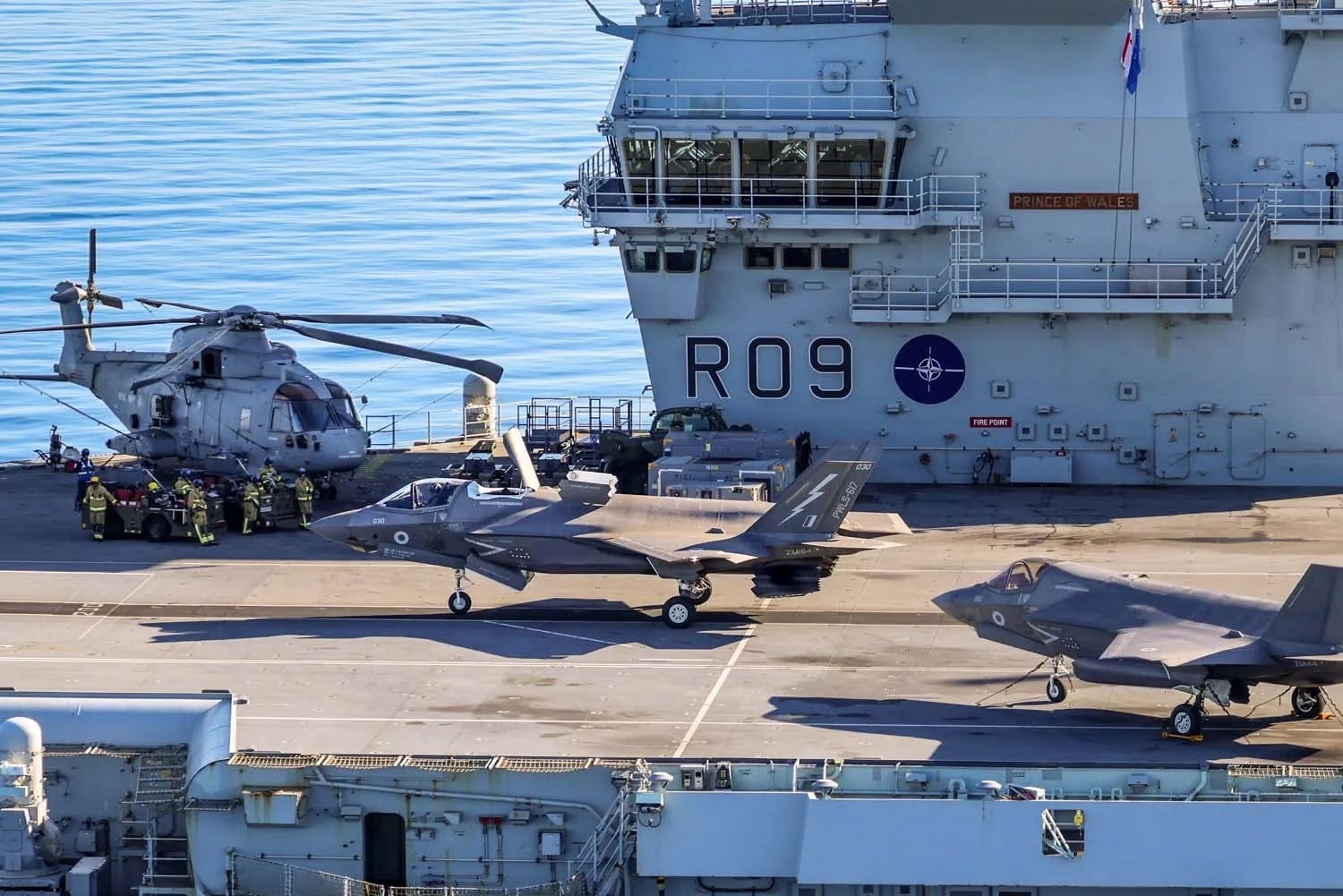
Currently the UK could send a force of 2 brigades to fight on the far side of the world. It could logistically support them better than in 1982. However, the Royal Navy couldn’t provide anything like enough escort ships and their carrier air power is currently in shambles. When equipped for carrier operations, the Queen Elizabeth class was designed to operate 36x F-35s and 4x helicopters. When equipped for amphibious assault (as the replacement to the Fearless class role) it was designed to carry about 40x helicopters of various types. In the class's most recent deployment the air wing was 8x F-35s, 5x helicopters and 2x uncrewed logistics aircraft. The Ministry of Defence anticipates having enough carrier capable F-35s for a full complement sometime in the 2030s.
At 5% of GDP going to defence spending on a regionally focused military you need to improvise when suddenly fighting on the far side of the world. At the UK’s current 2.1% defence spending (which frankly hasn’t been wisely spent by Whitehall) it eventually doesn’t matter how much global power projection is prioritised.
I calculated the 1982 Falklands deployment as the equivalent of 2.5 brigades. The ground force was 2x brigades that were overstrength for infantry, but under strength for everything else and very limited divisional troops.
For 2003 the British deployed 5 manoeuvre brigades, plus 3 brigade equivalents for divisional and corps level troops.
By 2010 British capabilities fell to 4 manoeuvre brigades, withe the same amount of divisional and corps level support.
The 2026 capabilities assume 2-3 manoeuvre brigades and 2-3 brigades of divisional and corps level troops.
Ironically HMS Sheffield, which was one the first major Royal Navy loss of the war.
Comments
Nothing yet. Say the first thing.
Sign in to join the conversation.