
This final article will examine and compare airframe attrition in Desert Storm versus Epic Fury. Airframe attrition is divided into damaged and lost aircraft, but my analysis mostly looks at losses, as this is a more reliable data set.
Coalition losses on Desert Storm were higher than you would expect, given the general narrative of that war, but much lower than most earlier conflicts. Epic Fury losses seem much lower than Desert Storm, but when measured by the size of the air fleet or by sortie US losses were either somewhat higher than Desert Storm, or over four times higher.
This wide spread of how the two campaigns compare is driven by how you factor in drone losses. Clearly, they are not as significant as losses to manned aircraft (financially, in terms of capabilities and morally), but drone losses do need to count to some extent. The kinds of drones used by the US Air Force are expensive and hard to replace assets with significant capabilities. They are often used on the riskiest missions, which reduces the number of manned aircraft losses.
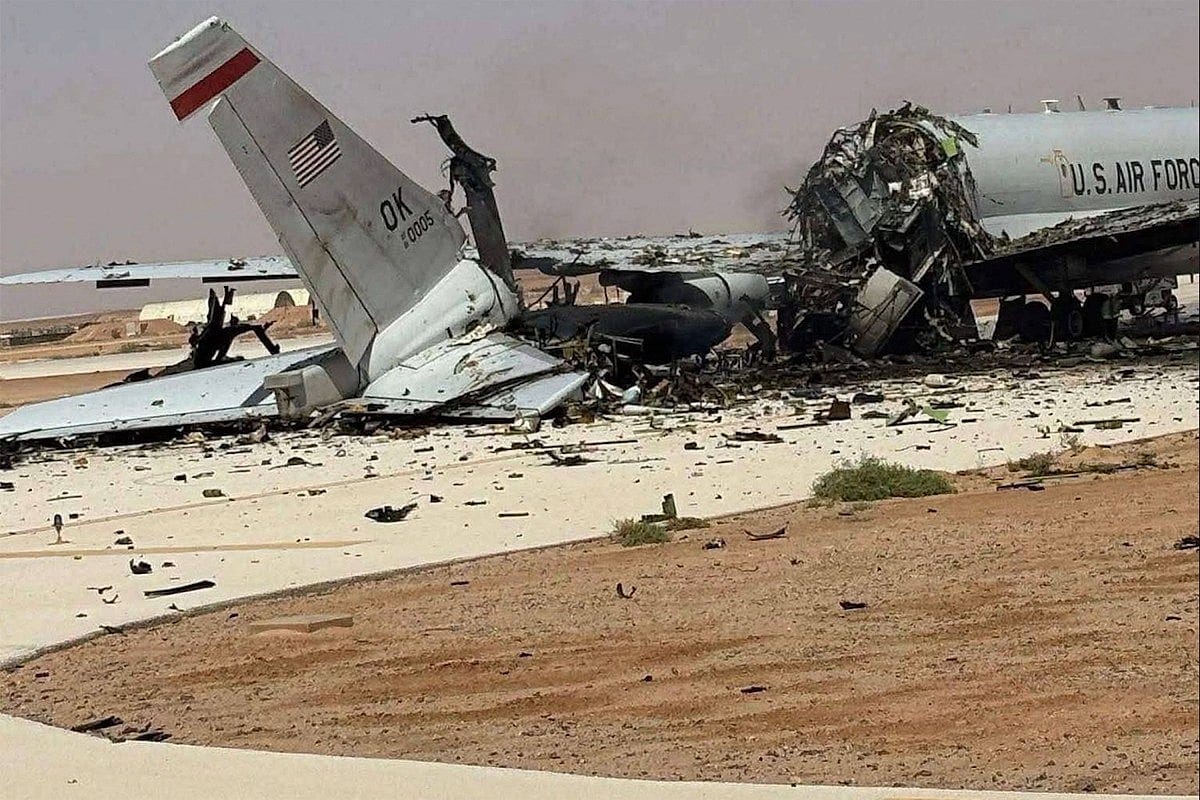
Depending on how you account for drone losses, I conclude that aircraft attrition on Epic Fury were either slightly worse or much worse than on Desert Storm. However, U.S. aircraft attrition on Epic Fury was lower than most historical US air campaigns, and well within a long term sustainable rate.1
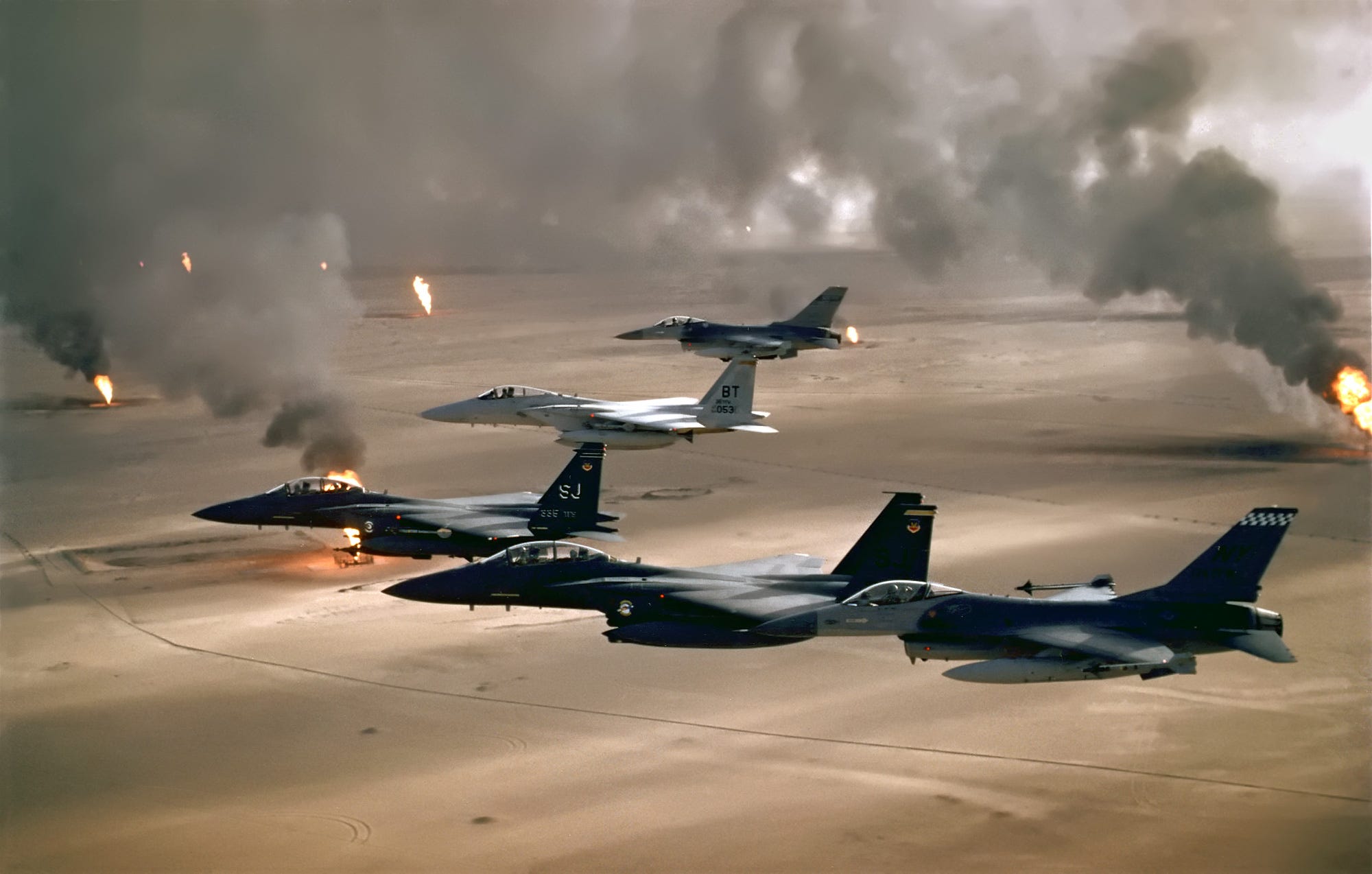
Due to the Airpower Survey we have a dizzying array of details regarding aircraft losses during Desert Storm. The headline stats are:
For fixed wing aircraft combat the Coalition suffered 122 damaged and lost airframes;
US only losses for fixed wing combat aircraft were 39 lost and 117 damaged; and
For helicopters the US suffered 23 lost and an unknown number of damaged airframes. There were no helicopter losses by other Coalition members.
However, a few caveats are needed. I would rely on US numbers much more than coalition numbers. The US had total access to its own records, but relied on voluntary reporting for other members of the coalition. During the operation a loss needs to be reported accurately, but reporting of damaged aircraft can be fudged, or at the very least subject to nation specific definitions. The percentage of US lost aircraft (71%) is a but lower than its percentage of the air fleet (78%). This is largely driven by the RAF being given the most dangerous mission of the opening stages; cratering the runways of Iraqi airfields.

Somehow the US suffered 96% of all damaged aircraft during Desert Storm. This is statistically very improbable, so it’s much more likely the coalition damage statistics are unreliable. This means for trustworthy statistics you should rely on losses only or US only numbers.
Secondly, the Airpower Survey did not include helicopters in its analysis. Statistics regarding helicopters during Desert Storm is surprisingly limited. They also played almost no combat role until the last 3 days of the conflict, as their job was mostly supporting the ground maneuver units, which did not cross the line of departure until the last 3 days of the war. The US deployed slightly more helicopters than fixed wing aircraft on Desert Storm, so adding in their loss statistics tends to do more harm than good in understanding airframe attrition. Therefore I will largely ignore helicopter losses for this analysis.
Overall the US had about 3 fixed wing combat aircraft damaged and 1 lost per day. In the course of the campaign this meant about 2.5% of US aircraft were lost and 2.5% were damaged. The coalition loss rate was slightly higher at about 2.8%, and as mentioned I don’t trust the coalition damage rate.
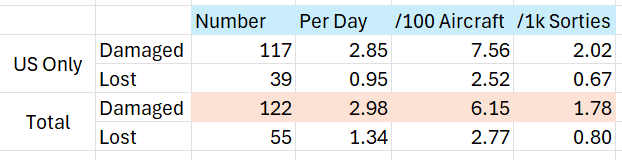
This equates to about 2 aircraft damaged and 0.7-0.8 aircraft lost for every 1,000 combat sorties.
The largest cause of lost aircraft was operational loss, which is a catch all category for losses not caused by enemy action. In the context of Desert Storm this would mean accidents and pilot error. The next largest cause of loss was Iraq’s air defences. There was just one loss (0.6%) from the Iraqi air force.
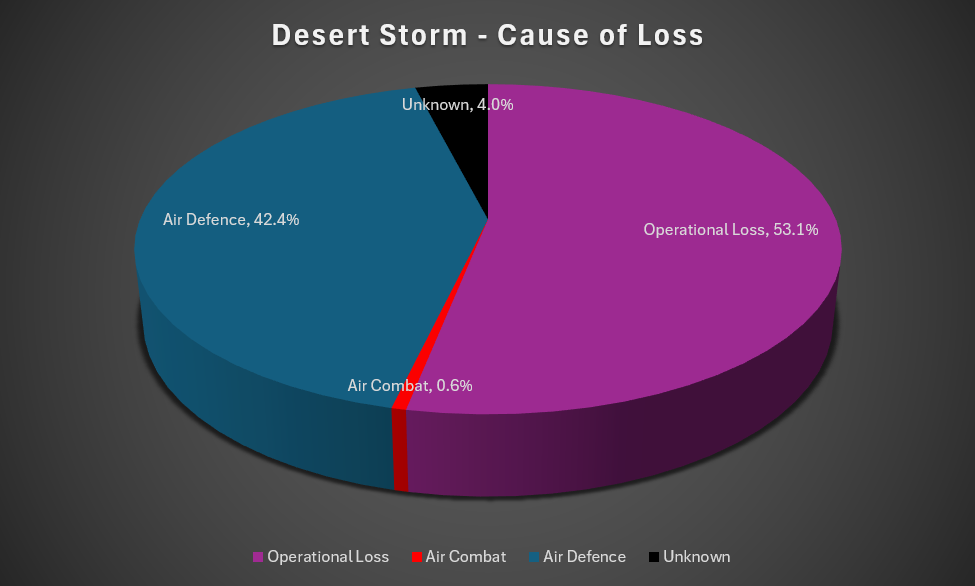
The percentage lost to air defences (42.7%) is actually quite close to US numbers from WW2 (around 47%), and much lower than the percentage from Vietnam (about 70%). The operational loss percentage is about twice as high as WW2 and Vietnam (both at about 25%). The higher operational loss rate is not because there were more accidents during Desert Storm. Rather, the losses to enemy action were so low that operational losses made up a much large percentage, despite flight safety improvements between WW2 and the 1990s.
Airframe losses also continued throughout the campaign. About 50% of lost airframes occurred in the first 10 days of the air campaign. After that losses were at a steady rate until the very end of the war.
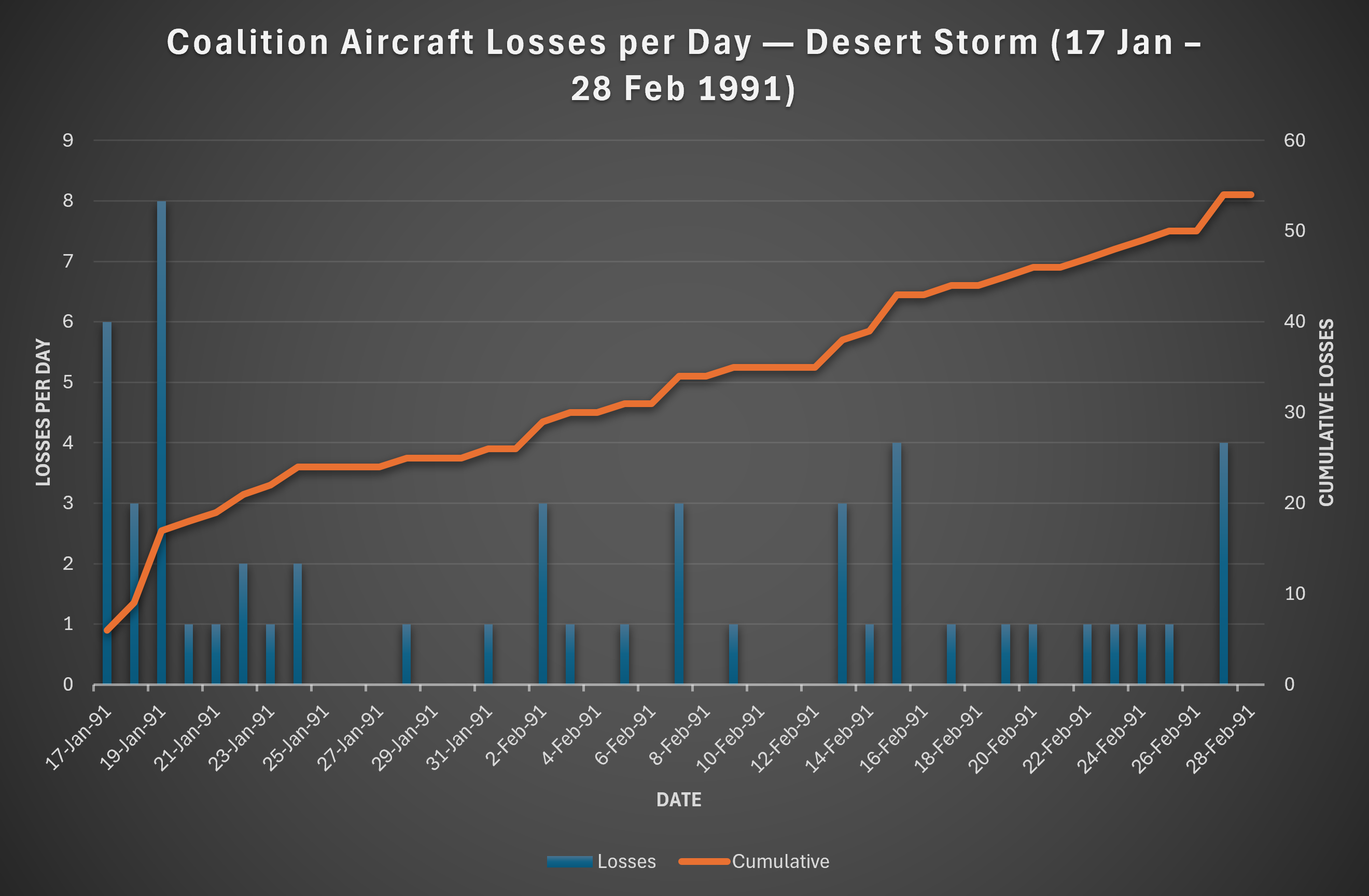
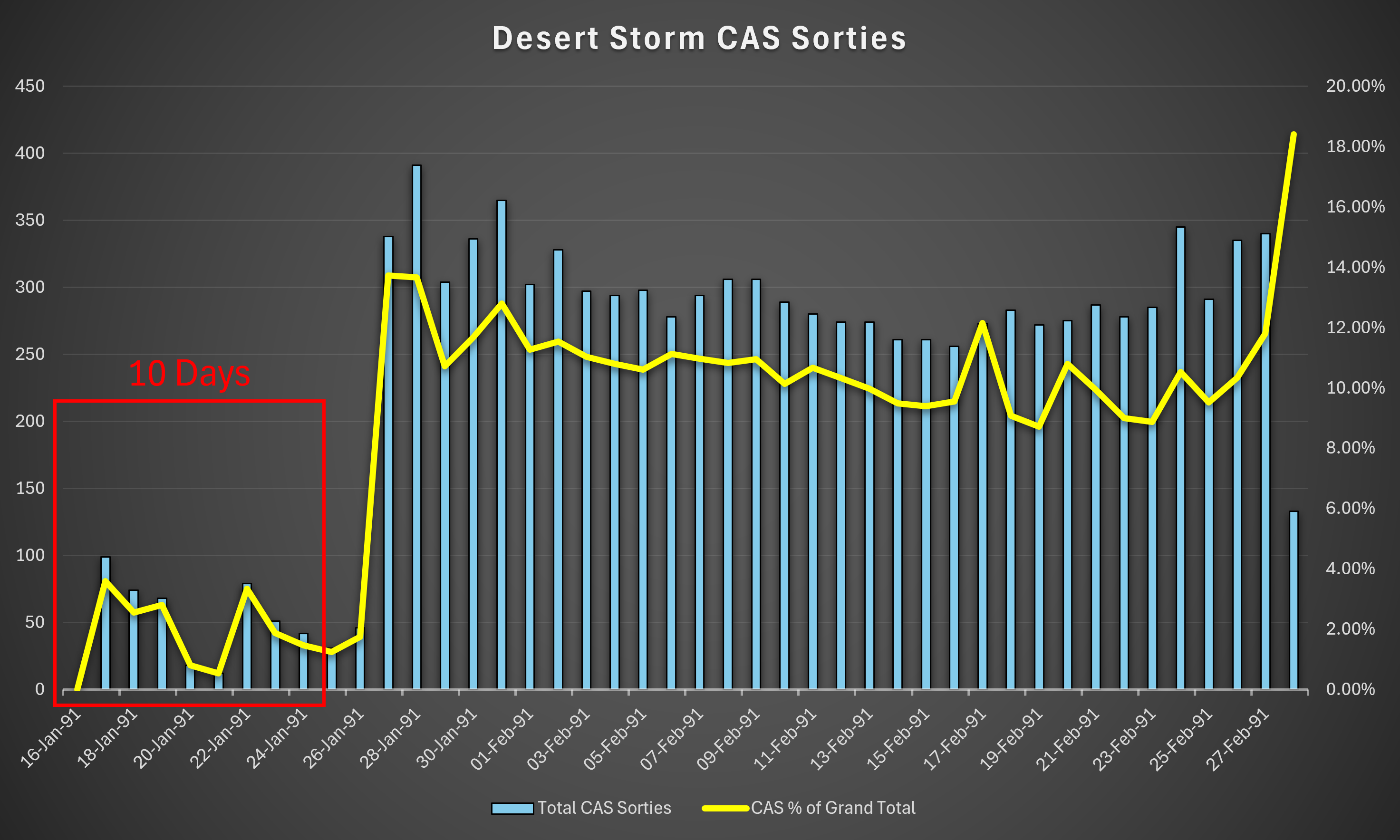
This higher loss rate was during the same 10 days where the coalition was focused on destroying the Iraqi air force and air defence system. By the end of that 10 day period the entire Iraqi air force was either destroyed or had flown to Iran seeking asylum. Iraqi’s long range air defences were also destroyed or very close to it.
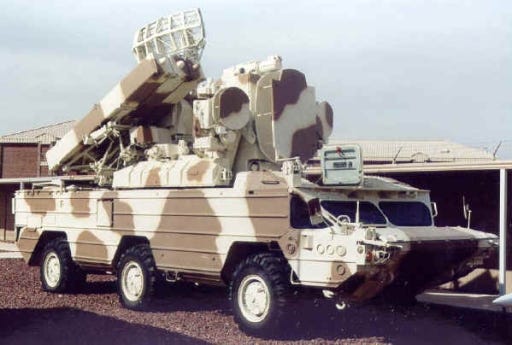
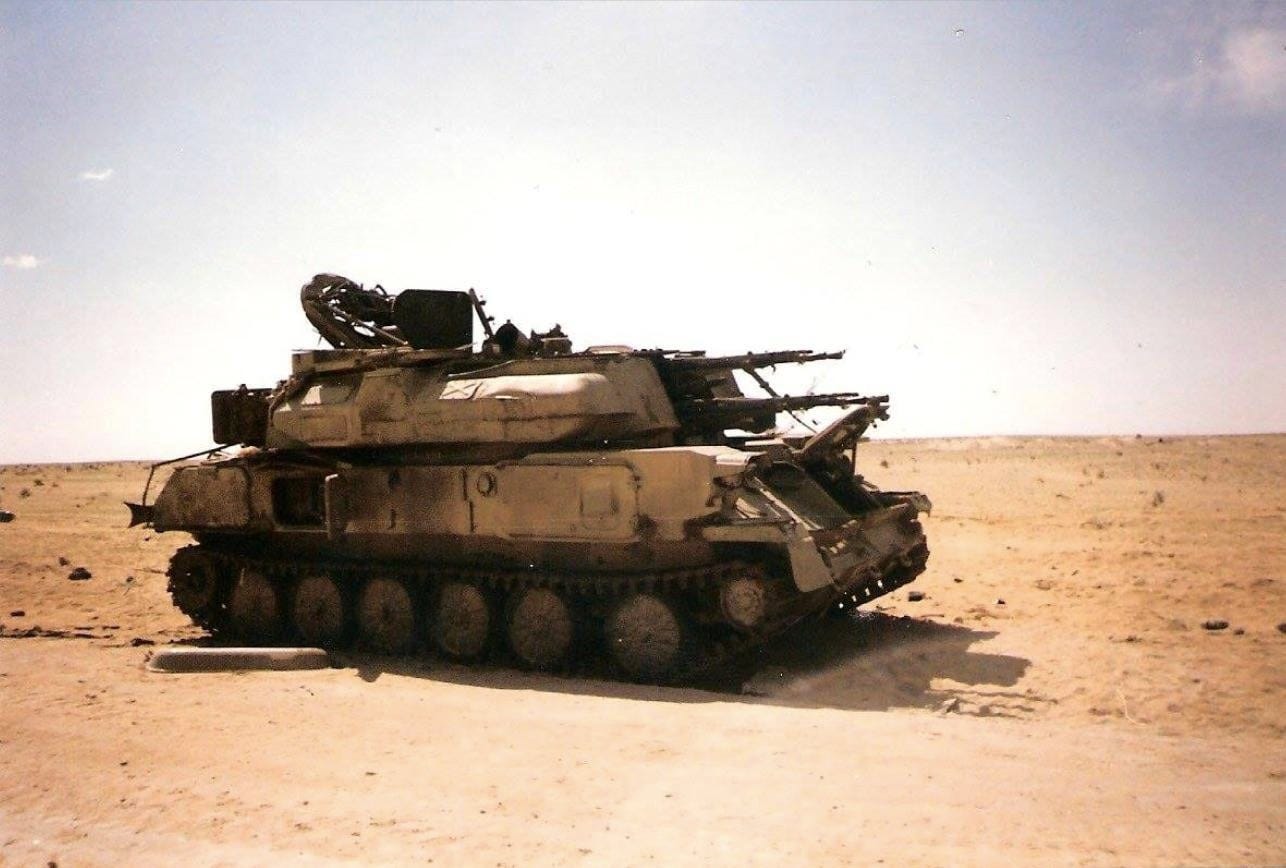
However, the coalition continued to take losses right through the rest of the war, mostly from infrared SAMs (heat seeking) and anti-aircraft artillery. Both these are what’s called passive systems, meaning they do not emit a detectible electromagnetic signal prior to launching their attacks. Medium to long range defense systems all rely on a active systems like radar. This gives them much longer range, but also makes them an easily identifiable target. Desert Storm shows how the enemy will always retain some passive air defence, like infrared SAMs and anti-aircraft artillery. This means you can significantly reduce risk by flying at altitude or keeping away from value targets, but there is always some risk. This is why modern militaries don’t speak of destroying enemy air defenses, but of suppressing them.
In conclusion, the best metric for comparing Desert Storm aircraft attrition is U.S. lost or damaged aircraft per 100 aircraft and per 1,000 sorties. By these metrics roughly 1% of the US air fleet was lost and 3% of it was damaged during Desert Storm. US losses can also be expressed as 2 damaged and 0.7 lost aircraft per 1,000 sorties. Almost all losses were from accidents (53%) and air defence systems (42%).
The Pentagon has yet to officially release details about airframe losses on Epic Fury. There were some OSINT accounts that tried to tack losses during the conflict, but there was a lot better security for Epic Fury than there has been in recent conflicts like Ukraine.
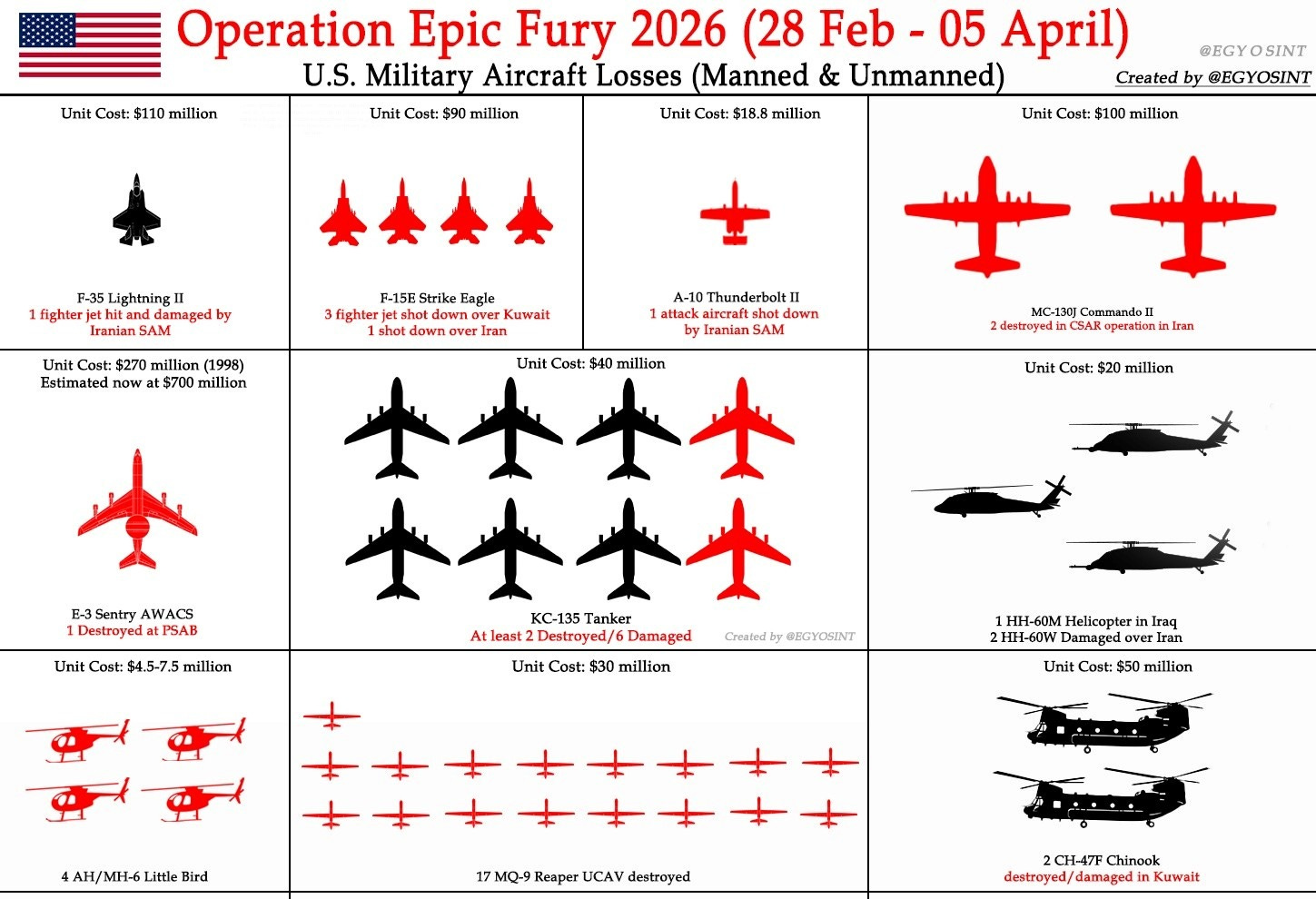
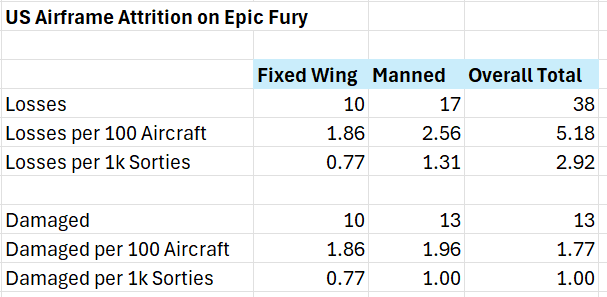
By reviewing online photographs and reports in the months since Epic Fury I have been able to confirm the following US airframe losses:
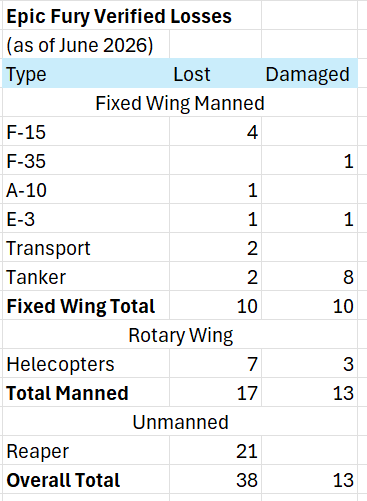
A few things jump out. To begin with, attrition is about 75% losses to 25% damaged, whereas Desert storm had the opposite percentages. This is probably a mixture of the US not reporting damaged aircraft (understandable while the conflict is still ongoing) and flying less low level sorties over Iran. During low level sorties anti-aircraft guns and machine guns often cause minor damage to aircraft.
The second thing to jump out is that drones (unmanned aircraft) make up 55% of US lost airframes. It is hard to say how these losses should be statistically calculated. Drones are typically chosen for sorties that have a higher loss rate, since the ethical and financial cost2 of a lost drone is much lower than a manned aircraft. Drones also allow an air force to attempt missions they normally would avoid with manned aircraft. Therefore, to a certain extent drone losses do not count to the same extent as manned aircraft losses.
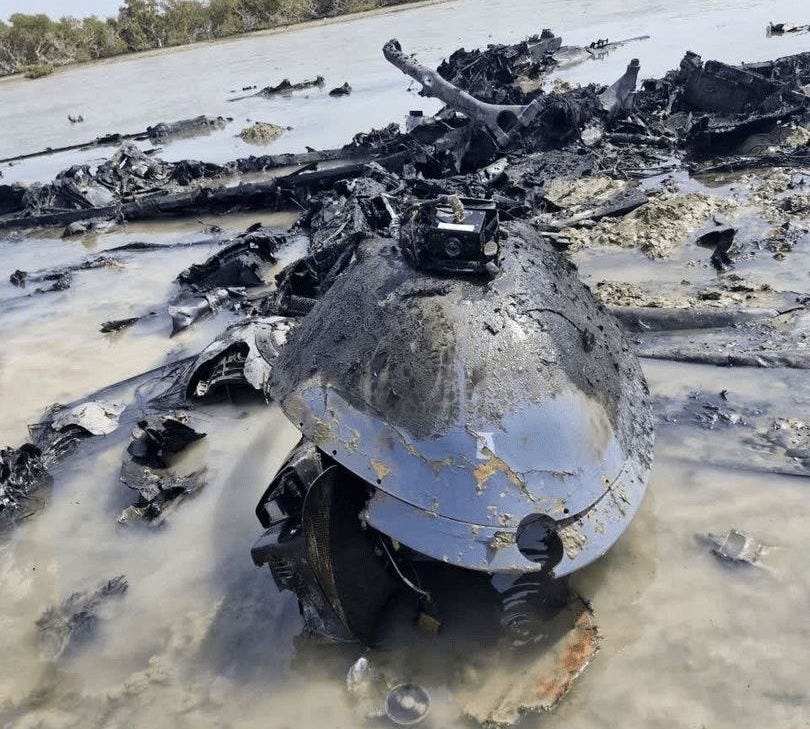
However, you cannot simply ignore drone losses when analysing air fleet attrition. They are a valuable asset that cannot be quickly replaced. By taking the most dangerous missions they also suppress the loss rate for manned aircraft.
The question of whether drone losses ‘count’ has a huge impact when we calculate losses per 100 aircraft and losses per 1,000 sorties.
In keeping with the theme, we do not have confirmed numbers on US aircraft involved in Epic Fury. My previous article estimated the US utilised 399 fixed wing attack aircraft, 34 attack helicopters, 199 fixed wing support aircraft and an unknown number of drones on Epic Fury.
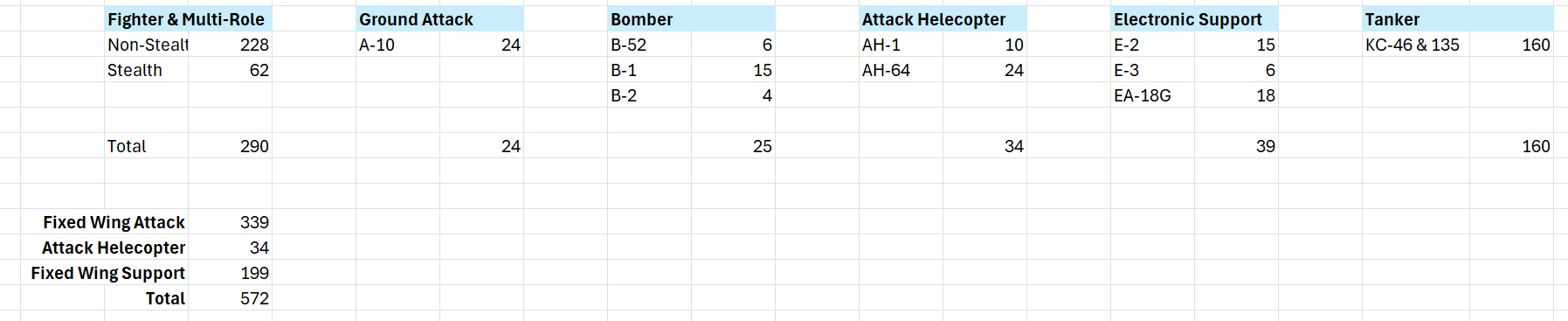
This gives us 3 categories for quantifying attrition:
Manned fixed wing aircraft;
Manned aircraft (that is including attack helicopters); and
All aircraft (that is including drones).
I think adding in attack helicopters for Epic Fury is fair, as they were involved in combat missions (particularly shooting drones and speedboats in the Persian Gulf) from the beginning of the conflict.
Loses per 100 aircraft varies from 1.9 to 5.2, depending on which category you pick. Damaged per 100 aircraft varies considerably less at 1.8 to 1.9, since I haven’t seen any claims that drones were damaged on Epic Fury. That claim is likely true, as drones are much less survivable than manned aircraft. Generally speaking, if you hit a drone it will crash.

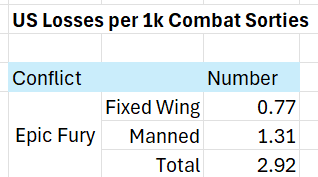
According to the Pentagon, they flew 13,000 combat sorties during Epic Fury. They did not release details of whether this included helicopters and unmanned aircraft (drones). Consequently, if the combat sorties were only fixed wing aircraft then the US lost 0.8 aircraft per 1,000 sorties. If the sorties include helicopters the losses rise to 1.3 per 1,000 sorties. If they included drone sorties then the losses rise to 2.9 aircraft per 1,000 sorties.
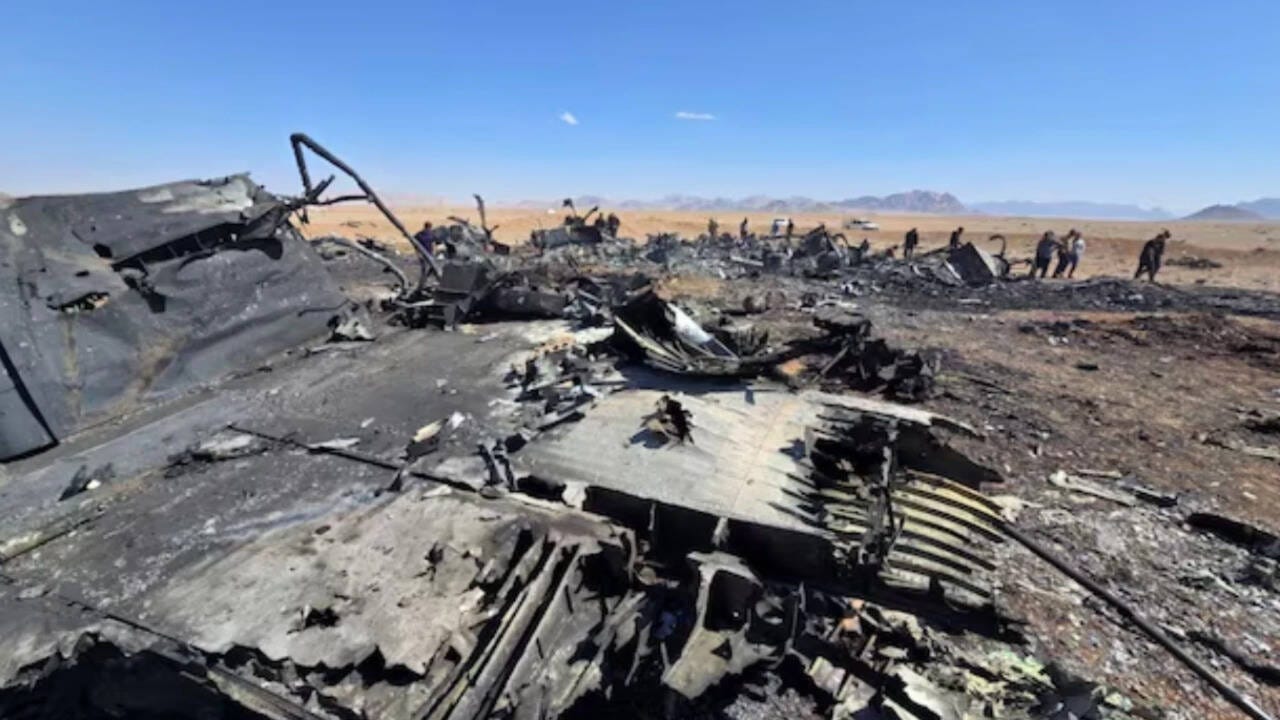
The cause of loss also varies greatly depending on whether you include drones. We know that:
Iranian air defences shot down an F-15 and an A-10;
2x C-130s and 4x MH-6 scout helicopters were destroyed by their crews on the ground during the rescue operation for the F-15 pilot;
3x F-15s were shot down in a friendly fire incident by a Kuwaiti F/A-18;
The remaining manned losses were destroyed by Iranian drone strikes; and
It is likely all the US drone losses were from Iranian air defences.
Crunching the numbers, Iranian air defences were largely ineffective against manned aircraft, but very effective against unmanned aircraft. This is to be expected. One of the main US criteria for using unmanned aircraft is the presence of significant air defences around the target. As a result 21 of 23 US aircraft lost to Iranian air defences (91%) were drones.
For manned aircraft, 64.7% of all losses were operational losses, not attributable to enemy fire. 35.3% of US losses came from a single incident (destroying aircraft during the rescue mission to prevent their falling into enemy hands).
This leads to two totally different graphs depending on whether you include drone losses.
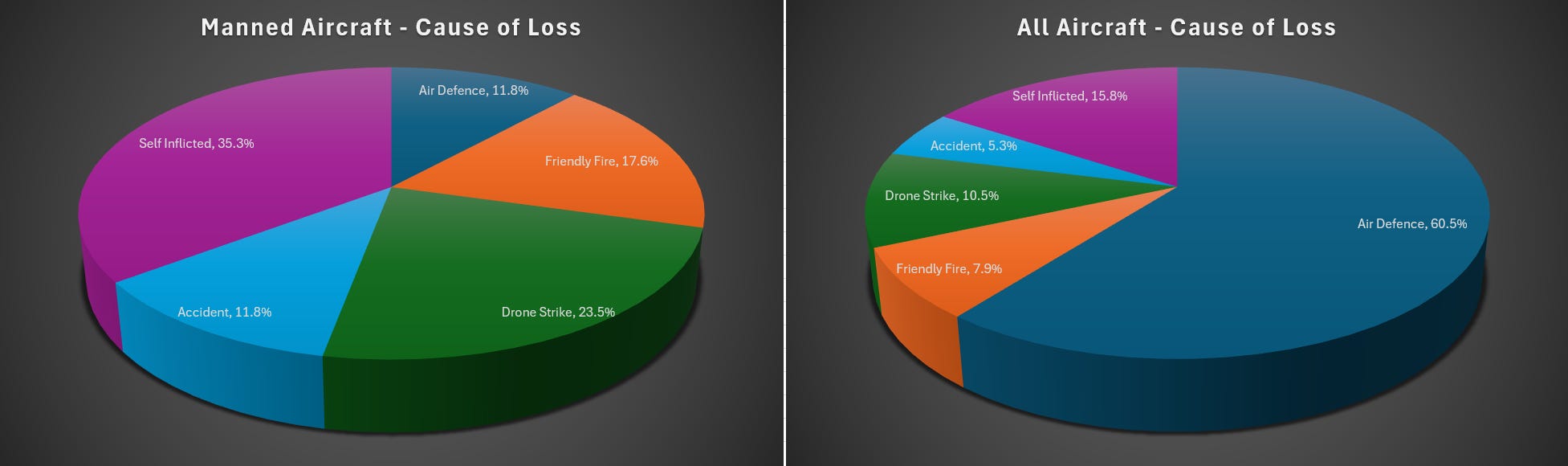
In conclusion, whether you count drones has an enormous impact on how you analyse aircraft attrition during Epic Fury. Drones accounted for 55% of US lost airframes and 60% of losses inflicted by Iranian fire. Losses per aircraft and losses per sortie are nearly twice as high if drones are included.
It is not fair to count drone losses at a 1 to 1 ratio for manned aircraft losses. However, it is also not fair to discount them completely. This will cause issues when we compare attrition rates on Epic Fury to those on Desert Storm.
Desert Storm and Epic Fury are good points of comparison, because they are both modern conflicts where the US technologically totally outclassed the enemy in the air. As brave as it was for those 2 Iranian F-5 pilots to bomb US airfields, it was never in doubt the US would have control of the airspace.
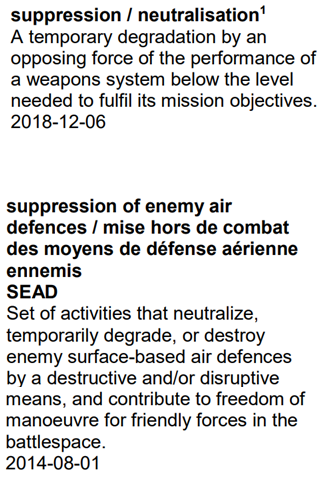
However, in both conflicts the enemy maintained an air defence capability that continued to extract losses throughout the conflict. This was to be expected. Like most enemy capabilities in modern warfare, you cannot destroy an enemy’s air defence system. You can destroy their high end systems, particularly the strategic air defence missiles that engage targets at high altitude and well away from the target. You can disrupt enemy centralized control and coordination of air defence assets. Taken as a whole, an enemy air defence system can only be suppressed, that is made ineffective within a confined time and place. This is why attacks on enemy air defence systems are called Suppression of Enemy Air Defence (or SEAD), not destruction of enemy air defence.
Below I have clipped the NATO standard definitions of suppression and SEAD. As you can see both are about creating a temporary situation where friendly forces can maneuver and complete mission objectives. In researching this article I discovered there is a NATO definition of destruction of enemy air defences. I’ve never seen that term used in practice, because destorying an air defence system is a nearly impossible task.
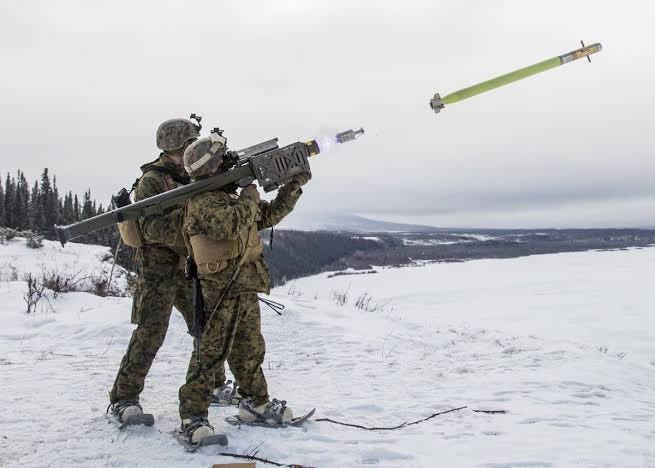
In particular, shorter range systems are almost impossible to completely stamp out. They mostly use passive sensors that can’t be detected until they are firing at you. They are also too widely dispersed to be eradicated. Ultimately, a modern SEAD campaign will always leave at least man portable missiles (MANPADs) and machine guns, which will still inflict losses under the right conditions.
As explained earlier, I don’t think fixed wing airframe losses is the correct measure for comparing losses between Desert Storm and Epic Fury. Epic Fury used attack helicopters on anti-drone sorties from the beginning of the conflict. Since there wasn’t a ground force, there was no mass of utility and transport helicopters corrupting the data for losses per sortie.
Using the manned aircraft metric, Desert Storm and Epic Fury had nearly identical losses per 100 aircraft in the air fleet, at had 2.3 and 2.56 losses per 100 aircraft respectively. However, if drones are counted on a 1:1 basis, then Epic Fury losses were about 2.5x higher.
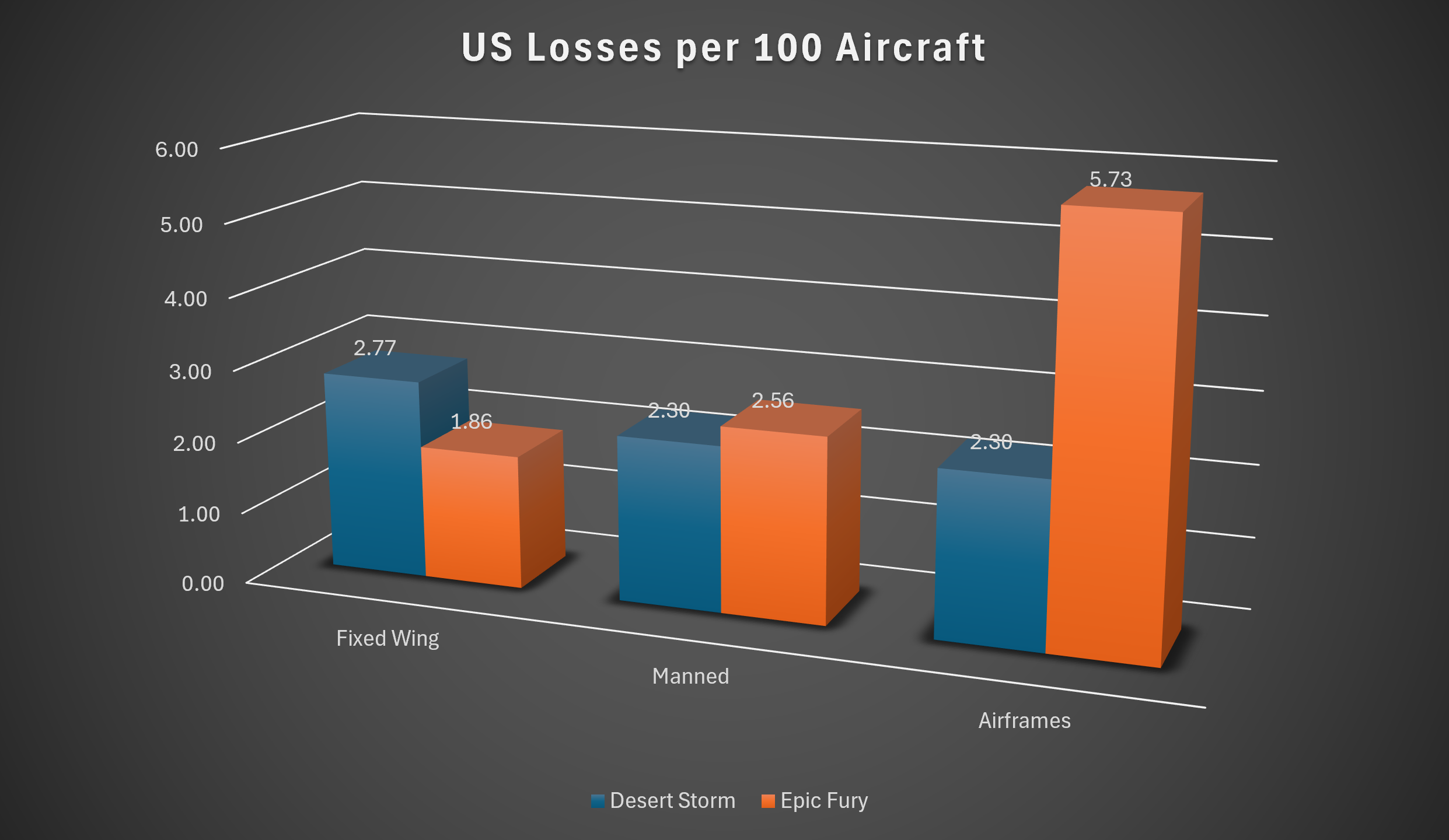
We don’t have statistics for the number of helicopter sorties on Desert Storm and unmanned aircraft did not fight in a combat role. So for comparing the losses per 1,000 sorties I have used Desert Storm’s fixed wing losses as a benchmark. By this measure Epic Fury’s losses are either about 2x or 4.4x higher than on Desert Storm. It is logical there’s a larger gap between Desert Storm and Epic Fury’s losses when measured by sortie. Epic Fury involved less sorties per aircraft, as Iran’s greater long range strike capability pushed U.S. airbases to much longer distances from their Iranian targets than on Desert Storm.
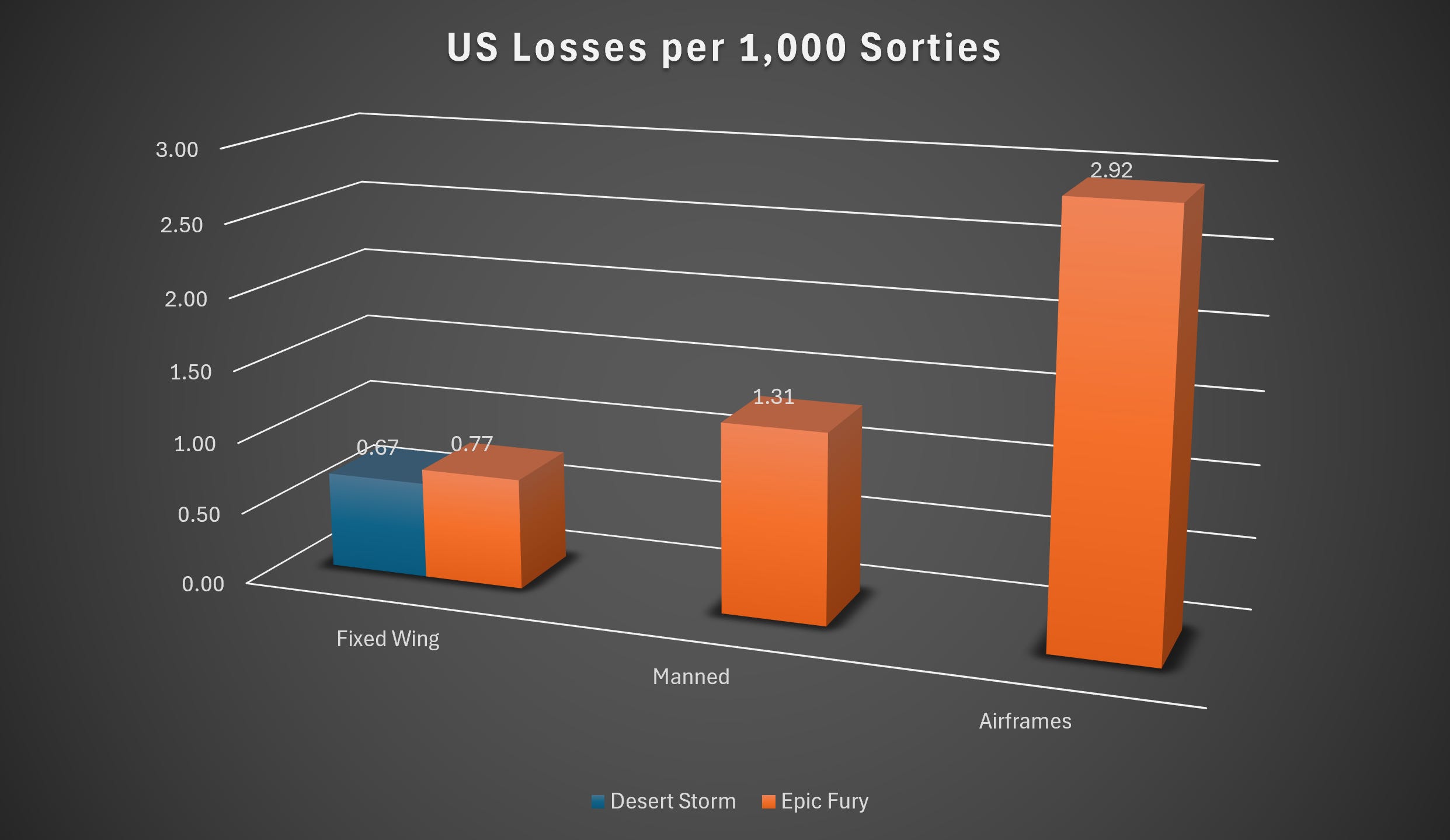
All this means a direct comparison of airframe attrition on Desert Storm versus Epic Fury depends on a non-mathematical question: how much is a drone aircraft worth in comparison to a manned aircraft and its pilot?
For what it’s worth, the average loss rates across the three measures is 3.38 per 100 aircraft and 1.67 per 1,000 sorties. This is about 1.5x the loss rate per 100 aircraft of Desert Storm and 2.5x the loss rate per 1,000 sorties. Therefore, it’s fair to say Epic Fury’s aircraft losses were either somewhat worse than Desert Storm’s, or significantly worse.
But similar to the question of shock action effect, comparing any air campaign to Desert Storm isn’t really fair. Desert Storm was a unique set of circumstances where the Western world, still flush with equipment from the recently ended Cold War, banded together to bomb an area the size of Vermont.
Going by losses per 1,000 sorties, Desert Storm has the second lowest loss rate for post WW2 US air campaigns at 0.67.3 Surprisingly, the lowest loss rate was in the Vietnam war at 0.4. The US military lost over 3,700 fixed wing aircraft in Vietnam (which is greater than the US military’s current combat aircraft strength). However - and I know I keep saying this - while the Vietnam war lasted 9 years, Desert Storm and Epic Fury only lasted 40 days.
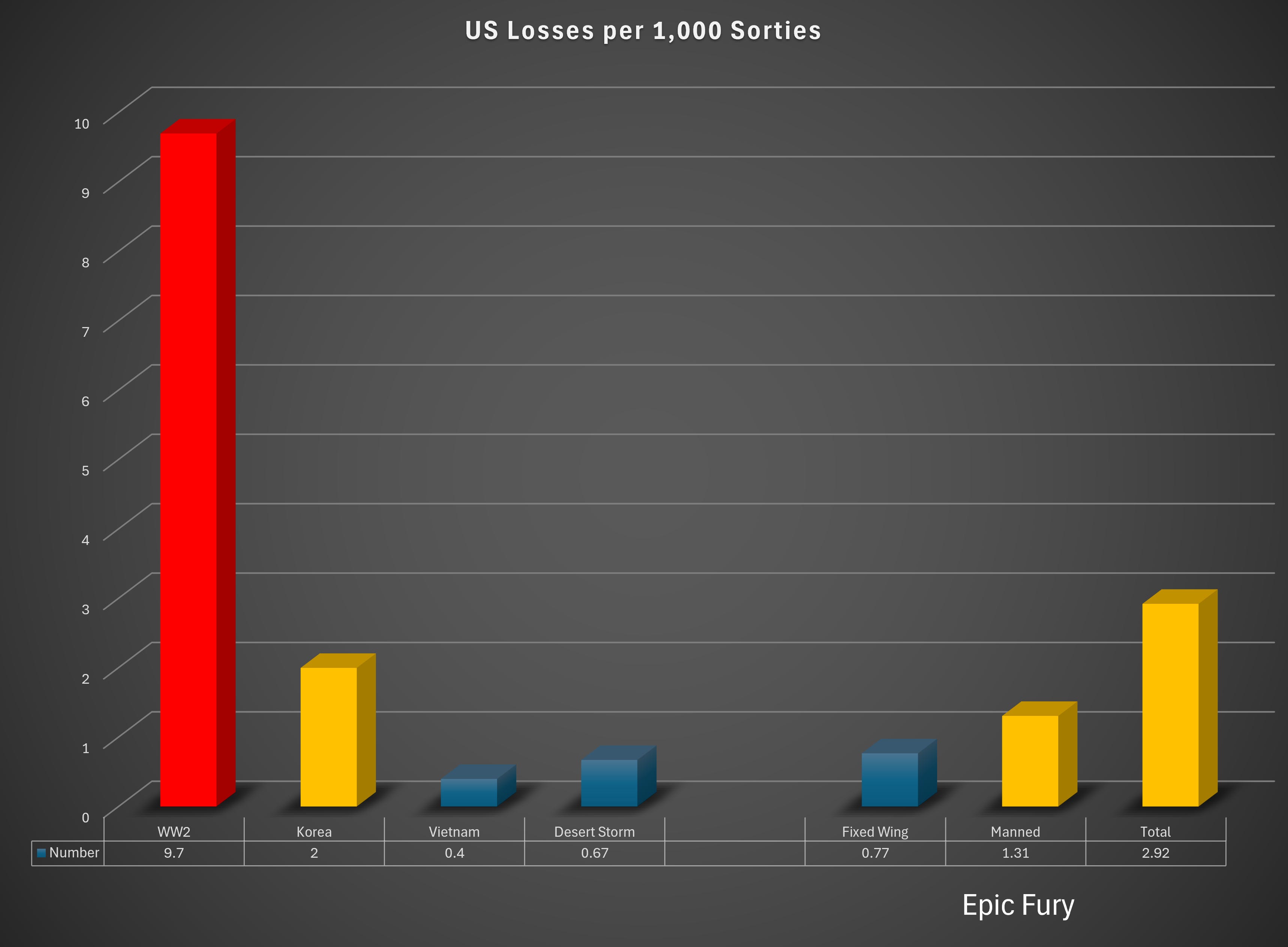
During the Korean war, where the enemy occasionally contested control of the skies with roughly comparable aircraft, the US suffered 2 losses per 1,000 sorties. During World War 2, a true near-peer conflict, the US suffered nearly 10 losses per 1,000 sorties. This comparison shows that Epic Fury is closer to the Korean War in terms of losses for 1,000 sorties than it is to Desert Storm.
If you break up losses by their cause, there are three interesting trends.4
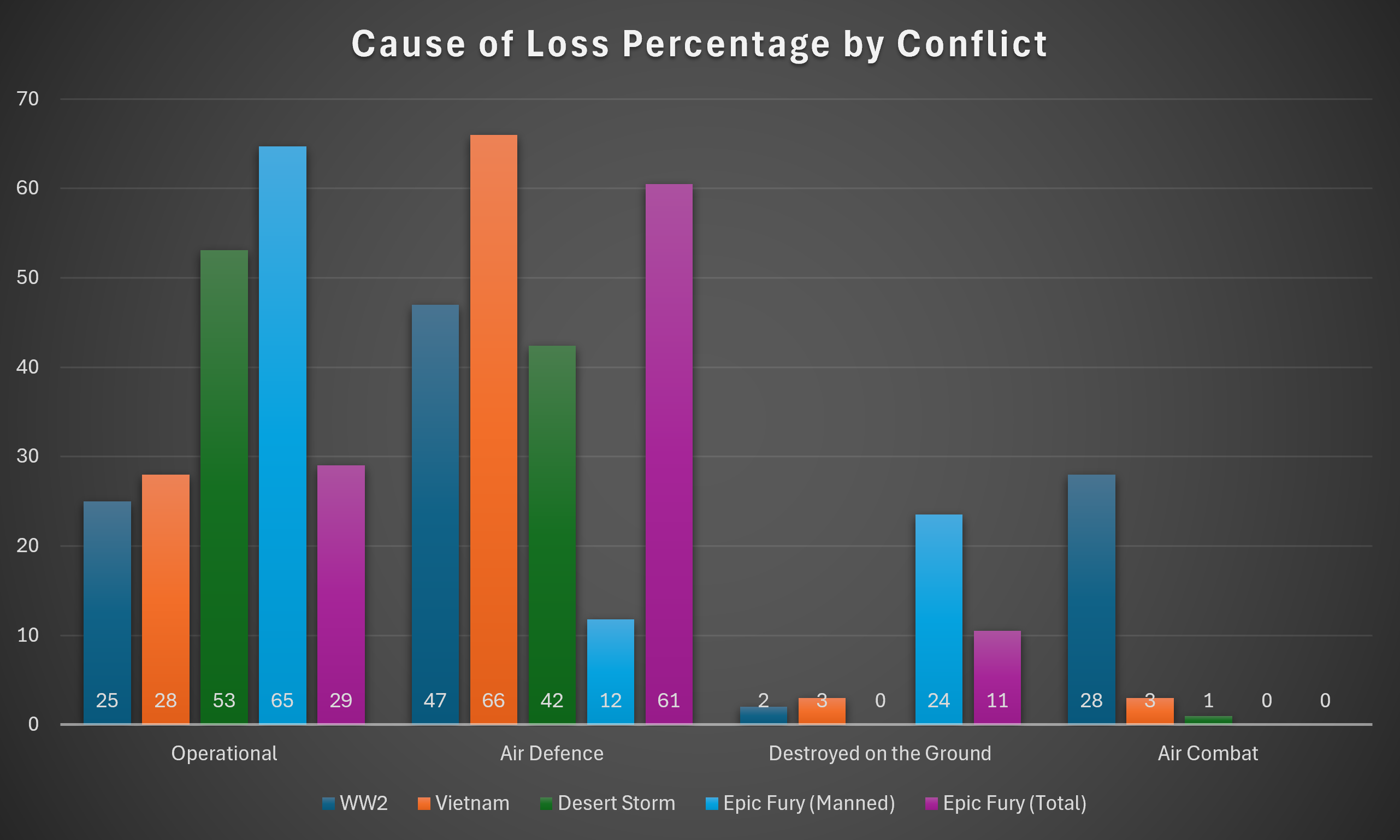
Firstly, operational losses (those not directly attributable to enemy action) makes up a greater and greater percentage of losses as the overall losses decrease. This is something of a tautology, but it does show part of why Desert Storm and Epic Fury had such a large proportion of operational losses. They weren't losing thousands of aircraft to the Luftwaffe and 88mm flack guns.
Secondly, the percentage of losses to air defense is surprisingly constant. The average percentage lost to ground fire between manned and unmanned Epic Fury is about 37%. This is within a few percentage points of the Desert Storm and WW2 losses. Air defense was uniquely effective during the Vietnam War for a number of technological, terrain and operational reasons.
Thirdly, for Epic Fury the share of aircraft destroyed on the ground is totally disproportionate to the other conflicts. Desert Storm had none. Vietnam, a war where enemy insurgents were regularly able to get within mortar range of U.S. airfields, had only 3% of losses due to aircraft destroyed on the ground. During World War Two, where a technologically comparable enemy air forces ran well resourced airfield interdiction missions, only 2% of losses were aircraft destroyed on the ground.
For Epic Fury, 11% of overall losses and 24% of manned aircraft losses were from Iranian long range strikes against aircraft parked at airfields. This shift towards ground losses is mirrored by a near disappearance of losses due to air-to-air combat.
We can therefore conclude that U.S. aircraft losses on Epic Fury most closely resemble those of the Korean War. In that conflict the enemy (mostly Chinese and Soviet pilots) sometimes contested U.S. air superiority in aircraft that were roughly technologically comparable. Despite many comments that Iran’s air defenses had underperformed, they inflicted about the same percentage of losses as every other major US air campaign (aside for the outlier of Vietnam). Unlike the Chinese during the Korean War, Iran did not challenge U.S. air superiority. Instead they inflicted similar losses per sortie through long range strikes on U.S. aircraft parked on the ground. Iran’s ground strike approach is in keeping with the asymmetric strategy employed by everyone who’s done fighting the United States since the end of World War II:
If America is totally dominant at a particular game in warfare, find a way to play a different game.
We shouldn’t overstate the case for Iran’s air defence and long range drone strike strategy. While Iran inflicted losses on the U.S. at a higher rate than in Desert Storm, the rate of aircraft attrition was nothing like enough to eventually win the air war. Saying Epic Fury’s air attrition rate resembles the Korean War more than Desert Storm is interesting, but isn’t a path to Iranian victory in the air war. The loss rate during the Korean War was certainly not enough to seriously threaten America’s control of the skies.
Losses during Desert Storm and Epic Fury show the capabilities and limitations of modern U.S. air superiority strategy. They can annihilate the high value systems - such as long-range active air defenses, fighter aircraft, and command and control - within a few days while taking acceptable losses. U.S. and allied aircraft can then operate without the enemy preventing completing their missions. This ability top operate with enemy air defences suppressed is only possible if the U.S. continues to dedicate resources to SEAD and avoids higher risk situations (like flying too low or too close to high value targets). The enemy will always retain an air defense capability (mostly through passive systems like IR SAMs) that will inflict attritional losses throughout the whole campaign.
As a matter of scale, U.S. losses on Epic Fury are either somewhat or significantly higher than Desert Storm, depending on how you account for drone losses. For U.S. aircraft attrition Epic Fury is most similar to the Korean War, where China sometimes challenged U.S. air superiority, but there was never a real risk the U.S. would lose control of the skies or run out of aircraft.
The major difference between U.S. losses on Epic Fury and the other historical conflicts is the number of aircraft destroyed on the ground. The U.S. did not suffer any losses for this category during Desert Storm, and losses in earlier conflicts were 3% of lower. U.S. aircraft losses to ground strikes were 24% of manned and 11% of overall aircraft lost on Epic Fury.
Iran correctly identified that they could not fight the United States military in the skies. Instead they developed a workaround through long range precision drone strikes. This allowed Iran to climb into the same loss category as the Chinese inflicted during the Korean War.
This is an accomplishment, but not decisive. China decisively lost the air campaign over Korea. We shouldn’t get carried away with writing off U.S. air power just because airframe attrition on Epic Fury is more like the Korean War than Desert Storm.
Note I am saying aircraft attrition is sustainable, not munitions expenditure. For that discussion see this article.
For example, a reaper drone costs about 1/3 as much as an F-35 or 1/4 as much as an F-15.
Not including the 1999 Kosovo Bombings, which I didn’t include due to time constraints and there being surprisingly little reliable data.
I was not able to find good data from Korea for losses by cause.
Comments
Nothing yet. Say the first thing.
Sign in to join the conversation.