
The last post gave an overview of how the British were able to achieve victory in the Falklands despite enormous challenges. It mostly described the challenges in terms of the distance between the British Isles and the Falklands, and there not being any contingency planning in place.
This post will look at why those challenges were greater than one would expect given British military power at the time.
In 1982 Britain had a 500,000 strong professional volunteer military and spent 5% of its GDP on defence (while being the world’s 5th largest economy). Argentina had a smaller economy (20th) and spent just 3.5% of GDP on defence. Consequently, if you look at the raw numbers for each country’s armed forces, the British had a decisive advantage in personnel, defence spending and the major types of equipment that would play a decisive role in the Falklands war.
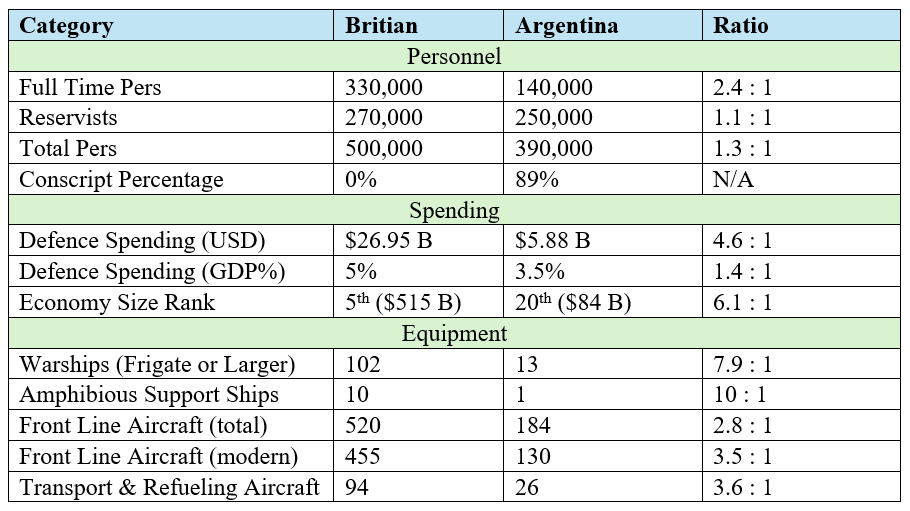
As the table above shows, the British outspent the Argentines 4.6 : 1 and had a professional military about twice the size of Argentina’s conscript military. At sea the British held about a 10 : 1 advantage, and in the air about a 3 : 1 advantage.
The British issue was not their defense capabilities, but force projection of those capabilities. As we see from the chart below, Britain fought the war with a disadvantage in numbers for the ground force, a small advantage in warships and while massively outnumbered in the air.
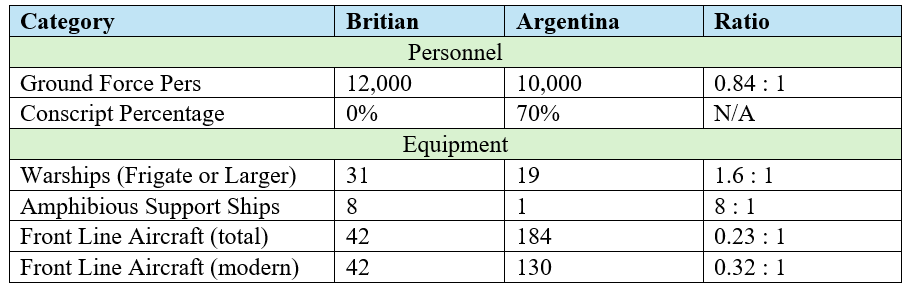
Argentina was always going to have a much larger proportion of its armed forces involved in the conflict, particularly for the Air Force and Navy, due to the homeland being closer to the Falkland Islands. The distance from Argentina’s nearest naval and air base to the Falklands was about the same distance as from England to Switzerland. This is certainly a greater distance than most people have in their minds for this war. However, it’s nothing like the campaign on to the far side of the world the British military had to conduct.
As a ballpark estimate, given the size and funding of the British military, you would expect their ratio advantage over Argentina to be approximately cut in half when fighting a conflict over the Falkland Islands. The actual ratio declines in every category except amphibious support ships, were much more dramatic.
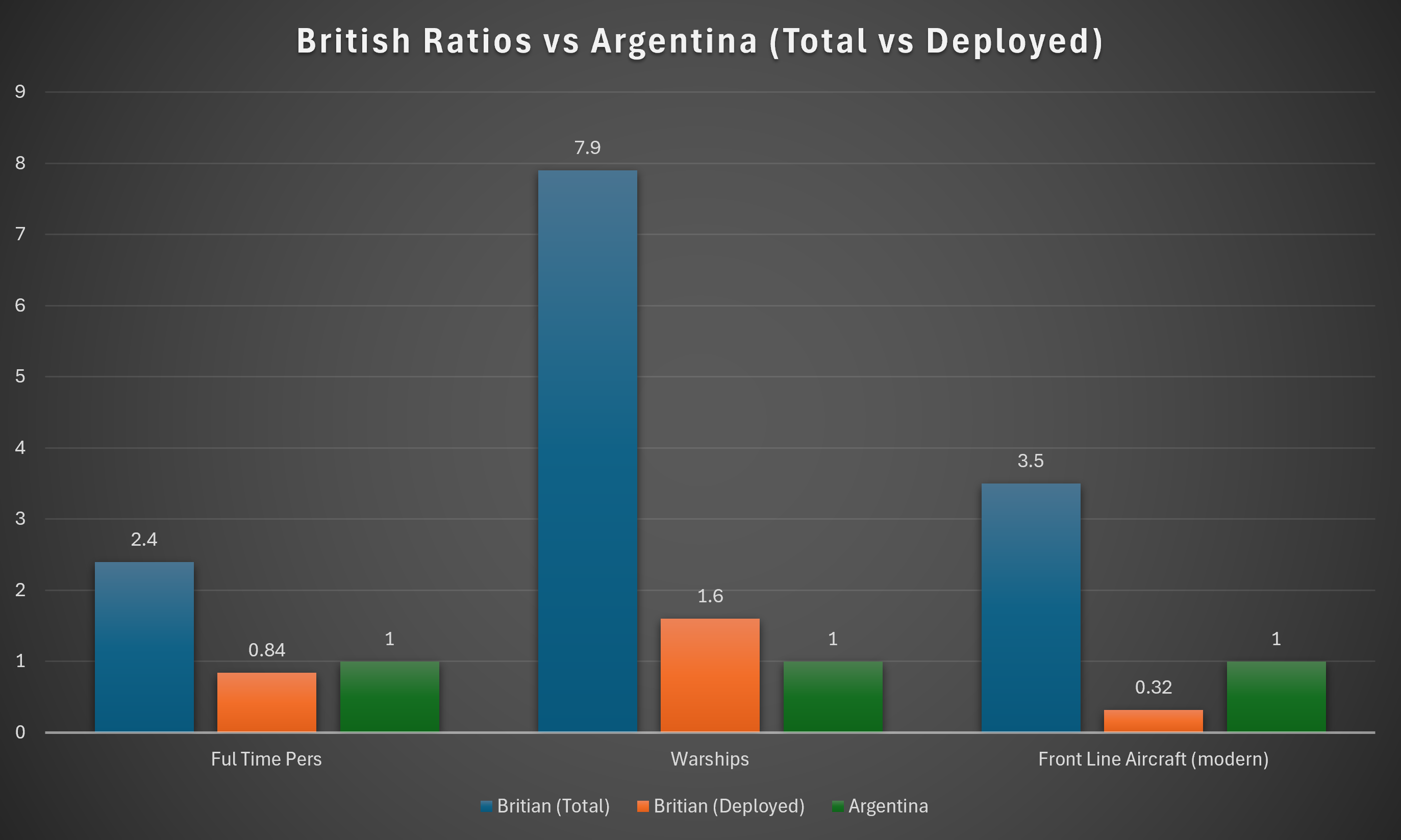
In 1982 Britain had a fairly large and decently funded military, but was only able to deploy a small proportion of this military power during the Falklands war. This was because in 1982 Great Britain was not a global expeditionary military. This is surprising, as Global power projection is THE historic role of the British military.
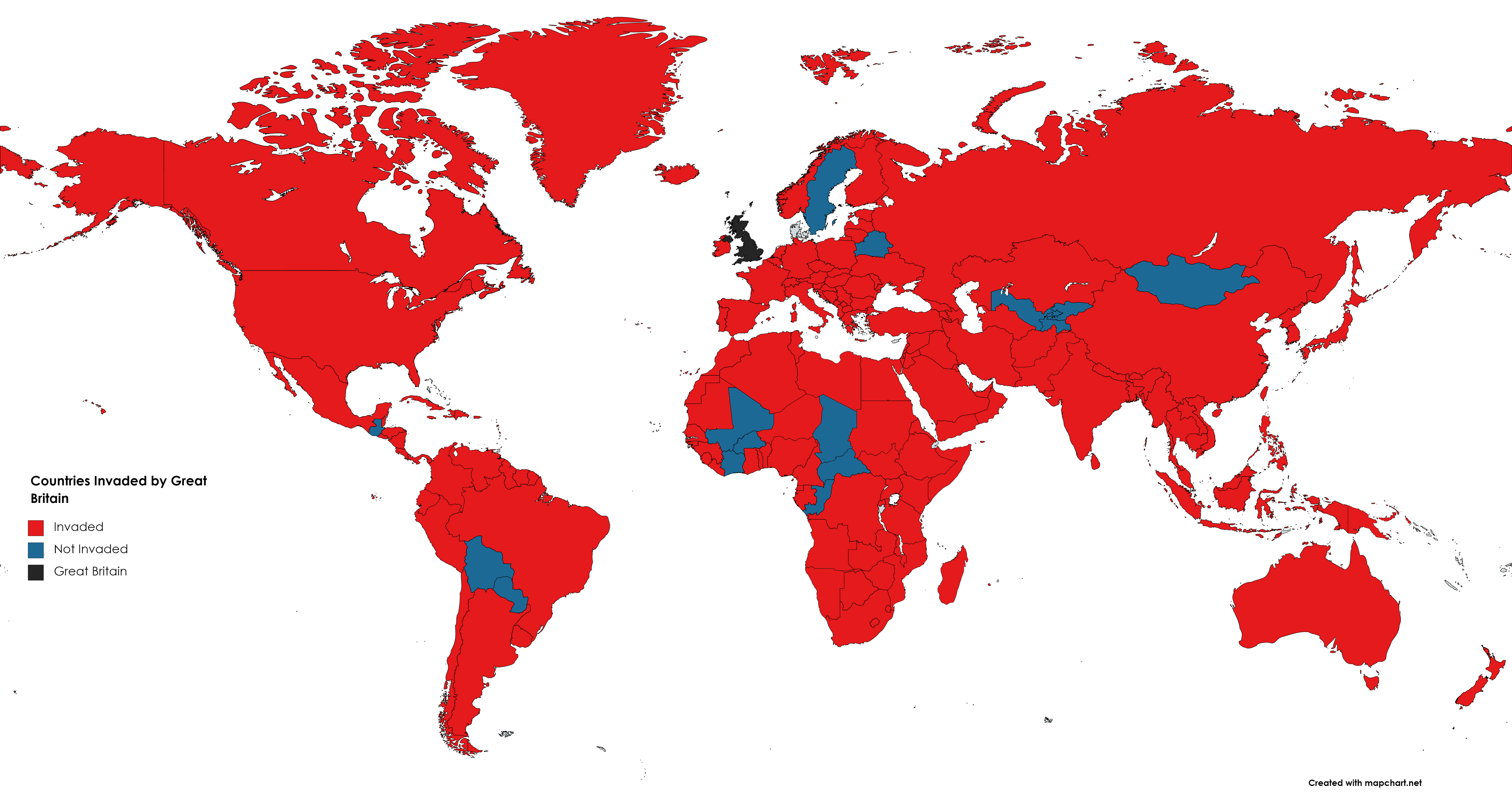
Narratives of the Falcons War usually describe Britain's global power projection in 1982 as part of a fairly steady imperial decline from the end of World War II to today. This is inaccurate, as Britain’s 1990 to 2025 global power projection capabilities greatly exceeded her 1982 capabilities. This is despite defence budgets declining from 5% of GDP and 500,000 personnel in 1982, to 182,000 personnel and 2.2% of GDP in 2026. Let’s look at a metric for each of the three major services (the RN, RAF and British Army) to show the post 1982 resurgence of Britain's global military reach.
In 1982 if you loaded every RAF transport and air-to-air refueling aircraft to it’s maximum capacity, they would be carrying 4.6 million pounds of fuel and cargo. At 500,000 military personnel this works out to 9.2 pounds per serving member. In 2026 the RAF would be carrying a 6.5 million pounds of fuel and cargo. At 182,000 military personnel this works out to 35.7 pounds per serving member. So in 2026 the RAF has nearly twice the lift capacity to support a military about 1/3rd it’s 1982 size.
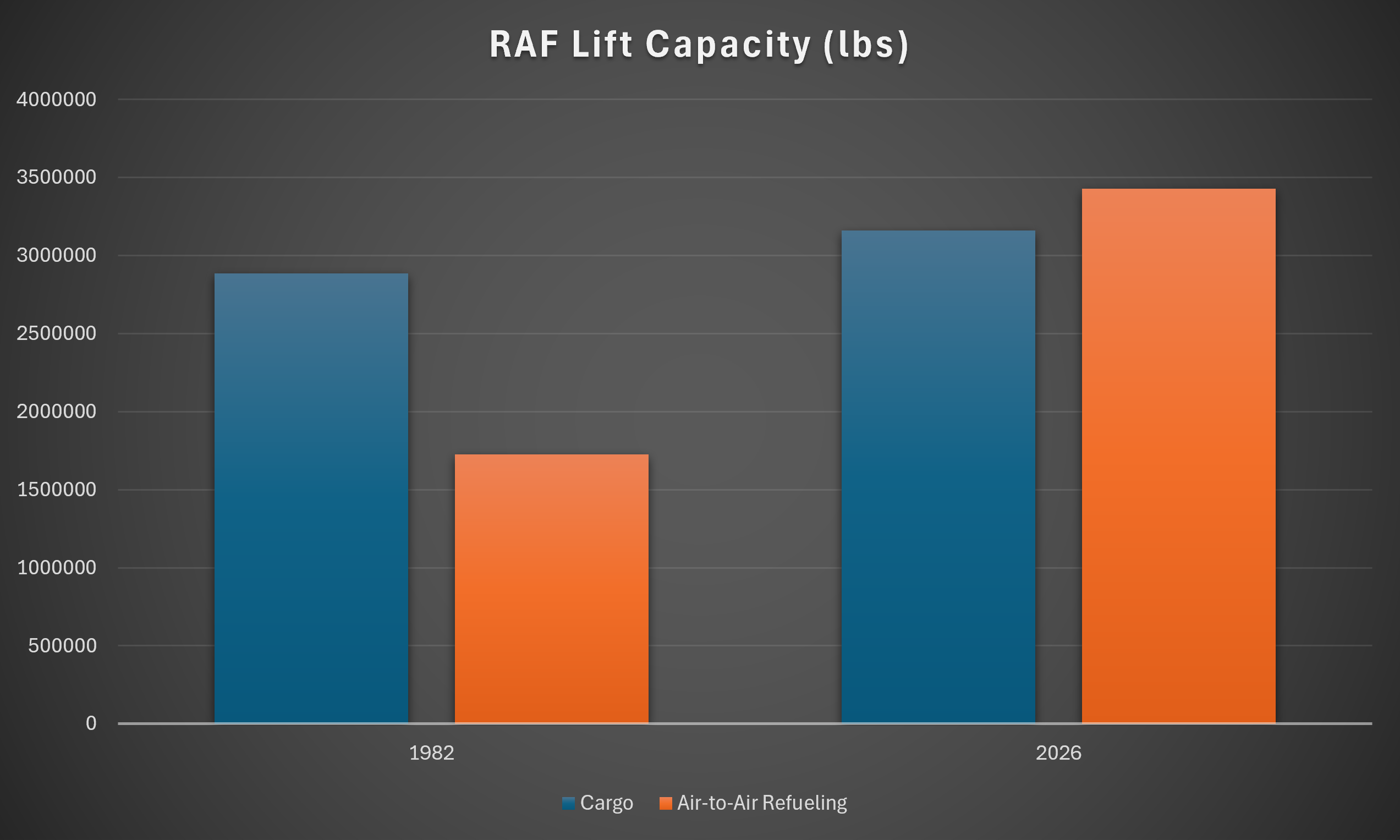
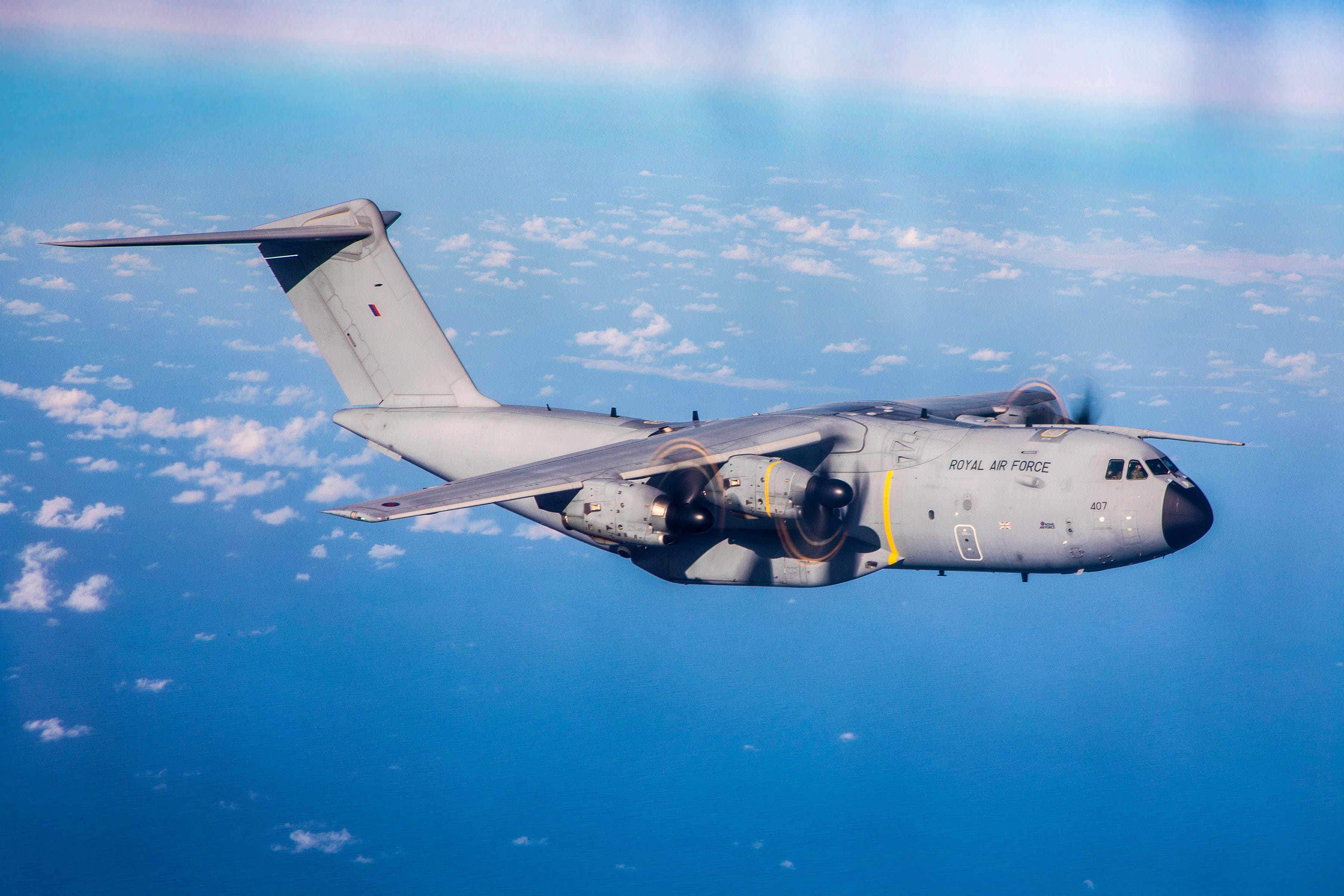
The current RAF transport and air-to-air refueling fleet also has longer range and a higher average speed. This is because in 1982 the backbone of the RAF’s transport fleet was a tactical level aircraft (the C-130 Hercules), but in 2026 the RAF’s transport fleet is mostly operational or strategic level lift aircraft.
There is a largely similar story for the Royal Navy and Royal Fleet Auxiliary's amphibious capabilities. In 1982, she had eight amphibious support ships, totaling just over 58,000 tons of displacement. After the Falklands war the British amphibious capability peaked around 2010, at fifteen amphibious support ships, totaling over 300,000 tons of displacement.
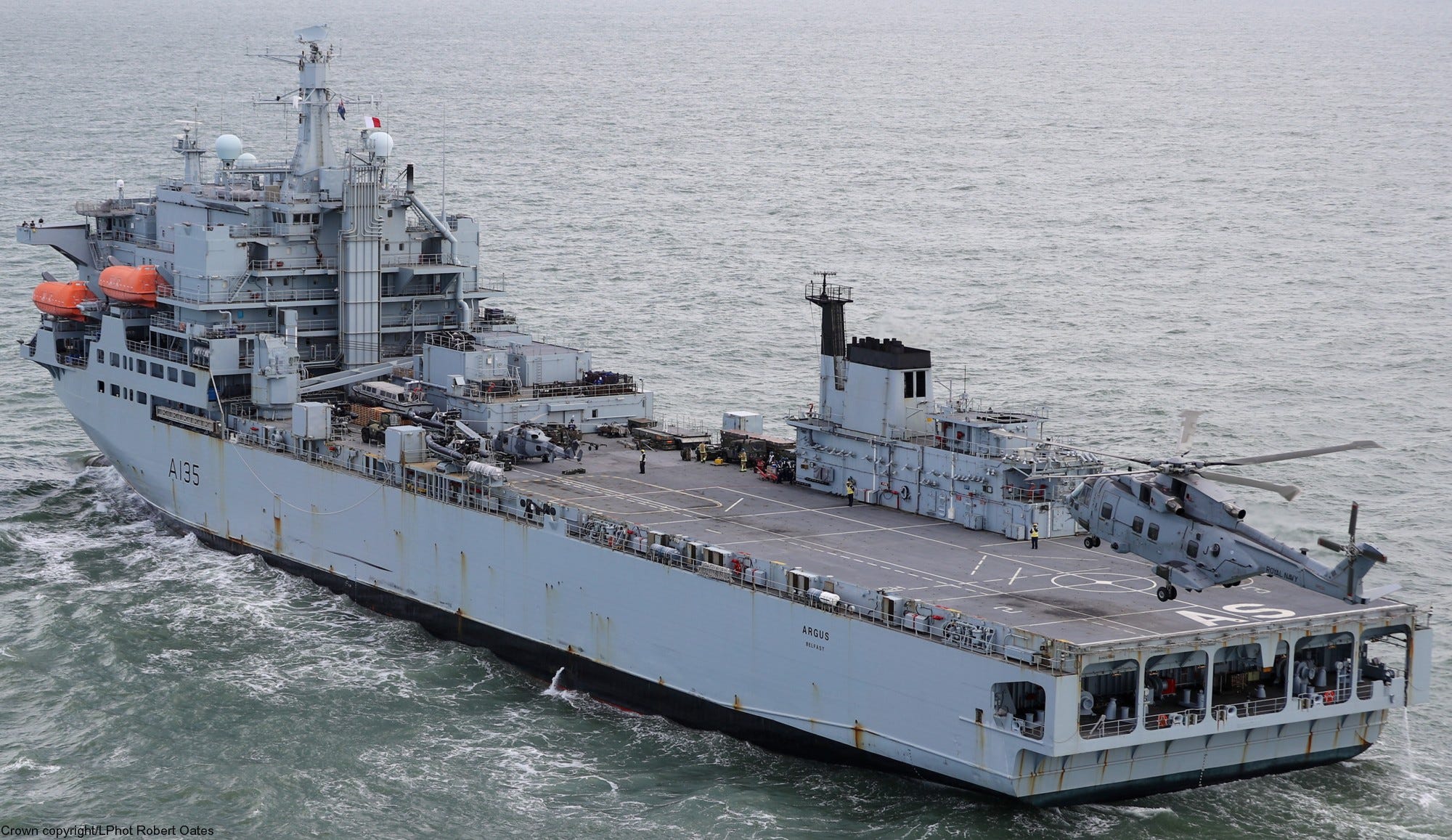
Almost half of this displacement came from roll-on, roll-off vehicle transport ships (what’s whimsically called a Ro-Ro by the shipping industry). The RN and RFA did not have any equivalent to this capability in 1982. They arguably do not count as amphibius support, since they require a working port to offload their cargo. However, even if we ignore the Ro-Ro tonnage, in 2010 the amphibious fleet was three times larger in 1982.
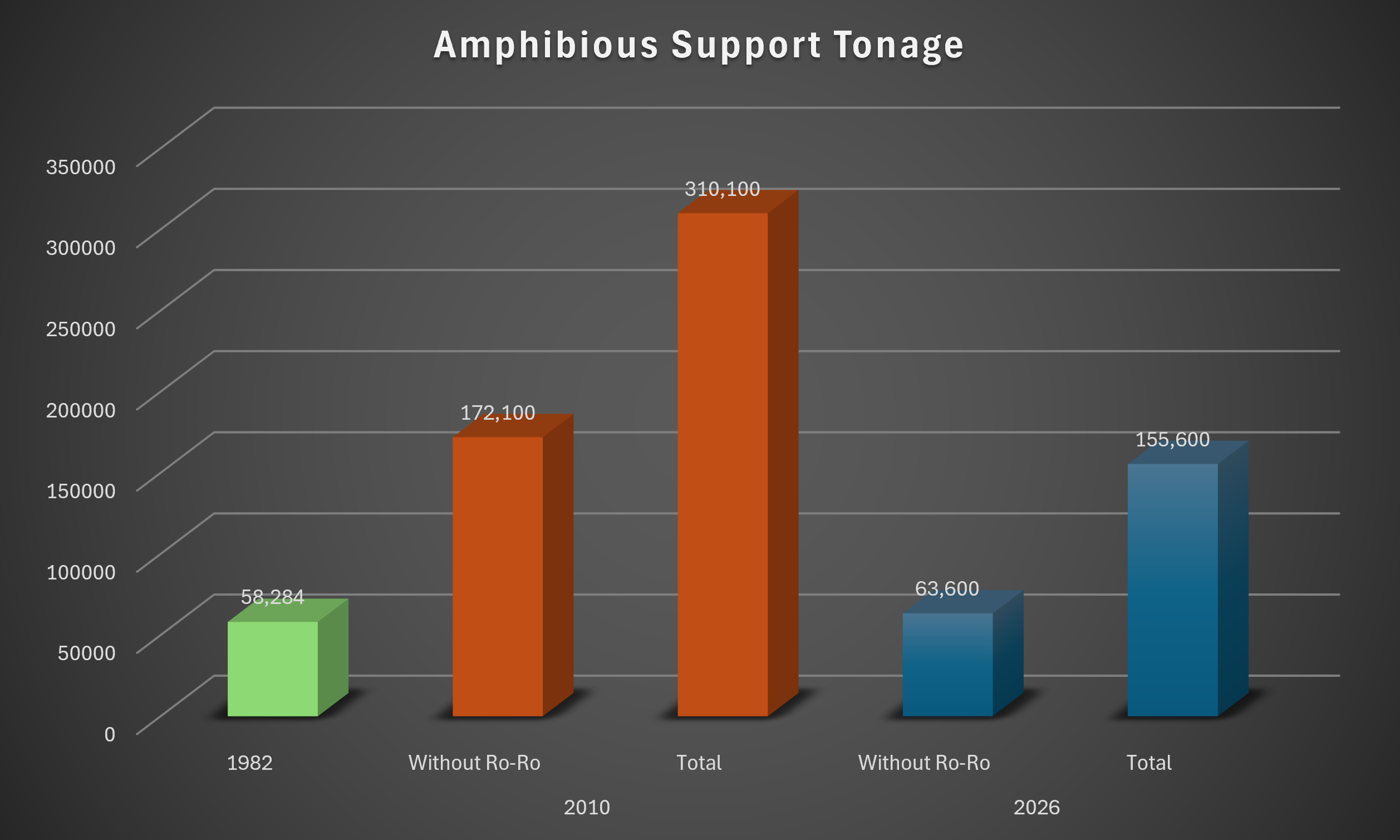
The British amphibians capability has suffered a dramatic decline since 2010. Even with that dramatic decline, in 2026 the RFA has slightly more Tonnage than in 1982 if we ignore Ro-Ro tonnage. If we include Ro-Ros the RFA still has nearly three times as much amphibious support tonnage as in 1982. It is missing dedicated command and helicopter facilities of the Fearless class, which proved so critical in the Falklands War. These capabilities are now provided by the Queen Elizabeth class fleet carriers. When they work, the Queen Elizabeth class has considerably more capability than the Royal Navy’s fleet of carriers and the Fearless class.
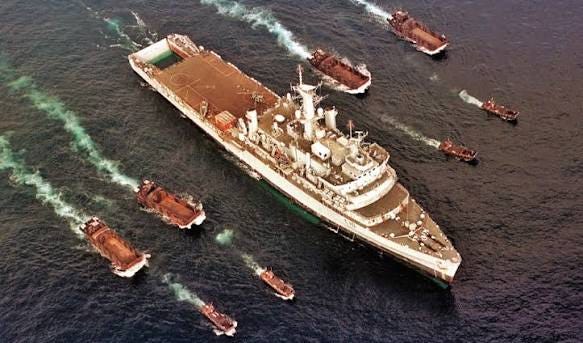
This increase in amphibious capability is not the result of the Royal Navy preserving fighting strength overall. In 1982 the Royal Navy had 102 major warships. They were down to 35 in 2010 and currently have 23. So similar to the rest of the British military, the navy currently has more of a capability that supports global power projection (amphibious ship tonnage) despite the navy being about 1/3rd it’s 1982 strength.
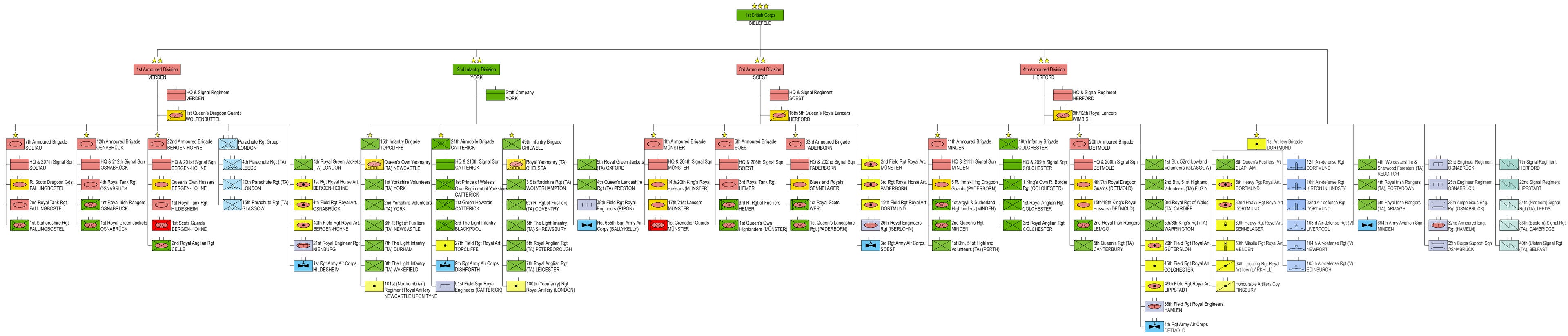
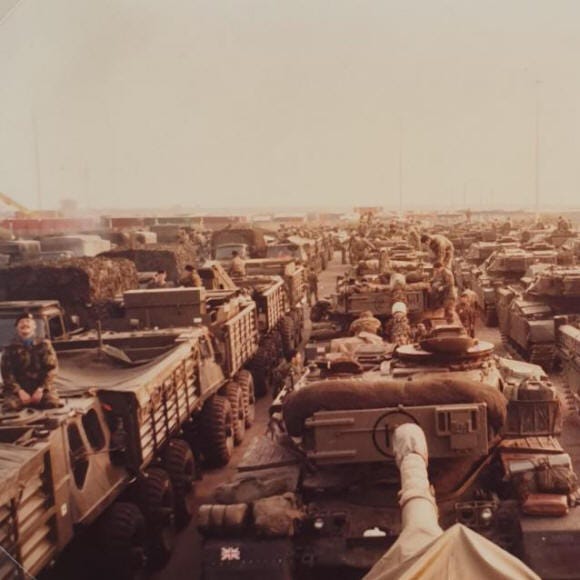
In 1982, the main role of the British Army was staffing the British Army of the Rhine (BAOR). This was a core of three armoured divisions stationed in Germany and a fourth armoured in Britain that would be shipped to Germany (hopefully) prior to an invasion of West Germany by the Soviet Union. To support this the British Army maintained over 1,200 main battle tanks and nearly 4,500 other tracked armoured vehicles. Almost the entire British Army existed to either be in the BOAR, or reinforce it in wartime or for home defence.
We already discussed that the Royal Marines had a task of reinforcing Norway with a commando brigade. Besides this asset (which was part of the Royal Navy not the British Army) the only ground force organisation tasked with expeditionary operations was 5th Brigade. The 5th brigade was created in January 1982 for the task they called Out-of-Area Outbreak Readiness. Out of Area in this case meant, not in Europe for NATO led missions, which says something in and of itself about British defence priorities at the time. Their specific mission was to provide battalion sized rapid deployment units for operations that fell short of war. The most common example being extraction of expatriate nationals from sudden situations of violent instability in the 3rd world.
The organization, equipment, and training for tasks like battalion level expatriate extraction is extremely different from the task 5th brigade was given just three months after the brigade was stood up. However, the British Army didn’t have any other units tasked with overseas consistency operations. So Fifth Brigade was sent, with mixed results entirely stemming from being a rapidly re-rolled organisation.
The BAOR was disbanded in 1994, and the large armoured force that supported it eroded over the ensuing decades. Today the British Army has less than 300 main battle tanks (half of which are in storage) and less than 1,200 tracked armored vehicles.
Since the end of the Cold War, the British Army has maintained roughly the following structure of units with a primary task of global contingency deployments:
A Corps HQ with most of the required Corps level support and sustainment units;
A light division with a Headquarters and supporting units on 10 days notice to deploy. That division consists of:
An airborne brigade tasked with a battalion on 48 hours notice to move and the balance of the brigade on 5-10 days notice to move;
A light mechanised brigade on 10 days notice to move; and
two light infantry brigades on 30-90 days notice to move.
A special forces brigade with units on notices to move as little as a few hours.
To give an example of British deployment capabilities during the post-cold war era, during 2003 the British Army and Marines concurrently had the following operational deployments outside of their territory:
A Division of 3 manoeuvre brigades taking part in the invasion of Iraq;
A brigade sized peacekeeping mission in former Yugoslavia;
A battalion conducting counter-insurgency warfare in Afghanistan;
Just under a battalion of special forces involved in the invasion of Iraq; and
Just under a battalion of troops doing close out tasks from the 2000 intervention in the Sierra Leone civil war.
All told, in 2003 the UK deployed about 47,000 personnel on combat operations outside of British sovereign territory and 17,000 more personnel on less kinetic security operations. As a comparison, 25,948 British military personnel deployed during the Falklands War.
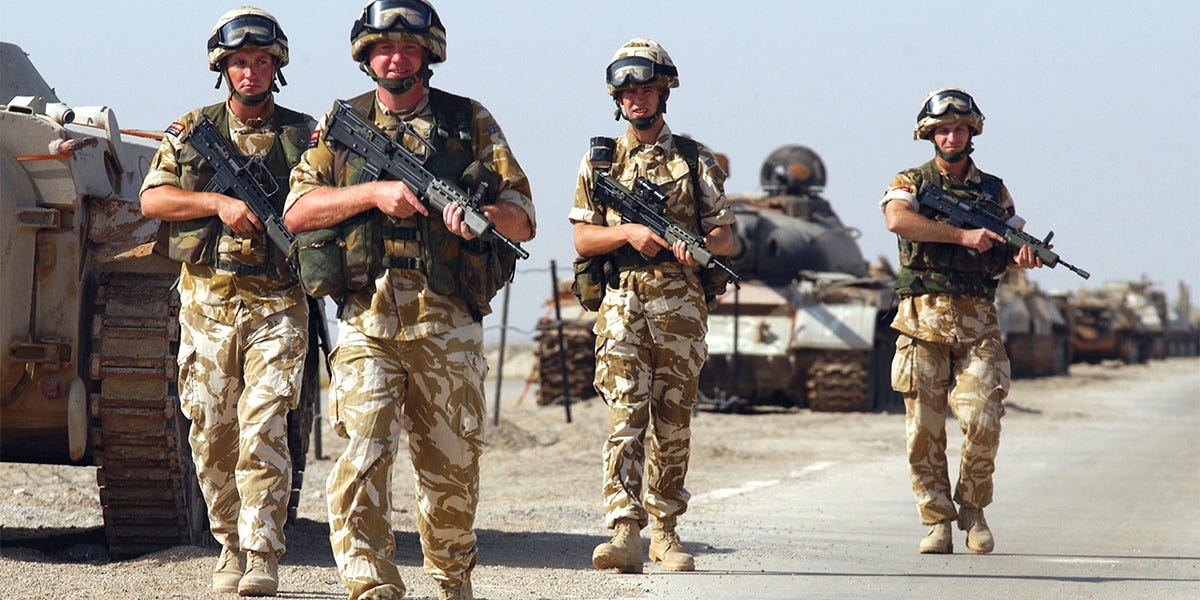
There have recently been Parliamentary hearings where the British Army admitted they would struggle to deploy the airborne and light mechanized brigade within their prescribed timelines, given current funding and equipment issues. Likewise, the Royal Marines have (at least temporarily) lost the ability to conduct brigade sized amphibious landings. This is certainly alarming and shows the rapid decline of the British military over the last decade.
However, compared to the situation in 1982, the British Army is still much better prepared for overseas contingency operations. In 1982 the British Army was prepared to globally deploy one or two individual battalions for operations short of warfighting. In 2026 there are alarm bells being sounded that the British Army would struggle to globally deploy a force 6-10x that size. The trade-off is that the British Army no longer has anything even remotely like the four armored divisions of the BOAR.
While the British faced enormous challenges in the Falklands War. The scale of the challenge is surprising. Given they had a military of 500,000 personnel and a defense budget of 5% of GDP. The British spent four point six times as much on defence as Argentina. Consequently, they had about 10xt as many warships, 3x as many aircraft and a army of volunteer professionals versus Argentina’s conscript army.
Given the distance from Britain to the Falklands, you would expect these ratio advantages to decrease, but not to the point they did for the war in practice. The British fought the war with a slight numerical advantage at sea, a slight numerical disadvantage on land and outnumbered nearly four to one in the air.
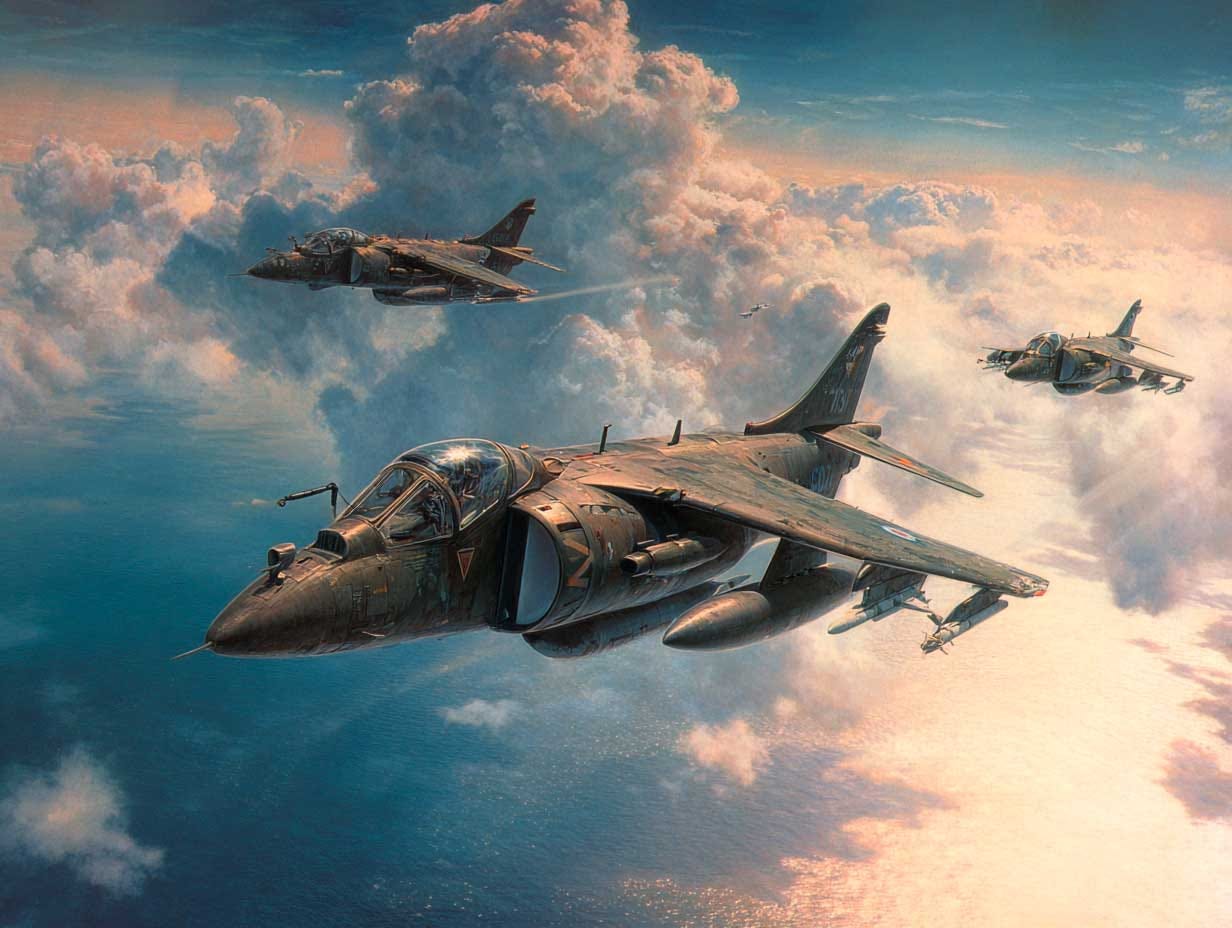
This is typically described as another entry in the long decline of Britain’s military capability from the Suez crisis to present. However, this is not the case. Following the Falklands War, and particularly following the end of the Cold War, the British military rebuilt its global power projection capability.
When looking specifically at global power projection, 1982 was the nadir of British capability. Even with the many rounds of defense and capability cuts over recent years, the British military significantly exceeds its 1982 global power projection capabilities in most categories. This was achieved despite the British military losing about 1/2 its budget and 2/3 its personnel between 1982 and 2026 by changing priorities.
In 1982, the main role of the British military was to fight the Soviet Union in West Germany with a reinforced Corps of four Armored Divisions. This task would involve 13x maneuver brigades of heavy equipment fighting a numerically superior mechanised near peer adversary. To accomplish this on a 5% of GDP budget, Britain’s global contingency force consisted of a single brigade tasked with deploying individual battalions for operations like extracting expatriate British nationals after the outbreak of a civil war in Africa. This is what’s known as a battalion within a brigade context task.
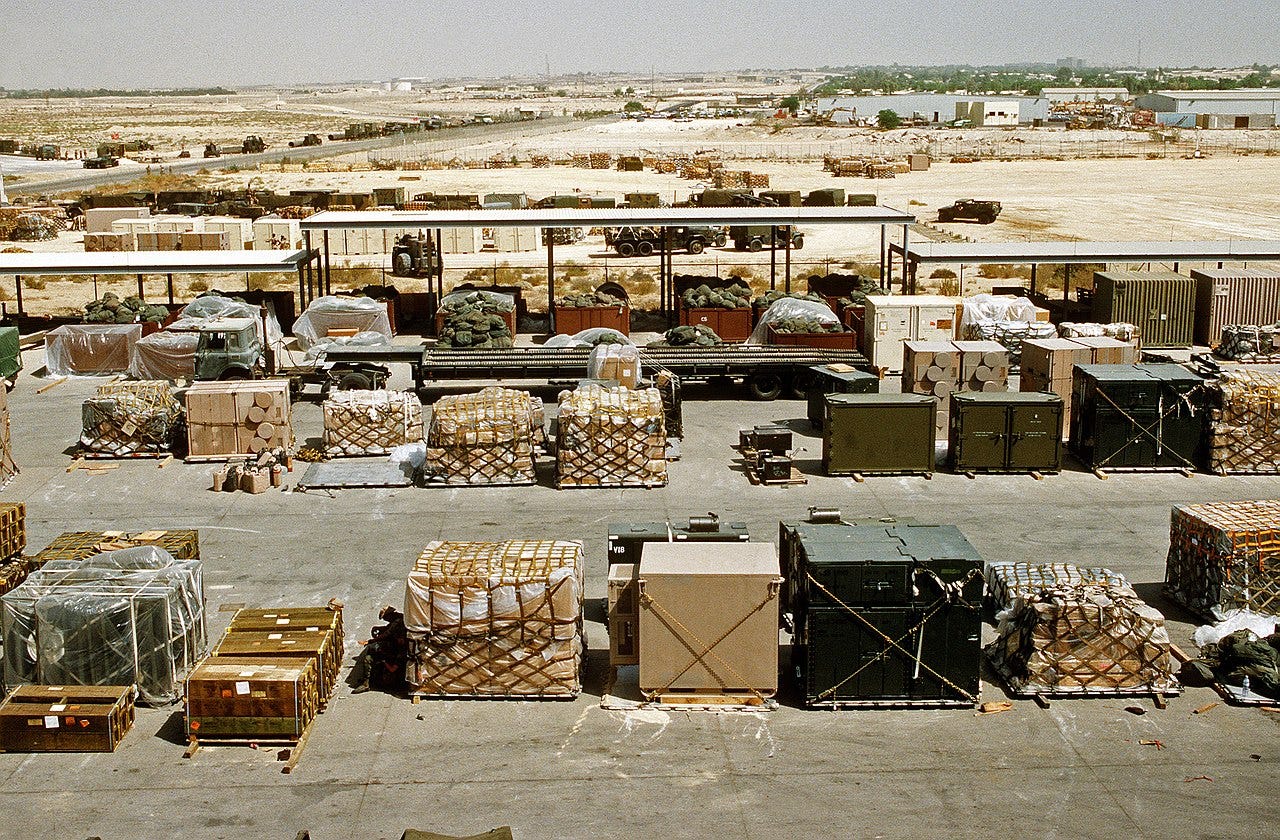
Today, the British military is organized around the global deployment of a division within a Corps context, which is two scales of magnitude larger. Looking at just this lens of global power projection, British capabilities are currently greater than in 1982. However, the British achieved this on a reduced budget by abandoning the BOAR. The BOAR consisted of 13x armoured manoeuvre brigades capable of fighting armoured warfare against a near peer adversary. Today the British Army can probably deploy a single brigade in this role.
This raises several questions:
When and why did the British military switch from a global deployment to a regional military?
What national level policy drove this shift? and
How much of the struggles in sustaining the Falklands war can be attributed to that policy?
The short answer is that most of the struggles in the Falklands war can be blamed on the 1966 Defense White Paper, which declared Britain would only fight conventional wars in Europe as part of a NATO coalition.
Explaining that in more detail will take a third (and final) article.
The UK military’s abandonment then rebuilding of global power projection is one of the more dramatic military transformations in modern history. You may recall my earlier article explaining there are two major types of military: expeditionary militaries that rotate small to medium forces through overseas missions and continental militaries that fight wars on that country’s borders. Historically Britain was THE expeditionary military power. Sometime before 1982 it transformed into a continental military power. After 1982 it transformed back into an expeditionary military power.
The British military of 1982 could fight a high intensity conventional war in Europe with 13 mechanised manoeuvre brigades in Germany, a marine brigade in Norway and another contingency light infantry brigade. The British military has admitted it recently has lost the ability to fight a low to medium intensity conventional war anywhere in the world with 2 brigades and a high intensity conventional war in Europe with 1 mechanised brigade.1 At this point they probably need to pick between the medium intensity and high intensity conflict. However, for the period of about 1990 to 2020 the British military demonstrated it could globally deploy more than a full division.
This means the British military is struggling with its current task to deploy just 1/5th the number of brigades as in 1982 (from 15 brigades to 3 brigades), while personnel has declined by about 2/3rds (500,000 to 182,000) and funding per GDP has been more than cut in half. However, the 1982 military struggled to deploy 2 light brigades out of the European theatre in a way the post-Cold War military did not.
If you look at historic comparisons, expeditionary militaries cost about 3x as much per manoeuvre brigade for for a continental military. You would expect the UK transitioning from a continental to an expeditionary military would reduce their deployment capability from 15 manoeuvre brigades to 5. In 2010, when their budget and personnel was over half it’s 1982 numbers you would correctly predict they could still deploy a division of 3 brigades outside of Europe. In 2026, with their budget and personnel below half of 1982 numbers you would also accurately predict that globally deploying 2 brigades would be a challenge. In many ways, the math of operational level military analysis is surprisingly consistent.
How long they can sustain this, both in terms of replacing losses and especially for replacing munitions is another discussion.
Comments
Nothing yet. Say the first thing.
Sign in to join the conversation.