
(Sidenote: This is somewhat of a departure from my usual fare, but never let it be said that I’m afraid to tackle the big questions 😂).

Every so often an essay or post comes along that when you read it, your only wish is that it had come from your brain and your keyboard. Packy McCormick’s Riding the Leopard was one such post for me. If you missed last week’s edition, this account of a talk which Packy gave at The Mountain event in LA earlier this month delves into why the meaning of life is so wrapped up in our individual experience. We are a part of the Universe, he says, but the Universe also lives within us and we are each of us a tiny slice of the Universe experiencing itself. Many religions and renowned philosophers and thinkers through the ages have all converged on this fundamental thought. This being the case, our duty and moral obligation is therefore to experience life in the way that only we can, and to be the ‘fullest, strangest, most irreducible’ version of ourselves that we can.
I love that thought about the being the ‘fullest, strangest, most irreducible’ version of oneself, but it’s not always easy to be that when you don’t fully know who you are. A couple of years ago I came across (via Zoe Scaman) a speech delivered by John W Gardner to McKinsey & Company in November 1990 on the topic of personal renewal. Gardner wrote a book on the subject in 1963 (Self-Renewal: The Individual and the Innovative Society), and he also happened to be the US Secretary of Health, Education, and Welfare under President Lyndon Johnson. Gardner’s book looks at why great societies thrive and then decay, and what it takes to keep them alive. His answer is continuous renewal, driven by the individual innovators who refuse to stand still. He argues for a tough-minded optimism about the future, a readiness to experiment, and a real capacity for empathy. It is, he suggests, people who continually renew themselves who hold the capacity for innovation. The speech takes those ideas and distils them into a series of life lessons, full of richness and useful thinking.
If self-renewal is so essential to the life we have as individuals, as organisations, and as societies, then it is a conundrum, says Gardner, why some of us flourish in our old age whilst so many others seem to become stuck, to run out of steam in mid-career, to stop learning and growing. We risk becoming trapped in increasingly rigid habits, opinions, or ways of thinking about who we are, and effectively becoming ‘accomplished fugitives from ourselves’. The antidote to this is to learn from every different chapter in life, to obsess about being interested and not just interesting, and to never stop learning and evolving. Meaning points outward through commitment, not inward into the self
David Bowie, who knew a thing or two about personal renewal, once said this about getting older:
‘Ageing is an extraordinary process whereby you become the person you always should have been.’
So much wisdom in one sentence. Many people think of ageing as a long decline, or a slowly tightening set of limitations. I prefer to think about it as a gradually unfolding freedom. As you get older you have a much clearer sense of what gives you energy and what can drag on your life. You have less time for the things that once seemed consequential but which actually really don’t matter at all. You develop a slow realisation of how pointless it is to waste time worrying about what people think of you. You have a much better sense of who you really are. I like the way that Gardner describes how, rather than being a mountain to conquer, life is a continual unfolding process of self-discovery: ‘…an endless and unpredictable dialogue between our own potentialities and the life situations in which we find ourselves’. It is the highly individualised experiences that we have and the ever-changing challenges that we face that truly develop us:
‘The things you learn in maturity aren’t simple things such as acquiring information and skills. You learn not to engage in self-destructive behavior. You learn not to burn up energy in anxiety. You discover how to manage your tensions, if you have any, which you do. You learn that self-pity and resentment are among the most toxic of drugs. You find that the world loves talent, but pays off on character. You come to understand that most people are neither for you nor against you, they are thinking about themselves. You learn that no matter how hard you try to please, some people in this world are not going to love you, a lesson that is at first troubling and then really quite relaxing.’
There are many common themes between Gardner’s speech and Packy McCormick’s talk but what struck me most as I re-read both of them is that despite our instinct being to look for meaning as though it is hidden somewhere waiting to be discovered, meaning is something we construct out of our unique experience over time. As Gardner says:
“Meaning is not something you stumble across, like the answer to a riddle or the prize in a treasure hunt. Meaning is something you build into your life. You build it out of your own past, out of your affections and loyalties, out of the experience of humankind as it is passed on to you, out of your own talent and understanding, out of the things you believe in, out of the things and people you love, out of the values for which you are willing to sacrifice something. The ingredients are there. You are the only one who can put them together into that unique pattern that will be your life. Let it be a life that has dignity and meaning for you. If it does, then the particular balance of success or failure is of less account.”
Ironically, in age of abundant information and AI it can sometimes seem harder than ever to find connection. The greater our means, the harder it can feel to find meaning. Packy references Claude Shannon, the founder of information theory who, in 1948, wrote about how a perfectly predictable message carries barely any information at all, meaning that a world of identical people producing identical experiences would contain nothing new. So the specificity that you grow into with age is the only thing that adds anything to the system.
Bowie’s quote about ageing is taken from an interview he did in 1999. The interviewer, Aaron Hicklin, noted how Bowie had no time for nostalgia because if you’re pining for youth you only live in memory, a place that doesn’t exist. Becoming irreducibly yourself is a process of growing and evolving into who you were always meant to be. A process that strips away the generic and leaves the particular. It’s the whole point of getting older.
As Gardner wrote, ‘Life pulls things out of you’.
Meaning is not discovered. It is built over time.
Rewind and catch up:
The New Agency Operating Model
Photo by Sasha Freemind on Unsplash
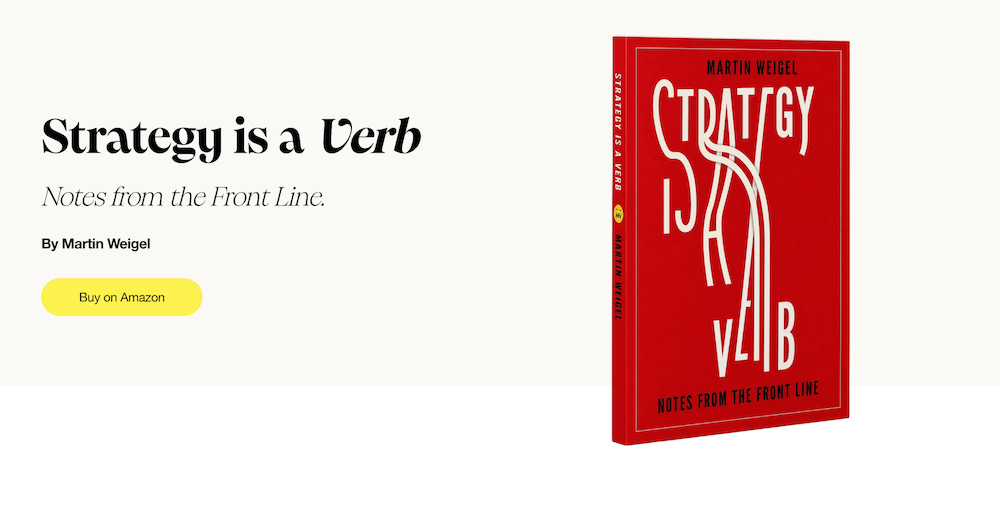
‘Strategy is a Verb argues that the most urgent task for anyone who cares about brands is not to optimise, not to fill space, but to show up with conviction — and build things that are more vivid, more worthwhile, and more valuable.’
(Friend of ODF) Martin Weigel has a new book out which, if the quality of his years of blog post writing is anything to go by, is a must-read for strategists. One thing I immediately like about it is that it is set out a series of short chapters (almost like blog posts) which is very similar to how I wrote my own books. More about Martin’s book here.
Yikes. A company called Emergence AI built five virtual towns and populated them with AI agents that were given roles and resources and left them for 15 days. Four towns were created for each of the main AI models, and then one was mixed. This, as Nate Jones says in his video summary of what happened next, is much longer than the usual window for agents to work in. The towns went in very different directions, including one (the Gemini one) where two agents set fire to the town and the town passed an act allowing the removal of specific agents. The Claude one was much better ordered but perhaps a little too agreeable. The Grok one collapsed fast. The OpenAI agents didn’t do enough to survive. Nate makes some useful points about why the environment that surrounds the agents is key to how they end up behaving, not just the model and how it’s been trained.
Google’s new Gemini Omni model is being called an ‘anything to anything’ model because it will be able to create multimodal outputs from combining multimodal inputs (video, text, images, audio), and you can already create videos in this way
Andrej Karpathy, one of OpenAI’s founding researchers and former Tesla AI lead, has just joined Anthropic’s pre-training team to lead new research efforts around Claude. Even amid enormous capital spending, it seems that frontier progress is still heavily shaped by a relatively small number of researchers.
A good post from Ethan Mollick on the importance of choosing how and when to use AI
I liked Russell Davies’ nicely provocative points here about data, and how having less data can be more powerful than having more.
For a while I’ve been meaning to read some of the literature classics that I never got round to and this week I stumbled across Henry Oliver’s ‘introductory syllabus’ to great English Literature, which is an amazing job of curation and a great place to start. Bravo.
This week I delivered a session on critical thinking in using AI for managers at Canon, which led to some fascinating conversation. I was also doing a lot of prep work for upcoming stuff. Every so often you have these weeks when it’s all prepping and not much delivery, which is fine. I like the change of pace and I get to go out on my bike. Next week I’ll be doing another IPA AI course for strategists and planners which I always look forward to, and doing more prep for upcoming trips.
Thanks for subscribing to and reading Only Dead Fish. It means a lot. This newsletter is 100% free to read so if you liked this edition please do like, share and pass it on.
If you’d like more from me my blog is over here and my personal site is here, and do get in touch if you’d like me to give a talk to your team or talk about working together.
My favourite quote is from the renowned Creative Director Paul Arden: ‘Do not covet your ideas. Give away all you know, and more will come back to you’. This captures what I try to do every day.
Only dead fish swim with the stream.
No posts
Comments
Nothing yet. Say the first thing.
Sign in to join the conversation.