

Most AI use today is open-loop. People prompt, get an output, use it, and move on, meaning that each interaction is consumed the moment it’s produced. Last week I wrote about AI as compounding capability in the context of agencies and operating models, but it’s a principle that has much broader application. Getting value from AI and compounding value from AI are not the same things, and very little of what’s currently in production is set up for the latter.
The OODA loop, originated by Colonel John Boyd, is a neat way to think about adaptive but compounding value creation with AI because it is closed and reinforcing by design. Boyd was a US Air Force fighter pilot turned military strategist whose theories on manoeuvre warfare, decision-making under uncertainty, and the dynamics of competition shaped modern strategic thinking well beyond the military. He was something of a maverick who clashed repeatedly with the Pentagon establishment, challenging entrenched assumptions about air combat, strategy, and the design of fighter planes. When I was writing my first book I read Robert Coram’s biography of Boyd and it gave me a lot of useful nuance around the man and his thinking. His OODA model (Observe, Orient, Decide, Act) describes how individuals and organisations adapt under uncertainty. Observation gathers information from the environment. Orientation synthesises that information against experience, models, and culture to make sense of it. Decision selects a course of action and Action commits it, generating new observations that feed the next cycle.
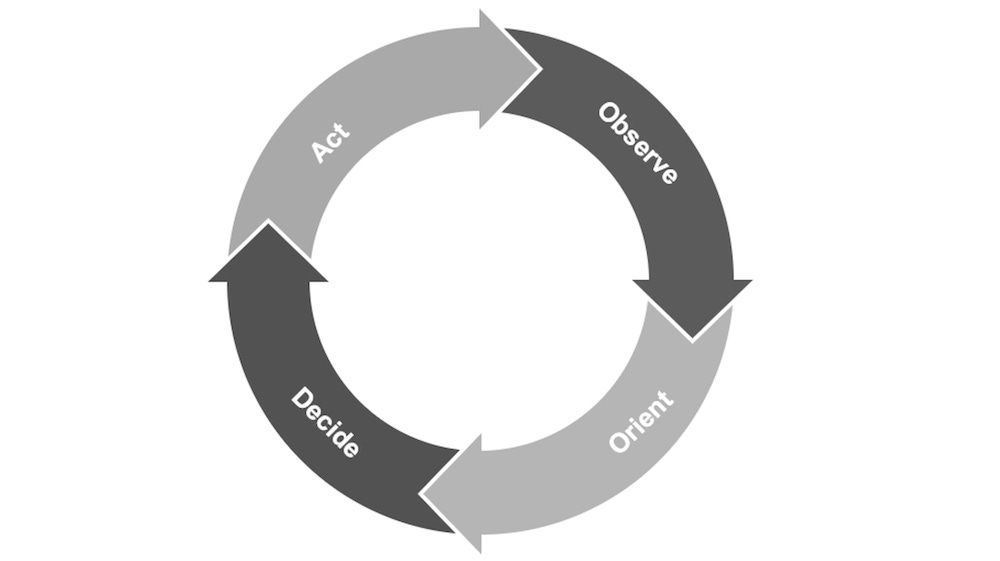
OODA captures the potential of compounding value because, if it is architected well, each Decide and Act feeds the next Observe, and understanding accumulates over time.
For value to compound with AI you need structured knowledge and retained context so that every interaction, decision and outcome improves the next. You need a closed, reinforcing loop. Much of the current focus for AI application is on the Observe stage (e.g. market and competitive intelligence, customer insight, trend analysis, meeting capture and synthesis, monitoring, briefing) and Act phase (execution, production, automation, optimisation, reporting). These are legitimate, valuable and increasingly well-funded use cases. They are also visible, measurable, and easy to justify and to accelerate with AI. But neither of them, working in isolation, improve and reinforce understanding over time. For that to happen you need to structure and feed context and knowledge from each decision and action into your next observation and orientation.
Boyd insisted that orientation is the most important stage of the loop. It's also both the constraint and the prize - the part where AI is slowest to help, and the part where durable advantage lives. The work of orientation (the work of ‘meaning-making’ if you like) still sits more naturally with human cognition and institutional culture and it’s slower to develop, so many organisations defer it. But good orientation is where value truly compounds because you are using your latest known context to inform your next decision. Faster observation without better orientation can simply result in faster error generation. Faster action without better orientation can result in hasty commitment to badly informed decisions. Without good orientation the loop risks producing motion without meaning.
The orientation phase is also likely to be where the distinctive frames, models, ways of working, and tacit knowledge that have grown up within the organisation sit. As the tools commoditise, orientation is the durable, defensible, distinctive thing left in the system. You might call it ‘asymmetric orientation’. It’s the moat. The practical question is whether you’re capturing it deliberately or leaving it to chance. This means architecting your institutional knowledge in ways that codify your operational ethos and values, but it also means continually updating this with new context from new decisions, new actions and new outcomes.
Good orientation will always rely on human qualities, notably adaptability, judgement, imagination, abstraction, tacit experience, combinatorial creativity. But AI can contribute in a couple of key ways, by codifying existing frames of reference, and by challenging us with new perspectives that break open our assumptions. In 1976 Boyd wrote an essay called ‘Destruction and Creation’ (PDF) arguing that staying oriented in a changing world requires both pulling existing frames apart and building new ones. The two halves are inseparable. AI arguably makes creation much easier, but destruction remains less obvious, and much harder. AI is helping organisations produce more without necessarily helping them to think differently, and the risk is that AI ends up encoding our current assumptions faster than we can question them.
So far this has assumed a single loop. In practice an organisation runs many OODA loops, and Boyd recognised that tactical loops sit within operational ones which in turn sit within strategic ones. But he also made a good point about tempo. Relative tempo is important in situations where manoeuvrability becomes essential. If you can adapt faster than your opponent you reduce ambiguity quicker and gain advantage. But not every loop benefits from speed. Tactical execution may reward faster cycles, but strategic orientation often benefits from slower, more deliberate ones.
The risk with AI is that it tends to accelerate the inner, tactical loops while leaving the outer ones untouched, producing tactical agility that lacks strategic coherence. Boyd recognised that advantage was not always about maximum speed but instead about controlled pace, and sometimes the best strategic move is to slow down. So the question here is what kind of orientation is required? Is this a responsive, rapid loop that requires specific, well-defined information to maintain agility or is it a more strategic question that needs deeper, and more nuanced thought and orientation? Put simply, an awareness of tempo in orientation helps us to make better decisions with the right level of context. With AI, we’re at risk of making everything about speed and potentially moving very fast but in the wrong direction.
Compounding value lives in reinforcing loops, and reinforcing loops live on good orientation. Pulling old frames apart and building new ones is slow work, hard to measure, and easy to defer. But it's also the work that decides whether everything else accumulates or evaporates.
Rewind and catch up:
The New Agency Operating Model
Why Every Company Needs an AI Philosophy
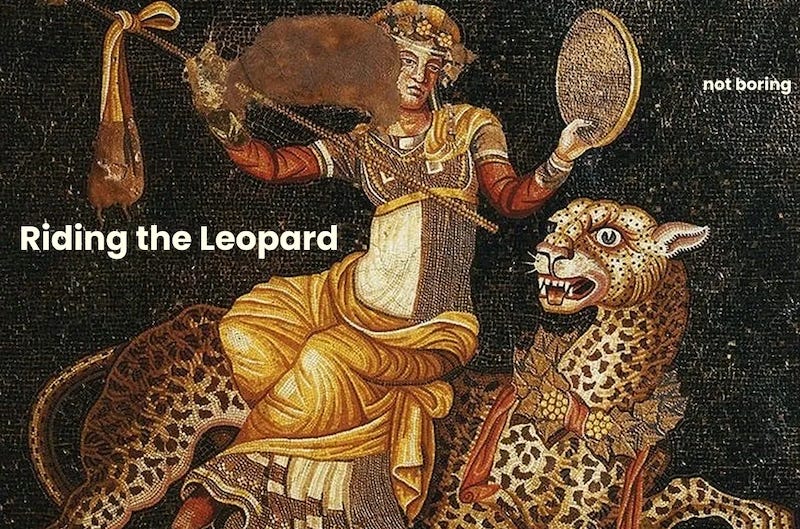
This is the most profound piece of writing that I’ve read in a long time. Packy McCormick looking at the question of why, in an age of technological abundance, so many of us are unhappy. And why, as the means at our disposal grow, the harder it seems to be to find meaning.
He draws on many of the greatest thinkers, philosophers, writers, and physicists to show that ultimately you are what you experience. That you are a little slice of the universe experiencing itself, and the meaning of life is to ‘expand the range and depth of experience in the universe in order to expand and co-create it’. And you are here to do that in a way that only you can.
‘Every one of these people is saying the same thing: you are a piece of the universe experiencing itself. And every one of them is saying, in different words, that this imposes an obligation on you: to be the fullest, strangest, most irreducible version of yourself. All of this so that each of us might create and experience the world differently than anyone else could. In other words, differentiation is a moral obligation.’
I’ve been thinking about it all week.
My 20 minute talk, ‘What the Victorians Knew About AI’, at the brilliant Watch Me Think conference in London is now online and you can see it here. My theme was what the big technological-driven changes of the industrial revolution can teach us about our current AI-inflection point and I used examples including the invention of the elevator, the telephone, the railways, the typewriter and the camera to show how it’s second-order effects, new social norms, rising switching costs, and the question of who benefits from the technology that truly characterises the impact of general purpose technologies like AI.
At this week’s I/O conference Google unveiled a big AI-powered overhaul of its search experience, away from lists of links and towards interactive experiences and ‘information agents’. There’s also Gemini Spark, a personal agent that ‘helps you navigate your digital life’, and which will work in the background for you even if your phone and laptop are turned off (video guide to what they announced and demo’d here)
A new ‘AI eats the world’ presentation from Benedict Evans - a bunch of insightful charts and some really interesting questions around three key areas: capital, deployment and change (including how AI usage is very wide but still mostly very shallow). Some echoes of themes I’ve touched on many times including the initial focus on doing the same things faster moving to doing things that are only possible with the new technology and then disruption/redefining the question you’re answering.
‘...for Brits, AI is simply the next logical stage of the Tesco Clubcard scheme and self-checkout machines: nobody likes it, nobody trusts it, everybody uses it, and every interaction contains the faint possibility of public humiliation. Unexpected item in the ideological bagging area.’ Tim Malbon wrote an excellent post on why Britain’s AI anxiety is not primarily technological, but cultural.
A forensic but brilliantly insightful article in the FT (£) on why birth rates are falling everywhere all at once (a huge macro trend)
This is a long and geeky but fascinating exploration of how long it takes for an invention to appear once it first becomes technically possible
I was working with a senior leadership team this week on AI transformation and the question came up about use case identification so I created a simple checklist based on the classic Design Thinking framework DVF - Desirability (real user needs), Feasibility (what’s technically possible) and Viability (benefit to the business). Full disclosure, Claude helped me put it together, but I thought I’d share it here as well in case it was useful for you
If you’re interested in improving your fluency in using AI in strategy work (or in general) I’ll be running the next IPA Advanced Application of AI in Strategy and Planning virtual course on June 1st and 2nd and you can sign up here
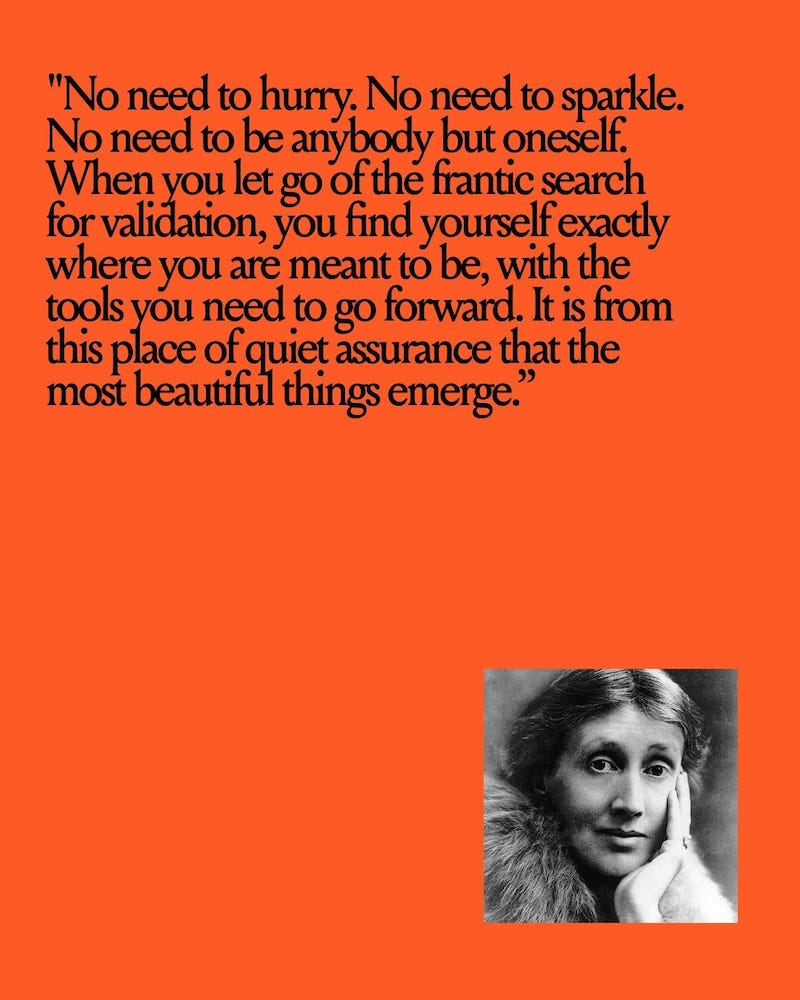
How good is this quote from Virginia Woolf? (HT MyMind/Katie Dreke)
This week I was out in Muscat again working on AI transformation with Omantel, Oman’s biggest telco provider. Some fascinating conversations around AI application and culture change. Next week I’m delivering a session on critical thinking in AI use, for a team at Canon, but I’m also doing some major prepping for upcoming projects. It’s a quieter week so I’m hoping to get some swims in at the local lido and maybe get out on my bike whilst it’s nicer weather.
Thanks for subscribing to and reading Only Dead Fish. It means a lot. This newsletter is 100% free to read so if you liked this edition please do like, share and pass it on.
If you’d like more from me my blog is over here and my personal site is here, and do get in touch if you’d like me to give a talk to your team or talk about working together.
My favourite quote is from the renowned Creative Director Paul Arden: ‘Do not covet your ideas. Give away all you know, and more will come back to you’. This captures what I try to do every day.
Only dead fish swim with the stream.
No posts
Comments
Nothing yet. Say the first thing.
Sign in to join the conversation.