
The interview with Joel Mokyr is part of the Great Divergence series, produced by Warwick University’s CAGE Research Centre and On Humans.
You can listen to episodes on Apple Podcasts, Spotify, or wherever you get your shows.
Alternatively, you can keep reading for a summarised essay and a bibliography.
Why did Western Europe become the wealthiest region of the early modern world? A litany of explanations has been given, from colonialism and capital markets to fuel prices and family size.
Joel Mokyr focuses on science.
“The Industrial Revolution happened after the Scientific Revolution,” notes Mokyr, a 2025 Nobel laureate in Economics. “And that is probably not a coincidence.”
Despite the popularity of this explanation among laypeople, many historians have remained sceptical. “Artisans with no scientific training were mainly responsible for the key inventions,” explains one. “The cause was not science”, writes another.
Mokyr agrees with the critics on one thing. “It’s not a simple model where science drives technology. They co-evolve and reinforce each other,” he says. For example, the we might not have thermodynamics without the steam engine, Mokyr explains.
But saying that science did not matter for the Industrial Revolution “is too strong”, Mokyr maintains.
Take the famous Watt steam engine. James Watt was not a scientist, but he spent a great amount of time interacting with people who were. His closest consultant was Joseph Black, one of the eminent physicists of the time.
Not all of Black’s advice was good. “Black did not understand the principles by which the steam engine worked,” Mokyr notes. But the very idea that craftsmen would consult scientists was revolutionary. And much of Black’s help was valuable.
Black was not the only link between science and steam.
“Evangelista Torricelli was a student of Galileo”, Mokyr says, “and he was the first to point out that the Earth is surrounded by an atmosphere – that we're living at the bottom of an ocean of air pressure. If you don't understand that, you'll never build a steam engine”. Together with other discoveries, such as vacuum pumps, this shaped the knowledge economy that gave rise to the Newcomen steam engine in 1712, and later, to the Watt steam engine in the 1770s. The inventors were not scientists, but they were the product of their times: a time ever more shaped by science.
“People have always invented new techniques, but for thousands of years, they did not really know why these techniques worked”, Mokyr explains. “And if you don’t know how things work, it is very difficult to improve them.” Then things changed. “At some point in the 1400s or 1500s, after the Gutenberg printing press and the voyages of Columbus, you start seeing a process where people are really trying to study the natural environment in a more systematic way.”
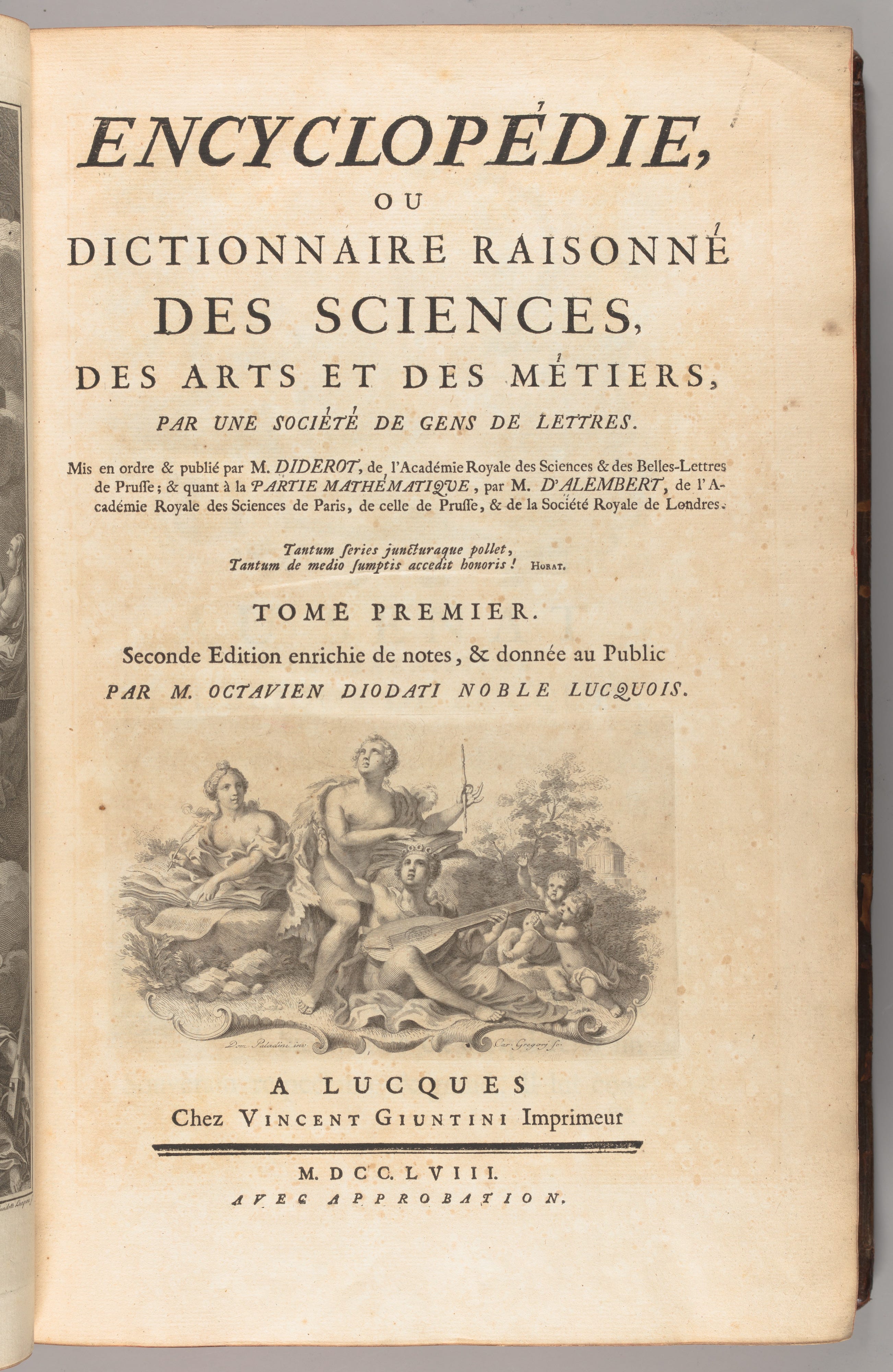
This was not just a matter of science. A more general change took place, too – a change exemplified in the European “Republic of Letters” and the encyclopedia movement. Ideas started circulating fast. “This was a marketplace for ideas,” Mokyr says.
The encyclopedias are particularly telling: their detailed drawings of the latest gadgets took Europe by storm.
The Chinese had great encyclopedias, too. Yet in China, the encyclopedias focused on science and technology never seem to have taken off: some were restricted to the emperor’s use, whilst others simply flopped, surviving to this day only by simple copies surviving by accident. What explains the different fates of China’s and Europe’s encyclopedias?
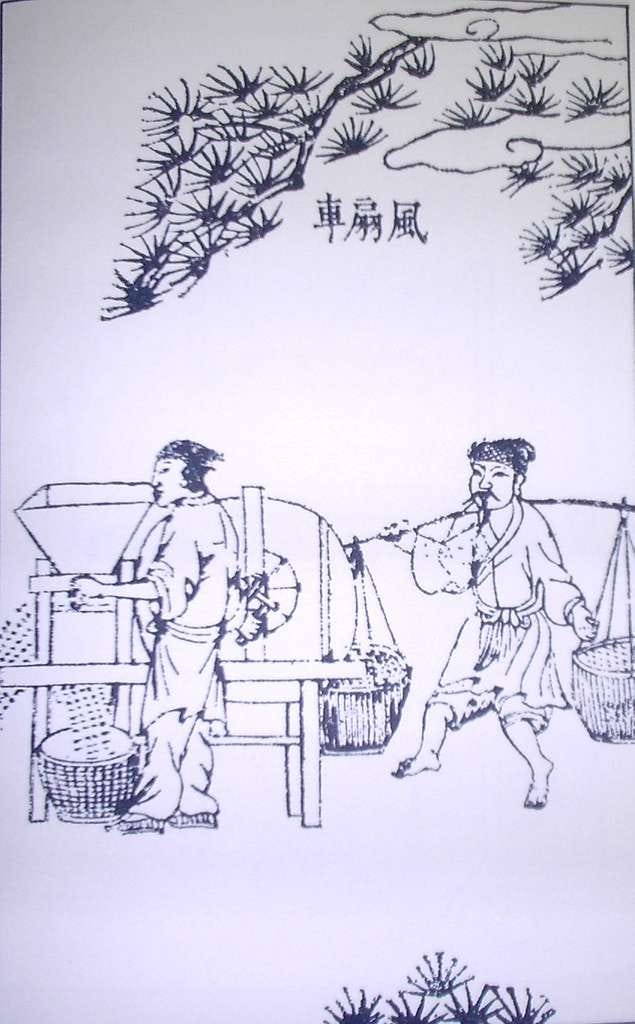
A possible explanation lies in politics. Some encyclopedias faced marginalisation, if not outright bans, when they didn’t please the emperor.1 China’s centralised politics made this a greater threat than ever existed on the opposite edge of Eurasia. A book could be banned in “France”, but not in “Europe”. The combination of small states and a shared literary language, Latin, offered Europe a natural escape from total censorship.
Furthermore, the Chinese reading public had its mind elsewhere. The centre of China’s intellectual culture was the civil service exams, all based on Confucian classics. “A real scholar will not read this,” admitted the preface of one Ming Dynasty encyclopedia. Real scholars were busy with Confucius.
“One of the great differences between China and Europe is that the [scientific and technological] advances in China all happened within the Chinese imperial bureaucracy or the mandarinate,” Mokyr explains. “In Europe, on the other hand, the scientific edge was held by the private sector. I pointed this out in the 90s, and I still think it's true.”
Mokyr is not alone in suggesting that the imperial Chinese state might have curbed its inventiveness. In a recent overview of ancient China’s inventions, a team from MIT and Tsinghua University discovered that China was at its most inventive at the time when its state was the weakest.2 As the power of the state bureaucracy grew, the number of Chinese inventions dwindled.
Yet Mokyr does not want to focus on politics alone. “I think what is driving all the other things is culture”.
The Scientific Revolution not only gave Europeans new knowledge. It gave them a new attitude.
“The majority of human societies have had an undeserved respect for the knowledge of people who came before them, whether it's Confucius or Aristotle or the people who wrote the Talmud ”, Mokyr says. Even radical reformists in many societies had to explain their vision as a return to the pristine path. “Chinese reformists like [Neo-Confucian Zhu Xi] never claim that Confucius was wrong”, Mokyr notes. “Rather, they claim that we have to interpret Confucius more carefully.”
Europe turns a different page. The Scientific Revolution proved that many of the ancient thinkers were wrong about the world — so did the “discovery” of the Americas.
Europeans started losing the veneration of past knowledge.
The Renaissance is often framed as a return to the lost antiquity of Greece and Rome – this much follows the typical pattern – but something profound had changed by the time of the Enlightenment.
“They still read Greek literature, they still admire Cicero”, Mokyr says. “But they think they can do better. They know they can.”
What about the dark side of the Enlightenment? Many of its thinkers were entangled with slavery and colonialism. How much praise do they merit from us?
“No one is saying that these are nice guys”, Mokyr says. “But what counts about the Enlightenment is a belief in progress.” Yet even many self-identified “progressives” call for less focus on the European successes and more on their overseas costs: less on cotton spinning machines and more on the enslaved labour toiling in the cotton fields.
Mokyr maintains that this is a false dichotomy. “The Enlightenment led to the abolitionist movement”, he says. “The banning of slavery took longer than it should have, but it did happen.”
Mokyr also believes that the Enlightenment belief in progress led to a greater search for technologies to reduce human suffering, from vaccines to farming practices.
“No critic of this period”, Mokyr exclaims, “wants to return to a time before it when life expectancy was 35, when people were constantly itching, covered with insects, and completely powerless against almost every disease imaginable – always living under the threat of hunger if the harvest fails.” Not only do we live longer and grow taller today. “We work far less than we worked in the past. We enjoy things that emperors and popes could not have dreamed about, like a retirement for 20 years,” Mokyr says with a laugh.
Despite his enthusiasm for the role of science, culture, and the Enlightenment, Mokyr has not ceased searching for complementary explanations. He recently partnered with Avner Greif and Guido Tabellini to explore the ways that family dynamics might have influenced the rise of Europe relative to China.
“After the year 1000, large extended families, or clans, became more and more important in China”, Mokyr explains. “In Europe, it's the other way around: the focus turns to nuclear families. And once you have a world of nuclear families, you have to create voluntary organisations that provide local services.” In China, you were born into a clan; in Europe, you decided to join organisations. “That made a huge difference.”
What about the future? “My optimism isn't particularly strong as far as politics is concerned”, Mokyr notes. “The world seems to be moving towards some kind of benighted form of populism”. On the other hand, “technological progress will only accelerate,” he maintains. “It's not that we're getting smarter, but we have better tools. Artificial intelligence is but the latest incarnation of these tools”, Mokyr says.
“And God knows what comes after that!”
Listen to the full episode on Apple Podcasts, Spotify or wherever you get your shows.
This interview is part of a series, produced by Warwick University’s CAGE Research Centre in collaboration with On Humans. The series searches for explanations to why Western Europe and North America overtook China and India as the richest regions of the modern world. Guided by six expert guests, including a winner of the 2025 Nobel Prize in economics, we approach this topic with balance and breadth, exploring everything from colonialism and fossil fuels to science and technology.
Why the West? Colonies, Fossil Fuels, and Lessons from China
Kenneth Pomeranz
Did Science and the Enlightenment Give Europe the Edge?
Joel Mokyr
Why Did the Industrial Revolution Happen in Britain?
Robert Allen
A View from the East: China, Japan, and the Other Path to Prosperity
Debin Ma
The Big Picture: Measuring the Origins of the Modern World
Bishnupriya Gupta and Stephen Broadberry
Mokyr, Joel. The Enlightened Economy: An Economic History of Britain 1700–1850. New Haven: Yale University Press, 2009.
Mokyr, Joel. A Culture of Growth: The Origins of the Modern Economy. Princeton, NJ: Princeton University Press, 2016.
Mokyr, Joel, Avner Greif, and Guido Tabellini. Two Paths to Prosperity: Culture and Institutions in Europe and China, 1000–2000. Princeton, NJ: Princeton University Press, 2023.
Pomeranz, Kenneth. The Great Divergence: China, Europe, and the Making of the Modern World Economy. Princeton, NJ: Princeton University Press, 2000.
Lucas, Robert E., Jr. “On the Mechanics of Economic Development.” Journal of Monetary Economics 22, no. 1 (1988): 3–42.
Jacob, Margaret C. Scientific Culture and the Making of the Industrial West. New York: Oxford University Press, 1997.
Crafts, Nicholas. “Explaining the First Industrial Revolution: Two Views.” European Review of Economic History 15, no. 1 (2011): 153–168.
Ó Gráda, Cormac. “Did Science Cause the Industrial Revolution?” Journal of Economic Literature 54, no. 1 (2016): 224–239.
Berg, Maxine. “Useful Knowledge, ‘Industrial Enlightenment’, and the Place of India.” Journal of Global History 8, no. 2 (2013): 247–267.
Hodgson, Geoffrey M. “Culture and Institutions: A Review of Joel Mokyr’s A Culture of Growth.” Journal of Institutional Economics 13, no. 4 (2017): 1003–1010.
Galofré-Vilà, Gregori. “The Diffusion of Knowledge during the British Industrial Revolution.” Social Science History 42, no. 4 (2018): 809–835.
The detailed fates of various Chinese encyclopedic books remain contested. Probably the clearest case of cencorship is the geographical compendium Fangyu shenglüe 方輿勝略, apparently forbidden because of its treatment of the Jurchens/Manchus who came to rule China. The more technologically oriented Tiangong kaiwu 天工開物 is sometimes cited as a case of cencorship, but solid evidence for an explicit ban is hard to come by. The details remain unclear. Benjamin Elman’s authoritative work does not mention a formal ban, but does state that Tiangong Kaiwu “was not widely available during the Qing dynasty (1644–1911)” because it “described processes that were government monopolies.” (Benjamin A. Elman, On Their Own Terms: Science in China, 1550–1900 (Cambridge, MA: Harvard University Press, 2005), 16.)
See Yasheng Huang, The Rise and Fall of the EAST (New Haven: Yale University Press, 2023), especially chap. 7; and Yasheng Huang et al., forthcoming, Reframing the Needham Question (Princeton University Press).
Comments
Nothing yet. Say the first thing.
Sign in to join the conversation.