
The interview is part of the Great Divergence series, produced by Warwick University’s CAGE Research Centre and On Humans.
You can listen to episodes on Apple Podcasts, Spotify, or wherever you get your shows.
Alternatively, you can keep reading for a summarised essay and a bibliography
Why was industrial modernity born in Europe rather than, say, China? The explanations abound, but the very question might be misleading. The Industrial Revolution was not a European event. It was a British event. And a focus on Britain might also shift the explanation. Science, for example, was a European success story. So why was the steam engine invented in Britain rather than France or Italy?
Oxford historian Robert C. Allen has spent decades trying to answer this question.
Allen thinks that the answer lies in wages.
British workers were expensive. And where does it make sense to invest in an expensive machine whose only job is to save time for workers? “It makes sense in Britain,” Allen says. “It does not make sense in France or Italy.”
China provides a dramatic example. “A hemp-spinning machine was invented there in the thirteenth century, but it was never generally adopted and fell out of use”, Allen wrote in his magnum opus, The British Industrial Revolution in Global Perspective. The spinning machine existed, but it made no business sense.
Workers were cheap enough.
Allen is not the first to argue for a relationship between high wages and the incentive to industrialise. In 1780, a British pottery manufacturer explained that, due to the high wages enjoyed by British workers, British manufacturers ”must long ago have given up all hopes of foreign commerce, if they had not been constantly counteracting the advancing price of manual labour, by adopting every ingenious improvement the human mind could invent.”
The French agreed.
“Given the manner in which the French and English lived, [the English] could never make a plate [of glass] which could enter into competition with ours for the price”, wrote a French manufacturer in the 18th century, continuing to a proud description of how little the French consumed compared to the more gluttonous Britons.
As the producers opined on the business impact of wages, others simply celebrated the condition of the British labourers. In 1725, Daniel Defoe wrote that “the working manufacturing people of England eat the fat, and drink the sweet, live better, and fare better, than the working poor of any other nation in Europe.”1 Remarkably, Defoe was writing decades before the onset of the Industrial Revolution, often dated to 1760 or 1770.
This insight was long lost to historians.
“English agricultural labourers were supposed to be at the bottom,” Allen recalls the received wisdom of his early career. Yet when Allen calculated their salaries as bread, beer, and so on, he noticed the same pattern celebrated by Daniel Defoe: The pre-industrial Britons lived well. The same was true for Britain’s neighbours in the Netherlands and Belgium, then known as “The Low Countries”, but not in other parts of Europe. People in Vienna and Florence lived close to bare-bones subsistence, as did people living in the key cities of China and India.
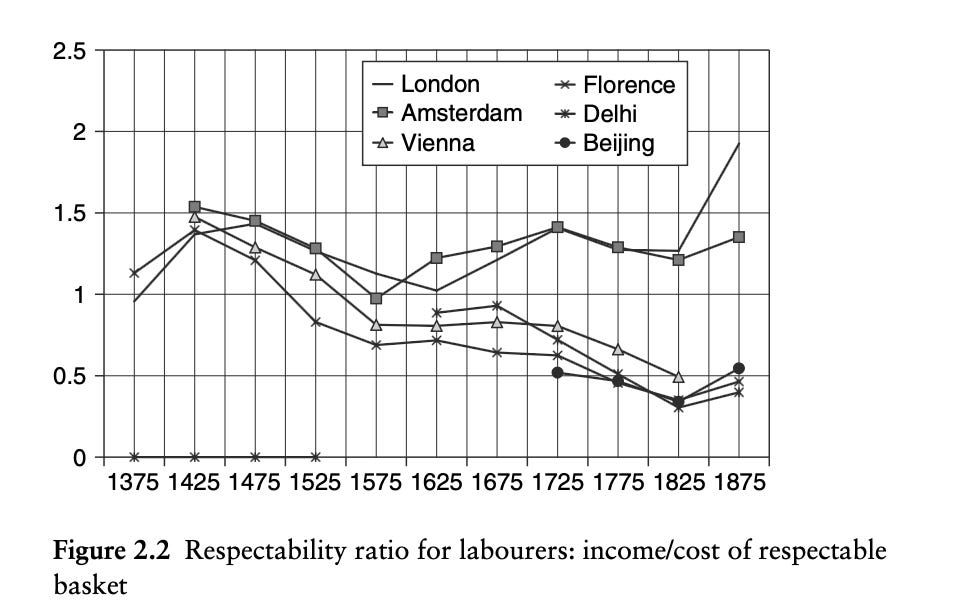
Figure 1: Income versus the cost of the “respectability basket” in six cities (Allen 2009, 137). The “basket” includes basic goods like food and cloth, slightly above bare-bones subsistence.
The rise of the British economy started long before the Industrial Revolution. “And my theory is that it drives the Industrial Revolution”, Allen explains.
So why Britain and not, say, Amsterdam, which also had high wages? Here, Allen focuses on fossil fuels. Britain had ample coal deposits, making it the Gulf State of the early modern world.
The British reliance on cheap fossil fuels was not only a wedge between it and its nearest continental rival: it was a wedge between northern Britain and the rest of the world. In a vast comparison between world economies in the early 1700, Allen discovered that northern British energy prices were a mile below any other region of the world. Together with Britain’s high wages, this pushed the country to a long quest for ways to use machines and fossil fuels as a substitute for manual labour. The quest for modernity had begun.
“There was only one path to the 20th century,” Allen wrote. “And it traversed northern Britain.”
If Allen is right, the so-called “great divergence” between the West and the rest happened in three stages. First, there is a “little divergence” where Britain and the Low Countries pull ahead of the rest. This gives British businesses an incentive to replace labour with fossil fuels and machines — an Act II that happens in Britain. In the final act, these inventions spread from Britain to its neighbours and settler colonies.
So what explains the high British wages that define the first act?
Allen believes that Britain excelled in trade, which allowed it to focus less on basic farming and more on complex manufacturing. The wool industry is a big part of the story. The Black Death made workers scarce but land plentiful. Landlords turned to a strategy that required few workers but much land: raising sheep.
“After the Black Death, there was a big conversion of farmland to pasture”, Allen explains. At the start, Britain exported raw wool, but eventually, Britain became a mass manufacturer of woollen cloths. British woollen products became an international success story, especially with the invention of a lighter woollen cloth, “the new draperies”, in the late 16th century.

Yet Allen does not think that Britain’s rise was mostly a matter of manufacturing ingenuity.
“I would focus on imperialism and the colonial system.”
The British Empire in Asia came much later, so Allen’s focus lies in North America and the Caribbean. The rapidly growing American farmland allowed Britain to outsource the growing of raw materials. At home, Britons could specialise in high-end products.
This echoes the views of Kenneth Pomeranz, a historian at the heart of debates surrounding the rise of Western economies.
My interview with Pomeranz is accessible here.
In his field-defining book, The Great Divergence, Pomeranz argued that American acres, together with cheap fossil fuels, were a prime ingredient giving the British a lead over China. “I think Pomeranz got it basically right”, Allen says. “If I have added anything, it is an explanation of how the colonies shaped British labour markets, thereby giving the incentive to use coal and capital as a substitute for the expensive labour.”
Colonial trade had yet another impact, Allen thinks.
“It gave rise to a greater capitalist class of people getting rich in the trade in the slave colonies and so forth”, he explains. “They wanted the government to promote this kind of activity, and the parliament gave them a forum to influence things.” With time, British policy becomes increasingly favourable to overseas trade. “The British labour markets respond well. This is a good time to be a British worker”, Allen says. But the cost of it was borne overseas.
What about science and technology? A 2016 paper found that the price of British watches dropped by a dramatic 75% the 18th century. Clocks were not labour-saving devices, nor were they shaped by a steam engine. Does this not show the real driver was not a scramble for cheap fuels, nor a battle against high wages, but something broader in the know-how of British artisans?
Allen admits that the clockwork was an interesting development, and part of a larger increase in artisanal skill. “But you have to ask yourself, what is driving all this?” Allen says. “I think it is the rise in urbanisation powered by foreign trade. People in cities learn to read and calculate because they have to.”
Allen does not agree with scholars, such as Joel Mokyr, who focus on science, the Enlightenment, and a cultural change towards curiosity about the natural world.
My interview with Mokyr is available here.
“I’ve studied Elizabethan math books”, Allen says. “I wanted to know why people were interested. Are they interested in science? No. The examples are all from business.”
Not all remain convinced.
Jane Humphries from Oxford has argued that British spinning wages were much lower than Allen claims. “There are a lot of nitty-gritty details in here,” Allen says. “But I want to highlight that Humphries has done very valuable work on women’s wages across the British economy. According to her, they all went up — all except the spinning wages. I’m not sure how that can be true,” Allen says. “People move between activities, and that tends to equalise wages.”
Despite their disagreements, Humphries and Allen share a goal in measuring the welfare of the common folk. What lessons have we learned?
“After the Black Death, wages went up everywhere in Europe,” Allen begins. This makes sense: those who survived were much needed and could bargain for better wages. “But the wages start to shrink around the mid-1400s. This happens everywhere except for Britain and the Low Countries,” he says. British wages stayed high, even rising after the 1600s. “But this created an incentive to mechanise”, Allen explains. The results were uneven. Some gained immensely, but for most workers, incomes went down, whilst working conditions deteriorated. The Industrial Revolution gave the elites an unheard-of economic muscle, and whilst certain occupations benefited, the fruits were far from glorious for most Brits. “The British workers grew taller before the Industrial Revolution”, Allen explains. “Many occupational groups have falling heights during the Industrial Revolution.”
The gloomy Dickensian period starts to taper out during the 1800s. As the century progresses, wages start to shoot up, not only in Britain but across the “West”. There are plenty of theories about the positive rupture, from technological breakthroughs and mass education to the labour movement and the plunder in Africa.
For various explanations of the boom of the last 150 years, see The Birth of Modern Prosperity, featuring Acemoglu, Galor, DeLong, and Milanovic.
Whatever the explanation, the outcome was good for workers in the West. Incomes rose. Inequality plummeted.
The hopeful era ends around the 1970s, Allen says. This is true especially in the US and the UK, where inequality started rising again. At the same time, many poorer countries grew richer. China led the headlines, but India, too, made great gains in poverty reduction. “How you see [the last 50 years] really depends on where you are”, Allen says. The gap between the West and the Rest started narrowing.
But why did the West become rich in the first place? As Allen himself noted, continental Europe remained far behind Britain during the Industrial Revolution. So how did the rest of the West join the British trajectory?
The first change had to do with the efficiency of machines. It took time, but eventually the British techniques were streamlined enough to make sense in, say, France. “The British engineers undid Britain's advantage”, Allen explains. By making their technology more efficient, “the British engineers made it accessible to everybody”. Yet not everybody imported the industrial techniques at a similar speed. So why was Western Europe faster than Russia, and Japan faster than China?
“The successful countries followed a standard model”, Allen explains. “It can be summarised as schools, banks, trains, and tariffs.”
Not every country had the same mix. Japan was unable to impose tariffs due to American interventions, but the government did not sit idle: it built schools, trains, and imported European banking practices. Instead of tariffs, “the Japanese invented industrial policy”, Allen says. The government still helped strategic industries, this time by subsidies. “Indian nationalists wanted the standard model, too,” Allen notes. “One problem with colonialism is that they were not allowed.”
If the standard model worked in the 19th century, what should we do now in the 21st century, with AI potentially causing a historic wave of new mechanisation?
“I’m not really a small-government person. The government should have an active role in setting good policy,” Allen says. “But what that policy is, I leave for others to decide.” Despite these reservations, he goes on to highlight one area where governments can have an outsized positive impact — an area where, according to Allen, “a lot of research shows that every dollar spent will pay back many times.”
“That is investing in children.”
You can listen to the full conversation on Apple Podcasts, Spotify, or wherever you get your shows.
This interview is part of a series, produced by Warwick University’s CAGE Research Centre in collaboration with On Humans. The series searches for explanations of why Western Europe and North America overtook China and India as the richest regions of the modern world. Guided by six expert guests, including a winner of the 2025 Nobel Prize in economics, we approach this topic with balance and breadth, exploring everything from colonialism and fossil fuels to science and technology.
Why the West? Colonies, Fossil Fuels, and Lessons from China
Kenneth Pomeranz
Did Science and the Enlightenment Give Europe the Edge?
Joel Mokyr
Why Did the Industrial Revolution Happen in Britain?
Robert Allen
A View from the East: China, Japan, and the Other Path to Prosperity
Debin Ma
The Big Picture: Measuring the Origins of the Modern World
Bishnupriya Gupta and Stephen Broadberry
Allen, Robert C. The British Industrial Revolution in Global Perspective. Cambridge: Cambridge University Press, 2009.
Allen, Robert C. “The Great Divergence in European Wages and Prices from the Middle Ages to the First World War.” Explorations in Economic History 38, no. 4 (2001): 411–447.
Allen, Robert C. “The Industrial Revolution in Miniature: The Spinning Jenny in Britain, France, and India.” The Journal of Economic History 69, no. 4 (2009): 901–927.
The spinning wage debate
Humphries, Jane. “The Lure of Aggregates and the Pitfalls of the Patriarchal Perspective: A Critique of the High Wage Economy Interpretation of the British Industrial Revolution.” The Economic History Review 66, no. 3 (2013): 693–714.
Allen, Robert C. “The High Wage Economy and the Industrial Revolution: A Restatement.” The Economic History Review 68, no. 1 (2015): 1–22.
Humphries, Jane, and Benjamin Schneider. “Spinning the Industrial Revolution.” The Economic History Review 72, no. 1 (2019): 126–155.
Allen, Robert C. “Spinning Their Wheels: A Reply to Jane Humphries and Benjamin Schneider.” The Economic History Review 73, no. 4 (2020): 1128–1136.
Humphries, Jane, and Benjamin Schneider. “Losing the Thread: A Response to Robert Allen.” The Economic History Review 73, no. 4 (2020): 1137–1152.
Other
Kelly, Morgan, and Cormac Ó Gráda. “Adam Smith, Watch Prices, and the Industrial Revolution.” The Quarterly Journal of Economics 131, no. 4 (2016): 1727–1752.
Allen, Robert C. “Technical Change, Globalization, and the Labour Market: British and American Experience since 1620.” Oxford Open Economics 3, Supplement 1 (2024): i178–i211.
Crafts, Nicholas. “Explaining the First Industrial Revolution: Two Views.” European Review of Economic History 15, no. 1 (2011): 153–168.
Kelly, Morgan, Joel Mokyr, and Cormac Ó Gráda. “Precocious Albion: A New Interpretation of the British Industrial Revolution.” Annual Review of Economics 6 (2014): 363–389.
The three 18th-century quotes are from Allen’s British Industrial Revolution in Global Perspective, pages 1, 105, and 25, respectively.
Comments
Nothing yet. Say the first thing.
Sign in to join the conversation.