
The essay is part of the Great Divergence series, produced by Warwick University’s CAGE Research Centre and On Humans.
Prefer listening to reading? Find the episodes on Apple Podcasts, Spotify, or wherever you get your shows.
Amongst the litany of theories about the rise of the West, it can be difficult to separate the good, the bad, and the ugly. Here, terms can help. The catchword 'great divergence' is increasingly used by historians who want to address this question whilst avoiding traditional East-West clichés.
The term was coined by historian Kenneth Pomeranz in his book of the same name. Europe’s rise was hardly a new topic when The Great Divergence was published in 2000, but Pomeranz’s background offered a fresh angle to the old question.

“I was going to do graduate school in European history, and in fact, had my applications in the mail,” he recalls. “Then I wandered, largely by accident, into a Chinese history course. I loved it and started thinking about this crazy idea of switching fields.”
The crazy idea took hold, and Pomeranz became an expert in China’s ecological and environmental history. This background allowed him to approach Europe’s rise with a more nuanced understanding of the most widely discussed “other”: China. Unlike past literature on the rise of the West, the literature he pioneered became a tightly controlled comparative exercise – an exercise where to know one country was to know no country.
Pomeranz argued that even a careful comparison of whole countries could be misleading.
“China is really big”, he notes. Imperial China’s economy might have looked stagnant, but a weak average was hiding two dynamic cores: the Yangtze Delta (including modern-day Shanghai) and the Pearl River Delta (including modern-day Hong Kong and Shenzhen). In a stark move against theories rooting Europe’s headway to the Renaissance, printing press, or Columbus’s 1492 voyage, Pomeranz argued that China’s cores were just as economically dynamic as Western Europe at the eve of the Industrial Revolution. For him, the great divergence happened late, towards the end of the 18th century, perhaps as late as the year 1800.
The late timing has not gone without challenge. One of the critics is Stephen Broadberry, who has constructed wage and GDP comparisons that push the great divergence back by decades or even centuries. Despite the ongoing disagreements, Broadberry agrees with Pomeranz about the need to zoom into China’s dynamic cores. “I date the great divergence to 1700, but that’s because I focus on the Yangtze Delta”, Broadberry explains. “If you take the whole of China, the date is closer to 1300.” The magnitude of the difference underlines the impact of Pomeranz’s method — and the dangers of broad-brushed civilisational comparisons.
Pomeranz’s method had another novelty: he focused on ecology, especially the use of land.
“In densely populated areas, there are trade-offs”, Pomeranz notes. “An acre that's growing grain for food is not growing cotton for clothes.” You could clear more fields from the forest, but then firewood becomes sparse.
Trade could ease the tradeoff. “You could source your wood from upstream, sending them manufactured goods in return,“ Pomeranz explains. “But in a world of expensive transportation, there are limits to these purely ‘Adam Smith -style’ solutions.”
In early modern China, population growth was pushing hard against such ecological limits. China’s proto-industrial areas felt the effects: many areas de-urbanised, with manufacturing workers moving back to the countryside.
Much of Europe was facing similar challenges.
Take Denmark. Whilst Britain was undergoing the Industrial Revolution, Denmark was increasingly deurbanising, with urban artisans returning to more basic jobs, addressing problems such as deforestation or erosion. In a key passage, Pomeranz wrote that:
“These patterns persisted well into the nineteenth century, even though Denmark had reasonable amounts of capital, good transport, participated in European science, and had plenty of nearby and culturally similar models for industrialisation.”
In short, Denmark shared many features traditionally associated with the rise of Europe. Yet this did not help them – not at the start.
“In the absence of some kind of ecological relief, Britain [could well have] entered a Danish pathway,” Pomeranz adds.
What helped Britain was a twin-set of ecological reliefs: coal and colonies.
For people of our century, it feels rather obvious that fossil fuels played a part in the making of the modern economy. “But it is interesting how long historians of this period did not pay attention to that,” Pomeranz says.
Pomeranz paid attention. “Coal is a really big deal,” he explains. “A ton of coal saves you roughly two tons of firewood. Yet the coal mine only takes up a small amount of surface area.” Coal eased the traditional tradeoff between fields-for-food and forests-for-fuel.
China had coal, too, yet small things made a big difference.
The British coal industry was close to London. It was also well connected to rivers and canals. “This was not the case in China, where most of the coal mines were in landlocked areas, far from the economic cores”, Pomeranz says.
The outcome was dramatic.
In the early 1700s, a British sailor kept a detailed diary of the prices in Canton. His notes reveal a striking pattern: England was more expensive than Canton, with basic foods costing four times more silver. Yet fuel was the exception: it was five times cheaper in England.
“Fuel power was around 20 times cheaper in London compared to muscle power,“ Pomeranz says. It is hardly a surprise, then, that England, not Canton, was becoming a fossil fuel economy: an economy in which architecture became synonymous with glass, bricks, and steel – heated in coal-powered furnaces – and in which manufacturing was increasingly done by machines, moved by the steam of coal-burning engines.
Britain and its neighbours pulled ahead. Their advantage was not ingenuity or necessity, but a lucky geography.
What about the steam engine? The origins of the steam engine have traditionally been told as a story of clever engineering – perhaps a reflection of the growing scientific knowledge in Europe. Pomeranz’s focus lies elsewhere.
“As you dig deeper in [British] coal mines, they start filling up with water,” Pomeranz notes. This was bad news for the coal industry, but in battling the water, the industry struck gold. In 1712, the world’s first steam engine started operating. The purpose of the machine was simple: to pump water out of the mine.
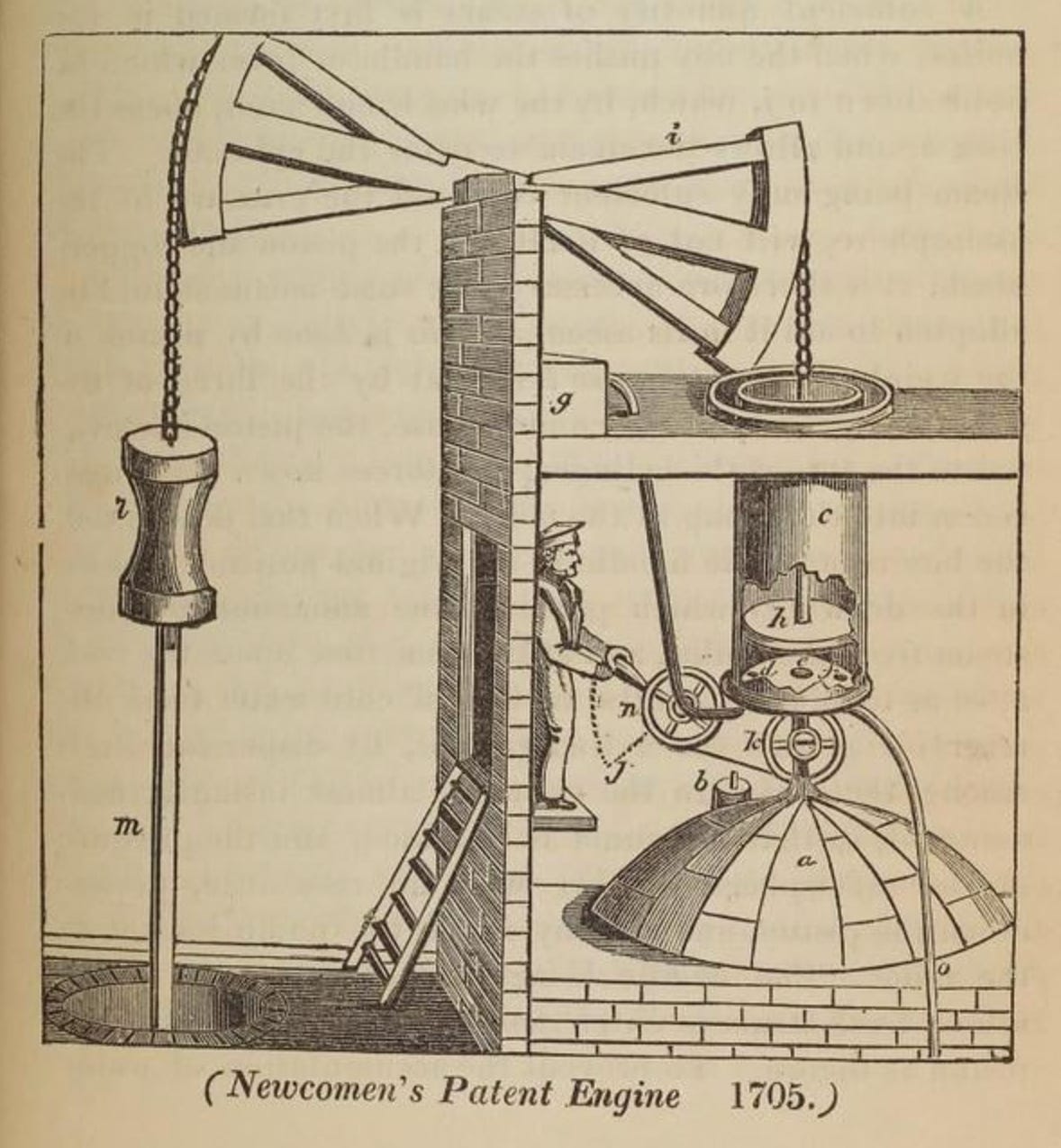
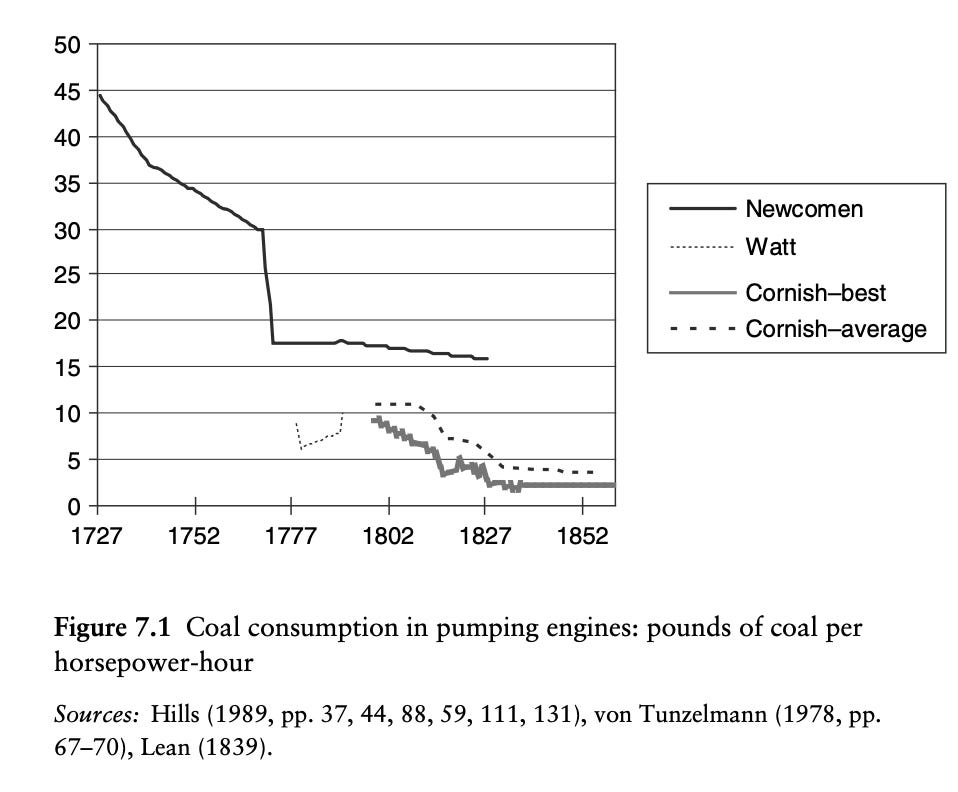
This “Newcomen steam engine” was deeply inefficient. “It lost over 99% of its power in conversion”, Pomeranz says. Yet it made economic sense, because it operated in the one location where coal was dirt cheap: by the coal mine itself. After all, “in the pre-industrial world, the price of coal is basically the cost of transportation”, Pomeranz says.
The steam-powered pumps later inspired the Watt steam engine, and eventually, the railways. This is true, but this well-known story had a much lesser-known origin: it started from British coal mines filling with water, something that never happened in China’s dry coal mines.
We will revisit the role of cheap fossil fuels in episode three with Robert Allen. Yet coal was not the only part of Pomeranz’s ecological argument.
“Britain gets its [ecological] relief partially from coal, and partially from its vast colonial possessions in the Americas,” Pomeranz explains.
Pomeranz calls Britain’s lands in America “ghost acres”: they serve the British economy, but without taking up British land. This is best exemplified by cotton. It was still true that an acre of food is not growing cotton, but with the British fields spreading across America, this compromise was an increasingly small inconvenience. Indeed, cotton is a harsh reminder of some broader patterns of the time: the precious raw material of the British Industrial Revolution was grown on land “acquired” from Native Americans and worked by enslaved labour, mostly trafficked from Africa.

If we move away from cotton, however, Pomeranz’s argument becomes more controversial. After all, very few other colonial imports were solving ecological bottlenecks. They were offering small daily pleasures: sugar, tobacco, coffee, and so on.
“Saying that colonial ghost acres were necessary doesn't mean that everything grown on them was necessary”, Pomeranz begins. He adds that the luxuries helped European economies in other ways, for example, by offering an easily taxable commodity that funded European military might. Yet many questions do remain on the role of colonies. Could Britain have gained raw materials by honest trade instead? Were there really such hard limits on the ‘Adam Smith -style’ solutions? This remains an active area of contention.
A further challenge to Pomeranz’s argument comes from its heavy focus on Britain and the British Industrial Revolution.
Take Denmark again: they stagnated whilst Britain industrialised, yet today, they are just as rich as Britain, if not richer. If we understand the great divergence as a broad rise of the Western economies, should we not focus on whatever links the rise of Britain with the rise of its neighbours and settler-colonies – the “West” that spans from Canada to Belgium, and from Denmark to Australia?
Even in Britain, the Industrial Revolution hardly lifted the welfare of the average worker. The massive gains in welfare enjoyed by British and other Western workers started much later, around the second half of the 1800s. This period is often called the “Second Industrial Revolution”, and focusing on it might shift the explanation: science was central to this era of electricity. Does focusing on the broader rise of welfare in the West shift the explanation towards science and technology?
“Without science, you don’t get the Second Industrial Revolution. That’s true,” Pomeranz admits. “It is also true that it is the Second Industrial Revolution that really lifts life expectancies and living standards”, he adds. “But you don’t get to the Second Industrial Revolution without the First Industrial Revolution.”
Furthermore, the ecological themes never disappear from the scene. “One of the reasons for this later boom [across Western Europe] has to do with grain and beef flowing from the Americas,” Pomeranz says. The themes are familiar. The food is grown on American soil. It is packed into trains and ships built from coal-powered steel. It is moved to distant lands with the power of steam. Again, overseas acres and fossil fuels are central players in the story – and we have not even mentioned the rubber plantations of Congo or the dawn of the oil boom.
The story continues as the new century opens. “One of the greatest transformations of the 20th Century was the capacity to turn fossil fuels into artificial land,” Pomeranz explains. The invention was the ‘Haber-Bosch process’, which uses energy from fossil fuels to capture nitrogen from the air, packing it into soil, and thereby increasing yields per acre.
How has this work shaped Pomeranz’s outlook on the future?
“Not surprisingly, I'm concerned about global warming,” he begins. “I keep thinking about how energy-drenched the modern world is. Can we get that energy in ways that don’t cook the planet? And what happens if we have to do with less energy in total? This is a big deal.”
What about the future of global inequality?
Pomeranz’s own approach focused on Western Europe and East Asia. On this front, “there has been a great deal of convergence”, he notes. China is still a middle-income country, but its richest regions are catching up fast. The catch-up has basically happened in Japan and the East Asian “tigers” of South Korea, Hong Kong, Taiwan, and Singapore. “Is this the first phase of a convergence that's eventually going to include the rest of the world? Or did East Asia catch the last train?” Pomeranz wonders.
“I don’t think we know the answer yet.”
In the full episode, we also discuss the global origins of modern science and the coal-powered economy in Song Dynasty China. Towards the end, Pomeranz places the great divergence within the broader story of humanity: a story divided into four acts, with the fifth act beginning now.
Listen to the full episode on Spotify, Apple Podcasts, or wherever you get your shows.
This episode is part of a series, produced by Warwick University’s CAGE Research Centre in collaboration with On Humans. The series searches for explanations to why Western Europe and North America overtook China and India as the richest regions of the modern world. Guided by six expert guests, including a winner of the 2025 Nobel Prize in economics, we approach this topic with balance and breadth, exploring everything from colonialism and fossil fuels to science and technology.
Why the West? Colonies, Fossil Fuels, and Lessons from China
Kenneth Pomeranz
Did Science and the Enlightenment Give Europe the Edge?
Joel Mokyr
Why Did the Industrial Revolution Happen in Britain?
Robert Allen
A View from the East: China, Japan, and the Other Path to Prosperity
Debin Ma
The Big Picture: Measuring the Origins of the Modern World
Bishnupriya Gupta and Stephen Broadberry
Key reference
Pomeranz, Kenneth. The Great Divergence: China, Europe, and the Making of the Modern World Economy. Princeton, NJ: Princeton University Press, 2000.
Works mentioned in the audio episode
Allen, Robert C. “Mr. Lockyer Meets the Index Number Problem: The Standard of Living in Canton and London in 1704.” Working Paper, 2004
de Vries, Jan. The Industrious Revolution: Consumer Behaviour and the Household Economy, 1650 to the Present. Cambridge: Cambridge University Press, 2008.
Diamond, Jared. Guns, Germs, and Steel: The Fates of Human Societies. New York: W. W. Norton, 1997.
DeLong, J. Bradford. Slouching Towards Utopia: An Economic History of the Twentieth Century. New York: Basic Books, 2022
Wrigley, E. A. Energy and the English Industrial Revolution. Cambridge: Cambridge University Press, 2010.
Hodgson, Marshall G. S. The Venture of Islam, Volume 3: The Gunpowder Empires and Modern Times. Chicago: University of Chicago Press, 1974.
Nate Hagens on Energy Blindness (‘Global Governance Futures’ podcast)
Further reading
Parthasarathi, Prasannan. “Review Article: The Great Divergence.” Past & Present 176 (2002): 275–293.
Huang, Philip C. C. “Development or Involution in Eighteenth-Century Britain and China? A Review of Kenneth Pomeranz’s The Great Divergence: China, Europe, and the Making of the Modern World Economy.” Journal of Asian Studies 61, no. 2 (2002): 501–538.
de Vries, Jan. “The Great Divergence after Ten Years: Justly Celebrated yet Hard to Believe.” Historically Speaking 12, no. 4 (2011): 13–15.
O’Brien, Patrick. “Ten Years of Debate on the Origins of the Great Divergence between the Economies of Europe and China during the Era of Mercantilism and Industrialization.” Reviews in History, review no. 1008, 2010.
Goldstone, Jack A. “Dating the Great Divergence.” Journal of Global History 16, no. 2 (2021): 266–285.
Thanks for reading On Humans! This post is public, so feel free to share it.
Comments
Nothing yet. Say the first thing.
Sign in to join the conversation.