
There is a reason most AI-assisted content sounds the same.
And instead of babbling on about what people think, I'm going to cut right to the chase.
Most people are afraid that their unassisted thinking is not good enough.
That is the actual reason.
The fear.
And boy, oh boy, do I get why..
It makes sense.
You have a lot to do, and the machine, like a warm, smiling friend, is always there. And ready. And confident.
It does not stare at the screen for twenty minutes, producing nothing. Or write three sentences and delete them. It has never had the experience of reaching for an idea, grasping it, and finding it ugly or dull.
It just…
humms along…
And when you compare what it does to your own slow, messy, unassisted thinking and drafts that go nowhere, the machine looks like the smarter choice.
So you use it.
Not out of laziness but out of fear.
That is the real reason everyone's face looks the way it looks.
Not because of too much AI.
But because of too much fear.

The fear of your own unassisted thinking is not irrational.
Your first draft is probably nowhere near as polished as the machine's first draft.
Your unassisted ideas have human gaps. Your natural writing style, if you have one, will never be as consistent as the machines.
All of that is true.
But that's also what makes you great.
Because every person I know who has produced work that has genuinely stopped people has done so by going through those inconsistencies and uncomfortable gaps.
Especially when you do not yet know what you think.
You know…
Where you write something, and it is wrong, and you know it is wrong, but you keep writing because you know the right version is somewhere on the other side of the wrong version.
That’s where the work that matters comes from.
As we all know or have been told by now, AI does not go through any of this.
AI goes around it.
As always, I am not telling you to stop using AI. I use AI constantly. The protocols in this newsletter are built on AI.
Nor am I saying that your unassisted thinking is always better than AI-assisted thinking.
It is not.
For certain tasks like research, structure, and generation of first drafts, you will heavily edit; AI is genuinely useful, and the output is genuinely better.
But what I am saying is this:
You do not actually know how good your unassisted thinking is. Because you have not tested it recently. Or at all. Because you went from occasionally using AI to habitually using it, and pretty much stopped finding out what you can actually do without it.
So the 30-day calibration behind the paywall is not a detox. It is more of a measurement.
If you are a paying subscriber, you are going to spend thirty days finding out what your unassisted thinking can actually produce. And you are going to find out on a specific type of work, in a specific context, so that you have real data about where the machine can make you better and where it is getting in the way of something valuable you already had.
I think that data is the most useful thing you can have right now.
The calibration protocol behind the paywall this week is a thirty-day structured experiment.
Please don’t think of this as a creative challenge or a productivity hack.
It is, as I mentioned before, a scientific measurement of your own thinking designed to give you specific, actionable data about where your unassisted mind is stronger than you believed, and where AI genuinely adds something you cannot produce alone.
It runs in three phases.
Each phase is ten days.
And each phase has a specific focus, a specific measurement, and a specific question you are trying to answer.
By day thirty, you will know something about your own thinking that most people never find out.
By the way, if you want to understand why you are still reading this, then you need to understand that only part of the reason is that you find it interesting. The other reason is that after I write whatever I write, I go through my drafts, hunting for places to make the kinds of improvements that keep people reading. If you are interested in that kind of thing, then you will probably be interested in my Copy Hunter course. 28 hunts have already been released. Use the code PRESALE to get the course for more than half of what it will be when it’s finally finished. [link]
So there are two parts.
Part 1 tells you exactly what this is all about, how to run it, and what to measure.
Part 2 is the AI-guided reflection session you run at the end of each phase to process what you found.
PART 1: THE CALIBRATION
What is this:
A thirty-day structured experiment in three ten-day phases. Each phase produces a specific type of output, like a post, a newsletter, or a piece of strategic thinking without AI assistance. At the end of each phase, you measure what you produced against your AI-assisted baseline and answer three specific questions.
Again, the goal is not to produce better work without AI. The goal is to find out what your unassisted thinking actually looks like so you can make deliberate decisions about what to hand off and what to keep.
What you need before you start:
A baseline.
Before day one, collect five examples of your best recent AI-assisted work. These are your control groups. Keep them somewhere you can reference.
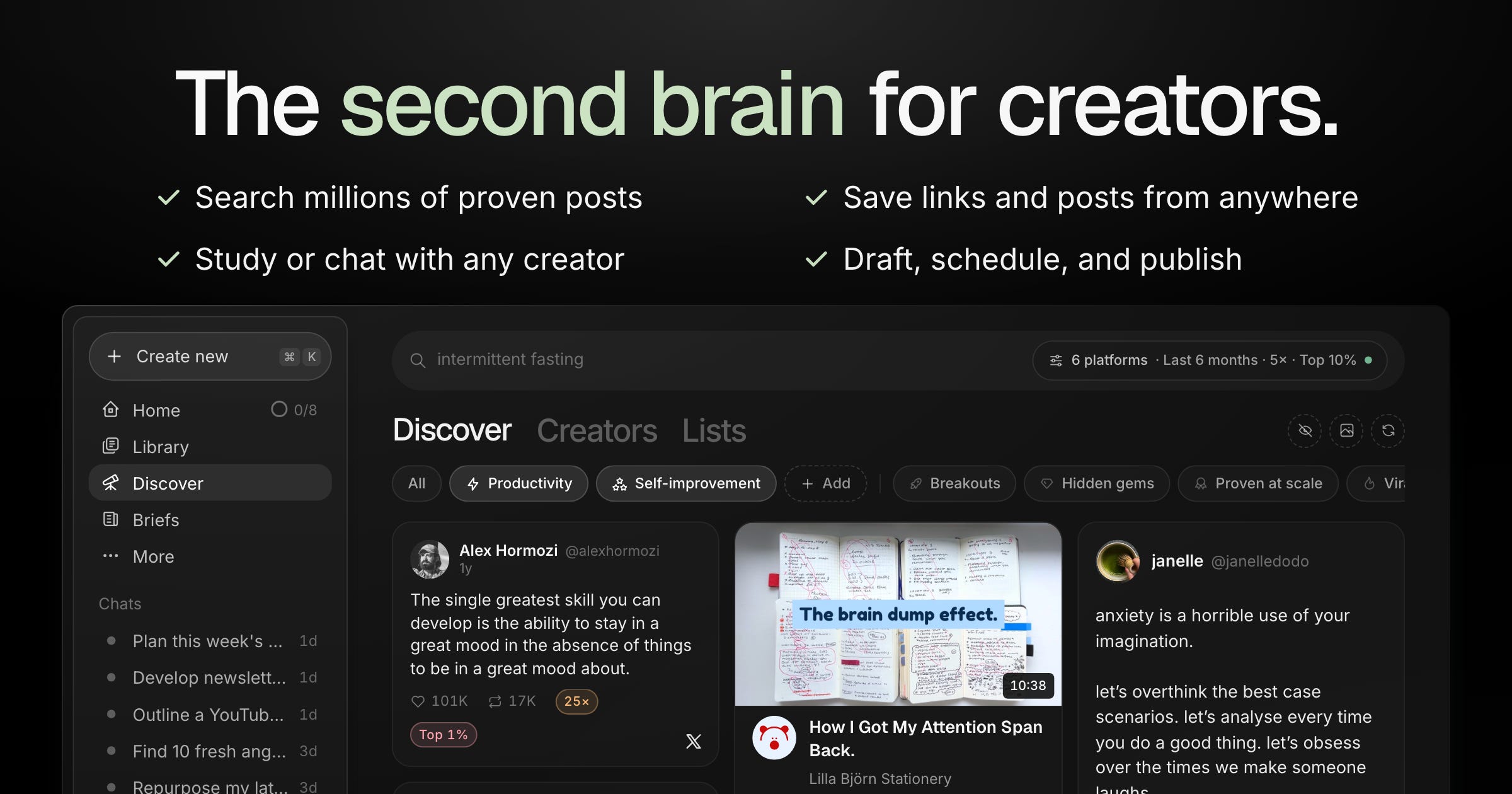
You will also need a journal. You will write in it for ten minutes at the end of every day. It doesn’t matter if it’s physical or digital. The prompts are below. Personally, I do all my protocol journaling and AI work this way in Eden. Here’s why:
The problem with running a calibration like this in a regular notebook or even a note app or a chat window is that the insights disappear. You write something on day four that matters, and, if we are being honest, by day fourteen you have forgotten it. And by day thirty, when the reflection session asks you to find the pattern, you are scrabbling and guessing rather than reading.
Eden solves this because it is built to capture raw thinking and store it in a way that is searchable and retrievable, and it can connect whatever you write one day to another day, and even to other ideas you collect from all over social media or the internet.
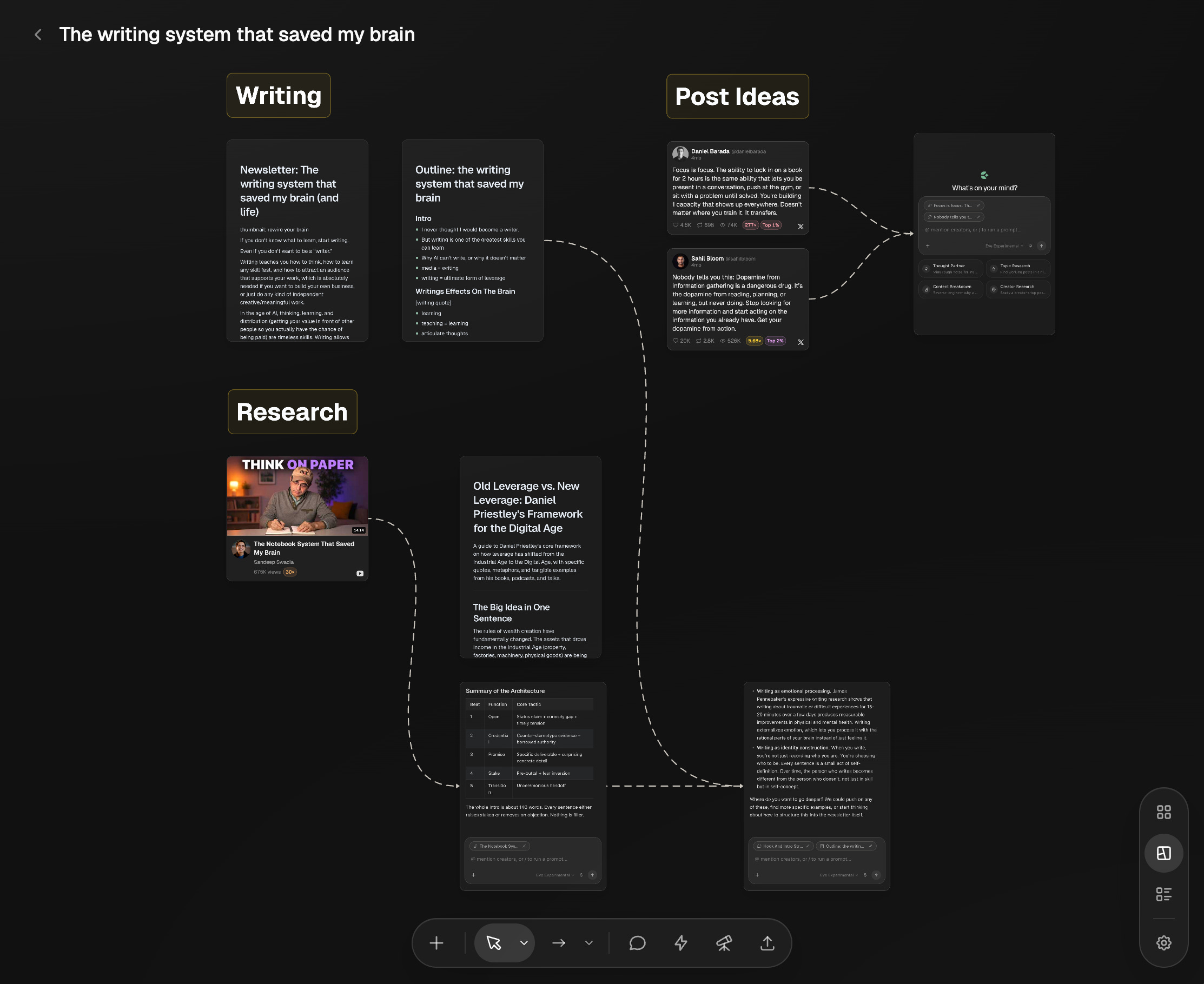
When I run a protocol journal in Eden, every entry is a note that lives in my workspace. I can search across them. I can see them side by side. I can even ask Eden to surface the ones that are related before I sit down for the end-of-phase reflection session. Eden is built on AI, but the AI part is really just there to help creators find the patterns in their own thinking instead of generating thinking for me. It’s the only AI tool I have found so far that does this.
Eden also lets me store the outlier posts and writing samples I am calibrating against (the control group) in the same place as my journal. Which means when I want to compare what I produced on day twelve against my AI-assisted baseline, everything is in one workspace instead of scattered across tabs.

Another great Eden feature is the ability to schedule posts to multiple social media platforms.
I also like Eden for an unintended reason. It is pretty bad at writing stuff. Which makes me rely on myself more. But this is made easier because that is what Eden is designed to make easier.
So if you feel like you are dumber than AI, there is no faster way to realize how wrong you are than by starting to use Eden.
Especially if you start using it by running the reCollaboration Protocol below.
The free plan is enough to get started, but to understand its real power, I would definitely consider starting with one of the minimal spend plans.
Besides that, you will also need to be ready to show up for thirty days because the calibration only produces useful data if you run it consistently. Missing days do not invalidate the experiment, but missing phases do.
PHASE ONE: THE ORIGINATION PHASE (Days 1-10)
Comments
Nothing yet. Say the first thing.
Sign in to join the conversation.