
Emily Eisner and Elizabeth Cooper argue that the Rent Guidelines Board’s primary mandate is to minimize rent increases for tenants, with landlord financial concerns functioning as a secondary constraint. To achieve this, the Board must abandon its longstanding practice of pegging annual increases to the overall Consumer Price Index, which includes market-rate housing inflation.
Tomorrow, the Rent Guidelines Board (RGB) will decide how much, if it at all, rent will increase in the upcoming year for New York City’s approximately one million rent-stabilized apartments. The board’s decisions have traditionally been determined by the economic and financial conditions of the stabilized housing across the city, cost-of-living information, rates of vacancy and housing supply, and the ability of tenants to pay rent. This year, the board’s deliberations are taking place amid a citywide movement to “freeze the rent,” one of the signature policy proposals of Mayor Zohran Mamdani’s campaign.
The debate over the feasibility, legality, and desirability of a rent freeze has been made more challenging by a basic ambiguity around the principles that should inform the RGB’s annual rent setting decision. The only legally binding text describing the rent setting function of the RGB in the NYC administrative code mandates that, in setting annual rent increases, the board must take into account “(1) the economic condition of the residential real estate industry in the affected area … (2) relevant data from the current and projected cost of living indices for the affected area, (3) such other data as may be made available to it.” What this economic data should be used for, and how precisely the RGB’s rent setting intervention should take into account the full set of economic indicators surrounding the city’s housing and tenants, is not explicitly stated.
Somewhat more instructive are the findings at the beginning of the Emergency Tenant Protection Act (ETPA) of 1974 that identify the ETPA as designed “to prevent speculative, unwarranted and abnormal increases in rents” that are triggered by an “acute shortage of dwellings.” This description of the ETPA’s motivation provides a strong indication of the economic function of rent stabilization, but does not in itself constitute a coherent foundation from which the RGB can develop a systematic rent setting policy.
In the following post, we aim to provide such a foundation. We conclude that rent stabilization policy must fulfill the task of minimizing rent increases within the constraints of the continued maintenance of the City’s rent stabilized housing stock. Embedded in this function is the understanding that tenants are the primary stakeholders of the rent stabilization system, the interests of landlords only holding relevance to the RGB insofar as it impacts rent affordability and tenant quality of life. Building off this intellectual foundation—itself built upon the statement of purpose of the City’s rent stabilization laws—the RGB can better account for the relative importance of landlords’ and tenants’ economic needs in their decision making schema, determine which metrics are most relevant to this end, and make more informed decisions about whether to raise rents.
We interpret New York City’s system of rent stabilization as designed to fulfill two objectives: (1) maintaining the city’s stock of rent-regulated housing, and (2) minimizing rent increases, thereby allowing as many people as possible to continue living in their homes. The goal of rent stabilization can thus be summarized as setting rents at the minimum rate such that landlords can both effectively maintain their properties in a state of good repair and be appropriately compensated for developing additional housing affordable to a broad range of New Yorkers.
Note that keeping the net income of landlords sufficiently positive to maintain their buildings effectively is a constraint but not the object of optimization itself. Rather, the objective of the policy is to reduce the net surplus of landlords in service of housing affordability for tenants. This point has important political implications for the RGB. In particular, if the RGB wishes to be in alignment with the findings of the ETPA, which frame the law exclusively in terms of the need for economic relief on behalf of rent distressed tenants, there can be only one group of primary stakeholders in the stabilized housing system from the perspective of rent stabilization law—that of tenants. While landlords’ financial concerns are important to the RGB’s decision making, they must only be considered insofar as landlords’ financial distress impacts the tenants themselves.
The excess surplus that the law is meant to reduce is derived from landlords’ excessive market power, which results from an insufficient supply of housing that leaves tenants with few, if any, options for alternative housing if they are forced to move. This excess of market power should come as no surprise. Increasingly strong evidence shows that New York City’s housing stock—and much of the country’s—is severely price inelastic, with stark rises in rents over recent decades resulting in little increase in New York City’s rental housing supply. The logic here is simple: when housing supply is constrained, high demand puts upward pressure on prices, causing large rent increases that Tenants have little choice but to pay.
Rent stabilization policy is meant to correct for this distortion in rental costs by restricting the amount that landlords of rent-stabilized units may charge. If New York City wishes to cultivate a housing stock that is sustainably affordable for its residents, the near-term goal of using price stabilization to correct price distortions should be paired with the long-term goal of correcting the housing supply shortage through private and public housing construction.
Yet even setting to one side the particulars of the City’s current housing supply, deep imbalances in market power between landlords and tenants are embedded into the character of the housing market itself. Compared to more analytically conventional commodities such as foodstuffs or clothing, it is exceptionally daunting and costly for a tenant to switch their provider of housing if they’re unsatisfied with the price they currently pay. As anyone who has had to move apartments can attest, the process of changing housing providers involves weeks or months of apartment hunting, moving expenses, a security deposit, and a bevy of logistical tasks that add extensive friction to the moving process. This friction makes housing demand inelastic by nature, providing the landlord a near captive customer base and broad license to overcharge tenants. These innate frictions have driven advocates to propose the socialization of the housing sector for over a century. Under continued market ownership, such frictions provide a strong mandate for price controls as an endemic component of the sector.
If the goal of rent stabilization is to reduce the net surplus that derives from landlords’ excessive market power, then we need some sense of the extent to which constrained supply has distorted the price of NYC’s rental housing. Figure 1 demonstrates this, by presenting the inflation-adjusted monthly rent distribution in New York City in 1993 and 2023.
Figure 1. Distribution of monthly rent for New York City apartments, inflation adjusted
Even after correcting for general price growth in the economy, the median inflation-adjusted rent rose substantially between 1993 and 2023, from just about $1,000 per month to over $1,500 (in 2023 dollars). More concerningly, the entire distribution of rents has shifted enormously. Rather than clustering tightly around the median rental value, as in the 1993 graph, rents in 2023 were heavily weighted towards luxury units, with nearly one hundred thousand units charging rents of more than $5,000 per month, up from less than twenty-five thousand in 1993.
Building new housing in New York City and the surrounding suburbs will be necessary to reverse this trend. However, because new construction takes time, rent stabilization policy can help preserve low-cost housing in the context of an overheated market. Further, new housing is often more expensive than older housing, making rent stabilization the only tool capable of keeping this low-cost stock of housing available to renters.
To do so, rent regulation should be used in the short- and medium-term to both lower inflation-adjusted median rent and increase the ratio of low- to high-cost rental housing. Note that if the RGB aims to lower inflation-adjusted rent over time (to more closely match rent distribution circa 1993), its annual rent increases will need to be lower than the regional inflation rate for a period of time.
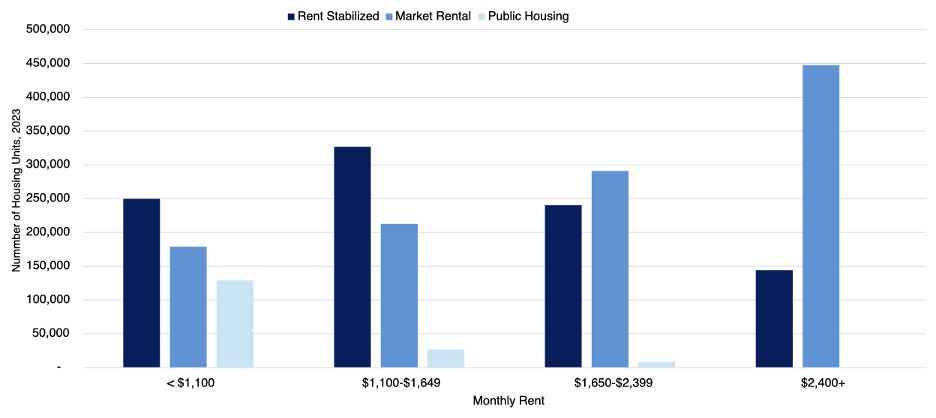
As rental prices have grown aggressively in response to inelastic supply and rising demand, the rent-stabilized housing stock has been essential to mitigating the above shift in rent distribution. Figure 2 shows that as of 2023 a plurality of rental units costing less than $1,650 per month are rent-stabilized. The vast majority are either rent-stabilized or public housing owned and operated by the New York City Housing Authority (NYCHA).
Figure 2. Rental apartments in New York City by type and monthly rent, 2023
As the above analysis indicates, the RGB has played an important role in mitigating distortions in the rental market. But has it been doing enough? One piece of evidence might lead readers to answer yes: for the past fifty years, the Rent Guidelines Board’s annual increases for one-year rental contracts have closely followed annual increases in the Consumer Price Index (CPI) in the New York City metropolitan area. This close correlation can be seen in the proximity of the purple and yellow lines in figure 3. While the deliberations of the RGB led them to raise rents faster than CPI inflation during the Bloomberg administration, recent RGB’s have since compensated for these abnormal rent hikes, bringing stabilized rents and CPI back in line with each other.
Figure 3. RGB 1-year rent increases have closely followed overall CPI, which incorporates market-rate housing inflation
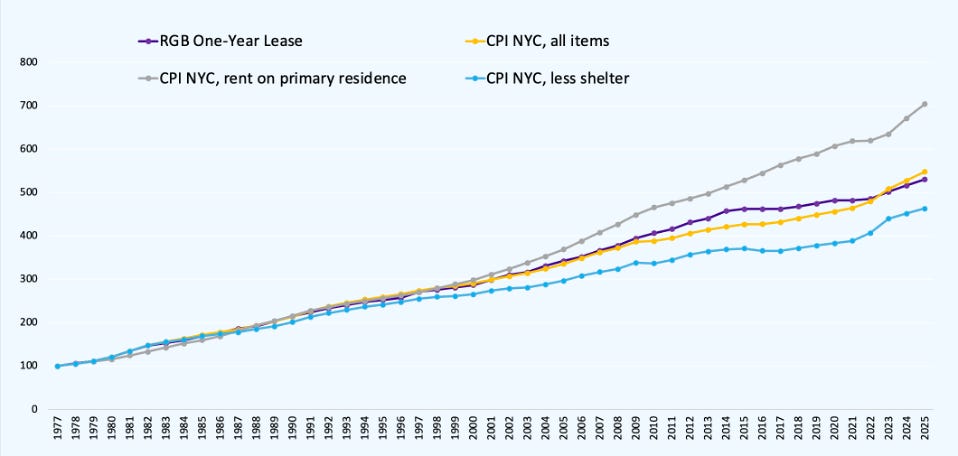
Allowing overall CPI inflation to guide rent-stabilized unit rent increases, though not mandated by law, may at first glance appear as a sensible policy choice. One could argue that rents must keep up with inflation so that landlords can afford to maintain buildings. But this misses a key fact: CPI inflation in New York is itself driven largely by market-rate housing inflation. Indeed, CPI includes rent of primary residence, and housing inflation accounts for about 35 percent of CPI as a whole.
Allowing New York City rent-setting in the stabilized housing stock to be guided by a measure of price increases that so heavily weighs market rents undermines the policy’s goal of being a corrective for price distortions in the housing market. In other words, this approach incorporates the very market distortions it is meant to address. When used this way, CPI becomes a circular metric. Rather than serving to bring CPI-derived-from-rent closer in line to CPI-less-shelter, the RGB’s method of pegging annual increases to overall CPI keeps the rent inflation rate elevated above that of other commodities and contributes to the increasing share of income New Yorkers must spend on rent.
To see this, return to figure 3, which plots CPI-less-shelter costs (the light blue line). When shelter costs are not included, the RGB’s increases over time outpace this measure of price growth. The RGB has on average set rental increases 0.3 percentage points higher than CPI excluding shelter costs. While this number may seem small, over decades the effect has compounded to produce a sharp divergence between rental increases and CPI-less-shelter, exacerbating New York City’s housing affordability crisis by forcing renters to spend ever-greater fractions of their income on housing.
That is not to say that the RGB could or should ignore inflation; landlord costs do rise over time and rent increases should account for that over the long run. CPI-measured inflation, however, is a poor guide for RGB, since it largely reflects the dynamics of New York’s dysfunctional and inflationary market-rate rentals rather than the costs landlords pay to maintain their buildings.
The introduction of CPI-minus-rent as an explicit benchmark for RGB rent increases could provide a critical long-term road map for the RGB in the case where they decide to freeze the rent in the coming several years. The case for the financial viability of even a multi-year rent freeze is strong, having recently been affirmed in a report from major credit rating agency Moody’s, published on June 3rd, which concludes that a five-year rent freeze would place only 6% of stabilized landlords at serious default risk. However, unless inflation ceases to be an endemic feature of capitalist economies, the RGB will at some point in the future need to allow an increase of stabilized rents or landlords will face net operating incomes that are simply unsustainable. It is at this point of transition that the role of rent stabilization as a corrective for housing supply inelasticity comes into play. By benchmarking rent increases in the long term to CPI-minus-rent, the RGB would help bring rent prices in line with overall wage and price growth, rather than contributing to an upward spiral in which rent takes up an ever-larger portion of tenants’ income.
The primary counterargument to an RGB rent freeze is that landlords are financially underwater, struggling under severe cost burdens that have outstripped rents in the most affordable and stabilized unit-dense housing. This argument has centered around a report put out by Enterprise Community Partners (ECP), a major New York affordable housing nonprofit with a portfolio primarily composed of Low Income Housing Tax Credit (LIHTC) recipient properties. Their findings around financial distress are quite dire for their own portfolio: they find that 57% of their buildings are experiencing negative cashflow when accounting for mortgage payments and other debt servicing. At the same time, according to the RGB’s annual Income and Expense Report for 2026, only 9.2% of the City’s stabilized buildings are experiencing negative net income when accounting only for net operating income (overall revenue minus operating expenses not including debt payments). Further, the average net operating income across rent stabilized buildings increased by an inflation adjusted 2.2% between 2023 and 2024.
How can both of these statistics be true? One can conclude based on this data that it is the debt burden, not operating expenses, that are primarily responsible for pushing substantial portions of the City’s affordable housing into financial distress. From the perspective of the landlord, financial distress is a dire concern regardless of source. In order to continue to own the property at hand, net income must be positive. From the tenants’ (and City’s) perspective, however, the source of the distress matters immensely. A building with negative net operating income cannot be run sustainably regardless of the owner and their financial position. Even a building owned outright by their landlord would not be financially solvent. If debt burden is the driver of financial distress, however, a building may be refinanced or sold to an owner under more favorable financing terms and maintained as affordable housing.
Further, many debt burdened buildings likely made their own beds and thus are not entitled to a public bail out. As Economist JW Mason has recently identified, before 2019 landlords of rent-stabilized buildings frequently took out large mortgages on their buildings, both to purchase new housing stock and to “cash out” their equity by refinancing existing mortgages. In doing so, they were betting on their ability to raise rents above RGB allotted increases using the “vacancy decontrol” policy enacted in the City at the time. This vacancy reset policy allowed them to raise rents in vacant units by 20% and completely decontrol units above a certain rent threshold, and thus provided a strong incentive for these landlords to evict rent-paying tenants, which many did, using both legal and illegal means. Since the Housing Stability and Tenant Protection Act of 2019 banned vacancy resets, many landlords have been unable to keep up with mortgages they assumed they could afford by displacing tenants and raising rents.
As established in our basic framework for rent stabilization, this “bad bet” derived debt burden should not be a justification for RGB rent increases. If the goal of rent stabilization is to prevent extortionate rent increases and curtail landlord market power, the RGB cannot bail out landlords who bet on circumventing rent restrictions through extortionate evictions. Similarly, the Mamdani administration must be careful not to reward these landlords with other avenues of financial relief except where absolutely necessary for the housing stability of these buildings’ tenants. To do so would directly contradict the basic goals of the ETPA.
The above points, if adopted by the RGB, would decisively strengthen its ability to fulfill its stated legal purpose. However, limiting the question of New York City housing’s future to the finer technical points of RGB rent setting risks curtailing both tenants’ and policymakers’ understanding of what will be required to build a housing system that allows New Yorkers to sustainably live and thrive.
Of great import is the structure of the RGB itself, an executive appointed body that takes consultative hearings from tenants, landlords, and policy experts but ultimately has free reign to dictate the rents of stabilized tenants based on its own assessment and prerogatives. This system deserves due credit. It has preserved a substantial body of often deeply affordable housing across decades of housing deregulation and rampant gentrification. Further, the public hearings the RGB holds annually have proven a vital public forum for organized tenants to develop and promulgate a robust and ever transforming program for the City’s housing future, often extending far beyond the immediate question of rent increases in stabilized private sector stock.
As they do so, however, these tenants frequently come up against the structural limitations of the RGB itself, both as a technocratic body in which tenants have no formal decision-making power and as a policy organ limited to very specific questions of rent setting. As anyone who chooses to attend a public hearing will see, tenants are often all too aware of these limitations. In order for New York to chart a new course for its housing system, the tenant movement will need to continue to clarify its understanding of its own role and function alongside the administrators who set their rents every year. Already this understanding is beginning to take form: tenants attest in RGB hearings to the need for increased funding for public housing, systematic improvements in the physical housing stock, and the proliferation of social housing options.
At the hinge of both the tenant movement and the RGB’s daily operations is the Mamdani Administration, which has put the RGB at the center of the political spotlight and channeled the City’s burgeoning tenant movement into an engine for electoral municipal socialism. Ultimately, New York’s elected representatives committed to housing affordability and its organized tenants will need to move in concert, selecting key targets at the municipal, state, and federal level for housing reforms beyond the administrative purview of the RGB and aggressively pursuing operational funding for subsidized housing and capital for mixed-income, publicly-owned units. The principles of tenant primacy and sustainable housing affordability, embedded in the structure of the City’s rent stabilization system, will ultimately require a fundamental reorientation towards decommodified housing stock in order to become a reality for the vast majority of renters.
Emily Eisner, PhD, is the Acting Executive Director and Chief Economist at the Fiscal Policy Institute.
Elizabeth Cooper is the Housing Policy Analyst at the Fiscal Policy Institute.
No posts
Comments
Nothing yet. Say the first thing.
Sign in to join the conversation.