
Joel Dodge and Dana Brown argue that New York City can improve access to medications by expanding an existing Health + Hospitals program to create additional publicly-owned pharmacies throughout the city, while also using targeted industrial policy to support independent pharmacies. This piece is co-published with the Vanderbilt Policy Accelerator Substack.
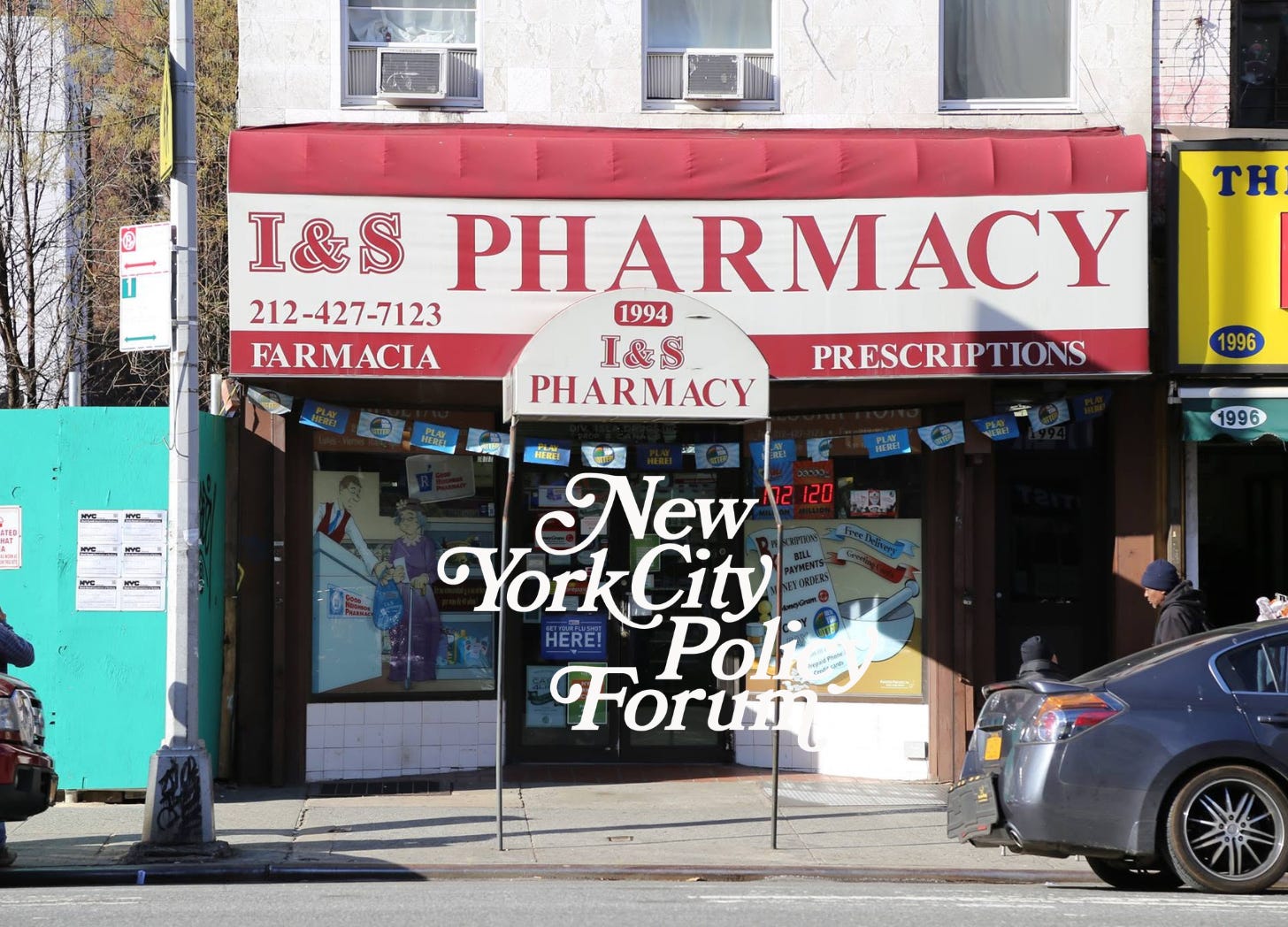
New York City has a growing pharmacy gap, and the culprit is corporate power. Large corporate pharmacy chains have increasingly abandoned the City’s most vulnerable neighborhoods, while other dominant healthcare corporations have short-changed the community-based independent pharmacies committed to serving the city.
In a new paper, we propose an innovative set of policy solutions to address this pharmacy gap, a framework and vision we call “CityRx.” CityRx deploys public power to strengthen citywide pharmacy access in two ways: First, it creates public options through an expanded network of city-owned pharmacies. Second, it wields industrial policy to support and strengthen the city’s independent pharmacies. Together, these approaches would use the might of city government to add public alternatives and lift up independent operators to improve healthcare access for New Yorkers.
New York City’s pharmacy gap has ballooned as large chain pharmacies have closed 45 percent of their locations in the city since 2019. That has left tens of thousands of New Yorkers living in pharmacy deserts, with limited access to nearby medicine. This poses particularly acute harm to elderly patients, those with limited mobility, patients with mental health conditions, and patients with extended working hours, such as those working multiple jobs.
Meanwhile, powerful healthcare corporations have systematically squeezed New York City’s small, independent pharmacies. Because they lack the scale of the big chains, independents pay more to purchase drugs from pharmaceutical wholesalers, and are reimbursed less by the pharmacy benefit managers that administer prescription drug plans for insurance companies. That leaves independent pharmacies with thin margins to survive on, and prevents them from filling the void in the city’s healthcare ecosystem left by the big chain pharmacies’ exodus.
To fill that void, we propose a three-part plan to improve healthcare access in New York City through a combination of publicly-owned pharmacies and targeted industrial policy for independent pharmacies. First, we propose creating city-owned delivery and mobile pharmacies. The delivery pharmacy would build upon an existing program run by New York City Health + Hospitals (H+H), the state-chartered public benefit corporation that operates the city’s public hospital system, that currently serves the city’s community health centers. The mobile pharmacy would be a “pharmacy on wheels” making regular scheduled stops in underserved neighborhoods, modeled on the city’s mobile vans used to test and treat patients for COVID-19.
Second, we propose expanding the city’s network of publicly-owned pharmacies. H+H already owns and operates a number of on-site pharmacies at its hospitals, which primarily serve Medicaid and uninsured patients. We propose opening up existing H+H pharmacies to Medicare and privately insured patients, and opening new satellite retail H+H pharmacies in high-need neighborhoods.
Third, we propose targeted industrial policy to support the city’s independent pharmacies. New York could create a CityRx Alliance, a city-certified network of high-quality independent pharmacies that receives a suite of structured supports. As one means of support, the City can leverage its contracting relationships to secure fairer terms for its independent pharmacies. For example, United Healthcare has a $60 billion contract to provide health insurance to City employees. The City could demand that United’s pharmacy benefit manager offer improved reimbursement terms to Alliance member pharmacies, on the grounds that the City’s contracting partner shouldn’t be undermining the City’s healthcare infrastructure. CityRx Alliance pharmacies could also be given access to the new city-owned delivery pharmacy for business use at competitive rates. Finally, CityRx Alliance pharmacies could be connected with existing city programs that support small businesses with preferential loan access, business development, and help adding ancillary services like immunizations and diagnostics.
CityRx could serve as a foundation for even more ambitious reform. For example, over the long term, CityRx could move toward direct drug procurement, bypassing wholesalers to offer patients more affordable near-manufacturer “cost plus” pricing. Ultimately, the city could even pursue public drug manufacturing, building on precedents in states like Massachusetts and California.
The CityRx vision can reduce New York City’s healthcare gaps. By leveraging, expanding, and strengthening the City’s existing public and private pharmaceutical infrastructure, CityRx can maximize the potential of both H+H pharmacies and high-quality independent pharmacies, ultimately improving medicine access and health outcomes for New Yorkers. CityRx would allow New York to lead the way for a healthcare system where public power corrects for the ills of corporate power.
All told, CityRx can help create a healthcare ecosystem where no New Yorker faces barriers to medicine because large corporations abandoned their neighborhood or squeezed their local pharmacy. By using the tools of public power at the city’s disposal, CityRx can serve as a model for the nation by building a stronger healthcare system for all New Yorkers.
Joel Dodge is the Director of Industrial Policy & Economic Security at the Vanderbilt Policy Accelerator. Dana Brown is a researcher, advocate and policy development professional whose work focuses on reducing health and wealth inequalities.
No posts
Comments
Nothing yet. Say the first thing.
Sign in to join the conversation.