
Andrew Perry takes a look at the New York City Economic Development Corporation’s portfolio and argues that the new administration should steer its capacities towards the challenge of building social housing at scale.
The business community in New York City is “still stressing out” about the Economic Development Corporation (EDC). Since New Year’s Day, a steady drum beat of articles has highlighted business leaders’ concerns about the agency: Mayor Mamdani has yet to appoint a leader, his Deputy Mayor for Economic Justice is ill-equipped to the task, and his administration is clueless or hostile to the job creators that bring growth and prosperity to the city.
But what is the EDC, and why has it attracted such pointed kvetching from the city’s business leaders? Founded in 1991, the City-chartered nonprofit organization commands an impressive $1.5 billion in annual resources and holds the title of the city’s largest landlord. Operating free of civil service rules, City Council budget appropriations, and procurement constraints, the quasi-agency has been the vehicle for a broad range of past mayoral initiatives—from Yankee Stadium and Hudson Yards to the NYC Ferry Service. Because of its unusual flexibility, the EDC is affectionately known in some government circles as the “Swiss Army knife” of city institutions.
In its twenty-five years of existence, the EDC has continuously evolved to meet mayors’ priorities, while retaining its core mandate to boost economic development in the city, and attract and retain jobs. The EDC is also synonymous with tax breaks for business, exchanging foregone public revenue for economic investment, with the goal of revitalized local economies and job growth. Indeed, those sounding the alarm about the Mamdani administration’s approach to economic development and the EDC most often cite job growth as the reason for their concern. But there is scant evidence that the agency’s incentive programs truly achieve their intended boon to economic activity and job creation.
Under a new administration, the EDC’s resources and significant institutional capacities need to be refocused to tackle the city’s most urgent economic challenges. In particular, housing, the single largest driver of unaffordability in NYC, is a policy area well-suited to EDC’s unique profile—as a steward of public land, a deal-maker of large-scale development projects, and the home to experienced and innovative public servants who take on big challenges. The EDC should pivot away from its habit of subsidizing businesses for fuzzy job growth numbers that they can’t deliver, and take up the mantle of building social housing at scale to meet the needs of working New Yorkers and enrich the economy that they make run.
The EDC is unique among New York City agencies. Legally independent but wholly controlled by the mayor, it is in fact a nonprofit organization and not actually an agency of the City at all. Political control and direction comes from the EDC’s President and its board, appointed directly by the mayor. This unique structure gives the Corporation more flexibility. Whereas city agencies like HPD or SBS have expenditures set by City Council appropriations, procurement subject to a famously complex web of rules and regulations, and staffing lines subject to civil service requirements, the EDC operates with comparative freedom.
Given this flexibility, the EDC has grown into a large entity engaged in a dizzying array of projects. Nearly 600 staff members work on designing incentives and tax breaks for businesses, redevelopment plans of post-industrial zones, high-profile deals for office towers and stadiums, the ferry system, tradeable credit schemes for wetland erosion, fellowships to attract venture capital firms to NYC-based startups, and much more. The work of the agency is split across real estate transacting and portfolio management, new capital projects, and administering business subsidies.
The breadth of work reflects the structural features of the EDC—its real estate-dependent revenue stream and its unusual relationship to bureaucratic regulation—as well as the accumulation of decades of differing mayoral priorities that have sought to make use of the EDC’s flexibility. Given the range of projects the EDC takes on, as well as the quasi-civil servant status of its workforce, the agency has developed a unique institutional culture and considerable in-house capacity. Recent projects include structuring financing for complex real estate deals, and capital and planning for infrastructure upgrades to entire neighborhoods and distribution systems. But while the EDC’s much vaunted flexibility as a multi-purpose tool for the Mayor is important, just as critical is its role as the city’s largest landlord, managing 64 million square feet of property owned by the City of New York.
The EDC’s status as an independent authority means its budget is also separate from the City’s. Despite its operations all being public, it can be difficult to understand the EDC’s opaque budget and the immense resources it commands. EDC revenues and tax expenditures amount to about $1.5 billion each year, equivalent to the Department of Transportation. On the
Lastly, the EDC makes what are called tax expenditures—tax revenues foregone by the city, typically as part of a deal to site a new development or start a new business in a particular area. These tax expenditures are best understood as a resource under the control of the EDC because they amount to foregone tax revenue that beneficiaries would otherwise pay to the city—in other words, tax expenditures represent subsidies that the EDC makes to businesses. Such subsidies fall into two broad categories: tax incentives, which allow qualifying businesses to skip out on a portion of their tax liability; and Payments in Lieu of Taxes (PILOTs), which are individually negotiated payments made by businesses to the city, made instead of, and typically lower than, payments on property taxes. In addition to these two subsidies to business, EDC’s subsidiary entities Build NYC and NYCIDA issue low-interest debt on behalf of businesses, whose dividends are not taxable.
The EDC’s tax expenditures will reach $213 million for fiscal year 2026. For the subsidiary New York City Industrial Development Agency (NYCIDA), the number is $350 million—a figure that has tripled since 2019, largely because rising property values have increased the amount of tax revenue foregone by the city in PILOT deals. Many such deals were made years ago, and were contingent on investment targets and new job numbers. When these fail to materialize, the EDC has the legal authority to rescind the benefits, but it has only very rarely exercised this power. Indeed, a recent report by the New York State Comptroller covering the period 2013–2021 found that despite profound inadequacies in NYCIDA’s evaluation of projects, including the fact that no audited projects had passed financial feasibility or cost-benefit assessments, 100 percent of subsidies proposed to the board were approved. The report also found that, on the rare occasions the EDC did try to claw back unearned benefits, recapture amounts were miscalculated, meaning that offenders were only required to repay a fraction of what they owed.
In light of the wide range of EDC projects and its opaque and off-budget finances, it can be easy to lose sight of the fact it is a public entity operating at the pleasure of the democratically elected mayor. All of the revenue the EDC raises and all of the tax revenue it forgoes is public money—downstream of City-owned property and City-granted authority. Are New Yorkers getting a good return on investment?
Economic development projects are often judged by the number of jobs they create: invigorating the local economy with new economic activity and employment. There’s a simple worthiness test for public subsidy of projects, called the “but for” test: but for the subsidy, would those jobs have been created in NYC?
A credible “but for” argument must demonstrate that a firm is mobile enough to easily locate outside New York City, and that private investment would not be feasible without the City’s assistance. How do current EDC projects measure up? Of the
Meanwhile, the world’s largest warehouser, Prologis, receives considerable benefits from the EDC, as do dozens of supermarkets, wholesalers, and goods distributors—companies all very closely tied to their place of business. Without business subsidies, it is safe to say New York would still have a functioning distribution and logistics systems and supermarkets.
These examples demonstrate a necessary dose of skepticism about the kinds of projects the EDC takes on. But assessing the EDC project list as a whole is no simple task, because it does not apply consistent logic across cases. For example, a recent report from the New York City Comptroller points out that EDC takes credit for the entire redevelopment of Goldman Sachs’s lower Manhattan headquarters because it handed the firm an energy subsidy equivalent for 0.02 percent of the project’s cost. EDC estimates the effects of investments it supports using a range of economic impact analyses. Without a clear assessment like the “but for” test, it is difficult to assess whether subsidy was in fact necessary for inducing new investment.
NYCEDC’s marquee projects do not paint a sympathetic picture. The largest project on its books is the Hudson Yards redevelopment, which was expensive enough that in the mid-2000s, developers and the Bloomberg administration agreed that even top-end office towers and market-rate residences required extensive, recurring public subsidy. Capital costs were carried by bonds issued by the Hudson Yards Infrastructure Corporation, a new, purpose-built public authority. EDC continues to provide recurring subsidy through PILOTs that represent deep discounts on property tax the towers would otherwise pay to the City. In fiscal year 2025, these payments represented $93 million in foregone revenue, rising to $2.2 billion over the total span of the benefits, typically fifteen to thirty years. The two next largest subsidies on EDC’s books—massive, forty-year tax benefits to Yankee Stadium and Citi Field—are less defensible, given the dubiousness of the teams’ likelihood of leaving the city and their overstated economic impact. Even Mayor Bloomberg argued that they were gratuitous.
Each EDC real estate deal amounts to a bet on the project’s commercial viability. Not all are successful. This year, two EDC-initiated commercial developments revealed significant financial distress. These buildings in Harlem and Downtown Brooklyn were built on land previously owned by the City and sold by EDC to the developers as part of an EDC strategy to boost commercial development outside of Manhattan’s core. Investments such as these should be measured not just by the probability of financial success but also against the opportunity cost of using scarce city-owned land for commercial development.
It is not impossible that these costs will pay for themselves. But the City must bear in mind that such investments are in direct competition with other public goals. Increasing the number of high-wage jobs is important to the City’s fiscal outlook, but it also puts pressure on the housing market—undercutting the city’s ability to face its greatest contemporary challenge: affordability.
The EDC was formed in 1991 as a marriage of two agencies: the Public Development Corporation (PDC), founded at the eve of the city’s deindustrialization in 1966, led real estate efforts to reindustrialize and otherwise redevelop city-owned property; the Financial Services Corporation (FSC), founded in 1979, represented a decidedly neoliberal vision of economic development marked by tax breaks and loans for businesses. The merger, midwifed by the consulting firm McKinsey, sought to synthesize these two pillars—real estate redevelopment and business financing—into a coherent strategy for local economic growth.
While retaining this core institutional character, EDC has evolved through mayoral administrations. Mayor Michael Bloomberg expanded EDC’s business tax incentive program to revitalize post-September 11 lower Manhattan and made administration-defining real estate deals to develop Hudson Yards and the Cornell Tech campus on Roosevelt Island. Mayor Bill de Blasio largely preserved Bloomberg-era institutional practices, while expanding them to subsidize the city’s life sciences industry and expand the ferry system. Under Mayor Eric Adams, EDC launched M-CORE, which abates property and sales taxes for landlords who renovate Manhattan office buildings, as a policy response to Covid-19 commercial vacancy rates. What will “A New Era” for the EDC look like under a Mamdani administration?
As the EDC begins to adapt under a new administration, it should refocus as an engine of development for public benefit. This should include seriously curbing business subsidies, which are not “as of right” entitlements, and revoking subsidies whose beneficiaries are noncompliant. An EDC refocused on more stringent and strategic criteria for doling out subsidy would reinforce the administration’s stated commitment to public excellence and the responsible stewardship of public resources for all New Yorkers.
But a new EDC needs a new and ambitious orientation that makes the most of its core competencies—engaging in large capital projects and structuring land and development deals—to evolve again, this time in line with a strong mandate for affordability.
Housing remains the principal driver of the affordability crisis for New Yorkers. By driving low- and middle-income people out of their homes, New York’s housing unaffordability poses an acute threat to its economy: sluggish population growth characterized by a hollowing out of the middle class means lower job growth. EDC should directly tackle housing affordability by using its unique tools to build mixed-income social housing.
Dense cities with constrained housing supply that attract high-income households tend to face extreme cost growth. A lack of housing affordable to those outside of the top one percent dampens New York’s ability to attract and retain middle class workers, constraining the city’s economic potential. New York’s population remains below its level in 2020 and its job growth has been slower than the nation as a whole. In the US, metro areas with the most job growth are those with the fastest population growth, which directly follows housing affordability. Building social housing that is insulated from a dysfunctional private market is an urgent task for the city government to redress the status quo.
What would an EDC-led social housing program look like? A typical EDC-backed housing project involves leasing or selling city-owned land to a developer who builds and operates the project, and agreeing to PILOTs that are low enough to guarantee a reasonable rate of profit for the developer.
Instead of following this template, the City ought to retain control of the buildings, paying a developer to capitalize initial construction and earn some profit thereon, but not offering recurring subsidy. Aggregate rents would then be set at levels necessary to operate the buildings, eliminating the need for recurring subsidy (as is needed for means-tested developments) and therefore freeing City funds to capitalize the development of even more social housing. While in this model, broadly followed by Austria, Denmark, and Finland, initial average rents may be near market level, they would be indexed to the costs of operating the building and servicing construction loans, insulating them from the vagaries of the private market and private operators’ seeking wide profit margins.
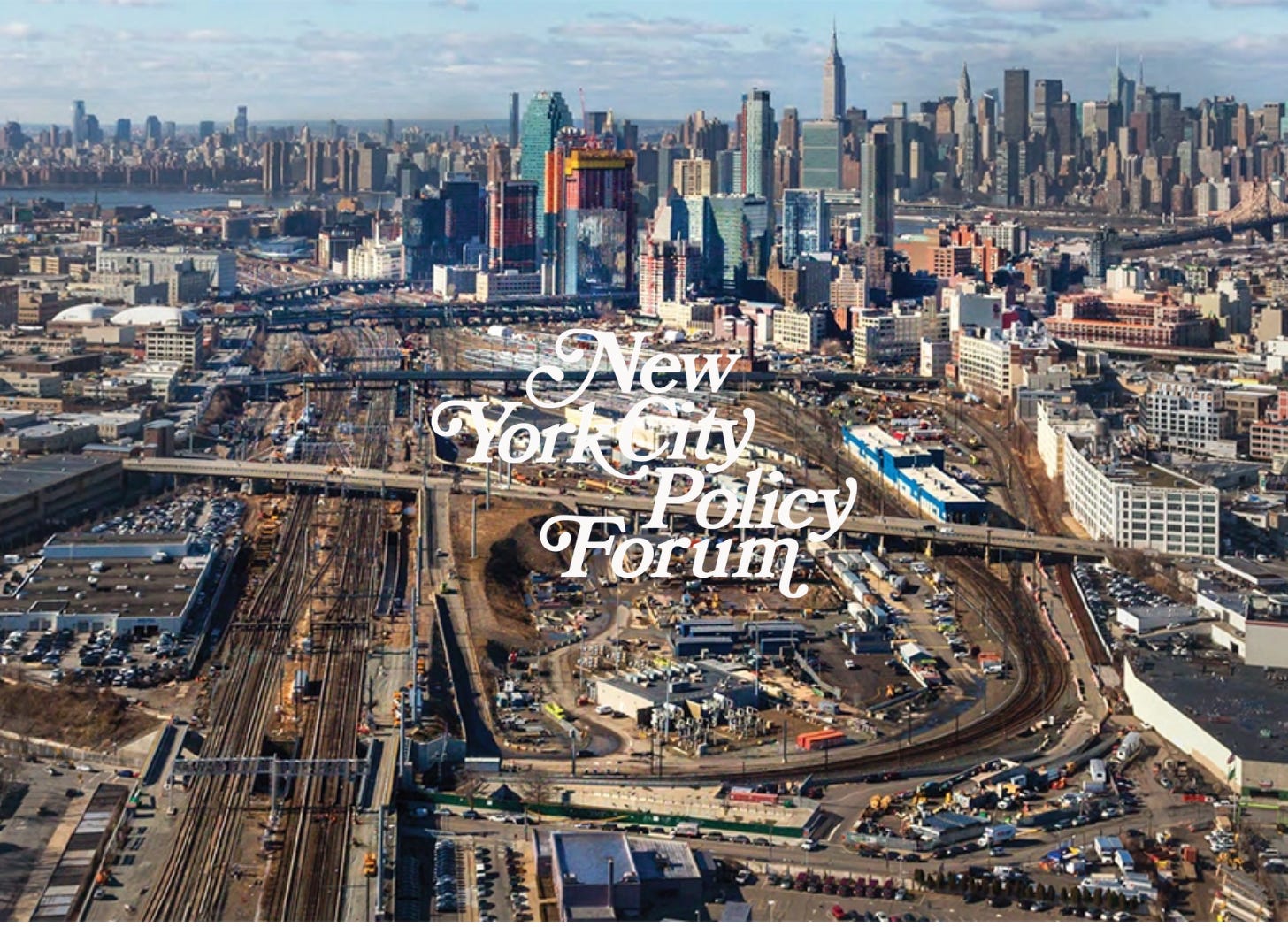
Under de Blasio, EDC made sporadic attempts to expand beyond business subsidization. The most ambitious proposal was to put a deck over the railyards in Queens that sit between Long Island City and Sunnyside, and build as many as twenty-two thousand mixed-income housing units on top of it. Amid opposition, the plan was reduced to twelve thousand means-tested units, whose greater required subsidy meant a reduced scope for the plan. The project stalled after the Covid shutdowns, but the revamped Sunnyside Yards proposal touted in a surprise joint announcement by Mayor Mamdani and President Trump offers an opportunity to pilot a new model of social housing in New York City.
Zohran Mamdani ran on an ambitious platform of building two hundred thousand homes backed by public financing. Ambitious projects at the scale of Sunnyside Yards will be necessary to meet that goal. EDC can help. The Mamdani Administration can refocus EDC to make the most of its significant resources and institutional knowledge, curb unjustified business handouts, and address the largest driver of the affordability crisis.
Andrew Perry is Director of Fiscal Research at the Fiscal Policy Institute, and was previously an economic analyst at the EDC.
No posts
Comments
Nothing yet. Say the first thing.
Sign in to join the conversation.