
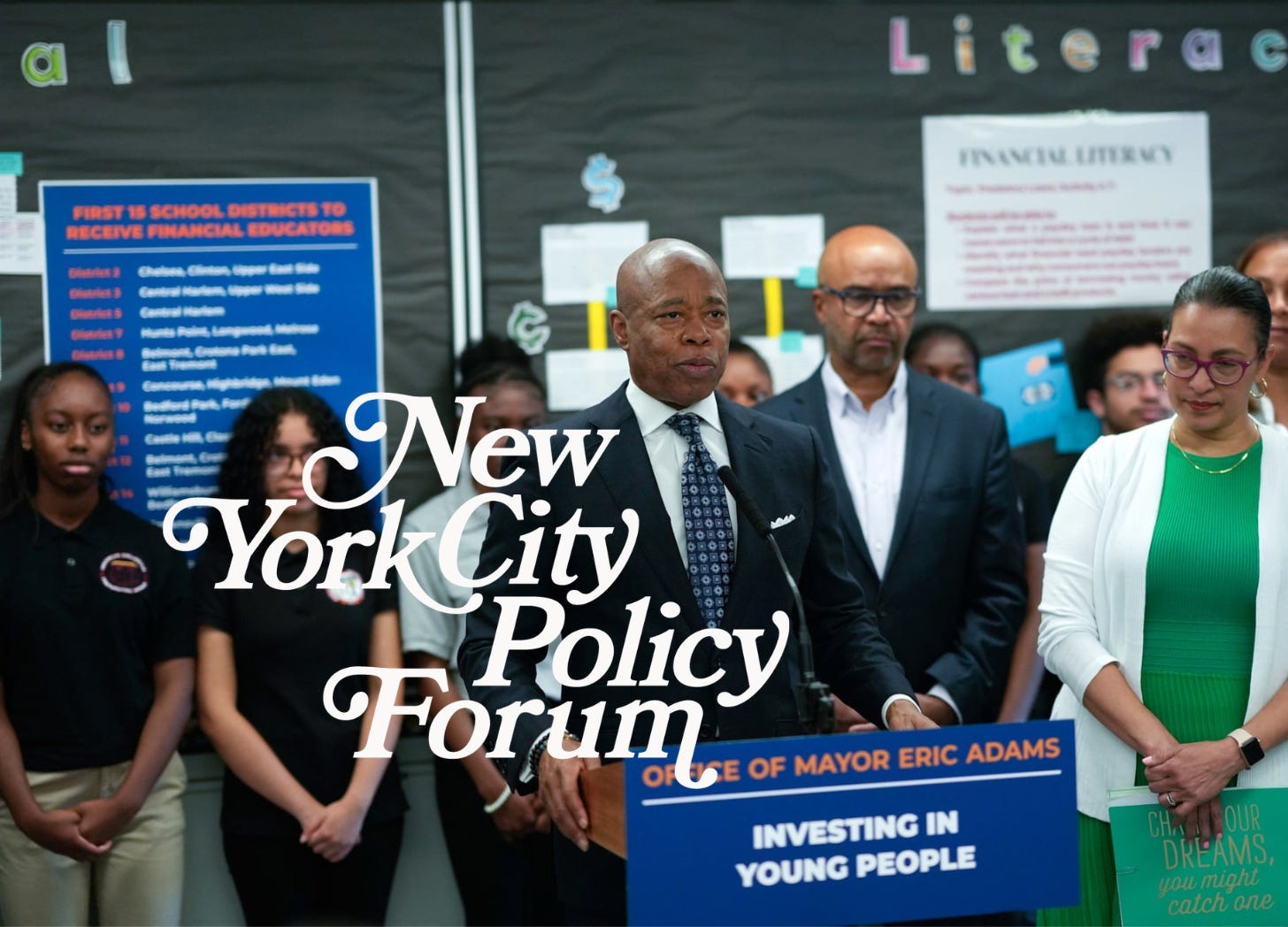
Luke Herrine explains how New York City’s financial empowerment programs can undermine, rather than reinforce, the power that banks hold over our lives.
Twenty years ago, New York City created the first municipal agency in the country to focus on helping residents make financial decisions. The “Office of Financial Empowerment” (OFE), initially a Bloomberg-era experiment, has become an established part of NYC government, with bipartisan support from City Council and a growing portfolio across mayoralties. Since its founding, its main task has been funding and supervising “Financial Empowerment Centers” (FECs)—where residents can receive free one-on-one counseling from non-profit financial advisors—but the OFE has taken on a number of additional duties over the years. It collaborates with other agencies to provide more specialized forms of financial advice (to small business owners and taxi drivers, for example), supports the free tax prep the city offers, and produces data and research on financial barriers facing low-income New Yorkers.
More recently, during the Adams administration, the OFE announced a contract with a new for-profit company called Summer to provide automated help with student loans and a pilot program to “introduce in-school banking services to students and their families, provide workshops on best banking practices, and, when possible, connect students to career development opportunities in the financial sector.” This pilot was to be the first step in a broader “Youth Financial Empowerment Initiative,” which, if carried out as planned, would eventually dwarf the budget for all other financial empowerment efforts.
The Mamdani administration should be skeptical of these Adams-era expansions and the broader Bloombergian inheritance of OFE. But that does not mean it should turn its back on the project of municipal financial empowerment. To the contrary: a critical rethink and creative reorganization of the financial empowerment programs could lay the groundwork for a more holistic and participatory approach to consumer financial regulation.
First, the reasons for skepticism.
Underlying Bloomberg’s initial vision for the OFE were two distinctively neoliberal ideas: first, that the state should reduce poverty not by providing direct aid, but rather by teaching low-income individuals to be better investors; and, second, that many financial problems—including exclusion, predation, and inadequate savings—could be improved on the cheap by increasing individuals’ “financial literacy.”
As Lauren Willis has argued, financial literacy education is best understood as a tool of responsibilization: it shifts risk from society onto individuals and then blames them when things go wrong. When Willis digs into the studies that leading researchers promote as demonstrating the substantial benefits of financial literacy education, she finds more equivocal and contradictory results. At best, financial literacy programs produce moderate improvements in the financial fortunes, and then only among people who go through relatively expensive and high-touch programs. At worst, they increase confidence without improving decision-making, leading individuals to act recklessly. Taking a more macro perspective, financial literacy resources are more widely available than ever, yet we are experiencing unprecedented rates of fraud and increasing inequality, driven largely by inequality in assets.
Meanwhile, most financial literacy programs encourage people to see their financial fortunes as primarily a matter of individual effort. Investing in these programs thus diverts energy from projects to impose constraints on the banks that make money from consumer errors, as well as projects to challenge institutions that distribute wealth and income so unequally. (This is likely one reason that banks and investment firms donate tens of millions of dollars a year to financial literacy programs, to research that promotes them, and even to institutions like the Cities for Financial Empowerment Fund—an organization founded by Bloomberg and former NYC Department of Consumer Affairs Commissioner Jonathan Mintz to spread the model to other cities). Providing true financial stability would require not person-by-person acculturation into a financialized society, but, to borrow Mayor Mamdani’s language, the “warm embrace of collectivism”: strong regulations to improve the quality of financial products, social insurance to smooth risk, de-financialization of many sectors of our society, and a massive redistribution of resources.
Even so, progressives cannot afford to reject financial empowerment outright.
Until our federal government creates rational healthcare, retirement, and public benefits programs (and even after it does), no one can avoid making a wide variety of high-stakes financial decisions. And even financial markets with much more serious regulation than we have today will require skills and knowledge to navigate. If sound financial advice is not made available to people regardless of income, it will be yet another thing hoarded by the wealthy. The rest of society may be forced to rely on AI-generated advice, which, even if it works reasonably well, is likely to worsen inequality, and comes with risks of sycophancy (making overconfidence worse), hallucinations, reducing metacognition, and manipulation by fintech funders.
Fortunately, financial empowerment need not be embedded in a project of responsibilization and bank propaganda. It can, instead, be part of a project of mutual aid, risk-sharing, and collective power building. Indeed, financial empowerment can be part of a system that undermines, rather than reinforces, the power of banks to shape our lives.
Willis has outlined the beginnings of such a vision. The first task is to ask less of financial education. By adopting more rigorous quality controls and anti-fraud enforcement for financial products, we can make saving, insuring, and borrowing simpler and fairer by default. As a result, an individual’s level of financial sophistication would matter less in shaping their financial outcomes. The second part is to make financial education more critical—to develop a form of “financial citizenship education,” which would help individuals understand how the current economic order is constructed and what some alternatives might look like. In other words, programs of financial education should aim to increase people’s capacities not just to navigate our current financial marketplace but to critically analyze its upsides and downsides and to work with others to make it better.
To Willis’s vision I would add that education and enforcement should reinforce each other. Financial citizenship education should provide people with the resources to assert their rights and report wrongdoing. And financial counseling should serve as a site to gather information about which financial struggles are most common and feed that information back to enforcement agents. Information learned by enforcers, meanwhile, should be provided to financial counselors and educators to ensure that curricula remain up-to-date. In general, there should be an effort to create feedback loops that produce ever-improving systems for collective financial empowerment by giving people agency to hold monetary institutions to account.
Luckily, OFE, in spite of its original ideological grounding, provides a good foundation to build on. Most of its offerings involve high-touch one-on-one financial counseling, rather than generalized financial literacy education. Many of these offerings were designed to improve public benefit delivery and impact with minimal financial industry propaganda. The Financial Literacy for Youth pilot creates new risks—especially with the possible introduction of actual bank branches into schools—but it also creates new opportunities for an approach that focuses more on financial citizenship. (The contract with Summer has its own problems, but it is reportedly under review.)
To promote feedback between enforcement and education, we would need to change the terms governing the Financial Empowerment Centers. FEC counsellors would require training that extends beyond the basics of financial planning to include the identification of red flags warranting enforcement action, along with access to tools for regularly reporting challenges faced by clients. The Department of Consumer and Worker Protection (DCWP), which oversees the centers, would need to integrate these reports with other information it collects on potentially problematic business practices.
To ensure that educational programming focuses on citizenship, the curriculum for Financial Literacy for Youth would have to be revisited. Opening bank branches in schools is, I have been told, already being reconsidered. Good. Students should not simply be trained that financial responsibility involves trusting banks (though they are better than crypto companies of the sort that Mayor Adams favors!). Some critical distance is required to teach financial self-defense, even if it is true that having a bank account is the best way to access the less predatory parts of the financial system. And relying on banks to provide such programming creates the possibility of regulatory conflicts of interest.
These efforts could be the first step toward a more significant transformation. The next step would require expanding the role of FECs, perhaps with the help of the Office of Mass Engagement, and more closely connecting their operations with the policy planning at DCWP. In the name of building public capacity, FECs could be moved out of non-profits and into the agency itself, ideally creating multiple DCWP outposts around the city. These outposts could combine OFE with enforcement and investigative personnel, so that a New Yorker coming in for financial counseling could be immediately directed toward an enforcement attorney and a New Yorker coming in to complain about wrongdoing could also access budgeting advice. (Alternatively, DCWP could develop outposts around the city that coordinate with non-profit FECs in those areas.)
Counsellors could expand uptake by hosting public informational and complaint sessions, along the lines of the Mamdani Administration’s “rental ripoff” hearings. DCWP could create and collect standardized forms for initiating disputes with creditors, credit reporting agencies, and the like (building on models from CLARO and the Debt Collective—both of which could advise on details), and perhaps even dedicate staff to helping people figure out which of these forms to use and how to follow up if a company responds. They could also help connect complainants to legal services organizations (the model I have in mind is the Tenant Power Toolkit from Los Angeles, which I helped to get off the ground).
The Office of Mass Engagement could expand the reach of these programs by including information on OFE programming in its canvassing efforts, helping to organize and follow up on “rental ripoff”-style public meetings. Over time, as these programs take root, additional layers could also be added. For example, community members and organizers trained in some of the basics of financial empowerment could be incorporated into referral networks. The city could also undertake outreach at courts to connect people with both legal services and financial advisers.
Put all of this together, and we are beginning to sketch something more than an improved approach to financial empowerment—we are calling forth a more participatory possibility for municipal consumer and worker protection. These are exactly the sorts of experiments that a socialist mayor should be undertaking.
Luke Herrine is a Visiting Assistant Professor of Law at Brooklyn Law School and an Assistant Professor of Law at Alabama Law.
No posts
Comments
Nothing yet. Say the first thing.
Sign in to join the conversation.