
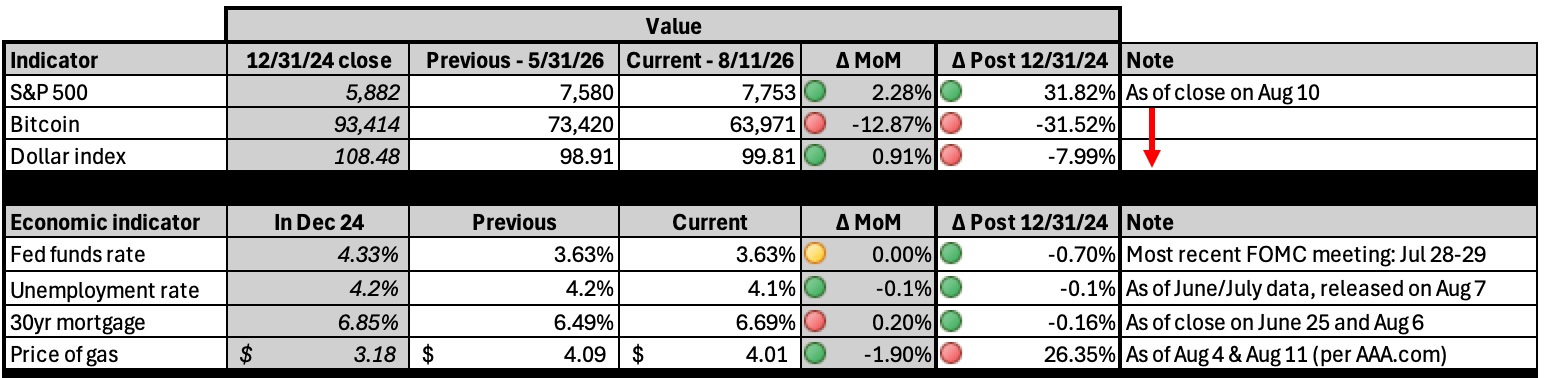
Green circle = indicator has moved in a positive direction
Red circle = indicator has moved in a negative direction
MoM change = month-over-month change
I would much appreciate it if you could hit the like ❤️ button!
It helps more people discover Nuance Matters and is a cost-free way to let me know you appreciate the work!
Monthly (June 1- Aug 10) return: -12.87% 🔴
2025 return: -6.28% 🔴
2026 YTD return: -26.93% 🔴
Post-election return: -7.88% 🔴
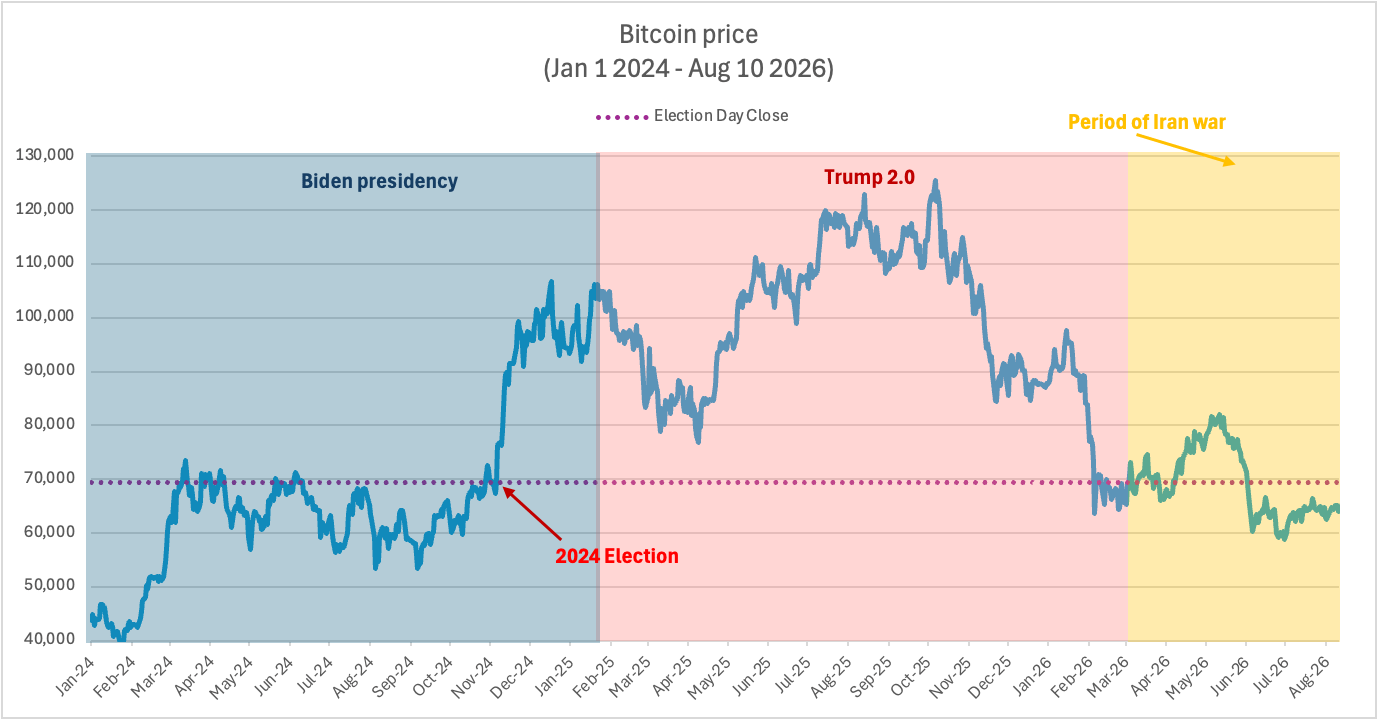
Source: Marketwatch
***********************************************************************
It is a day that ends in ‘y,’ so Trump or someone around him is doing something for their financial benefit. Much of the focus has been on crypto and how wealthy individuals are using money to gain access to buy political influence and enrich themselves. At the end of July, there was a lengthy report in the Wall Street Journal detailing how Trump goes above and beyond to get companies and high net worth individuals to donate.
SoftBank donated $50 million toward Trump’s presidential library. Apple cut a check for around $25 million toward his White House ballroom project, while Microsoft gave around $10 million and Amazon chipped in around $5 million, according to people familiar with the contributions. Meta Platforms recently gave $10 million to a Trump-aligned political committee, people familiar said, on top of a multimillion donation to the ballroom and a prior $22 million payment to the planned presidential library.
Trump stands out for taking personal control of the fundraising, and no sitting American president has ever raised these amounts for his pet projects. At the same time, companies have paid new attention to the White House as Trump has gotten involved in regulatory decisions that once were made by independent agencies, dramatically shifting the balance of power across Washington.
Trump has been demanding large checks from companies for a range of political and legacy projects—telling executives and lobbyists that their companies should give $25 million or $50 million. He has sometimes offered donors special access.
No laws prohibit presidents from raising unlimited sums of money for nonprofits, like the ones used for the ballroom and his presidential library, his super PAC or political issue committees. For most of these types of transactions, public disclosure of donors isn’t required and reporting on spending is infrequent.
All told, the second-term president has raised more than $800 million since returning to office, according to an updated Wall Street Journal analysis.
Some of the money is earmarked for specific projects, including the White House ballroom and the Freedom 250 funds for the nation’s birthday celebrations, but Trump has floated using funds in other ways. The president, at the dinner thanking contributors to the ballroom project, said, “We’ll have money left over, and we’ll use that for something…maybe for the arch or something else that will come.”
To this end, it is unsurprising that, as The Washington Post reported, he is using the power of his office to hand out no-bid contracts worth hundreds of millions of dollars to rebuild the East Wing of the White House.
As the WSJ story notes, none of this is illegal, but it is instructive as to what Trump is focused on.
In the meantime, more people are showing up to emergency rooms uninsured, unable to afford coverage after the One Big Beautiful Bill Act — Trump’s signature legislative achievement — slashed funding for Obamacare. Additionally, more than 4.5mn people have lost SNAP food stamp coverage (11% of the previously covered population) because of rule changes made in the OBBBA.
Notably, in strategic sectors like critical minerals, which will be important to the US long after Trump is out of the White House, Trump’s family continues to benefit financially. At the end of June, The New York Times published a long read on an arrangement between the US and Kazakhstan which hands concessions to companies partially owned by Donald Trump Jr. and Eric Trump. In total, there are at least 14 companies working on critical minerals deals with the US government that are associated with the Trumps or Cantor Fitzgerald (the investment firm of Commerce Secretary Howard Lutnick, now run by his kids).
Put it all together, and it’s little wonder there are questions over why, when Trump announced his latest round of tariffs last month, certain products were exempt. Are diamonds a strategically important import for the US economy? Or is it possible that a diamond-encrusted gold ring, gifted to Trump for 250th anniversary by the Antwerp World Diamond Center, was a way to grease the wheels and secure an exemption?
There are a couple of other recent developments that merit consideration.
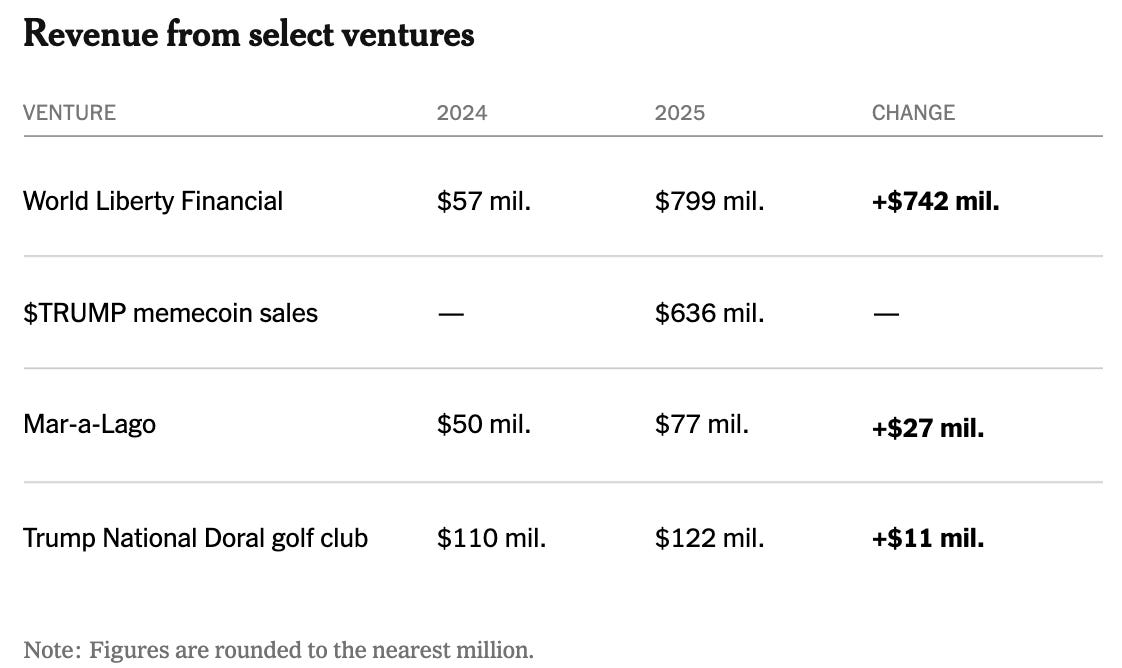
At the end of June, Trump filed his mandatory annual financial disclosure. The information was not surprising1, but the sheer scale of it all was nonetheless stunning.
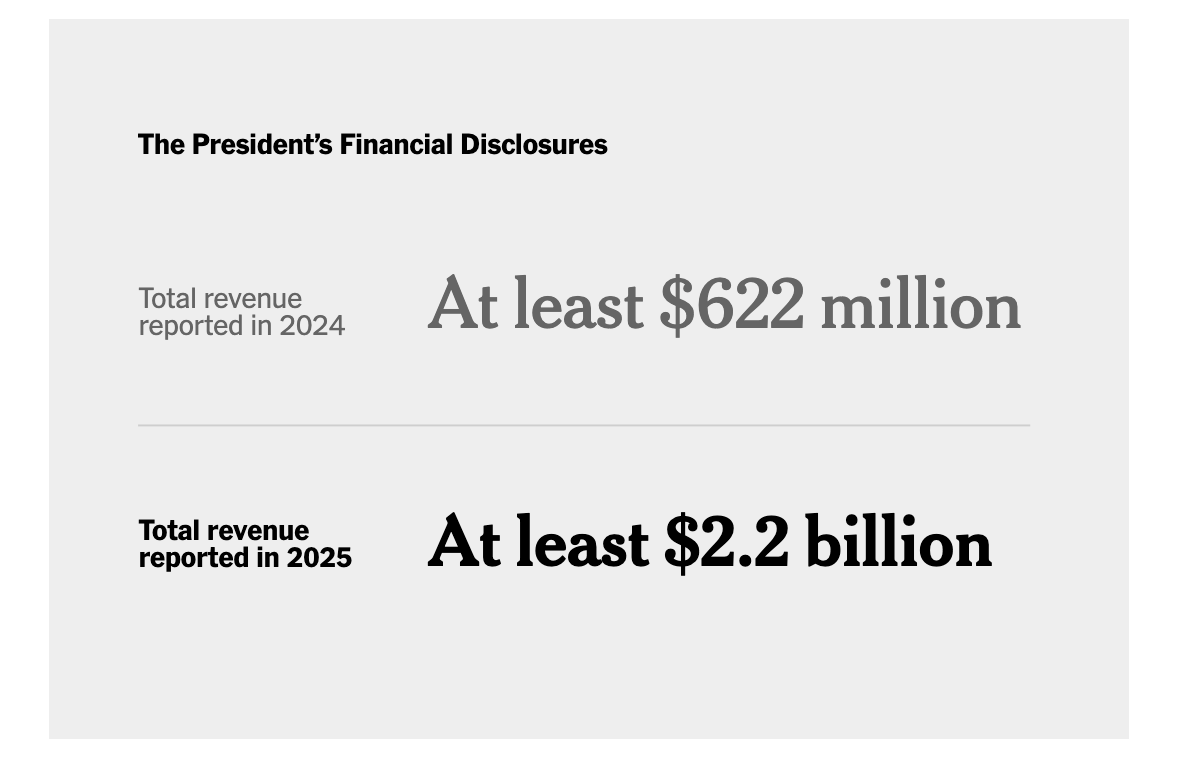
Trump himself earned over a billion dollars selling cryptocurrencies and other memecoins, including more than $600mn alone from the sale of the $TRUMP memecoin.
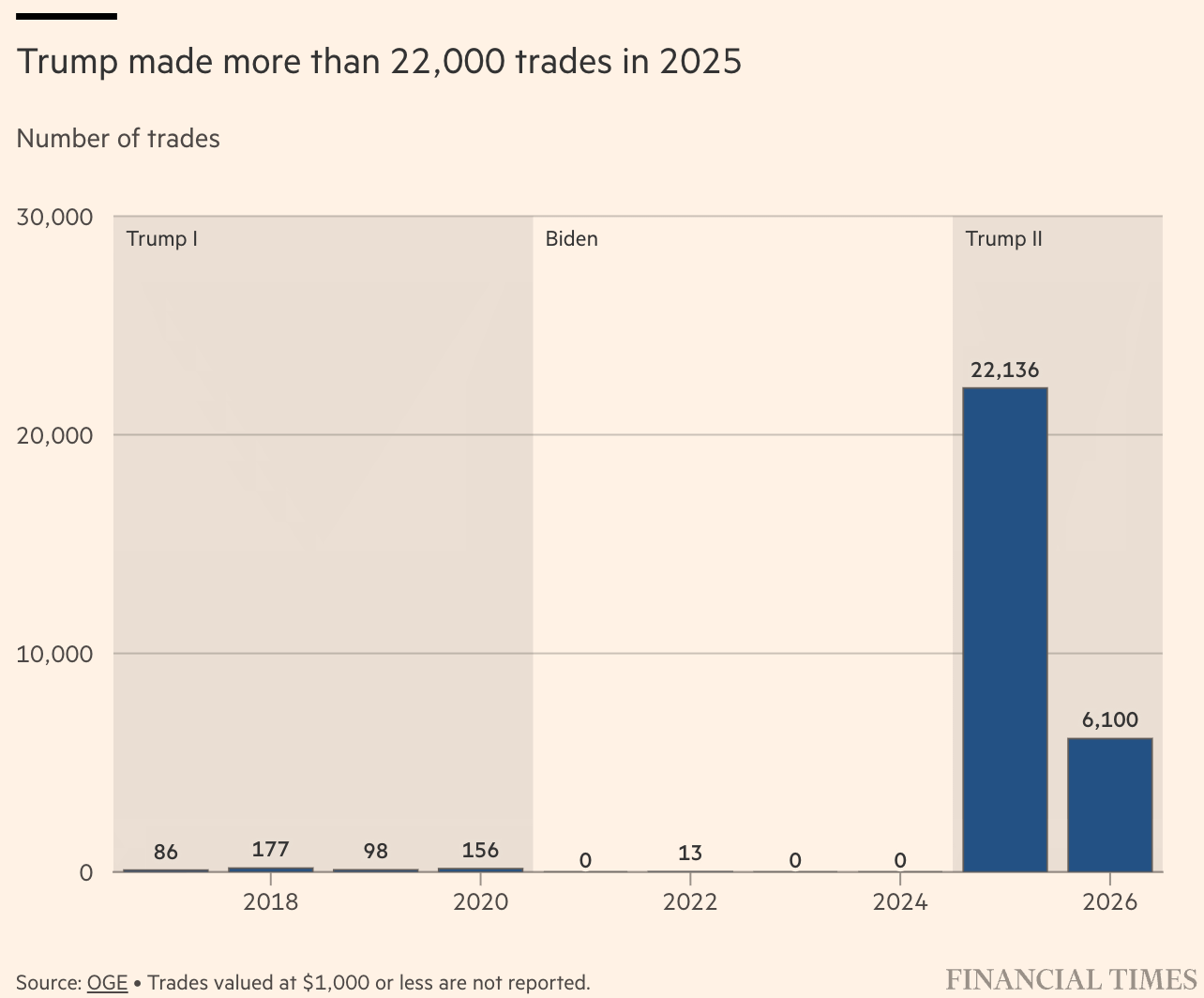
The most revealing part was probably the stock transaction section. Trump declared over 22,000 stock trades in 2025, a ridiculous number of transactions for any single person, let alone someone who — as president of the United States — ostensibly has a lot on his plate.2
Last month, Trump Media & Technology Group (TMTG), the company behind Truth Social, announced a plan to launch Truth API (‘application programming interface’) in order to provide “real-time access to posts from the highest-ranking Truth Social accounts.”
Obviously, there is only one Truth Social account that anyone follows. Trump is constantly using his Truth Social feed to provide updates and announcements on everything from the Iran War and foreign policy to economic news and the government’s investment in certain companies.
This isn’t a product for a retail investor, or even most institutions. Rather, you have these algorithmically driven, high-frequency trading firms that conduct thousands of trades a day. These trading shops seek any advantage they can get on the market, even if it is by mere milliseconds. Knowing what Trump is going to say just before the rest of the market could theoretically be the golden goose.
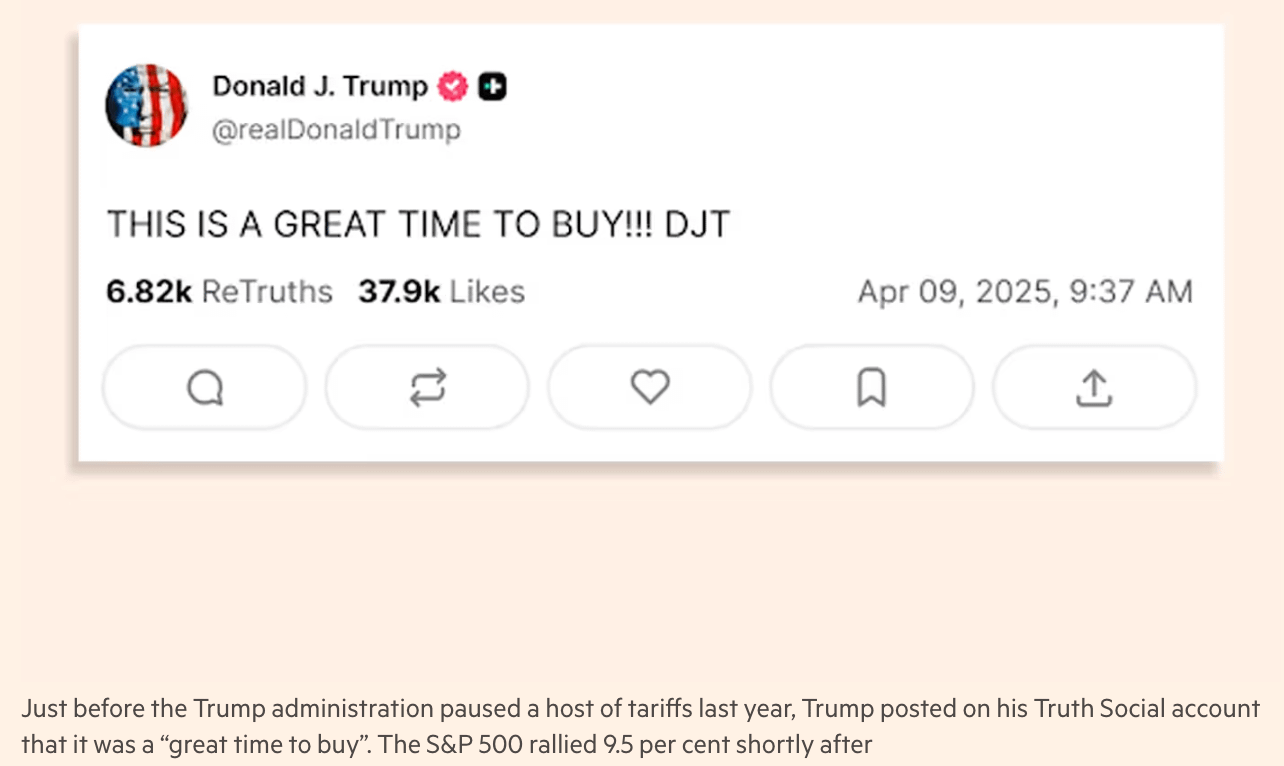
So for a monthly fee of as much as $100k, high-frequency traders could have access to Trump’s words before the rest of the public. Wall Street has not been too keen on this, conscious of the risk that this might be insider trading.3 After all, the API is offering material information to people who buy the service before the rest of the world has access to the same information! As Bobby Allyn at NPR noted (PTO emphasis added):
So experts told me that is the definition of material nonpublic information, and one executive at a very large Wall Street firm told me, if this was any other administration, this would be considered criminal. And I put that to the Trump media spokesperson, and she said that is absurd.
After the service went live last week, The NYT reported that so far ten customers had signed up for what TMTG advertises as “a direct, licensed, real-time feed of [Truth Social’s] most market-moving Truths.”
Congress also may enact a law that bans social media companies from selling faster service…but I’ll believe this when I see it.
Last month, The NYT reported on the Trump administration’s decision to cancel Biden-era grants for clean energy projects in October 2025. How did the administration determine which projects to cancel? As the court-filed report reads (PTO emphasis added):
DOE accepts that the inclusion of grants in the October notice tranche was based solely on the political identity of the grant recipient’s state, i.e., whether the recipient’s location and/or place of performance was in a Blue State or a non-Blue State. DOE will not contend that it looked beyond the prime grantee(s) to consider the political identity or geographic distribution of downstream beneficiaries of the grant funds.
In official court documents, the Trump administration plainly stated that it canceled funding for projects “based solely” on the fact that they were located in states that voted for Kamala Harris in 2024. Grants for 284 projects were terminated, 283 of those grants were for states Harris won.
Relatedly, last month Politico reported how Trump overruled administration officials and regional FEMA offices to deny disaster aid for the states of Massachusetts, New Jersey, New York, and Rhode Island. These four Democratic-led states had requested a collective $227mn in aid following the massive snowstorms that hit earlier this year, after which FEMA had gone in and verified the requests were reasonable.
In the past when a state had requested aid and FEMA approved it, sign-off from the White House is perfunctory.
But now, it has been turned into a political weapon.
If you enjoyed this edition of Nuance Matters, consider letting me know by buying me a cup of coffee!
Cheers!
Of course, Trump isn’t actually dialing up his trader or logging into a Bloomberg terminal himself to pull the trigger on these transactions, but he is certainly shaping the overall strategy and dictating when certain trades should happen.
To this point, other social media companies offer a similar service, but those services are for data from a social media company not posts from the current president of the United States.
Comments
Nothing yet. Say the first thing.
Sign in to join the conversation.