Summary commentary: While spending decades focused on trade with the US, and concentrating investment on optimizing that relationship, Canada largely ignored internal trade barriers that have created a real problem for the wider economy.
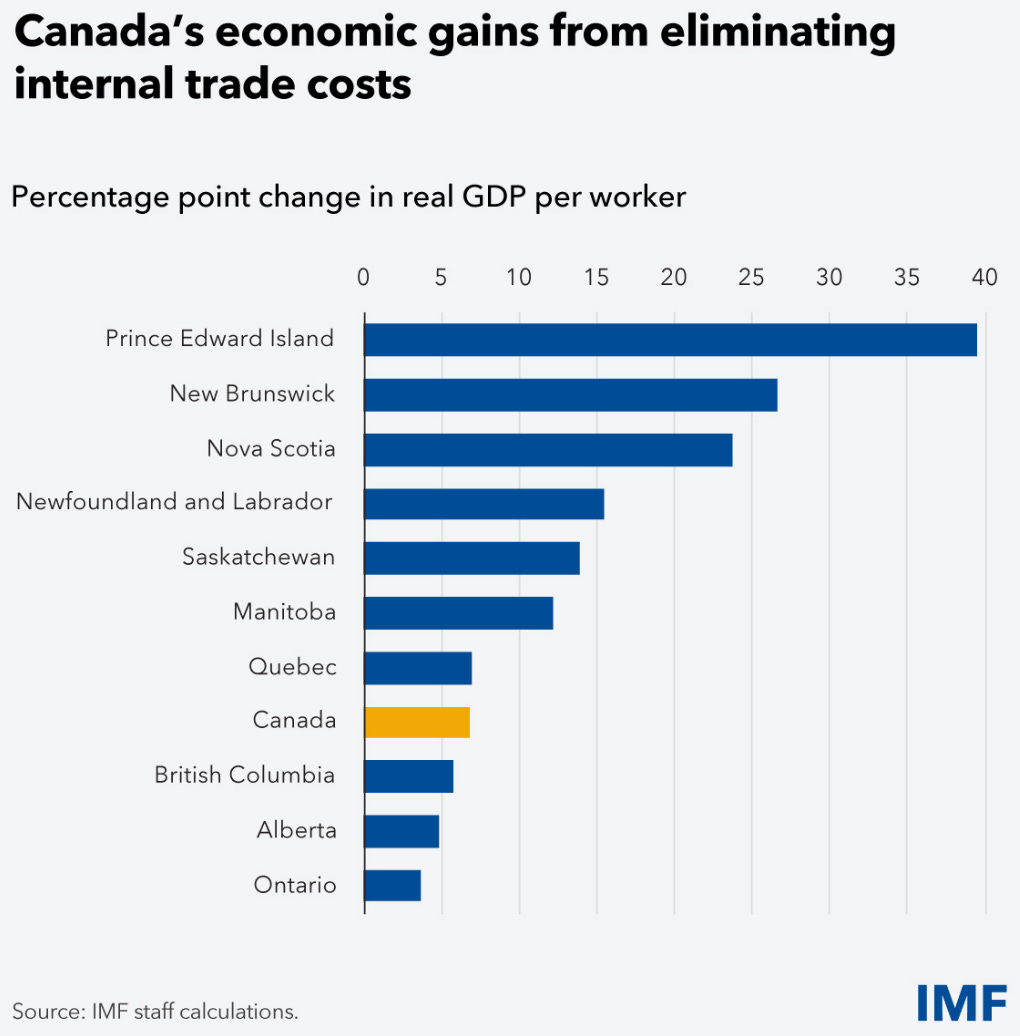
How big a deal could reducing these trade barriers be? A recent IMF report suggests that removing intra-provincial trade barriers could push up Canada’s real GDP by 7% (~CAD $210bn).Another study from 2022 found that Canada’s economy could grow by 4.4-7.9% over the long-term if mutual recognition policies were adopted.
Source The smaller, more remote Atlantic and northern provinces would benefit from being able to trade more within Canada.
Even if the real economic impact is more muted (after all, eliminating all trade barriers is not seamless and infrastructure investments are notoriously expensive), this mindset of breaking down walls would be a step in the right direction, and a move to reduce dependence on international trade.
I would much appreciate it if you could hit the like ❤️ button!
It helps more people discover Nuance Matters and is a cost-free way to let me know you appreciate the work!
On January 1, 1989, the US-Canada Free Trade Agreement went into effect. This agreement eliminated tariffs and most non-tariff trade barriers, bringing about a new era of neighborly relations and cross border trade.After a few years of successful implementing the deal, it was expanded to include Mexico. This revised edition, the North American Free Trade Agreement (NAFTA), was signed into law in December 1993 and created a continent-wide free trade zone.
NAFTA spent the next twenty years as a political football, debates raging on both sides of the aisle over the merits and demerits of the arrangement. Eventually Trump tore it up during his first term, though his negotiated replacement, the US-Mexico-Canada Agreement (USMCA), was essentially the same thing with new branding.
The legacy of this string of agreements is North American supply chains that transcend borders. For nearly 40 years, the US and Canada have traded with minimal fuss or red tape. Famously, individual auto parts cross borders multiple times to put together a single vehicle.
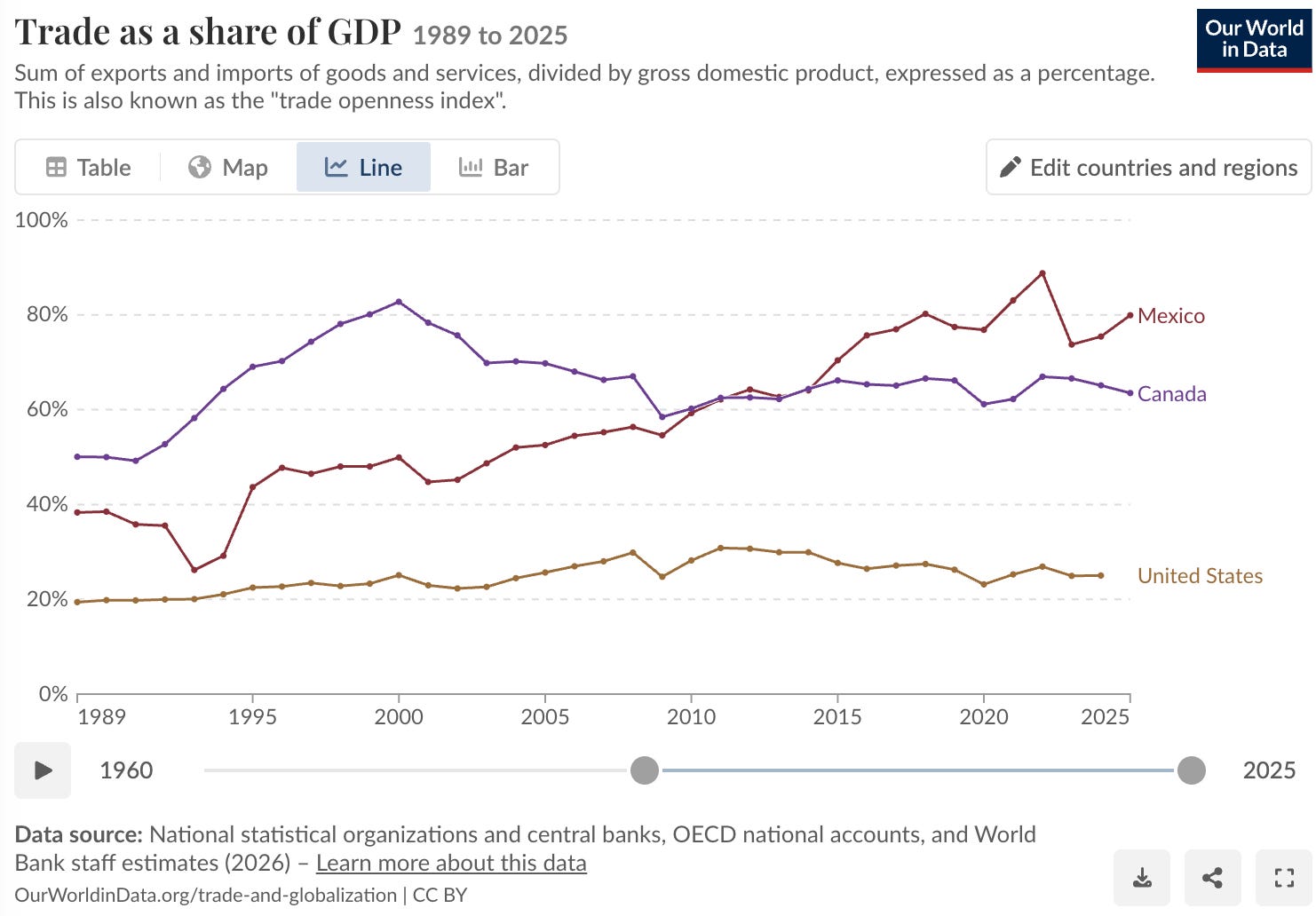
For the US, international trade is an important part of the economy, but not overwhelmingly so. The same cannot be said for Canada (or Mexico), where international trade represents well over 60% of GDP.
Source International trade is a relatively minor aspect of the US economy.
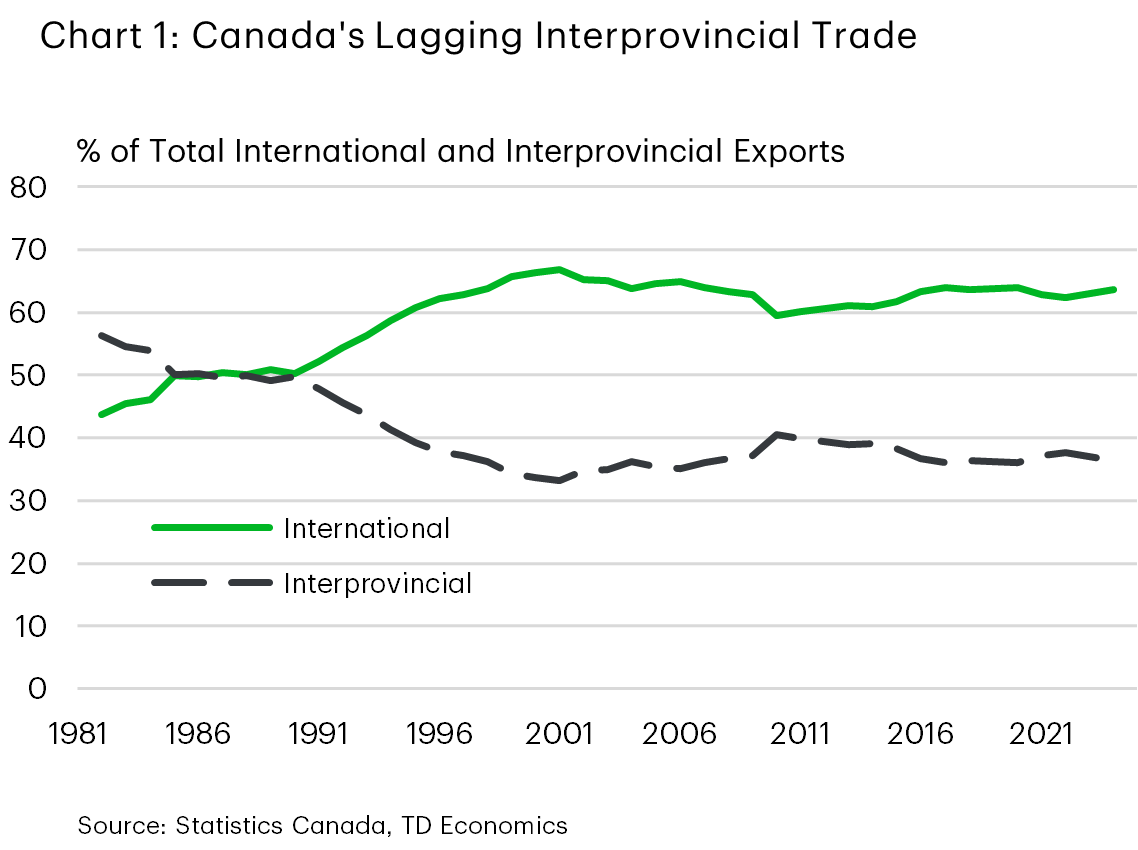
For Canada, international trade is a more important aspect of the economy than trade between provinces.
Source For the past 35 years, Canada has prioritized international over interprovincial trade.
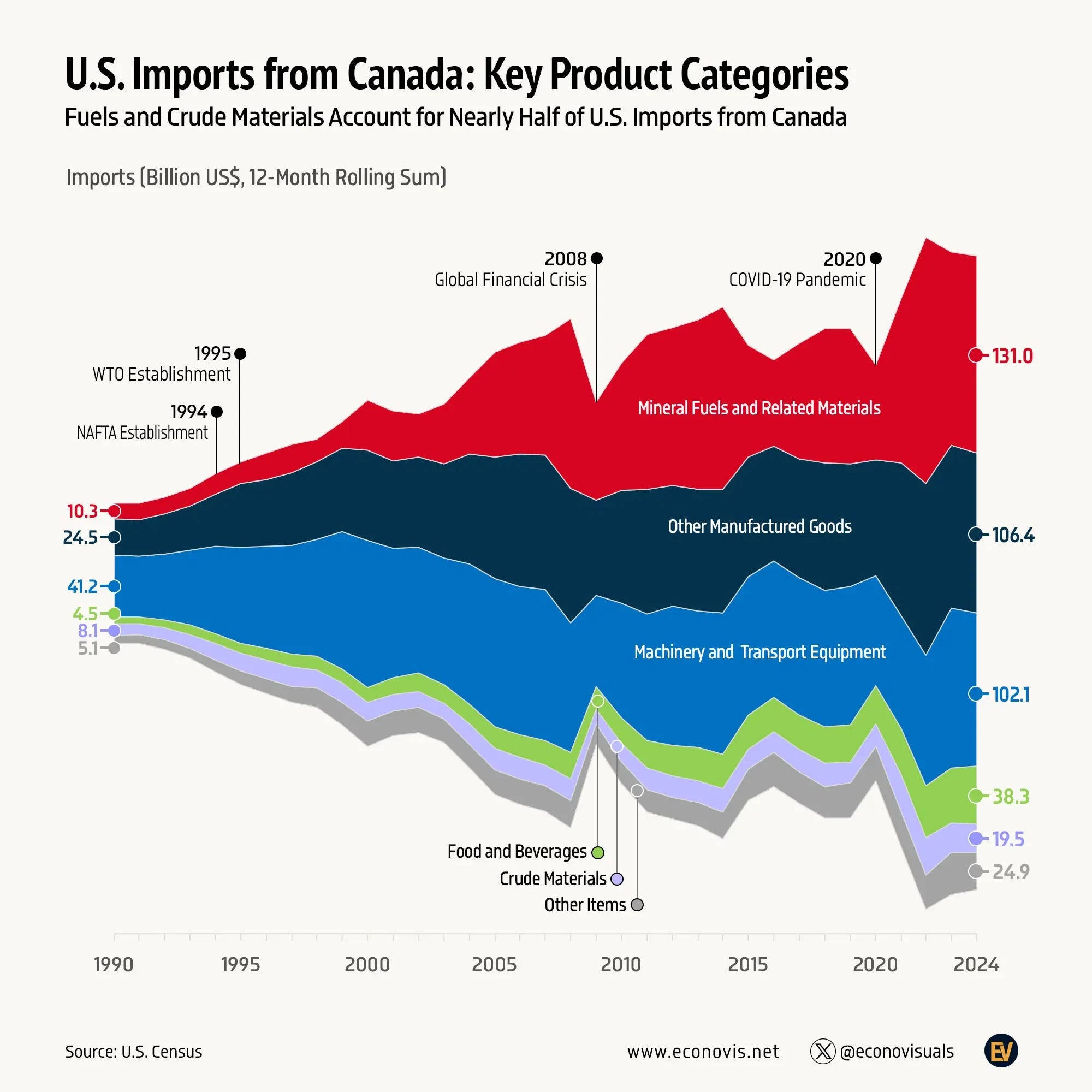
Part of this is a legacy of Canada’s resource wealth and what it trades with the US. As we have previously discussed, one of the most important Canadian exports to the US is crude oil (much of which is sent to US refineries where it is distilled into end-products like gasoline and diesel). Canadian exports to the US were pretty diverse in the early NAFTA years, dominated by machinery and manufactured goods. But fossil fuels slowly became more important.
Source Canada’s trade with the US has been led by energy-related goods.
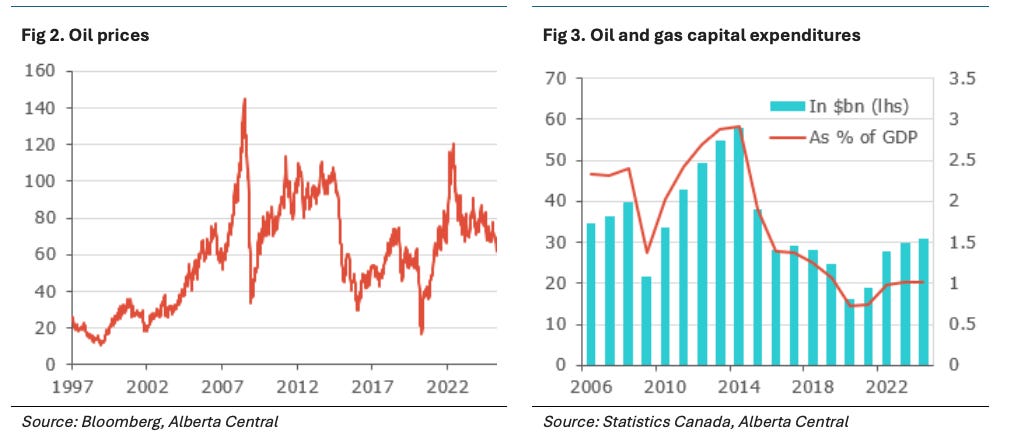
With the US demanding more oil, and Canada possessing one of the largest oil reserves in the world, Canadian firms spent the 2000s and early 2010s investing in oil infrastructure.
Oil prices fell sharply during the financial crisis, but quickly recovered, giving Canadian firms plenty of runway to continue spending apace. But the music stopped at the end of 2014 when oil prices collapsed, thanks to a supply glut that came, at least in part, due to the US shale boom.
When oil prices dropped nearly 60% between June 2014 and January 2015, Canadian oil and gas capex came to a screeching halt.
Source When the price of oil fell near the end of 2014, oil & gas capex in Canada quickly collapsed.
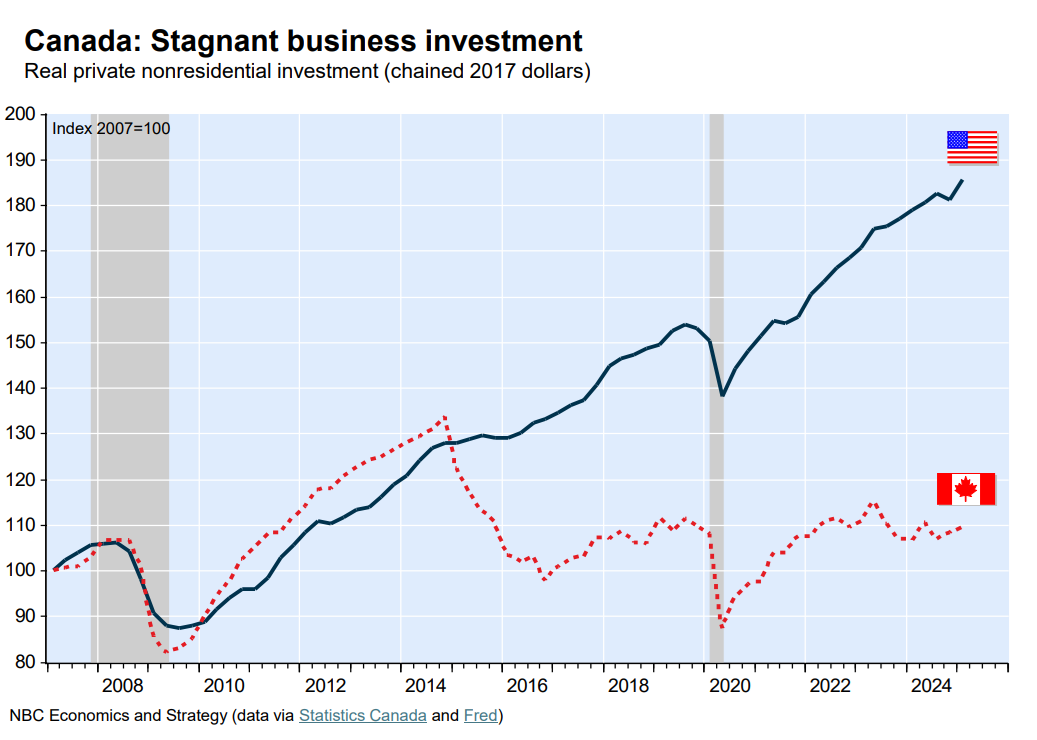
And as the chart below demonstrates, with oil and gas investment down, business investment across Canada basically stopped growing.
Source Over the past decade, US business investment has surged while Canadian investment has flat-lined…
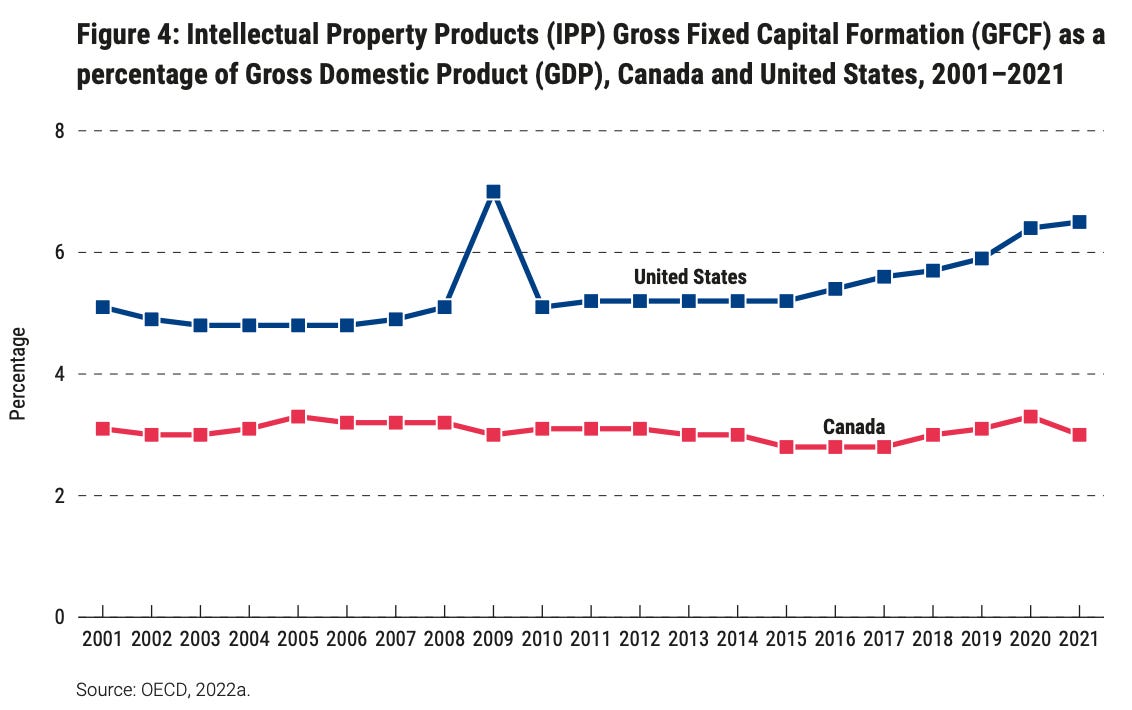
To make matters worse, Canadian business investment has barely grown in the decade since. In the meantime, US business investment has soared. As you can probably guess, this is a legacy of where the US and Canada have historically targeted investment. One study by the Fraser Institute, a libertarian think tank, suggests that Canada’s investment in two key productive asset classes, Information and Communications Tech and Intellectual Property Products has been significantly lower than the US’s since 2000 (we’re talking 20-50% lower depending on the period).
Source US investment in international property has consistent been around 5-6% of GDP compared to ~3% for Canada.
In this way, Canada suffered from a variation of Dutch Disease in which a focus on one resource crowds out other investment.1 The result is an economy over reliant on one sector (in Canada’s case, fossil fuels), and if that sector slows, the ramifications will reverberate across the landscape.
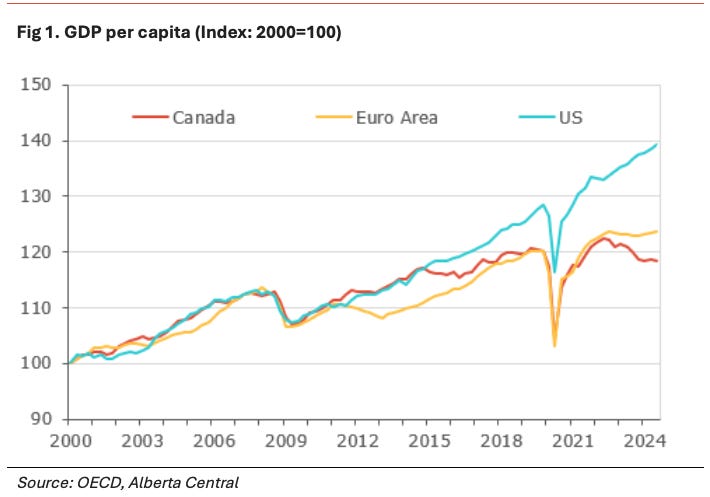
The outperformance of Canada’s oil and gas sector in the 2000s and early 2010s was covering up for deeper structural issues in the Canadian economy. Between the fall in oil prices and lack of productive business investment, the gap in growth in GDP per capita between the US and Canada has grown cavernous.
Source Canadian GDP per capita has fallen below that of the Eurozone.
To summarize:In putting so much emphasis on international trade and fossil fuel investment, Canada’s wider economy slowed.
On top of these problems, exacerbated now by Trump’s trade war, in an effort to protect jobs and boost local economies, Canadian provinces erected intra-provincial trade barriers that provided little wiggle-room for growth.
While some of Canada’s trade restrictions are natural (an IMF report from 2019 estimated that geography is responsible for 57% of Canada’s trade barriers), other more malleable problems are regulatory-based.
Intra-territorial trade barriers / red tape add costs and possibly restrict the sale of goods across provinces.
A study from 2016 suggests that domestic trade barriers increase the price of Canadian goods and services by 7.8-14.5%.
Another 2017 report by Statistics Canada (a government agency found that Canadian trade barriers amount to a nearly 7% tariff on domestic goods trade (a comparative model for the United States found there to be no internal trade costs).
A more recent IMF study found that policy-related barriers were equivalent to a 9% tariff (notably, a lower rate than the 5.9% effective tariff rate Canada has been dealing with from Trump).
This has materialized in a few ways including:
Credentialing details vary by province, which can make it difficult for workers to relocate.
Truck drivers encounter different rules and regulations that are often addressing real public policy concerns (e.g., heavier trucks beating up roadways) but nonetheless are an issue.
For example, the maximum weight for a trailer-truck carrying goods is 1,000kg less in Nova Scotia than in other provinces along the Atlantic coast which makes moving products that much more difficult.
Cross-border mark-ups and taxes make goods more expensive (e.g., Canadian wine)
In 2018, the Canadian Supreme Court upheld a fine imposed on a New Brunswick resident who had bought 14 cases of beer in neighboring Quebec and tried to bring back into New Brunswick, in excess of the carrying limits under New Brunswick law. As such, by ruling that economic activity cannot obstruct the regulatory requirements of the provincial governments the court essentially said there was no constitutional guarantee of free trade within Canada.
Put it all together, and its little wonder Canada trades more with the US than itself.
The provinces and federal government are trying to tackle the issues, though not necessarily in a consistent manner. Some examples include:
Ontario announced new legislation that makes it easier to cross-certify workers from other provinces.
One wider initiative is the Atlantic Physician Registry, which allows doctors to register in a central database and practice anywhere across the Atlantic provinces (New Brunswick, Newfoundland and Labrador, Nova Scotia, and Prince Edward Island), though uptake has been slower than hoped.
Most importantly, at the federal level last November (2025) Ottawa announced the landmark Canadian Mutual Recognition Agreement, tearing down barriers for the sale of goods across the country (with notable exceptions like food and alcohol). The rule states that,
If a good may be lawfully sold in one province or territory, it may be sold across the country without having to meet additional testing, certification or other requirements – unless a government has identified a specific requirement it will retain.
This rule became effective in June (2026), with the government’s goal to also cover services by the end of the year.
One group, the Canadian Federation of Independent Business, releases an annual score card judging the provinces and federal government on their domestic cooperation. And in July, the group released its 2026 edition. There were high marks all around (except for the northern Nunavut territory) as it was agreed provinces were working to bring down barriers to improve cooperation and cross-jurisdictional recognition.
At the same time though, CFIB was quick to point out that much of the recent progress stems from commitments and intentions — close to 70% of Canadian small businesses surveyed noticed no significant change to business across territories, and 16% said it had gotten more difficult.
Last but not least, while the natural geographical issues of a land-mass stretching over 5,000km east-to-west are real, they can also be mitigated. Investment in high speed rail (the first of which, the Alto project, is connecting Toronto and Quebec) and better port infrastructure (such as upgrading the Port of Vancouver to facilitate more trade) can reduce the impact of these interprovincial barriers.2
These are the sort of big ticket investments that would cost a lot of money, probably run over budget, but — if actually completed — could really make a visible difference.
If you enjoyed this edition of Nuance Matters, consider letting me know by buying me a cup of coffee!
Unsurprisingly considering the circumstances, there is also talk of Canada and the US reviving the Keystone Pipeline. The pipeline has a long history: First proposed during the tail-end of the Bush administration, Obama rejected applications to build it. Trump then restarted operations in 2017 before Biden scuttled it in 2021 (much to the disappointment of then-Canada prime minister Justin Trudeau). If Keystone were to be fully operational, the province of Alberta could move an additional 800k b/d of oil down to US refineries.

Comments
Nothing yet. Say the first thing.
Sign in to join the conversation.