
Summary commentary: Despite devoting years as a bank official and private citizen to the climate crisis, Canadian prime minister Mark Carney has entered public office and completely shifted focus.
Indeed, at the end of June Carney was brutally honest when he communicated that Canada’s emissions would increase in the coming years, saying that “the certainties of the world of 2015 are long gone” and “the world hasn’t been this unstable geopolitically since the end of the Second World War.”
That may be true, but the fact that Carney the politician has committed so much to fossil fuels, despite his past support for climate action, demonstrates just how difficult the political economy of the energy transition is.
I would much appreciate it if you could hit the like ❤️ button!
It helps more people discover Nuance Matters and is a cost-free way to let me know you appreciate the work!
Back in the fall of 2015, around the time when Obama and Xi were negotiating what became the Paris Climate Agreement, the head of the Bank of England gave a speech to insurers in London.
In the hallowed halls of the Lloyds of London, this banker warned that if the status quo continued, climate change would cause an economic disaster. “The challenges currently posed by climate change pale in significance with what might come. The far-sighted amongst you are anticipating broader global impacts on property, migration, and political stability, as well as food and water security. So why isn’t more being done to address it?”
That governor who made this now landmark address coined the “Tragedy of the Horizon?” Mark Carney, then the head of the Bank of England, now the current prime minister of Canada.
For the next decade, Carney was the global face of a certain type of climate action. A money-man through and through, after all he spent over a decade at Goldman Sachs and served on the boards of both the Bank of Canada (during the financial crisis) and the Bank of England (during Brexit and the early days of the pandemic), Carney became the UN special envoy for climate action and finance. In this role, he launched the Glasgow Financial Alliance for Net Zero (GFANZ) with the goal of mobilizing the financial strength of Wall Street and the City of London in the fight against climate change.
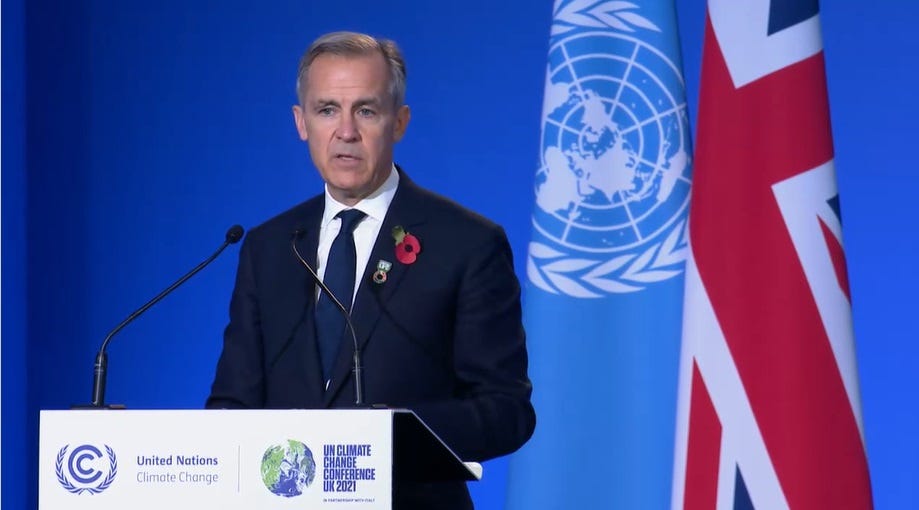
At the 2021 UN Climate Conference in Glasgow, over 450 financial institutions, controlling trillions of dollars in assets, joined GFANZ pledging that by 2050 all of their investments would be aligned with the goal of net zero. The rush to join GFANZ was surely aided by occuring at the precise moment when the global community was at peak post-pandemic enthusiasm for climate cooperation.
But then the moment passed. And in the years since, as inflation + Russia’s invasion of Ukraine in 2022 caused energy prices to soar and then Trump returned to the White House determined to undermine clean energy, much of this finance-led climate action across the US and Europe has gone the way of the dodo bird.
Once Carney took over in Ottawa last year though, there was hope he would turn Canada into a beacon of light against the dark cloud of the Trump administration’s total disregard for climate policy. After all, during his pivotal 2015 speech, Carney explicitly pointed out what was required for action. (PTO emphasis added)
Financial policymakers will not drive the transition to a low-carbon economy. It is not for a central banker to advocate for one policy response over another. That is for governments to decide.
His efforts to mobilize financial institutions may have failed, but now he was in government, and the belief was Carney could be the change he wanted to see. But unfortunately, things have not gone the way advocates have hoped.
During his first 15 months in office, Carney has turned back the clock in Canada to focus more on fossil fuels as an engine of growth.
Carbon tax: Struck down Canada’s carbon tax on consumers. For Carney, who has spent his life dedicated to the market, to scrap a carbon tax, the holy grail of market-based climate solutions, is a real gut-punch.
EV mandate: Repealed an EV mandate (which would have required EVs to account for 20% of auto sales in Canada this year, and 100% by 2035) and replaced it with targeted credits to incentivize EV uptake. The government acknowledged that Canada’s EV adoption will slow as a result (goal now is for EVs to represent 75% of sales by 2035). At the provincial level, governments have also rolled-back EV rebates.
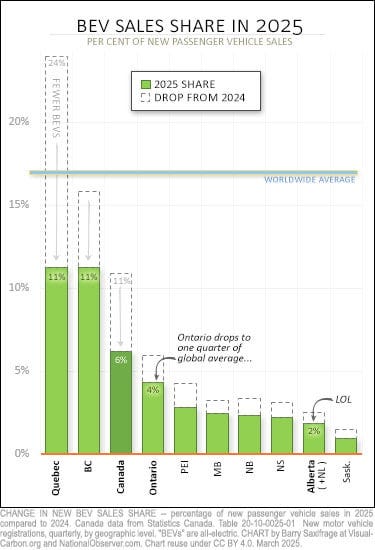
Source In 2025, battery EV sales in Canada fell from the prior year and lagged well beneath the global average. Gas tax: Earlier this year, Carney suspended this tax through the summer to offset the price hikes caused by the Iran War. As it is, Canada has an exceedingly low gas tax which has reduced the economic rationale for purchasing an EV.
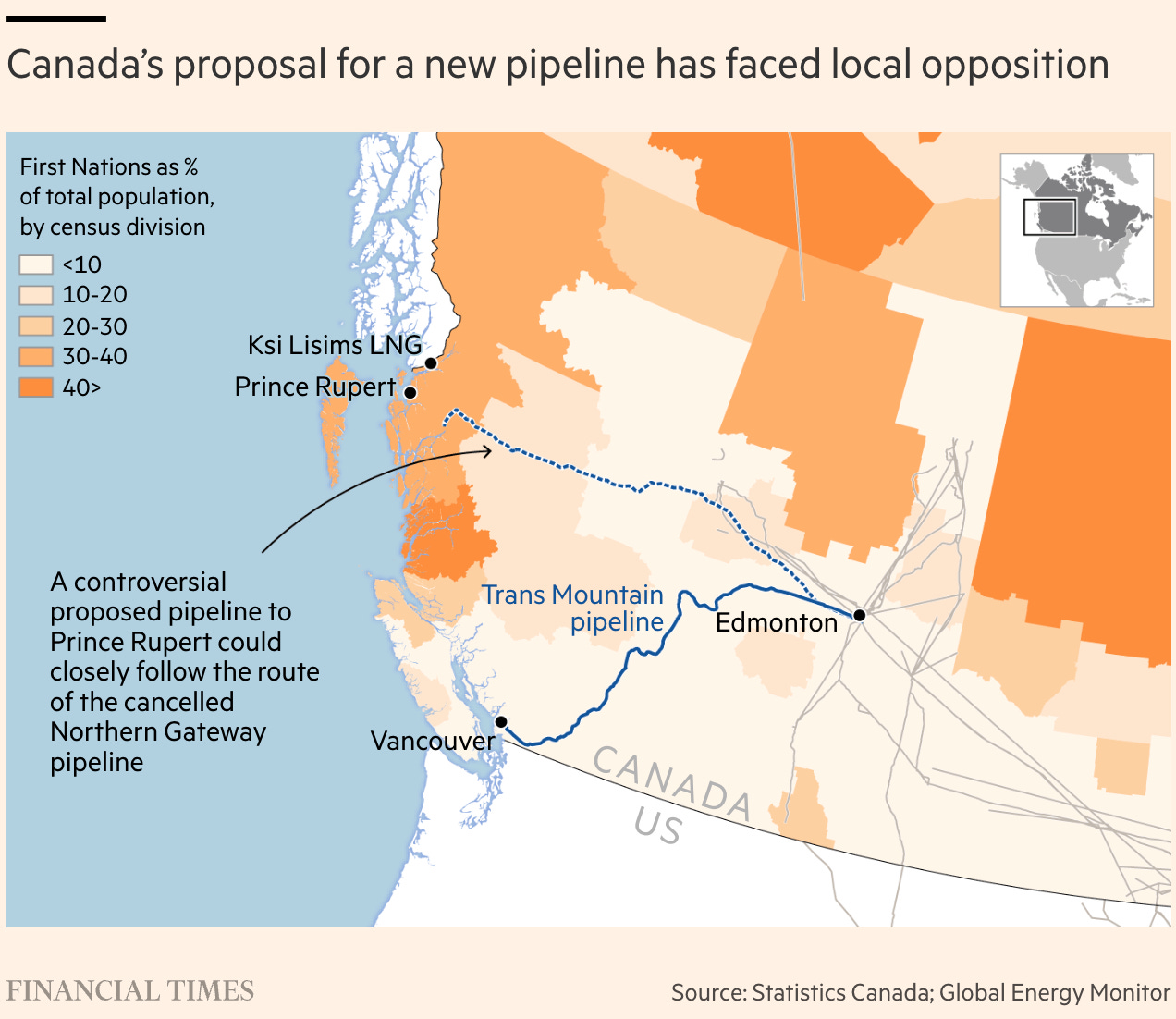
Oil production: Has encouraged crude production by supporting a new oil pipeline from Alberta to British Columbia to export more oil to Asia (the hope in Canada is that they begin work in 2027 and the pipeline is up and running by 2035). As part of this agreement, the government also weakened Alberta’s industrial carbon price regulation. Interestingly though, Canadian fossil fuel companies have been a bit more circumspect when it comes to increasing production, worried about the shifting global trends away from fossil fuels and political uncertainty.
Keystone Pipeline: In a similar vein, Canada and the US have discussed reviving the Keystone Pipeline.1 The pipeline has a long history: First proposed during the tail-end of the Bush administration, Obama rejected applications to build it. Trump then restarted operations in 2017 before Biden scuttled it in 2021 (much to the disappointment of then-Canada prime minister Justin Trudeau). If Keystone were to be fully operational, the province of Alberta could move an additional 800k b/d of oil down to US refineries, assuming the two nations are back on speaking terms.
Project oversight: Approved government legislation that will speed up environmental reviews for projects considered in Canada’s “national interest.” While permitting reforms may be welcome, this particular move came much to the dismay of indigenous groups, which assert they have not been properly consulted or compensated for the loss of land and impact these projects have on their local communities. Environmental groups also decried the new rules, claiming the government pushed them through without any consideration of the wider impact on communities and wildlife.
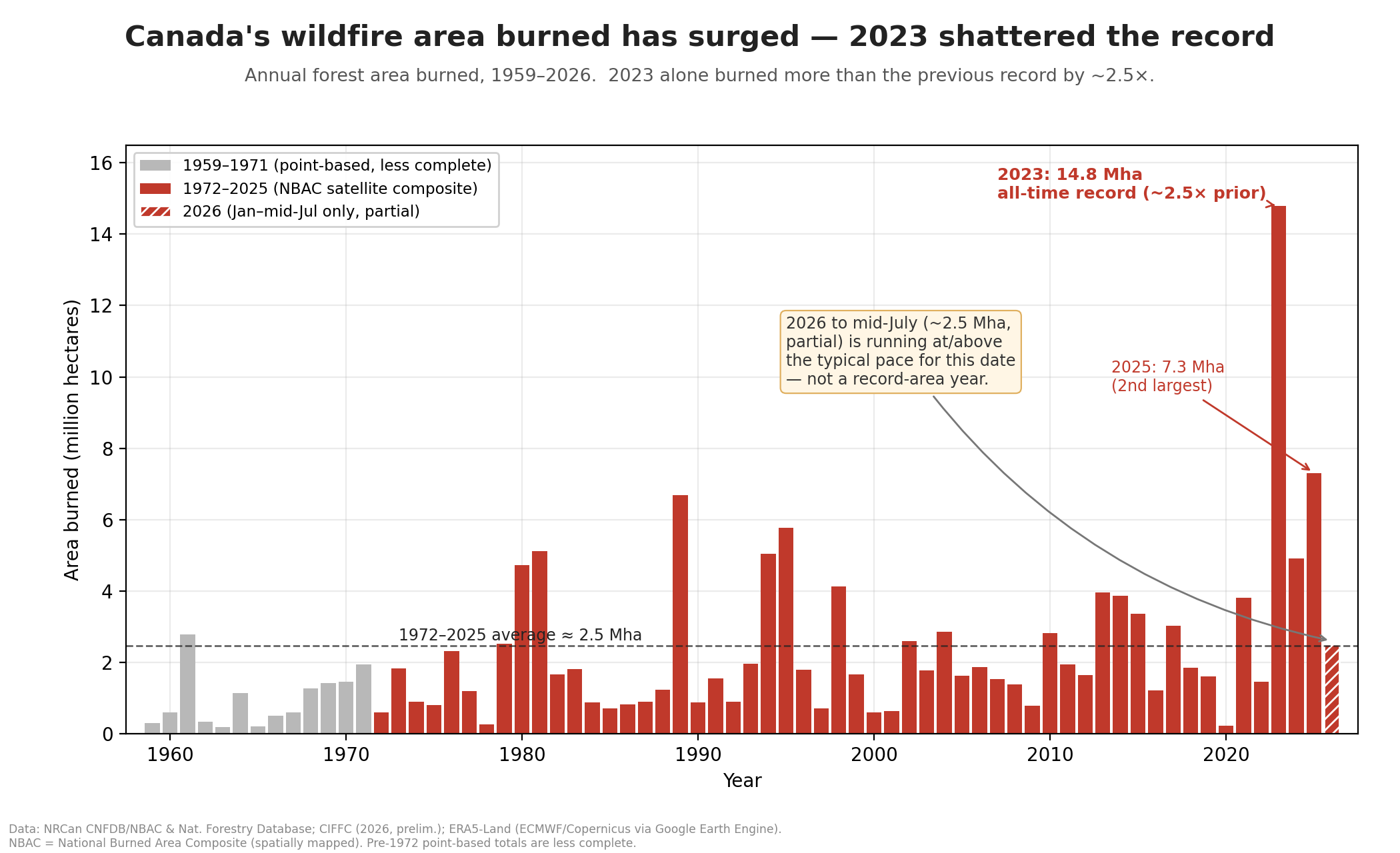
All of these changes come at a time when Canada2 is dealing with the fallout from wildfires that have exploded to new heights — a phenomenon due, at least in part, to higher temperatures and drier seasons.
Unsurprisingly, this fossil fuel pivot has resulted in a slowdown in Canada’s emission journey.
To be fair to Carney, Canada had already been backsliding on its climate goals before he took over. Last year, the Canadian Climate Institute noted that emissions had stagnated in 2024 and that without real political change, Canada would miss its 2030 emissions reduction target.
Lest you think Canadians don’t care about climate change, recent polls show that over half of all Canadians are either ‘very’ or ‘extremely’ concerned about climate change. But of course, when asked if they are personally impacted, just 39% believe they will be among those most impacted, while over 80% believe future generations will bare the brunt of the damage.
Carney’s time in office is an example of just how difficult it is to expend political capital and real money on a problem when most constituents feel the greatest dangers are in the future, especially when you are dealing with a slowing economy (an economy has been committed to fossil fuels) in the present. Right now, with Canada’s economic problems front and center (even before the whole Trump debacle), Carney is doing what he can to stimulate the economy.
Could some of that come through clean energy investment? In a more encouraging sign, representative of an ‘everything-energy’ policy, last week (Aug 17) Carney announced what the Canadian government called the “largest clean energy investment in North American history” in the form of CAD $70bn for hydropower, onshore wind projects, and transmission lines to spread this clean electricity (some of it to the US).
*************************
Hope you enjoyed this series on Canada, (or at least learned something). As a completely unrelated capper, enjoy this goal scored last weekend in the English Championship.
We are only one week into the season, but it is difficult to imagine someone scoring a more remarkable strike the rest of the campaign.
If you enjoyed this edition of Nuance Matters, consider letting me know by buying me a cup of coffee!
Cheers!
Tough with the two nations now locked in a trade war, this could be tricky]
Comments
Nothing yet. Say the first thing.
Sign in to join the conversation.