
Note at the top: Our series on Middle Powers rolls along this week focusing on Canada, America’s hard-bitten neighbor to the north. Most of the research and writing was conducted last week, while the US and Canada were in the midst of trade negotiations. With talks falling through on Friday night, Trump imposed tariffs and Canadian prime minister Mark Carney proclaimed Canada was now “at war” with the US over trade.
The original plan for today was to post about Canada’s relationship with the US, and how Canadians want the government to respond to Trump. But with circumstances evolving, I decided to hold off on that for a day. Let’s let the dust settle a bit and assess how things look today (Monday Aug 24).
So instead, we begin the series with a look at how Mark Carney is positioning Canada with respect to the rest of the world.
Summary commentary: Within the global community, Canada’s prime minister Mark Carney is a realist. He understands the importance of international cooperation for economic and defense purposes and is pursuing alliances accordingly.
While much of his focus has been on Europe Carney has met with leaders around the world, putting in work to mend fences with two important potential export markets, India and China, where relations have been strained over the years. Carney’s successful de-escalation of tensions with the leaders of the two most populous countries is a clear statement of intent and move Canada away from relying so heavily on its fickle neighbor to the South.
I would much appreciate it if you could hit the like ❤️ button!
It helps more people discover Nuance Matters and is a cost-free way to let me know you appreciate the work!
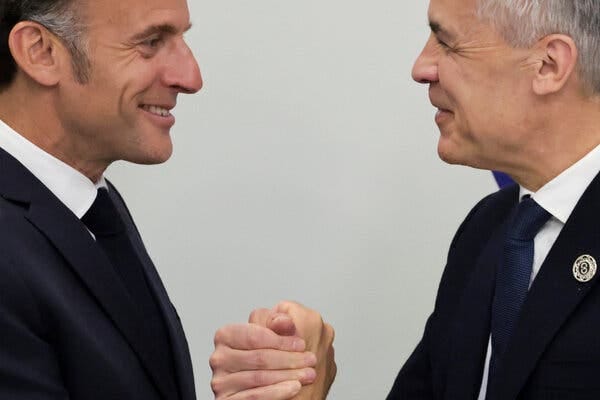
When Donald Trump returned to the White House in January 2025, we all knew things were going to be a bit nuts…but no one predicted just how crazy and farcical (if the resulting chaos did not impact literally billions of people around the world) the first year truly was.
In January, after almost exactly one year of Trump’s madness1, Canada’s prime minister Mark Carney got on stage in Davos at the annual World Economic Forum. A Goldman Sachs man, a former head of the Bank of England, and organizer of some of the biggest climate finance initiatives, Carney rode a major anti-Trump backlash to become Canada’s premier last year. And now after spending much of his adult life as the embodiment of globalization, here he was, about to make a speech that for the past eight-months has largely defined the current era.
In the face of Trump’s rhetoric about Canada becoming the 51st state and tariffs2, Carney’s Davos speech encouraged middle powers of the world unite, “because if we’re not at the table, we’re on the menu.”
Collective investments in resilience are cheaper than everyone building their own fortresses. Shared standards reduce fragmentations. Complementarities are positive sum. And the question for middle powers like Canada is not whether to adapt to the new reality – we must. The question is whether we adapt by simply building higher walls, or whether we can do something more ambitious.
Predictably, the speech was ridiculed by the Trump administration, but it galvanized the rest of the world, particularly Europe whose leaders hailed Carney as a champion of the international order, as an example of how one can stand up to Trump (even if they are generally less willing to say so in public). Carney has responded in kind.3
In May (2026) he travelled all the way to Armenia to make a brief appearance (just a few hours) as the first non-European leader to participate at a European Political Community Summit.4 While there, Carney gave another speech in which his soaring rhetoric, highlighted by statements like, “the international order will be rebuilt, but it will be rebuilt out of Europe,” was warmly received by Europe. As Antonio Costa (president of the European Council noted, Canada is a “like-minded country” sharing “a certain vision of the world.”
But its not just words and in-person events that have the two sides excited. Last year, Ottawa and Brussels agreed on a defense partnership. As part of this alliance, Carney joined the EU’s joint defense procurement project (Security Action for Europe, SAFE), which will allow Canadian businesses to sell defense equipment and munitions to European countries.5
Historically Canada procured 80% of its defense infrastructure from US firms but Canada is trying to break that dependence. This was evidenced recently by Ottawa’s decision to go with a European defense warning system (Saab’s GlobalEye) as opposed to the American alternative (Boeing’s Wedgetail). Meanwhile, negotiations are ongoing over Canada’s plan for fighter jets, and how to balance Lockheed Martin F-35s (from the US) and Saab’s Gripen-E fighters (from Europe).
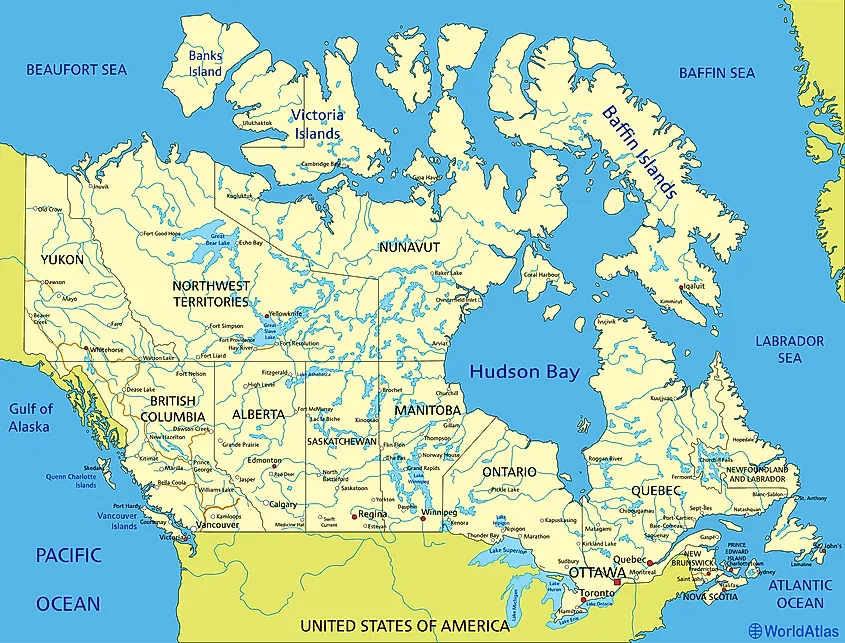
Relatedly, as the Arctic warms, Canada is planning on by adding more infrastructure links to the Hudson Bay region which should help expedite trade between Europe and the central/western provinces like British Columbia and Alberta. Canada’s industry minister Melanie Joly also visited the Nordics last year in a bid to shore up diplomatic and military ties. Then in March Carney linked up with the five Nordics to sign a joint-defense agreement, highlighting the importance of Arctic security.
Critically for European defense, Carney has also been unwavering in his support for Ukraine. In July at the NATO summit in Turkey, Carney promised CAD $2.8bn of military assistance in the form of ammunition, armored vehicles and tech/engineering equipment.
Overall, how has Carney’s outreach gone? It’s gotten to the point that European ministers have publicly mused that maybe Canada should join the EU. While perhaps not very serious, these statements demonstrate the close ties Carney is fostering with European leaders
In the wake of his infamous Davos speech, you might have thought Carney’s next trip would be to Europe. You would be mistaken.
Carney’s next international trip (March 2026) was a 10-day swing across India, Australia, and Japan. Together, these nations represent four quintessential middle powers, and this trip was a chance for Carney to demonstrate the power of his vision for the world. He addressed Australia’s Parliament and signed a new economic and security partnership with Japan’s prime minister Takaichi Sanae. But perhaps most notably, he met with India’s prime minister Narendra Modi to try and mend Canada-Indian ties.
Ottawa’s relationship with India had been strained ever since the Trudeau government asserted the assassination in 2023 of Hardeep Singh Nijjar, a Sikh activist living in Canada, was sanctioned by the Modi government. But in the year since Carney’s election, these tensions have eased as the two sides have sought to cooperate on issues like security and energy flows. Closer India-Canada ties could be mutually beneficial as India has not historically imported any crude oil or LNG from Canada (and instead has continued to rely on Russian exports to meet its energy needs).
During Carney’s trip to New Delhi, he and Modi inked a handful of deals including one worth nearly $2bn for Canada to supply India uranium for India’s civilian nuclear program through 2035. Significantly, the issue of Indian actions on Canadian soil did not come up during this visit.
Two other interactions that bare mention
On trade: In July, Carney became the first Canadian prime minister in 26 years to visit Saudi Arabia. While in the Kingdom, Carney met with Crown Prince Mohammed bin Salman (MbS) and signed over a dozen commercial agreements / MoUs across a variety of topics including mining of critical minerals and defense.
On defense: Carney’s diplomacy has attracted visits from foreign leaders including Ferdinand Marcos, the president of the Philippines, the first visit by a Philippine head of state to Canada in over a decade. The two agreed to cooperate on defense and security.
Last year, Canada sent its first tanker of LNG to Asia (South Korea), a major breakthrough for Ottawa and its ambition to diversify energy trade away from simply relying on the United States as the behemoth market. On a visit to India earlier this year, Canada’s energy minister Tim Hodgson noted the “strategic blunder” that has been Canada’s nearly wholesale dependence on the US market (Canada is the fourth largest oil producer in the world, and 90% goes to the US).
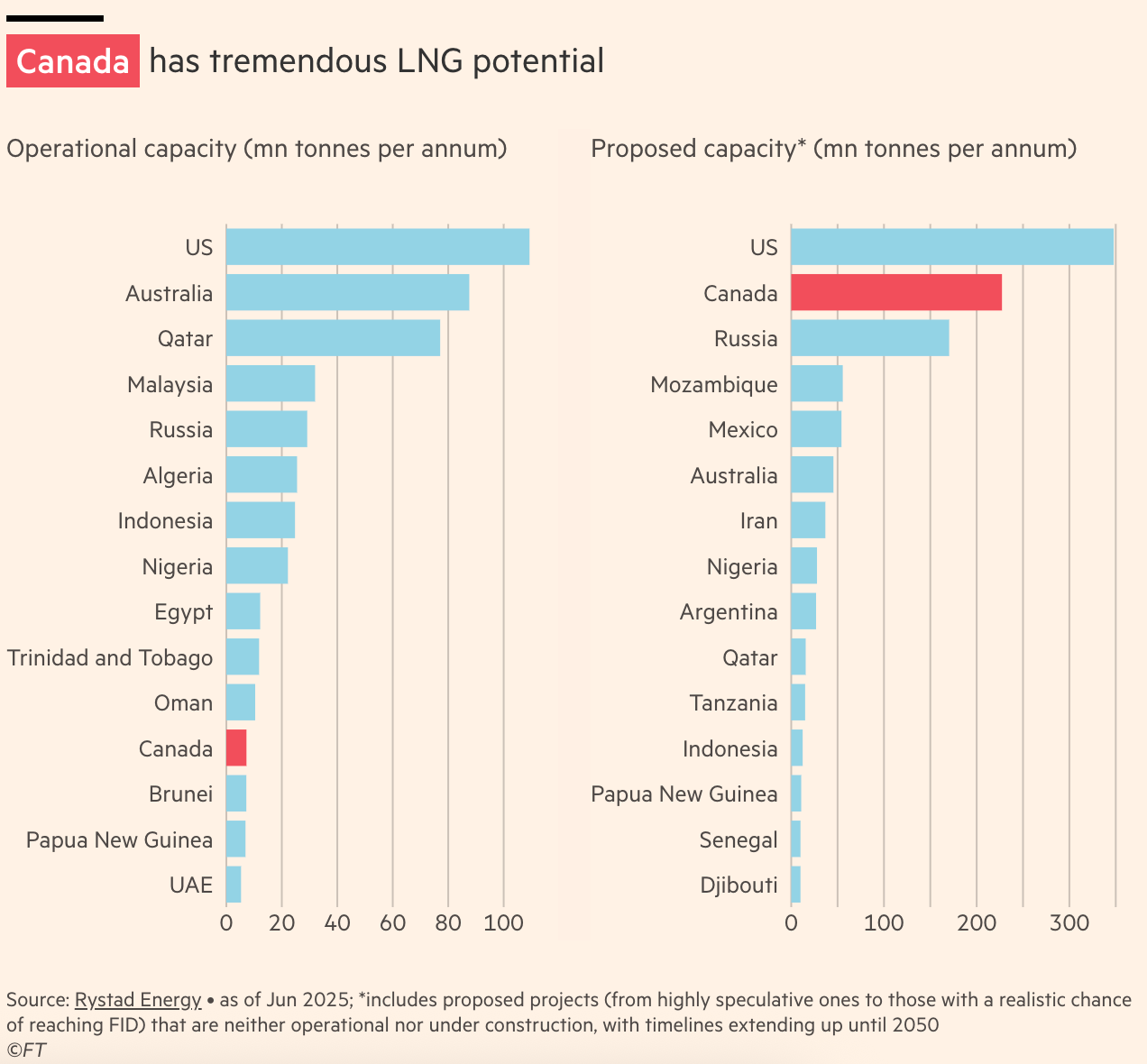
As part of this new diversification approach, Carney is promising to double Canada’s LNG production and increase exports to Asia and move away from just oil (the vast majority of which goes to the US).6 That being said, a lack of sufficient infrastructure means it will take time for this to blossom.7
Last, but certainly not least, is Canada’s relationship with China.
Back in the late 2010s, this relationship was not in a great place. Near the end of 2018, a tit-for-tat escalatory spat began after Canada detained the CFO of Huawei at the behest of the US for violating US sanctions.8 China responded almost immediately by imprisoning two Canadians. These individuals were held until September 2021, nearly three years, when the two sides (+ the US) finally reached a diplomatic solution.
The relationship hit a low point a year later in 2022 when, at the G20 summit in Bali, China’s president Xi Jinping confronted Canada’s prime minister Justin Trudeau, accusing the then-Canadian premier of leaking details of a private conversation. This came just a few weeks after Trudeau had accused Beijing of undermining the democratic process and attempting to subvert Canada’s national elections. The Trudeau government had followed Biden’s lead and imposed 100% tariffs on Chinese EVs, a clear sign of the times.
But over the past 15 months or so, Carney has worked to patch things up. After all, China is Canada’s second largest trading partner (total goods trade was ~CAD $120bn in 2024), albeit dwarfed by Canada’s trade with the US (2025: total trade of ~USD $872bn). It would be irresponsible for Ottawa to completely abandon this relationship, no matter what Washington says and does.
Back in January he made the trek to Beijing where the sides reached a trade deal securing an export market for Canadian agricultural exports in exchange for Canada opening up to Chinese-made EVs. Notably at the time, Carney described the Sino-Canada trade relationship as “more predictable” than that between the US and Canada.
Finally, in an indication of how things have progressed, in May China’s foreign minister Wang Yi became the first Chinese foreign minister to visit Canada since June 2016. During his visit, Wang acknowledged the work Carney has done to mend the relationship.
If you enjoyed this edition of Nuance Matters, consider letting me know by buying me a cup of coffee!
Cheers!
Mere weeks after the US kidnapped Venezuela’s president Nicolas Maduro
Even before this speech, in May 2025 Carney’s first official visit abroad as prime minister last year was to France where he met with president Emmanuel Macron to emphasis the importance of this trans-Atlantic relationship. He then stopped over in London to visit the King and then-prime minister Keir Starmer.
The European Political Community is a relatively new, biannual forum for 40 European leaders created shortly after Russia’s invasion of Ukraine in 2022.
Canada is planning on building eight LNG facilities.
Comments
Nothing yet. Say the first thing.
Sign in to join the conversation.