
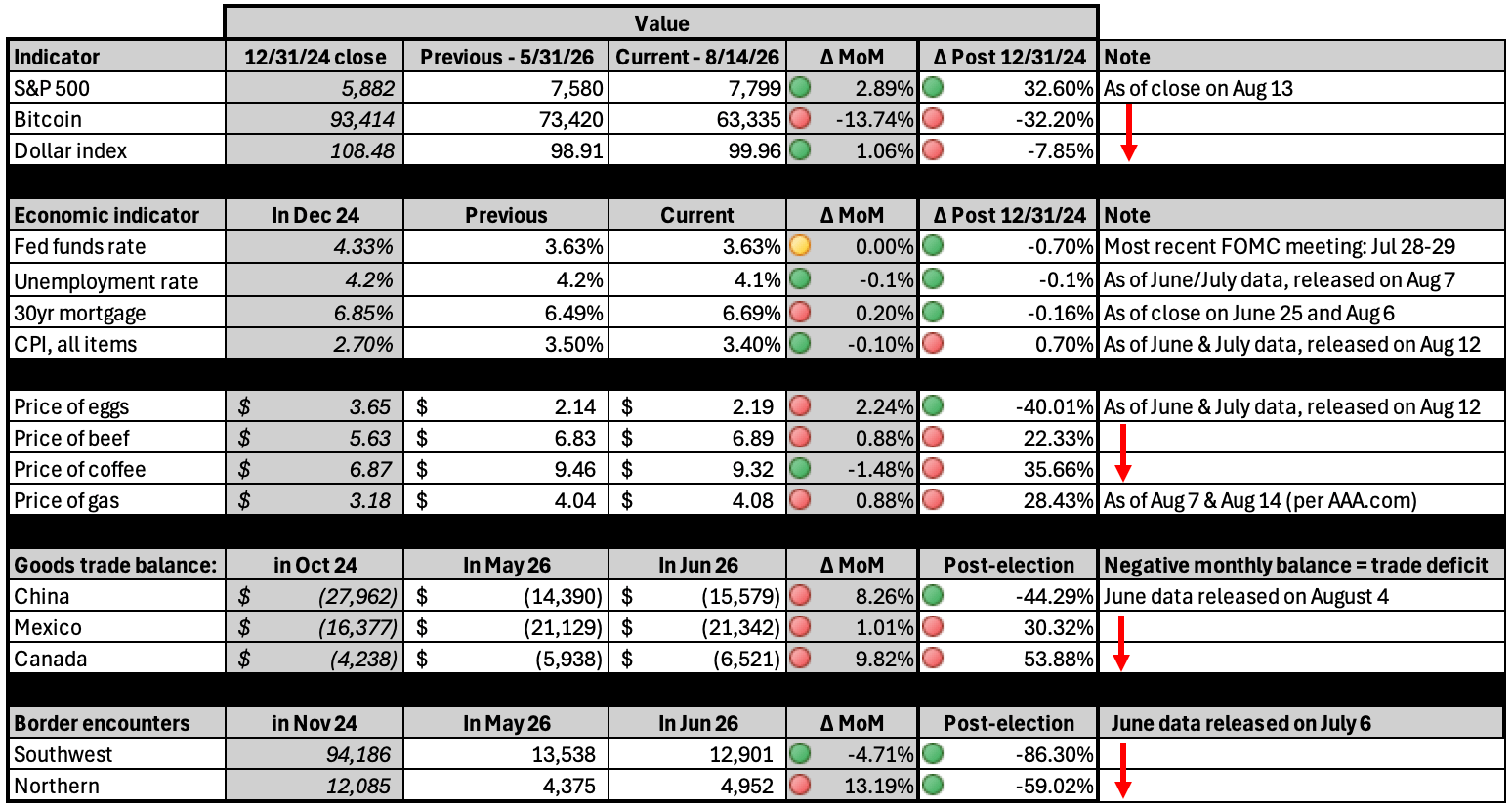
Green circle = indicator has moved in a positive direction
Red circle = indicator has moved in a negative direction
MoM change = month-over-month change
I would much appreciate it if you could hit the like ❤️ button!
It helps more people discover Nuance Matters and is a cost-free way to let me know you appreciate the work!
Encounters at the Southwestern border (June 2026, released on July 6): 12,901
Encounters along the Northern land border (June 2026, released on July 6): 4,952
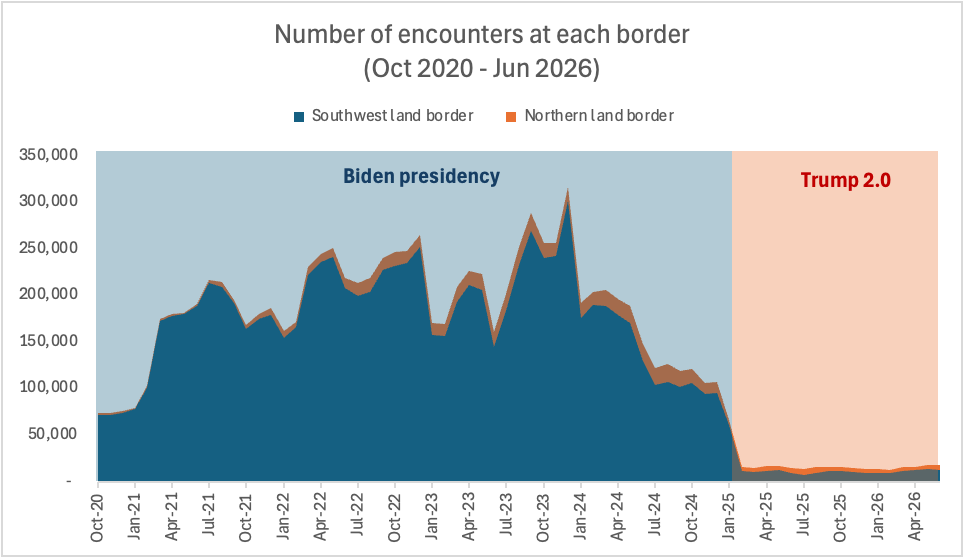
Source: US Customs Borders & Protection
***********************************************************************
At the end of June, the Supreme Court announced a couple of rulings that have a material impact on American immigration enforcement. The decisions in both cases, ruled 6-3 along ideological lines (the six Republican-appointees vs the three Democratic-appointees), went toward the side of a more restrictive immigration policy.
Asylum claims at the border: The first, Noem v Al Otro Lado, ruled that the Department of Homeland Security (DHS) could refuse to admit non-citizens at the border without hearing asylum claims. Obama had established limits in 2016 to stem a surge of Haitian migrants before Trump expanded this policy during his first term. Biden reversed much of this during his first term.
Deportation protection: The second, Mullin v Doe & Trump v Miot, ruled that the Trump administration could rescind temporary protection status (TPS) for hundreds of thousands of Haitian and Syrian migrants.
TPS was created in 1990 during the Bush Sr. administration as a way to provide temporary status to people who arrived from countries deemed unsafe because of ongoing conflict or a natural disaster. To receive TPS the grantees, who typically receive 18-month protection that can be renewed as circumstances dictate, must not have a serious criminal record.
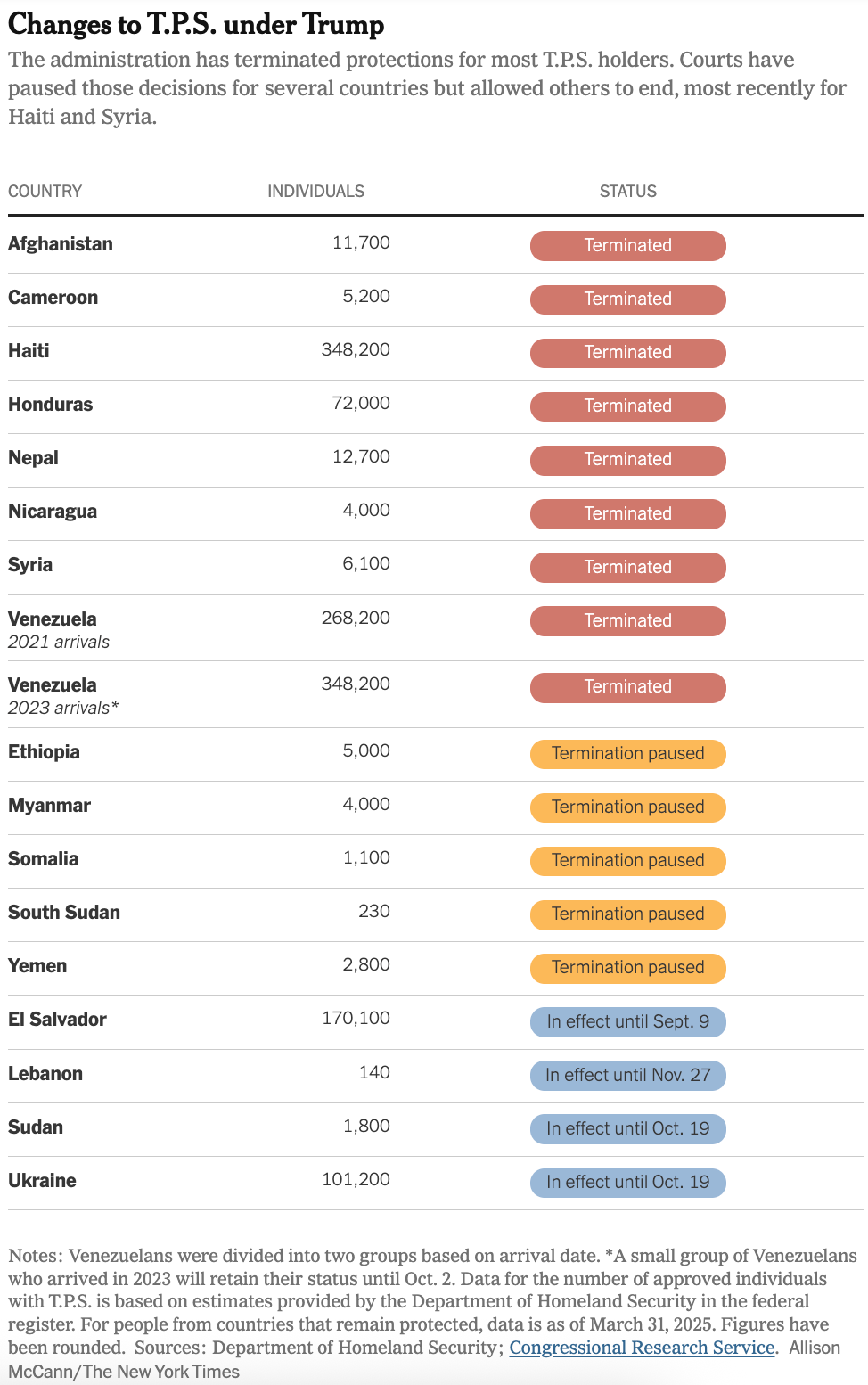
Haitian refugees were first granted TPS back in 2010 after a massive earthquake rocked the nation. More recently, rampant gang violence has further destabilized the country. Syrians were offered protection following the outbreak of civil war in 2011, which embroiled the country for well over a decade until the fall of Assad in late 2024.
Needless to say, despite uncertainty over how this ruling will be applied (e.g., the timing of the possible loss of work permits and any detention/deportation), the idea that hundreds of thousands of people who have been in the US for decades could suddenly be deported, sent a shock through the American body politic.
The human cost will be tremendous, nearly 350,000 Haitians across the country have lost TPS and are worried about what will happen next, and so is the economic. According to an analysis conducted at the Penn, around 70% of TPS holders participate in the US labor force, predominantly in health care and construction work.
What is interesting is that, thus far there hasn’t been much movement to enforce this decision, though how long that lasts when the administration is feeling pressure to act from the right remains to be seen.
Relatedly, ICE’s actions may have fallen out of the headlines, but they remain ever-present. After all, last month we had the murders of
Lorenzo Salgado Araujo in Houston, a 52 year-old Mexican who had been in the US for 35 years, shot by ICE during a traffic stop, and
26-year-old Joan Sebastián Durán Guerrero, a Colombian with legal status and a work permit, in Maine.
At the start of the year, DHS announced it had hired over 12,000 new ICE officers and agents. But with the pressure on to fulfill Trump and Steven Miller’s outlandish deportation targets, it is unsurprising that DHS did not conduct the most thorough and diligent background checks when vetting these ICE recruits. This was exposed shortly after the murder of Duran Guerrero in Maine, when the AP reported how the ICE agent responsible, David Brouillette, “has a history of terrifying and violent behavior” who has “struggled with serious mental health issues since early childhood and never should have been given a badge and gun to patrol American streets, several of his close relatives told The Associated Press.”
We received another visual reminder that ICE is still active and dangerous earlier this week when a woman recorded video of ICE agents stopping her at a parking lot in Virginia. After the woman yelled at the agents, they surrounded her car to force her to stop. They came up to the window, masked up, and one pointed a gun at her.
Birthright citizenship: The 14th Amendment in the Constitution guarantees citizenship to everyone “subject to the jurisdiction” of the United States (i.e. essentially everyone born in the States except for the children of foreign diplomats). It was ratified in 1868 shortly after the Civil War as a way to ensure the rights of formerly enslaved Black Americans. On his first day back in the Oval Office last year, one of Trump’s first actions was signing an executive order “Protecting the Meaning and Value of American Citizenship” declaring that kids born of mothers who are temporarily or illegally in the US are not citizens.
In Trump v Barbara, the court ruled in a 6-3 decision (three of the Republican appointees aligned with the three Democratic appointees) that Trump’s executive order limiting birthright citizenship was unconstitutional (though, notably, Justice Brett Kavanaugh dissented on the grounds that only Congress could limit birthright citizenship by enacting legislation).
Despite this judicial defeat, Trump is trying again. Earlier this month, he issued a new pair of executive orders designed to limit birthright citizenship. While part of the information included in the EOs simply reiterated the status quo (e.g., children of accredited foreign diplomats are not US citizens), they also stretched beyond this to exclude
Foreign government employees (who are subject to American laws and do not enjoy diplomatic immunity),
Alien enemies (those considered members of a designated Foreign Terrorist Organization or Specifically Designated Global Terrorist)
Mothers who engage in birth tourism (pregnant women who travel to the US in order to give birth to confer American citizenship to their newborn). According to the CDC, tourist births represent less than 2% of the ~3.6mn children born in the US every year.
Undoubtedly, the legality of these EOs will be challenged and end up in front of the Supreme Court. Based on past precedent, SCOTUS should rule against, but the fact we are having the debate at all further pushes the Overton Window when it comes to American citizenship.
Comments
Nothing yet. Say the first thing.
Sign in to join the conversation.