
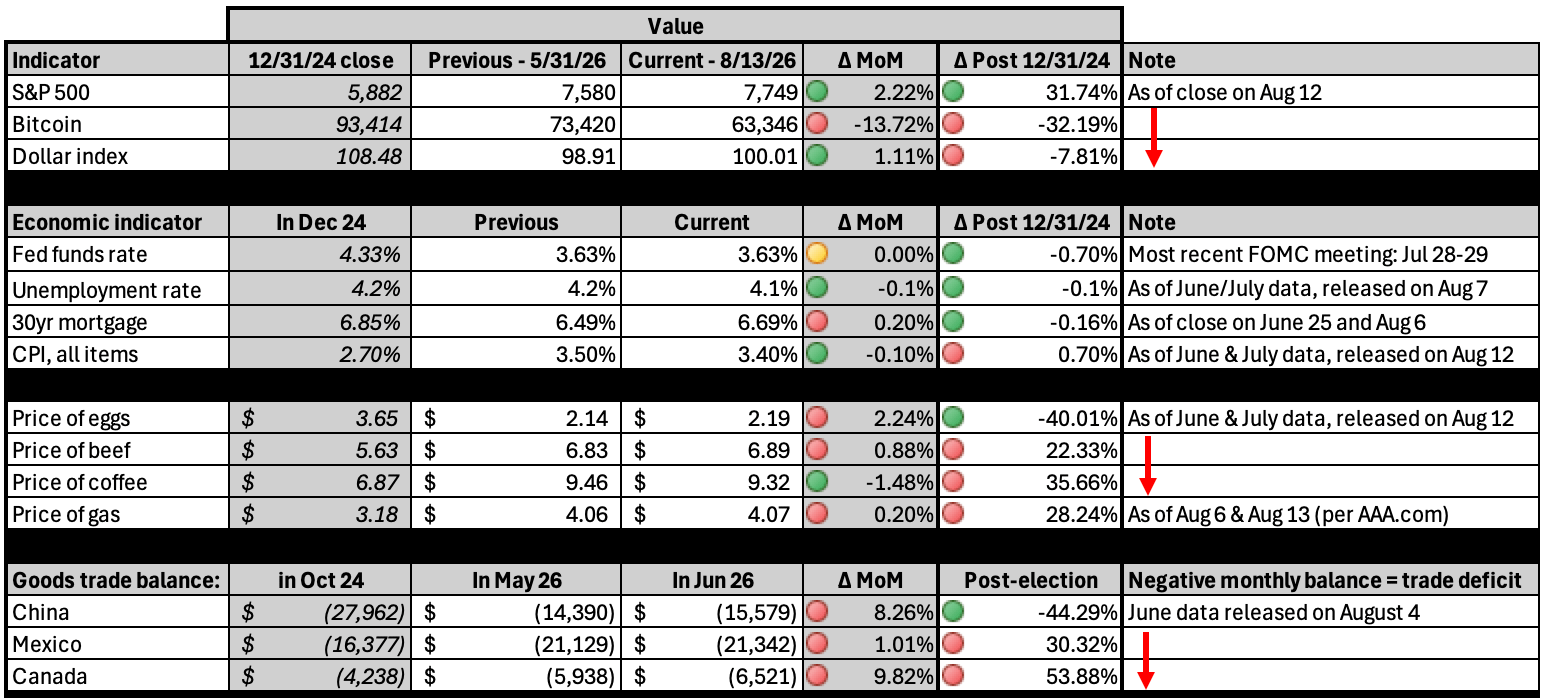
Green circle = indicator has moved in a positive direction
Red circle = indicator has moved in a negative direction
MoM change = month-over-month change
I would much appreciate it if you could hit the like ❤️ button!
It helps more people discover Nuance Matters and is a cost-free way to let me know you appreciate the work!
Consumer Price Index, all items (July 2026, released Aug 12): 3.4% 🟢
CPI, less food and energy (July 2026, released Aug 12): 2.5% 🟢
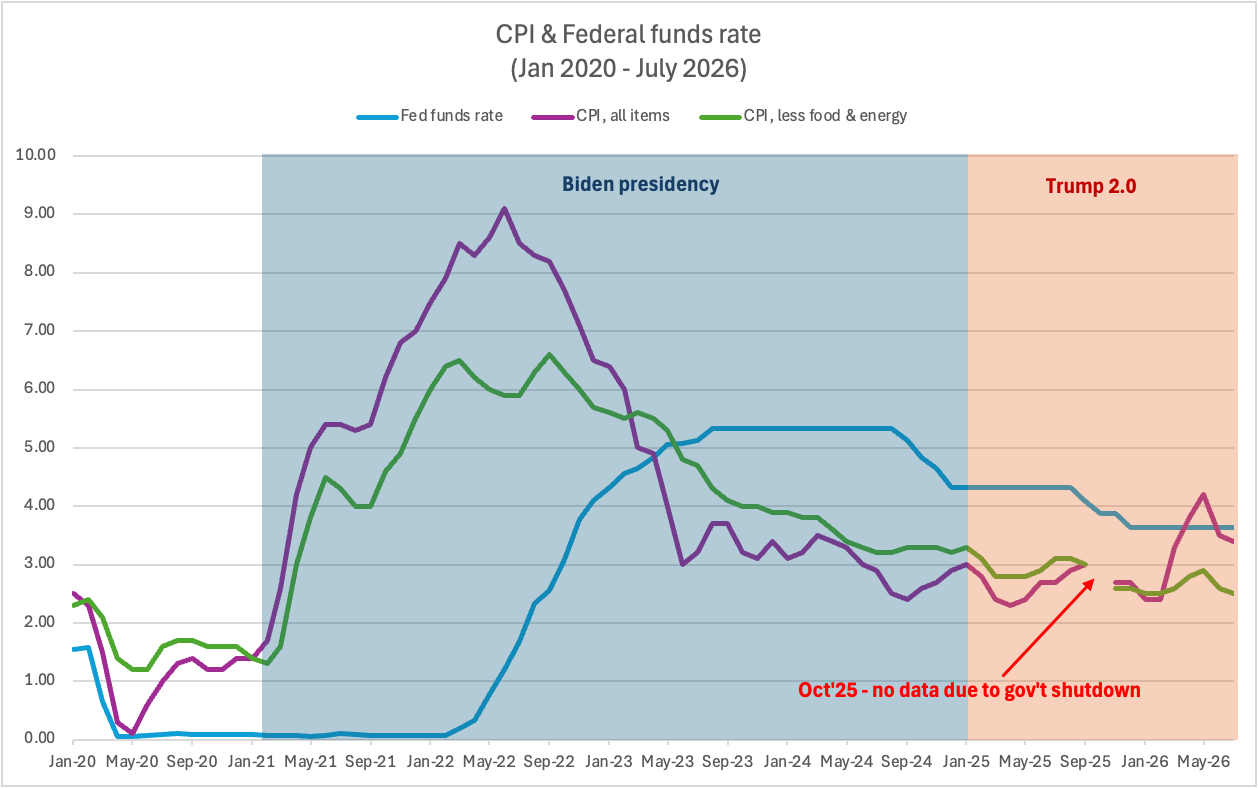
Source: Federal Reserve, St. Louis Fed & US Bureau of Labor Statistics
***********************************************************************
Yesterday the US Bureau of Labor Statistics released the July inflation data which indicated consumer prices rose 0.1% in July and are up 3.4% year-over-year, a slight fall from the June reading of 3.5%. So-called ‘core’ inflation, stripping out volatile food and energy prices, was up 2.5% year-over-year (down from 2.6% in June).
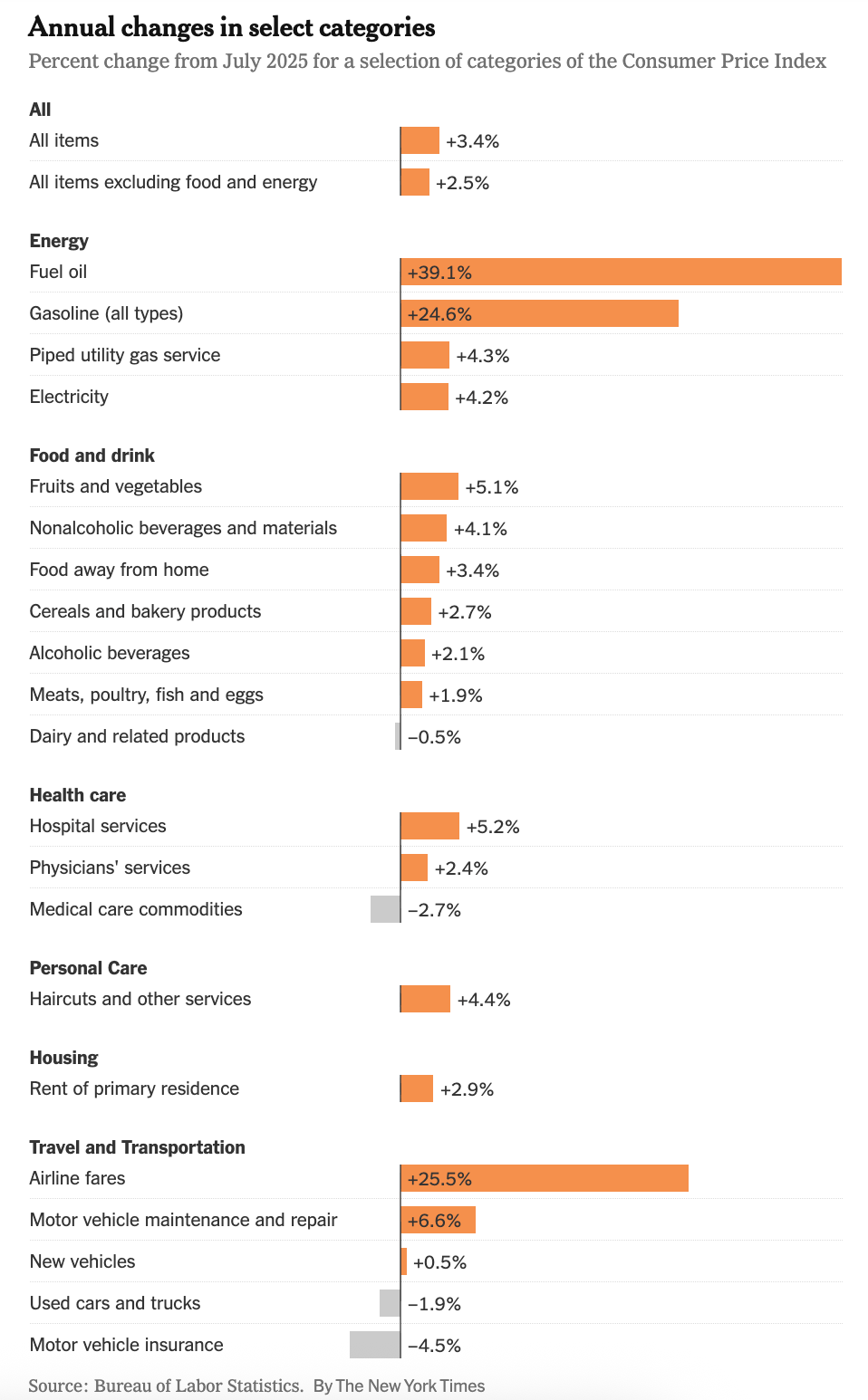
One commodity not listed above that had quite the month? Lettuce, the price of which fell 16% last month over fears stemming from the cyclospora outbreak.
This announcement was consistent with expectations, leading to a relatively muted investor response and further solidifying the view that the Fed will keep interest rates steady at its next meeting in September (though there is still a firm belief that rates will rise in October or December).
That being said, we will get August’s inflation reading before this September confab (consumer price report on September 11 v FOMC meeting on Sep 15-16) and with things still unsettled in the Strait of Hormuz and Red Sea, anything is possible!
More broadly, thus far the global economy has been able to rework supply chains around the war in Iran to mitigate the inflationary impact (though we should never discount the real-life impact this has had). Across emerging markets this has been far less impactful, on a purely inflationary basis, than the post-pandemic + Russia-Ukraine war surge.
But if the Houthis close the Bab el-Mandeb, that could force shippers to pay higher fees to transport shipments further distances and make efforts that much more difficult.
One other global event worth watching is the rapidly strengthening ‘super El Niño’ event. The European Central Bank recently calculated that a strong El Niño historically hikes global food prices by 9% as crop failures are more common and fishing yields fall. While the World Bank is warning that food prices could rise, there is some optimism that the world is better prepared to withstand this sort of event thanks to massive stockpiles of key foodstuffs like rice and what.
But when you couple this with the uncertainty in the Middle East and the ongoing war in Ukraine, which have already impacted global fertilizer production, it is clear the system is being stretched.
Avg price of eggs (dozen, Grade A, Large) (July 2026, released Aug 12): $2.19 🔴
Avg price of ground beef (July 2026, released Aug 12): $6.89 🔴
Avg price of coffee, ground roast (July 2026, released Aug 12): $9.32 🟢
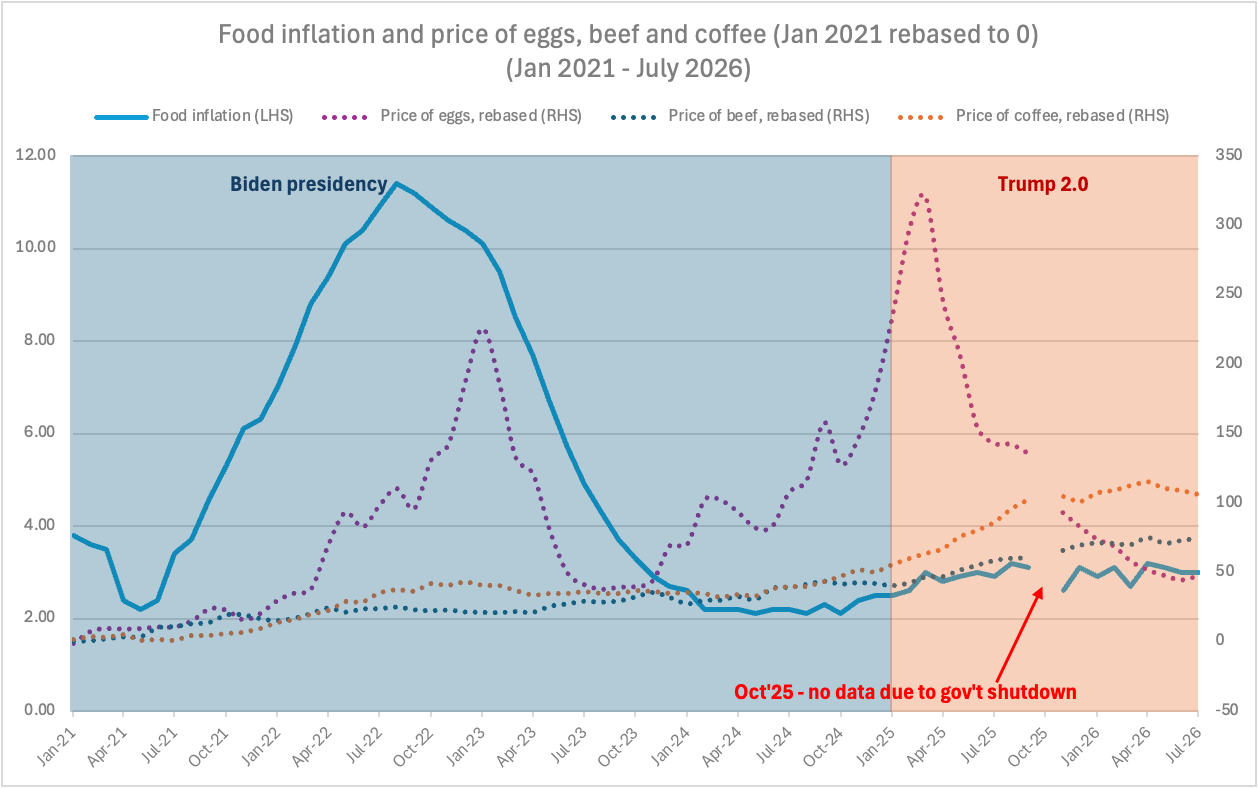
Sources: US Inflation Calculator (food inflation) & St. Louis Fed (price of eggs, beef and coffee)
***********************************************************************
Back in the spring of 2025, a group of US federal and state authorities filed a lawsuit against three Big Egg companies (Cal-Maine Foods, Versova, and Hickman’s Egg Ranch) alleging that between June’22 and Mar’25, these three worked together to artificially inflate the price of eggs.
As you can see in the chart above (dotted purple line), the price of eggs fell considerably between March and April 2025 after the news broke that the Department of Justice was conducting an initial investigation.
Prosecutors alleged that, while the avian flu that had worked its way through the chicken population had indeed impacted supply, Big Egg executives had secretly colluded to collectively exploit this shortage. As the Financial Times nicely lays out, the executives bid up the price to Urner Barry, a pricing service, causing prices to remain higher. All the while, the companies were telling shareholders the price hikes were due to the avian flu.
In September 2022, Cal-Maine told investors egg prices had risen because supply had tightened due to bird flu and customer demand. Its conventional egg-selling price had more than doubled from a year earlier.
A little more than two weeks later, according to prosecutors, a Cal-Maine executive texted the chief executive of rival Hickman’s Egg Ranch: “We are bidding up. Let’s hold it today.”
By mid-October, the complaint alleges, bids from Hickman’s and Cal-Maine accounted for more than half of all bids submitted through Egg Clearinghouse, an exchange used in the wholesale market. The bids succeeded in keeping prices from falling, with a Cal-Maine executive texting Hickman’s chief executive: “No change.”
In December 2022, as Cal-Maine reported record quarterly sales and net income, Miller said the market faced record prices for conventional eggs “primarily due to reduced supply” related to bird flu.
At the same time, the company acknowledged there had been no positive bird flu tests at any Cal-Maine-owned or contracted production facility. And on December 20, Hickman’s chief executive allegedly urged senior executives at rival producers to post “strong bids, early and often”.
Two months ago (June 2026), Big Egg agreed to settle the case. As part of the terms of the settlement, the companies agree to collectively donate more than 50mn eggs to food banks and non-profits1 and pay $3.3mn in damages to the states involved.
Despite this settlement, which is pending court approval, none of the companies have admitted any wrongdoing.
**************************
Step back to 2022-24, a time when the US (and the rest of the world) was dealing with soaring inflation. And people did not like it at all!
Inflation isn’t the sole reason Trump was re-elected, but it tops any list…and the price of eggs was a big factor.
So the question must be asked: Is this act of collusion, which netted the family behind Cal-Maine over $320mn after they sold their controlling stake last year, why we are where we are today?
We’ll never know the answer, but it certainly makes one think about unintended consequences. At the very least, they owe the American public and the rest of the world a bit more than $3.3mn in damages.
Comments
Nothing yet. Say the first thing.
Sign in to join the conversation.