
Longtime readers will know I enjoy writing about leadership races from the recent federal NDP and federal Liberal contests to the upcoming Ontario Liberal race. I’m even following the current Green Party leadership race - a contest that you almost certainly weren’t aware started last week.

Alex Kohut@KohutAlex
The Green Party of Canada leadership race (which is currently ongoing!) has an application form that asks potential candidates to disclose any accounts they have on DeviantArt or Club Penguin
9:44 PM · Jun 20, 2026 · 63.3K Views
14 Replies · 59 Reposts · 831 Likes
The more I’ve looked into these races with their dramatic storylines and idiosyncrasies, the more I’ve wondered about who chooses to enter a leadership race and what barriers might be stopping quality candidates from running for these positions.
After all, almost anyone can put up their hand and run for the leadership of their political party, but not many of the prominent politicians we associate with each federal party actually run for the top job at any point in their careers.
Most leadership races in the modern era feature two or three highly credible candidates, a second tier of politicians building a resume for the future and a surprising number of virtual unknowns who often don’t even make it on a ballot, but who prove the leadership process is more accessible than people often assume.
I recently created a database of every person who has declared themself a candidate for the leadership of a federal party in a membership vote contest since 2000.1 This includes 129 total candidates over 13 contests, although only 73 of those candidates (57%) were listed on the final ballot in their races. The other 56 candidates either withdrew during the campaign or failed to meet ballot criteria, including at least 10 who were denied access to the ballot due to vetting concerns.
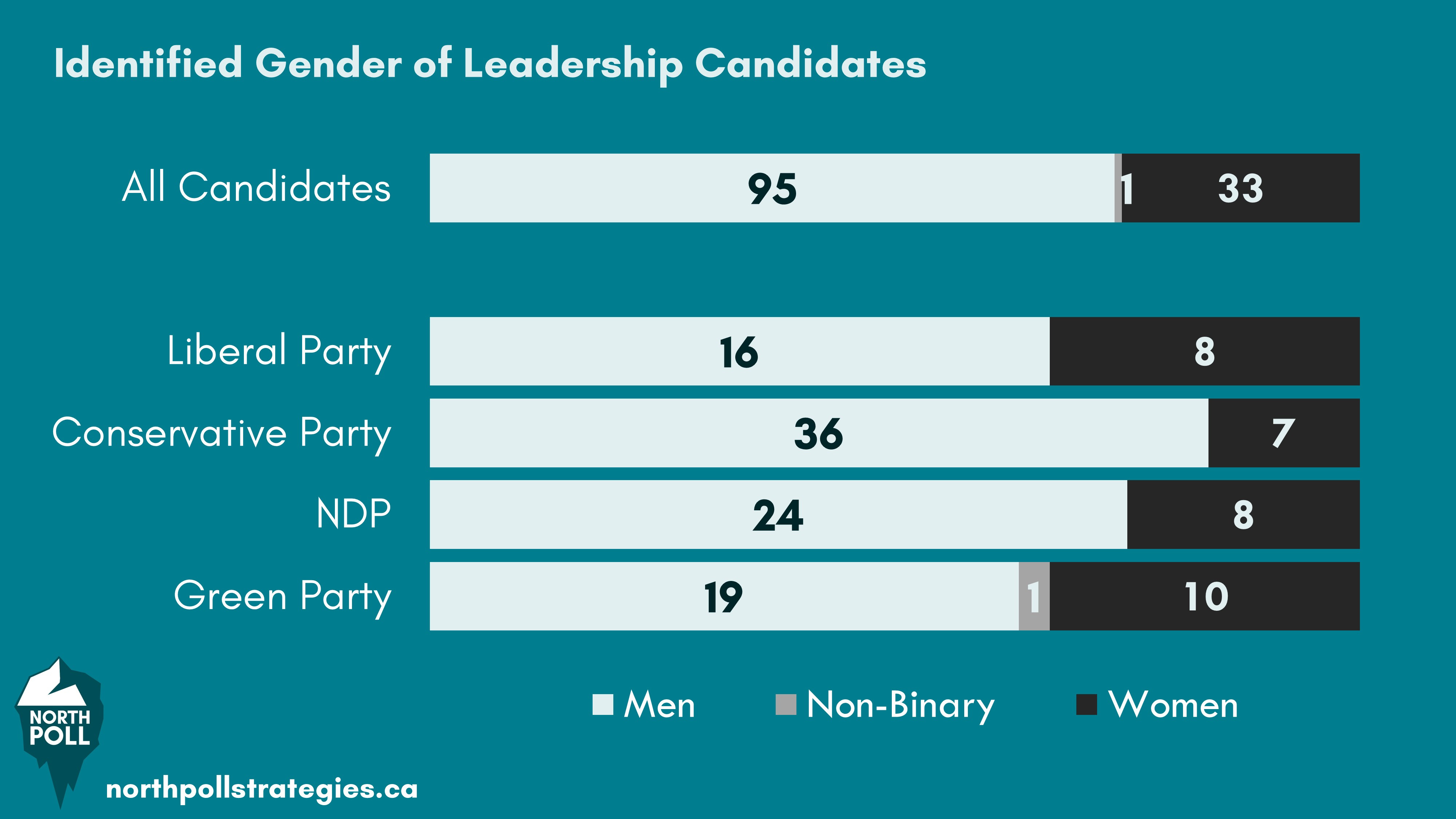
The undeniable first stat that jumps off the page when the candidates are listed together is the stark disparity in the identified gender of leadership candidates. Almost 3-in-4 leadership candidates (74%) have been men, and this rises to 84% of all candidates for the Conservative Party’s leadership in recent years.2
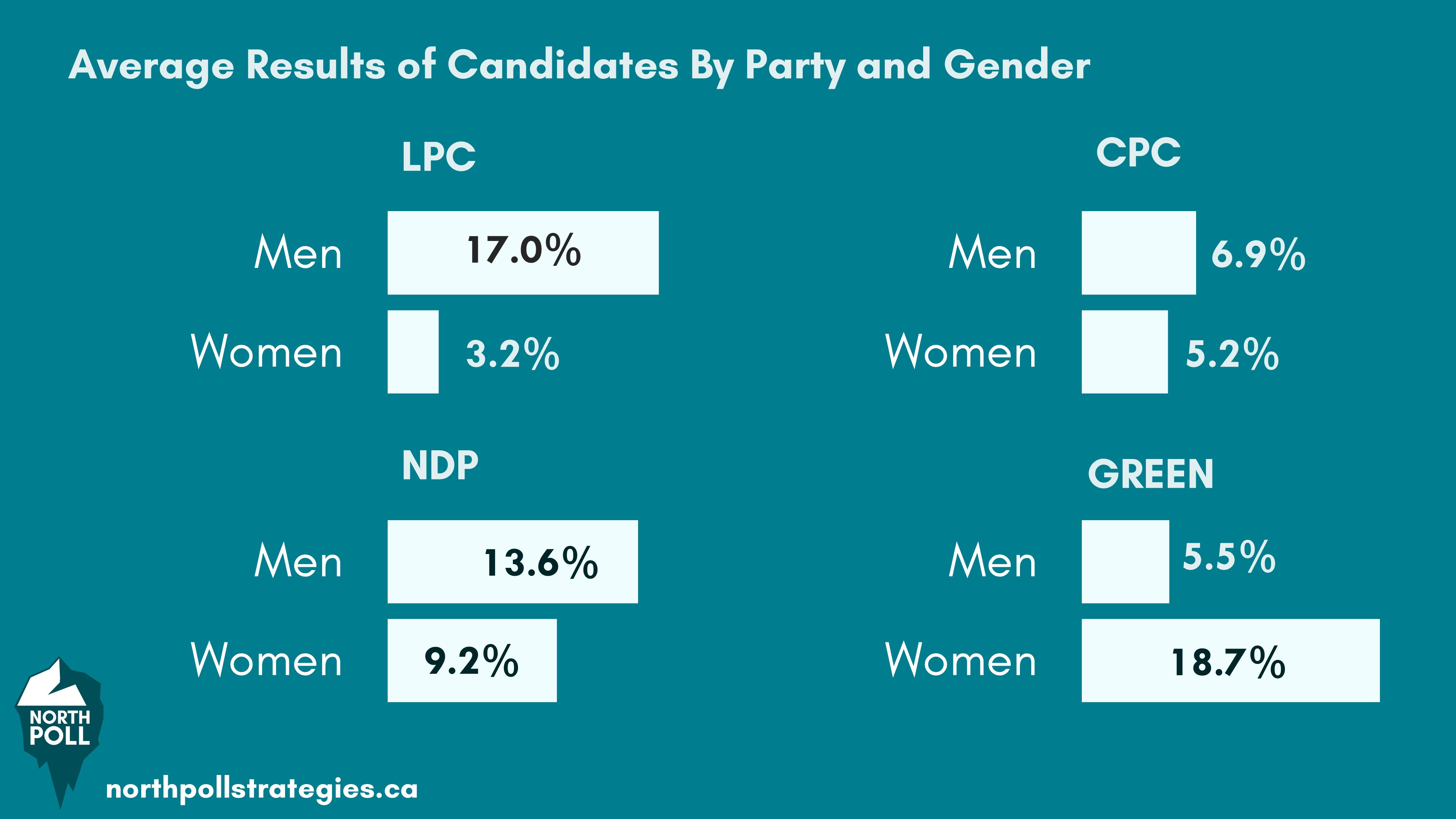
While more men run for these positions, the average result of men and women who launch campaigns is virtually equal, with men and women candidates each averaging 10% popular support on the first ballot of these races.3
While this seems promising and suggests more women leaders will result if more can be encouraged to run for the top jobs, the results are less equitable among the major parties, and the Green Party membership is far ahead of the other federal parties when it comes to actually voting for female leadership candidates (including Elizabeth May and Annamie Paul).
Men (17.7%) also perform slightly better than women (14.0%) among the candidates who actually make it to the final ballot, which leads us into the second major gender difference in the data: Men are far more likely to run campaigns that don’t reach the finish line.
Among the 73 candidates on the final ballot, only two-thirds (67%) are men, while more than 4-in-5 (82%) of the candidates who drop out identify as men. While women are less likely to enter these races, they are far more committed to seeing them out once they have joined and/or far less likely to launch a campaign if they aren’t confident they can reach qualification requirements.
This follows a larger pattern in politics where women aren’t always forgiven for public losses the way men can be. The vast majority of the losing women candidates on this list left electoral politics shortly after their failed leadership campaigns (i.e. Chrystia Freeland, Lisa Raitt, Deborah Coyne, Kellie Leitch). Meanwhile, male candidates like Erin O’Toole, Maxime Bernier, Bob Rae and Charlie Angus were elevated to larger roles in their respective parties after their losses, with two of them becoming future party leaders.
If we want more women to succeed in politics, we have to allow more women to fail in politics too.
The average age of leadership candidates is 50.4 years, with men who run doing so at a slightly older average age (51.3) than women (49.8)4
The average age of candidates for the three largest parties is over 50, while Green Party candidates are much younger at only 44.3 years.
Younger candidates perform worse in leadership races, with candidates aged 45 and under averaging only 7.6% of the vote in their contests (15.6% among those who make the final ballot).
Among candidates who make the final ballot, those over the age of 55 tend to perform the best (20.1% on average), although older candidates are also significantly more likely to drop out before the voting occurs.
But all of this is is a relatively small sample size - let me know in the comments if you would like me to expand this analysis to provinces and see how the trends hold over a larger database of contests in different contexts!
I excluded contests that were decided under the old delegated convention format that the major parties used into the early 2000s. I also excluded the Bloc Quebecois from this analysis as they are not a national party and have had less contested leadership contests in recent years (their last two leaders were acclaimed with no other names on the ballot).
The 2017 CPC leadership race only reported results weighted by riding, but I have used popular vote numbers when analyzing all other races (including the 2003 NDP leadership race where I have only used the membership vote numbers, excluding the 25% of the result based on special labour delegates).
Finally, while I did include Green Party leadership races in this analysis, I excluded the 2025 Green Party co-leadership election, which can be better classified as a referendum on co-leadership than a formal leadership race.
The one openly non-binary candidate is Amita Kuttner, who later became the first non-binary leader of a federal party when they became interim leader of the Greens in 2021.
In this calculation, those who dropped off before the final ballot are credited as receiving 0%. More on this later in the post.
I was only able to find the ages for 114 of the 129 candidates, as some of the fringe candidates have limited information available about them online (mostly Green leadership candidates who dropped out before the final ballot), Those candidates are excluded from this average.
Comments
Nothing yet. Say the first thing.
Sign in to join the conversation.