
It’s impossible for me to overstate how privileged I feel to have been able to work closely with Elise Maiolino during her time at the Prime Minister’s Office.
There’s two outcomes for most people who enter political staffing - either politics changes you or you change politics - and Elise has been the latter from the moment she walked into the door at PMO. Elise took a leap of faith leaving academia to become the first ever Senior Gender and Diversity Advisor at the PMO and was a key architect of the government’s feminist agenda without ever losing sight of her exceptionally positive and optimistic approach to politics.
Whenever I proposed projects to survey staffers and advocate for changes in workplace culture she was the always my first and most enthusiastic collaborator, and I will forever be grateful to her for that. It’s rare to find voices in politics so steadfast in bringing compassion and kindness to both policy and the offices that make those policy decisions.
More recently she has been running the Ontario Liberal leadership campaign of her partner, Dylan Marando.
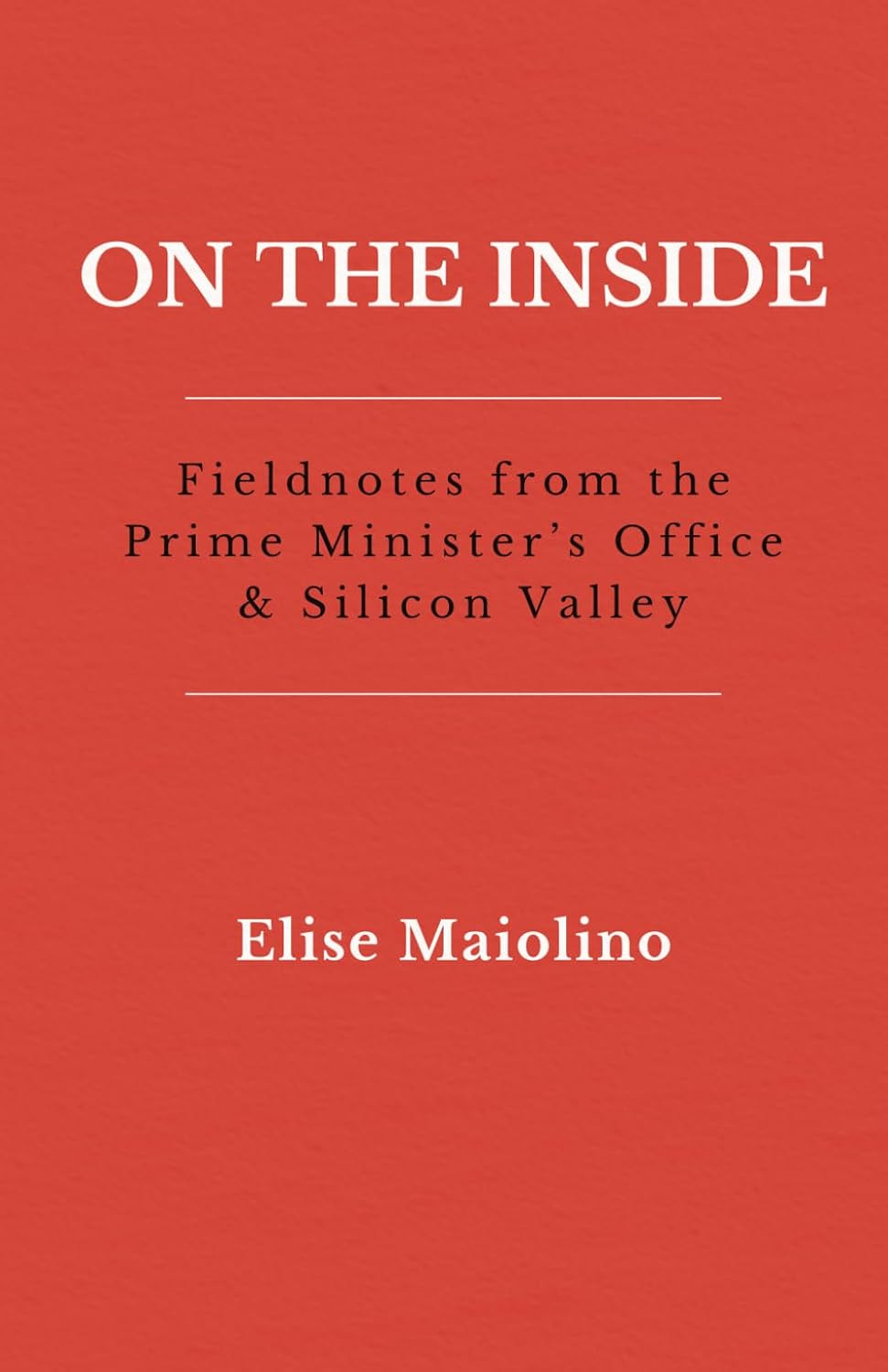
I managed to steal some time from her busy schedule to sit down and talk about her new book “On The Inside,” which is easily one of the best accounts I’ve seen about what it was like to practice politics in the Trudeau era and gives an excellent account of the behind-the-scenes processes that led to some of the key policy accomplishments of that government.
You can (and should!) buy her book here.
AK: For those who don’t know you, who are you and what has been your political journey so far?
EM: Well, I am a sociologist by training, so I did a PhD in sociology at the University of Toronto. That is also where I did some teaching in the sociology program and in the public policy program. I spent four years in the Prime Minister’s Office as a senior gender and diversity advisor and following that I went on to be the global head of women’s safety policy at Uber, which took me to San Francisco and Washington DC. And then I decided to write this book.
So that’s a bit about my background, but I would say what’s not on my LinkedIn or what you don’t really know about me is that I’m also a granddaughter and a daughter and a partner and a sister and that informs who I am and was formative to the work that I did in politics and do in politics just as much as my education and as much as my titles. I wanted this book to convey that too. I think politics is very personal and the personal is very political and so for me separating those two things just doesn’t make sense.
AK: I was really struck by this excerpt from the prologue that I felt was a beautiful thesis statement for your book and an apt description of the way you approached politics in all of our interactions:
“[…] my way became the way of soft power. A subtle, resilient, often underestimated form of service that I practiced and witnessed in the rooms where decisions were made. The kind of power that isn’t celebrated in performance reviews or typically written about in business-y books but comes from listening, being kind, loving trial and error as much as trial and triumph, and refusing to become hardened by environments that can reward cynicism over care”
It’s unfortunate that kindness can sometimes be treated like a radical tactic in a political world that has become so cynical, and I love that you are challenging that perspective. Can you explain why you feel so strongly that kindness and empathy can be a tool that helps accomplish change in politics?
EM: I wish I could say that my approach to soft power or kindness is something that I cultivated, but I do think it was taught to me from a very young age by teachers and parents and family. I think that those are values that were instilled in me by the people that raised me.
That being said, we all have these two voices inside of us - we have the voice that is telling us to do good things and to be kind and then the other voice that’s telling us to be angry, and I think you really do need to choose which voice you are going to listen to. It’s a choice, and in my experience, choosing to listen and choosing to be kind just always led to better outcomes.
I think there are these narratives around being tough and combative, which suggest you need to be those things to get stuff done, especially in powerful spaces such as politics or in tech, but in my experience that’s not the case.
In my experience when I was nicer to people not only did I enjoy my job more and I enjoyed the people that I engaged with and interacted with, but we were all more likely to do good work together and to try to be the best versions of ourselves.
So for me I really hope that this book challenges that dominant belief and gives some oxygen to this idea that politics doesn’t have to be a tough mean aggressive space - there’s some really amazing people who are doing great work like you who are really kind and wonderful and those are the stories that I think need to be told.
AK: Do you have any examples off the top of your head of things where that approach kind of made something a little bit easier to do?
EM: Child care is a good example. Our national child care program doesn’t happen if people don’t trust you. If advocates don’t trust you, stakeholders don’t trust you, if you don’t take the time to build relationships that are built on kindness.
So I think in order for us to have gotten stuff done like child care in government, you had to have invested the time and the energy into relationships both within and outside of government so that you could work together to get the job done.
AK: The story of how you reached out and created an opportunity for yourself at the Prime Minister’s Office is quite inspiring, especially as it resulted in a role that had never existed before. What is your advice for other subject matter experts who want to bring their knowledge to make a difference in politics but don’t know where to begin?
EM: To experts, I would say don’t wait for governments to come to you. In my view, we need people who are experts, who have a skill set that is useful to our democracy. We need them to come forward and to knock on doors and by that I really mean reaching out, putting up your hand and saying I’m here to help. For me there’s a lot of doors I knocked on that didn’t open. I didn’t get into law school, I applied for other jobs in academia or other jobs on parliament hill that I didn’t get and I just kept knocking.
I could have said well I didn’t get the job in the senator’s office so I should lower my expectations. Instead of that, I said no I’m going to try the prime minister’s office and I think you just have to keep at it and keep going because we really, really need people who have expertise to come forward and help us get this work done for the sake of the country, for the sake of democracy, for the sake of society. And so I would say keep raising your hand keep knocking on the door and keep saying you’re willing to do the work.
AK: It was illuminating to see you demystify binder review meetings in your book. Can you explain to readers what those meetings are and how information gets filtered up to the Prime Minister for decisions?
EM: Binder review was something that I knew nothing about before coming into government. Every government probably has a system that plays a distillation function but might look a little bit different depending on what government you’re working for.
In my time, binder review was exactly what it sounded like: we literally reviewed binders. The chief of staff Katie Telford and the principal secretary, Gerald Butts would go home with binders that were nearly identical to the binders that the prime minister would eventually take home. Inside those binders were the decisions that the PM needed to sign off on. Many of which were written by the public service, but those notes did not go to the prime minister without some kind of cover note, an executive summary of sorts with advice from political staff.
Binder review gives us some insight into what political staff actually do and how important their job is. We needed to decide if the PM had all the information he needed to make a final decision. It was the last check. People in that meeting often represented different teams from the Prime Minister’s Office. They helped to make sure that we weren’t missing anything and that we had included the best quality advice or the PM.
Often the work of a political staffer is bringing together different inputs and pieces of information. It’s really important work.
I’m not sure people on the hill even knew their work was going through that process, so in my book I wanted to convey a little bit about what it’s like behind the scenes. It was a a really fun meeting to be a part of but also extremely intense because the stakes were so high, and I tried to capture that mood in the book. Sweaty armpits, pages quickly exchanging hands, a quick bite of a burrito covered in hot sauce between sentences.
AK: People should buy your book to read your full account of the behind the scenes process that led to the $10/day childcare program, but I want to dig into what lessons we can learn from that experience. In your mind, what does the story of the early learning and childcare policy tell us for how staffers and advocates can advance bold progressive ideas in Canada?
EM: For me I think the experience of working on $10 a day child care was a really powerful lesson about how leaders can evolve and leaders can change their minds. If you haven’t yet read the book and you don’t know the story behind early learning and child care, I will just say that the government I was a part of did not have early learning and child care as a top priority when they came into government, but when we left government early learning and child care was one of our biggest legacies. Early learning and child care is provincial jurisdiction and, therefore, it’s not an issue that federal governments have led on, historically. But there was an opportunity, as a result of COVID, to explore what a federal government could do for early learning and child care. The the Prime Minister, who had previously not taken major action on that policy, decided to make a decision that would impact the lives of women and children in Canada for generations.
So I would just say that for me, childcare is an example of how good leaders can evolve and change their mind, and I just give the PM so much credit for doing that; I was so impressed. I think I would also say that work could not have been done without advocates and without stakeholders who actually knew what needed to be done in Canada in order to get to ten dollar childcare, in order to cut fees in half for parents across the country. That only happened because they were patient with us, because we developed relationships with them over many years, and they stayed with us.
If you’re a political staffer wondering what to take from this, I think it’s to keep being patient, keep pushing our leaders to evolve. I’m really really hopeful that the legacy that we have in childcare keeps getting talked about because I think that we need continued investment from the feds and from provinces and if we don’t talk about it we’re not going to get those investments.
AK: We had a unique experience that I’m planning to talk more about on my Substack soon where we got to survey Liberal staffers across Parliament Hill and investigate questions of training, workplace culture and inclusivity. When you reflect on the project and its findings, what stands out to you?
EM: I think one of my biggest takeaways from our experience interviewing political staffers was that we were part of a really talented really important community.
I think we take political staff for granted and we put a lot of expectations on them. They make a lot of sacrifices, they work long hours. I think we underpay them, which is a really sad thing because money often indicates that you matter to someone.
And so for me, I feel strongly that we need to invest more in our political staff. The cruel irony of that treatment is that it’s often other political staffers who hold staff back. That kills me because we really shouldn’t do that to each other.
Over the last couple of months, I’ve been helping to run a leadership campaign for someone who was a political staffer, for someone who worked for two premiers and a prime minister. And sometimes this candidate still gets questioned about whether he has enough experience to actually be the leader of a political party. And, occasionally, it’s political staff themselves who are asking the question. I think it’s a strange sentiment because it suggests that political staffers think of themselves as second-class citizens. But we’re not!
I’m not trying to say that we’re more important than other members of the political system, but we certainly aren’t less important. We have to start saying that more.
AK: I feel like every government runs into this problem over time - you get 10 years into a mandate and then suddenly the original group of staffers that are so talented and have learned so many things are all out the window at that point because it’s just not sustainable to be there.
EM: Yes. People don’t value the human capital that leads to these successful governments.
AK: In your opinion, what is the most important thing that should be done to improve the workplace culture on Parliament Hill?
EM: I’ve been off of Parliament Hill for about five years now, so I can’t speak to what is happening on the Hill these days, but two things come to mind that I hope apply to any government. The first is to pay political staffers well.
I believe strongly that paying staffers well tells them that you value their work. Political staffers sacrifice a lot personally to do the jobs they do, they work long hours, and do work that isn’t always celebrated but has immense impact. . We need to make sure they know their worth, that they are motivated, and stay in the job. so It seems like such a clear win-win. The second would be to invest in the careers of staffers coming out of politics. Most staffers won’t be in the role long term.
One of the reasons I wrote about my time at Uber was to provide an example of what life looks like after politics. - I went on to work for a global technology company, working on corporate safety policy. Not something I assumed would have followed my time on the Hill. Folks might think they’re going to end up in a government relations role and that’s great, I’m not suggesting it’s not. But there are a lot of jobs that you can do coming out of politics. You’re building a skill set that we need to be selling to other people. I was able to do that in the corporate setting that I moved to and they appreciated that. It was a great fit and I want other people to feel like they have the support they need to enter a rewarding job after politics.
AK: Do you have any other advice for staffers?
EM: Take your shot, and don’t worry about failing. If you’re failing, it might actually be a sign of success, so keep at it. No one else can take it for you.
Comments
Nothing yet. Say the first thing.
Sign in to join the conversation.