
I recently took a tour through the Hansard database of words spoken in the House of Commons to see how Liberal and Conservative messaging has shifted in the first year of the Mark Carney government compared to the final term of Justin Trudeau.
The results tell one story of dramatic messaging changes, and one story of a party that has failed to adapt to the moment.
Note: for all of the word clouds below, I have excluded common non-meaningful words like “the” and “and”, as well as the phrase “Mr. Speaker” that begins all remarks.
Mark Carney’s first year in office has ushered in a significant shift in the language coming from the Prime Minister’s Office. The following word cloud summarizes everything the current Prime Minister has said in the House of Commons since elected just over one year ago:
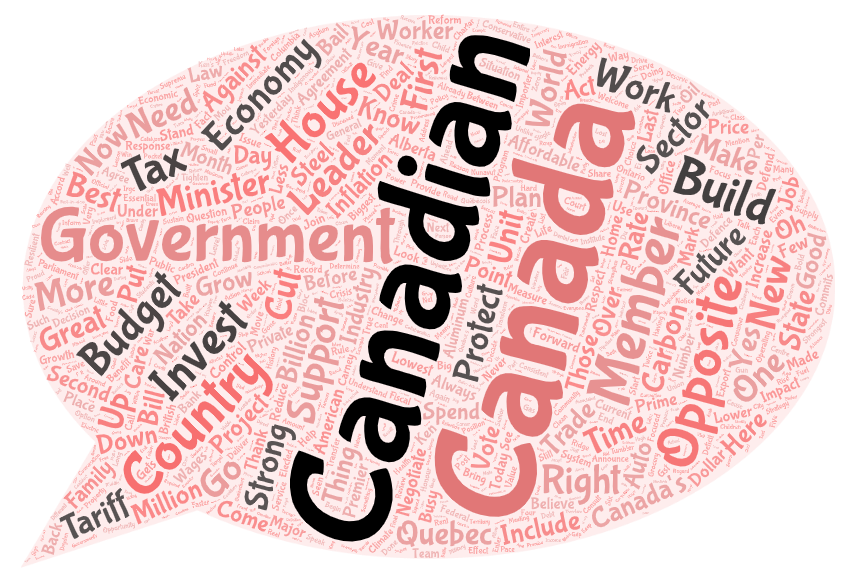
As the word cloud illustrates, the former banker has been very focused on economic issues, reflecting the priorities of Canadians in recent public opinion polls. Carney talks a lot about his promise to build a stronger Canada and uses most of his speaking time to talk about the government’s economic plans.
By contrast, here’s a word cloud summarizing the language used by Justin Trudeau during his last term in office (2021-2025):
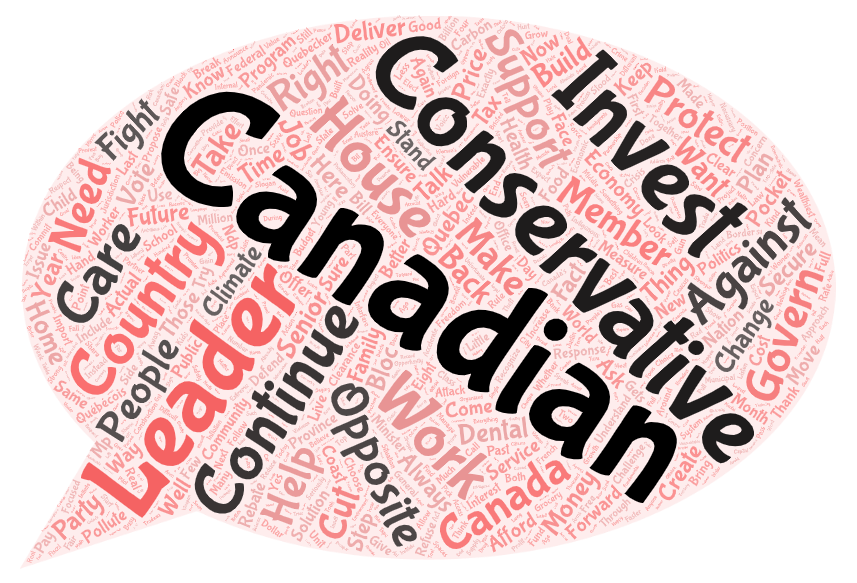
There are some similarities: both Prime Ministers use the word “Canadian(s)” more than any other in their interventions and both emphasized investments with their speaking time.
However, Justin Trudeau’s language in his final years in office was far more confrontational. The former PM was far more likely to mention the Conservatives in his remarks and contrast government policy against the rhetoric of the opposition.
Trudeau was also more likely to use emotive language like “fighting” for priorities and “standing up” for values, and he discussed a much broader range of issues in the House than Carney has, with particular emphasis on climate change, health care and dental care.
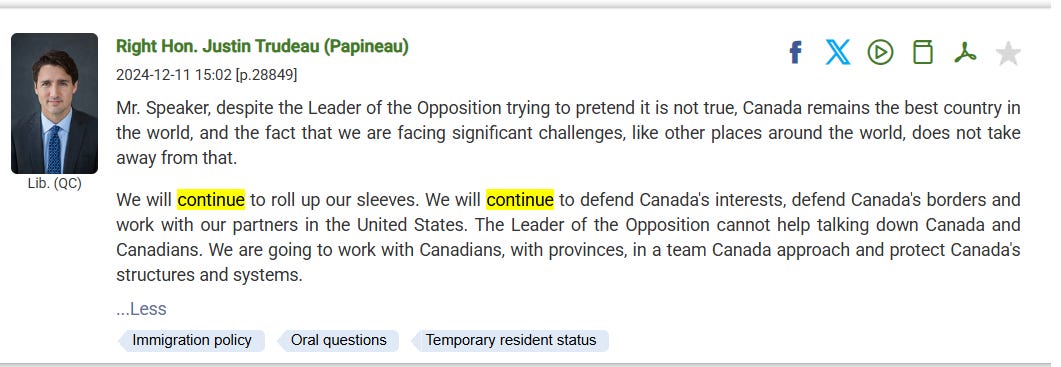
Finally, Trudeau’s final years in office saw a heavy use of the word “continue” both from the PM and his key Ministers. This tends to be a crutch word leaned on by long-in-the tooth governments who find themselves constantly defending their past record, but it is hard to improve public opinion of your leadership when constantly emphasizing continuity in a government agenda that is no longer popular.
While the messaging from the Prime Minister has shifted, Poilievre and the Conservatives have remained consistent in their messaging.
Below is a summary of the language used by Poilievre in the House from the beginning of his leadership in September 2022 up to Trudeau’s resignation in January 2025:
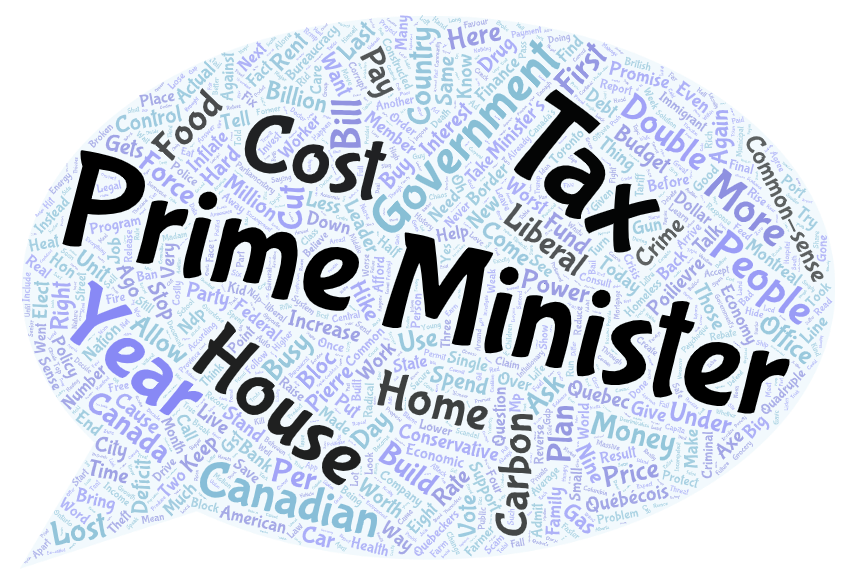
During that time period, Poilievre was laser focused on three things: the carbon tax, the cost of living and criticizing the Prime Minister himself. His party’s message discipline was effective and helped hasten Trudeau’s resignation among poor poll numbers, but his inability to shift messaging to counter the appeal of Mark Carney has hurt his party ever since.
The word cloud below shows Poilievre’s language in the House of Commons since the 2025 election, and looks quite similar to the one above:
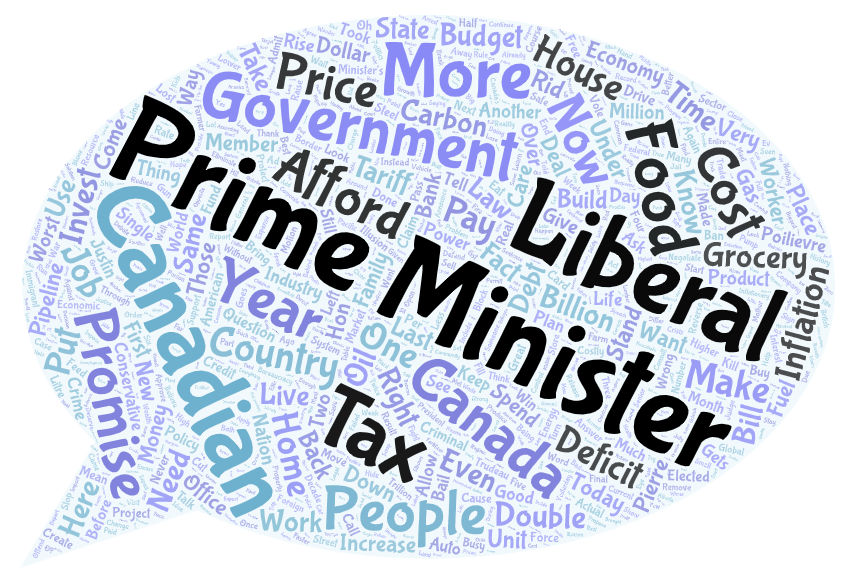
Poilievre’s top priority continues to be attacking the Prime Minister in the House of Commons, although he has shifted a bit more towards referencing the “Liberal” record as a way to tie Carney to actions from the Trudeau era.
He continues to use his speaking time to hammer the government on the cost of living, affordability, and even the carbon tax from time to time despite Carney’s cancellation of the policy.
However, Carney isn’t blamed for those issues the way Trudeau was, leaving Poilievre arguing with the ghosts of Liberals past instead of building a case against his current opponent.
If Poilievre wants to recover in the polls and pose a genuine threat to Mark Carney in the next election, he needs to stop campaigning against Justin Trudeau and find new language that draws a contrast against the current government.
Kevin Lamoureux (Lib - Winnipeg North) is not only the MP who has spoken the most since the 2025 election with 1988 interventions, but he has now surpassed former speakers Peter Milliken and Andrew Scheer to become the MP with the most interventions in the entire 21st century. The long-time Liberal has risen to speak in the House of Commons an astonishing 16,951 times since first elected in 2015.
On the other end of the spectrum, there are two MPs re-elected in 2025 who have only spoken once in the House of Commons since the last election: Jonathan Wilkinson (who is leaving his seat soon to become EU ambassador) and Shaun Chen (Lib - Scarborough North).
Braedon Clark (Lib - Sackville-Bedford-Preston) is the only MP who has mentioned “Heated Rivalry” in the House of Commons.
Expect a busier June for this newsletter as I try some new types of content and get back to my interview series with former staffers!
Comments
Nothing yet. Say the first thing.
Sign in to join the conversation.