
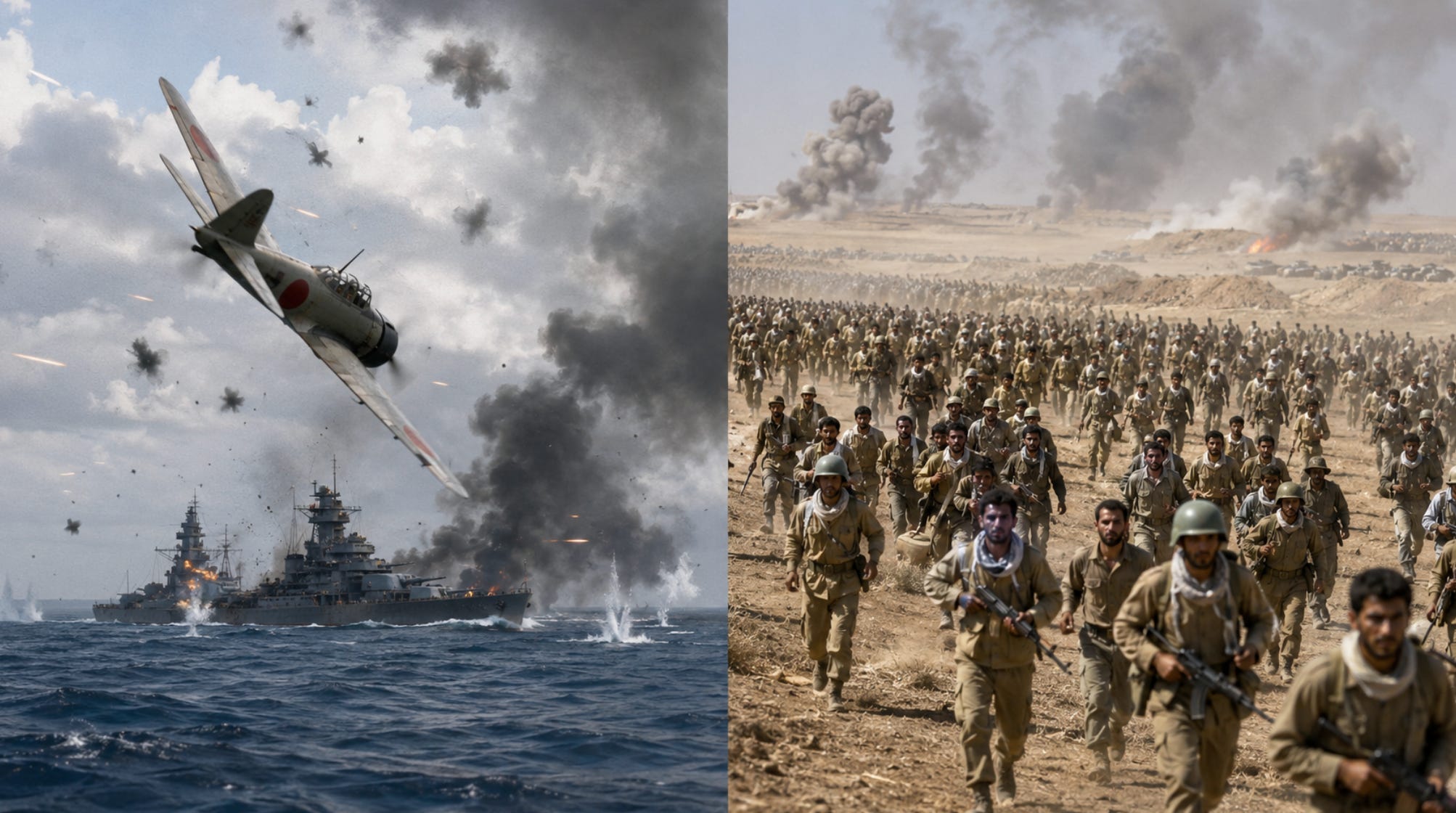
In times of war or other crisis, states or regimes that started with an extreme nationalist, political, or religious outlook can find themselves experiencing an increase in extremism, one that is outside the direction of the central leadership, which may even undermine the standing of the central leadership, and threaten the state itself.
This occurs through a process that historians have identified on several occasions and which we can describe as ‘competitive radicalization’.
In systems that already include a healthy dose of extremism, further extremism can be compounded and increased by radicalization that emerges organically from the structure of the political system itself.
Rival institutions compete to demonstrate loyalty, ideological commitment and resolve. Officials who advocate escalation protect themselves against accusations of weakness, while those who recommend compromise become vulnerable to charges of cowardice, disloyalty, or betrayal. Military and security organizations create facts on the ground that civilian leaders cannot easily reverse. Responsibility becomes dispersed even as policy grows more dangerous.
Imperial Japan offers one of the clearest historical examples of this phenomenon. By the late 1930s and early 1940s, Japan had a government, an emperor, a cabinet, and powerful military institutions, but lacked an effective mechanism for establishing strategic priorities and enforcing them across the state. The Army and Navy pursued competing institutional agendas. Junior officers repeatedly exceeded or ignored instructions while claiming to act in the higher interests of the emperor. Political assassination and intimidation narrowed the range of opinions that could safely be expressed. Leaders who understood that Japan could not win a prolonged war against the United States nevertheless struggled to make the case for withdrawal from China or diplomatic accommodation.
Contemporary Iran is not a replica of wartime Japan. Its history, ideology, and institutions are different, and the Islamic Revolutionary Guard Corps is more cohesive and politically dominant than either of Japan’s competing armed services in the middle of the 20th century. Iran has also demonstrated considerable capacity for calculated restraint, indirect negotiation, and tactical compromise. Nevertheless, the comparison is useful because Iran exhibits a related pattern: overlapping centers of authority, a political culture that rewards displays of resistance, powerful security institutions capable of limiting civilian choices, and a growing risk that moderation may become more dangerous for an official to advocate than escalation.
Historical analogies rarely work neatly. The most useful question is whether the same underlying mechanism is emerging in Iran as we saw in Japan during WWII: a system in which actors compete to appear more uncompromising than their rivals, operational initiatives narrow the space for diplomacy, and no individual or institution can easily assume responsibility for retreat.
The political logic of competitive radicalization
Competitive radicalization generally requires several conditions.
The first is fragmented or overlapping authority. Multiple institutions possess sufficient power to obstruct decisions, initiate policies, or claim control over particular areas of state activity. No single institution, however, consistently assumes responsibility for integrating military, diplomatic, economic and political objectives into a coherent strategy.
The second condition is an ideology that equates political virtue with militancy. Compromise ceases to be treated as one strategic option among others. It becomes evidence of moral weakness. Officials are judged not only by whether their policies succeed, but by whether they appear sufficiently determined, patriotic, or revolutionary.
The third is asymmetric accountability. The political consequences of caution are immediate and personal. An official who advises restraint can be removed, discredited in public discourse, or accused of treachery. On the other hand, the consequences of failed aggression may emerge only months or years later and can often be attributed to foreign enemies, inadequate resources, internal saboteurs, or less committed colleagues.
The fourth condition is the erosion of honest deliberation. Pessimistic analysis becomes defeatism. Intelligence that contradicts official assumptions is suppressed or softened. Military officers exaggerate what can be achieved, while civilian leaders avoid asking questions whose answers may make them appear disloyal. The system gradually loses the ability to distinguish courage from recklessness.
These conditions create an escalatory cycle. A military or security actor takes an initiative. Senior authorities hesitate to reverse it because doing so would appear unpatriotic or expose internal division. The initiative is retrospectively accepted. That acceptance becomes a precedent. Other actors learn that bold action produces influence and that restraint produces vulnerability.
Over time, policy can become more radical even when many participants privately doubt its wisdom. Each individual supports the position that is safest within the system. Collectively, however, the state moves toward outcomes that few would have selected in a setting where the alternatives could be discussed freely.
This mechanism has been identified in different language by several historians and political theorists. Masao Maruyama described prewar Japan as a “system of irresponsibility.” Hugh Byas wrote of “government by assassination.” Danny Orbach has emphasized Japan’s culture of military insubordination, while Paul Johnson presented the system as one in which competing factions made moderation increasingly dangerous.
There were similar factors at work in Nazi German, which we’ll discuss later. In the German context, Hans Mommsen used the term “cumulative radicalization,” while Ian Kershaw described officials “working towards the Führer.” These formulations are useful because they identify recurring features of decision-making in authoritarian states with multiple and competing centers of power.
Imperial Japan’s divided state
Japan’s political structure was especially vulnerable to this pathology. The Meiji constitutional order placed supreme authority in the emperor, but practical power was divided among the cabinet, the civilian bureaucracy, the Army, the Navy, the court, and other elite institutions. The emperor occupied the sacred center of the system, but this did not produce straightforward executive control.
The armed forces claimed a special relationship with the throne through the principle of supreme command. The Army and Navy did not see themselves simply as departments subordinate to a civilian government. They regarded themselves as servants of the emperor with constitutional standing independent of ordinary cabinet authority.
This distinction gave the military substantial leverage. Serving officers were required to hold the posts of Army and Navy minister. A service could therefore destabilize or prevent the formation of a cabinet by refusing to provide a minister. Civilian leaders could negotiate with the military, but they could not reliably command it in the manner expected in a modern system of civilian control.
The emperor’s position further complicated responsibility. Emperor Hirohito was neither a powerless symbol nor an omnipotent dictator. He could question ministers, influence appointments, approve decisions and, in exceptional circumstances, intervene decisively. However, he generally operated through established procedures, conferences and recommendations from his advisers.
Because the emperor’s status was sacred, officials could claim that their own proposals represented the true imperial will. The throne became a source of legitimacy that could be invoked by competing institutions. An Army officer, naval commander, civilian minister, or court official could present his position not as an institutional interest but as service to the emperor and the nation.
This produced the paradox identified by Maruyama. Ultimate authority was theoretically concentrated at the top, while practical responsibility was continually displaced. Officials could say that they had obeyed orders, followed constitutional procedure or acted in accordance with the national essence. Policies emerged through committees and institutional struggles, but ownership of their consequences remained unclear.
The system was not incapable of making decisions. It was capable of mobilizing resources, conducting military operations, and enforcing obedience once a course had been adopted. Its weakness was the absence of a reliable mechanism for testing assumptions, reconciling rival institutional objectives and reversing policies that had become strategically disastrous.
Patriotic insubordination
The Japanese military is often remembered as an institution of extreme obedience. That description is accurate when applied to the relationship between soldiers and their immediate superiors, but misleading when applied to the armed forces’ relationship with the state. Within the Army in particular, disobedience could be seen as a higher form of loyalty.
Junior and middle-ranking officers sometimes claimed that hesitant superiors had been corrupted by party politics, financial interests, or insufficient patriotic conviction. By ignoring instructions, they could portray themselves as acting directly for the emperor and the nation. The ordinary military hierarchy was therefore vulnerable to an ideological inversion: subordinates disobeyed their commanders while claiming obedience to a purer authority.
The Manchurian Incident
The Manchurian Incident of September 1931 became the most consequential demonstration of this principle. Officers of the Kwantung Army used an explosion on the South Manchurian Railway as a pretext for military expansion. They acted beyond the effective control of the civilian government in Tokyo and rapidly created a new political and military reality.
The government was then faced with an impossible-looking choice. It could order withdrawal and publicly repudiate officers who had achieved dramatic victories in the name of national security, or it could accept the fait accompli and attempt to manage the consequences. The second option was politically easier. Japan eventually recognized Manchukuo, the nominally independent state established under Japanese military domination.
The lesson became foundational for Japan’s increasingly radicalized and militarized political system. Unauthorized aggression had succeeded. The officers responsible had expanded Japanese territory, enhanced the Army’s prestige, and confronted the government with a result too politically costly to reverse. Their conduct established that military initiative could become national policy after the event.
This altered the incentives facing ambitious officers. Formal authorization became less important if an operation could produce rapid success. Senior leaders who might have rejected a proposal in advance could be pressured to approve it retrospectively. The capacity to create facts became a source of political power.
The Manchurian precedent did not mean that every later Japanese operation was unauthorized. It meant that the boundary between military initiative and state policy had been weakened. Senior authorities had demonstrated that they were more likely to ratify successful insubordination than punish it.
Assassination and the destruction of moderation
Political violence intensified the process. During the 1930s, ultranationalist officers and civilian extremists targeted political leaders, financiers and officials accused of betraying Japan. Prime Minister Inukai Tsuyoshi was assassinated by young naval officers in May 1932. In February 1936, radical Army officers led troops into central Tokyo and murdered senior officials, including Finance Minister Takahashi Korekiyo.
The February coup attempt was defeated. Hirohito reacted angrily and demanded that the rebellion be suppressed. Its leaders were punished, and the radical Imperial Way faction lost influence. Nevertheless, the broader political effect of violence had already been established.
Assassination does not need to remove every moderate to shape policy. It changes the calculations of everyone who survives. A politician considering opposition to military spending, withdrawal from occupied territory or accommodation with a foreign power must weigh not only the policy consequences but the possibility of being branded a traitor.
The direct perpetrators did not govern Japan. Their violence governed the boundaries of permissible debate. A leader who supported expansion could present himself as patriotic. A leader who questioned expansion might have to prove that he was not protecting foreign interests or dishonoring soldiers who had already died.
The result was a political environment in which moderation required unusual personal courage and offered few institutional rewards. Even officials who privately understood Japan’s material weaknesses often adopted the language of militancy. Public rhetoric became more extreme than private analysis.
Once this happened, the state lost access to some of its own knowledge. Naval officers who doubted Japan’s ability to defeat the United States could explain the risks privately but found it difficult to transform those warnings into an acceptable national policy. Diplomats could describe the likely consequences of confrontation, but diplomatic compromise appeared increasingly equivalent to national humiliation.
Factional rivalry and incompatible strategies
Japanese radicalization was not produced by a unified military imposing a single plan upon peaceful civilians. The Army and Navy were bitter institutional rivals. They competed for budgets, industrial resources, political influence, and strategic priority. Each service developed its own understanding of Japan’s main threats and opportunities.
The Army focused heavily on the Asian continent. Its position in Manchuria and expanding war in China generated enormous institutional commitments. Many Army officers saw the Soviet Union as the principal long-term threat.
The Navy concentrated on maritime power, access to Southeast Asian resources and the possibility of conflict with the United States and Britain. Its institutional position depended upon maintaining a fleet capable of confronting the world’s strongest naval powers. The identification of the United States as a potential enemy therefore justified the Navy’s size and importance.
These strategies could not easily be reconciled. The war in China consumed resources without producing decisive victory. It also increased Japan’s dependence on imported oil, metals and other materials. Western economic pressure then strengthened the argument for expansion into Southeast Asia. That expansion, however, threatened war with the United States and Britain.
Each stage of escalation created the requirement for another. The Army’s commitments in China contributed to the resource crisis. The resource crisis strengthened the Navy’s southern strategy. The southern strategy implied a wider war. The prospect of wider war justified further military mobilization.
Institutional rivalry therefore did not produce balance. It produced cumulative expansion. Neither service could easily surrender its central mission without losing influence, resources and prestige. National strategy became the sum of incompatible institutional imperatives.
This helps explain why Japan could demonstrate considerable operational brilliance while lacking a plausible theory of final victory. Its armed forces planned the attacks on Pearl Harbor and across Southeast Asia with great skill. They could identify immediate military objectives, coordinate complex operations and achieve rapid success.
What they could not do was explain how those victories would compel the United States to accept a durable settlement. Japanese strategy relied upon the hope that a series of devastating early blows would break American political will. That assumption was partly a substitute for a realistic assessment of the industrial and demographic balance.
The decision for war
By 1941, many senior Japanese leaders understood the dangers of war with the United States. Admiral Yamamoto Isoroku warned that Japan might dominate the first months of the conflict but could not promise success in a prolonged struggle. Prime Minister Konoe Fumimaro sought diplomatic alternatives and ultimately resigned. Hirohito repeatedly questioned ministers and commanders about the prospects for victory.
Knowledge of the risks did not produce retreat because retreat had become institutionally and politically unbearable. Withdrawal from China would undermine the Army, discredit the government and appear to render years of sacrifice meaningless. Acceptance of U.S. demands could be condemned as submission to economic coercion. Continuing without settlement threatened eventual economic strangulation.
War became the option that postponed the immediate political consequences of compromise. It allowed each institution to preserve its prestige, justify its previous conduct, and avoid admitting that Japan’s strategic position had become untenable.
Sunk costs intensified the problem. By 1941, Japan had invested years of fighting, large quantities of resources and many lives in China. A compromise that might have been politically possible earlier now seemed to invalidate the sacrifices already made. Further escalation could be presented as the means of redeeming past losses, while withdrawal would transform those losses into acknowledged failure.
Nazi Germany as another, though slightly contrasting, model
Nazi Germany experienced a related form of competitive radicalization. Its political order contained overlapping party, state, police, military, and economic institutions. Hitler often encouraged jurisdictional ambiguity and allowed subordinates to compete for access and authority.
Officials attempted to anticipate Hitler’s wishes. They proposed increasingly radical measures in the hope of advancing their careers, expanding their organizations, and demonstrating ideological reliability. Policies could therefore intensify without a detailed order from Hitler at every stage.
This resembles Japan in several respects. Both regimes rewarded initiative in an ideological direction. Both weakened legal and bureaucratic restraints. Both created systems in which officials could portray extreme conduct as loyalty to a higher purpose.
The crucial difference was the location of ultimate power. Nazi Germany had a clear personal and ideological center. Hitler’s worldview supplied the direction toward which institutions competed. Rival agencies struggled to implement, interpret and intensify the Führer’s objectives.
Japan’s emperor occupied a sacred position, but did not provide the same consistent ideological and executive direction. Japanese institutions could advocate incompatible strategies while claiming that each represented imperial will. The Army, Navy, civilian government and court were not simply competing to implement a single detailed program.
Germany therefore experienced competitive radicalization beneath a dictator. Japan experienced competitive radicalization within a more fragmented structure whose sacred sovereign did not routinely impose unified operational control.
This distinction helps clarify the contemporary Iranian case. The central question is whether Iran resembles a fragmented system in which institutions can create policy from below, or a hierarchical system in which competition occurs beneath an increasingly dominant security leadership. The answer appears to contain elements of both.
Iran’s dual political order
The Islamic Republic combines elected and unelected institutions. The president, cabinet and parliament exercise genuine administrative and political functions, but they operate within a system ultimately supervised by the Supreme Leader and institutions designed to protect the revolutionary order.
The Supreme Leader commands the armed forces, appoints senior officials and shapes the boundaries of national security policy. The Guardian Council vets political candidates and reviews legislation. The Supreme National Security Council coordinates major security decisions. The regular military coexists with the IRGC, which possesses ground, naval, aerospace, intelligence and overseas capabilities as well as substantial political and economic influence.
This structure was designed partly to prevent any single elected institution from capturing the revolution. Overlapping authority is therefore intentional. The presidency can conduct diplomacy, but it does not control the entire security establishment. Civilian ministries can administer the state, but they cannot independently determine the ideological limits of foreign or defense policy.
The IRGC is not simply a conventional military organization. It regards itself as the guardian of the Islamic Republic and the revolution. Its institutional mission includes protecting the system against internal subversion, foreign attack and political deviation. This gives the Guards a claim to intervene in questions that would elsewhere belong primarily to elected officials.
Under Ali Khamenei, these competing institutions were usually managed by a powerful central arbiter. Khamenei balanced factions, permitted limited political competition and determined when negotiations or tactical compromises could be presented as consistent with revolutionary resistance.
This did not eliminate institutional conflict. Presidents, clerics, parliamentarians, intelligence bodies, and IRGC commanders frequently disagreed. However, the system generally possessed a leader capable of defining the final political line and protecting an approved compromise from hardline criticism.
The 2026 war and the killing of Ali Khamenei significantly altered that arrangement. Mojtaba Khamenei’s succession preserved the formal structure of supreme leadership, but did not automatically reproduce his father’s authority. His prolonged absence and reported injuries have increased uncertainty over the relationship between formal leadership and operational decision-making.
At the same time, wartime conditions have strengthened the IRGC. The institutions controlling missiles, drones, maritime forces, intelligence networks, and internal security naturally gain influence during a conflict threatening the survival of the state.
The resulting system may be more centralized in some respects and less effectively arbitrated in others. The IRGC can impose operational discipline, but it is also a participant with its own institutional worldview and interests. The body increasingly responsible for managing the conflict is also the body most closely identified with revolutionary resistance and military deterrence.
The politics of appearing weak
The Japanese comparison is strongest in the political asymmetry surrounding moderation.
An Iranian official advocating continued resistance can present himself as defending sovereignty, honoring the dead and preserving deterrence.
If the conflict produces concessions from Iran’s adversaries, he can claim that steadfastness succeeded. If it produces further attacks, he can argue that the enemy’s conduct proves negotiation was futile.
An official advocating compromise faces a more difficult political position. He must explain why negotiation will not reward aggression, weaken the regime or dishonor national sacrifices. He assumes immediate responsibility for any concession. If an agreement fails, his entire approach can be discredited as naïve or treacherous.
This does not mean that all Iranian hardliners favor unlimited war or that all civilian officials favor unconditional accommodation. The divisions are more complex. Some IRGC commanders may support negotiations that preserve the regime and its military capabilities. Civilian officials may support forceful retaliation as a necessary element of bargaining.
The important point is that the political costs are uneven. Militancy possesses greater ideological protection. Compromise requires more extensive justification.
That inequality can influence even those who privately favor de-escalation. Pragmatic officials may adopt maximalist rhetoric to protect themselves. Negotiators may demand compensation, recognition of Iranian rights and visible reciprocity before they can safely support an agreement. A ceasefire must be presented as the achievement of resistance rather than a retreat under pressure.
Military facts and diplomatic choices
Iran also resembles Japan in that military or security actions can narrow the options available to civilian officials.
Missile strikes, maritime attacks, proxy operations, or actions by affiliated groups can produce retaliation before diplomats complete negotiations.
Indeed we have seen this several times during the recent conflict, particularly in relation to attacks by autonomous IRGC units on Oman, for which both the Iranian President and Foreign Minister have apologized for an promised to halt, but which the IRGC has continued to conduct.
An operation does not need to be wholly unauthorized to have the effect of undermining the political hierarchy. It may result from broad strategic direction, local discretion, or competing interpretations of national strategy. Once conducted, however, it changes the political environment.
Diplomats must defend or explain the action. Foreign governments may retaliate. Casualties create demands for further response. Hardliners argue that the resulting escalation proves the need for greater resistance. Hence, the space for compromise contracts.
This resembles the Japanese use of faits accomplis. Kwantung Army officers could take territory and force Tokyo to decide whether to ratify or reverse their success. Iranian military actors can conduct operations that alter the balance between negotiation and confrontation.
The IRGC and the possibility of coercive predominance
The IRGC makes Iran different from wartime Japan. Japan’s Army and Navy were separate, intensely competitive institutions with different strategic priorities. Neither consistently dominated the entire state. Their rivalry contributed to incoherence and expansion.
The IRGC is more integrated. It contains multiple branches but shares a common institutional identity and revolutionary mission. It has influence across security, politics and the economy. Rather than producing the open interservice paralysis seen in Japan, its rise may produce the predominance of a military-security establishment.
This could reduce the likelihood of unauthorized action in some areas. A dominant IRGC leadership may be better able to coordinate missile, naval, intelligence and proxy operations than Japan’s divided services were able to coordinate national strategy.
However, greater organizational coherence does not necessarily produce greater strategic moderation. If the dominant institution derives its authority from resistance and confrontation, it may systematically discount policies that reduce its political role or challenge its assumptions.
External pressure can reinforce this process. War increases the demand for security, secrecy, sanctions evasion, and centralized control. These conditions favor the IRGC over civilian technocrats and elected politicians. Even if confrontation damages Iran as a whole, it will likely enhance the domestic authority of the institution responsible for confronting it.
This does not require the Guards to desire endless conflict. They may recognize that regime survival requires negotiation. But they have strong incentives to shape the terms, timing, and presentation of any settlement. An agreement must preserve their capabilities, protect their institutional position, and allow them to claim that resistance forced the enemy to compromise.
Iran may therefore be moving not toward Japan’s condition of uncontrolled military fragmentation, but toward a system of coercive predominance in which the security establishment has the strongest voice and civilian advocates of moderation possess limited room for independent action.
Similar mechanisms elsewhere
Other historical cases illustrate elements of the same process. During the French Revolution, factions repeatedly accused rivals of insufficient commitment. The Girondins were displaced by more radical forces, while those who later advocated reducing the Terror became vulnerable to charges of protecting the Revolution’s enemies. Moderation became evidence against the moderate.
During Stalin’s purges, officials and security officers faced incentives to identify more conspirators and enemies. Failure to expose sufficient treachery could itself arouse suspicion. The safest bureaucratic position was often to demonstrate excessive vigilance.
China’s Cultural Revolution produced intense competition among groups claiming the purest loyalty to Mao Zedong. Rival Red Guard factions denounced one another as reactionary or bourgeois. Political survival frequently depended upon appearing more revolutionary than one’s accusers.
These cases differ from both Japan and Iran because they involved different degrees of central direction. Stalin remained the principal architect of the terror. Mao’s interventions shaped factional competition even when events escaped control. The French Revolution lacked a comparable permanent supreme leader.
Their relevance lies in the common incentive: when ideological loyalty is difficult to measure, actors prove it by attacking moderates and demanding more radical action. The political center continually shrinks because each faction fears being outflanked.
Iran’s restraint and strategic calculation
Any comparison that depicts Iran as mechanically trapped in escalation would be misleading. Tehran has repeatedly demonstrated strategic patience. It has used intermediaries, indirect negotiations and calibrated responses. It has accepted pauses when necessary and avoided immediate retaliation on occasions when a larger war threatened regime interests.
Iranian leaders have often distinguished between ideological objectives and tactical methods. Hostility toward the United States and Israel has not prevented negotiations over the nuclear program, prisoner exchanges, sanctions relief, or various regional arrangements. The state has combined revolutionary rhetoric with pragmatic bargaining.
This record differentiates Iran from the late Japanese system, which became progressively less capable of reversing its imperial commitments. Iran’s leaders still possess a clear overriding objective: preservation of the Islamic Republic. That objective can justify resistance, but it can also justify compromise when confrontation threatens the regime itself.
Japan’s Army and Navy pursued institutional objectives that did not always converge upon a single definition of regime survival. The continuation of the China war, the northern strategy, the southern strategy, and the naval confrontation with the United States reflected different organizational imperatives.
Iran’s factions disagree strongly, but most remain committed to the survival of the same political order. This shared objective provides a possible foundation for restraint that was weaker in Japan’s divided strategic system.
External military pressure validates the security establishment’s decades-old warnings and preparations, strengthens narratives of encirclement, and makes advocates of engagement easier to discredit. An adversary seeking to weaken hardliners may instead confirm their argument that only military power can protect the country.
This creates a strategic dilemma for foreign governments. Pressure may be necessary to deter Iranian attacks or constrain military capabilities, but maximal pressure can reduce the political space available for Iranian compromise. The more humiliating the demanded concession, the harder it becomes for any Iranian official to advocate for it.
The central comparison
Wartime Japan and contemporary Iran are best compared through the relationship between formal authority, institutional power, and the political risks of moderation.
Japan possessed a supreme emperor but fragmented operational authority. The Army and Navy claimed independent access to the imperial will. Officers could create facts through insubordination. Political violence intimidated civilian leaders. Institutional rivalry generated incompatible strategies. The state became capable of escalation but increasingly incapable of strategic moderation.
Iran possesses a Supreme Leader and a complex dual state. The IRGC has become the most powerful operational institution, particularly under wartime conditions. Elected officials and diplomats retain important roles, but do not monopolize the instruments of coercion. Revolutionary ideology provides hardliners with greater protection than it provides advocates of accommodation.
The Japanese system radicalized through competitive radicalization in a fragmented system. The Iranian system may be further radicalizing through a combination of factional outbidding and security consolidation. In Japan, no military institution could fully impose a coherent national strategy. In Iran, the IRGC may increasingly be able to impose one, but the strategy it favors is likely to privilege resistance, deterrence, and preservation of military capability, which is appears to believe is most likely to be achieved through aggression rather than compromise.
The systems may therefore produce a similar bias against compromise by different routes. Japan made retreat difficult because authority was divided and every institution feared loss of prestige. Iran may make retreat difficult because the dominant security institution can define the ideological terms under which compromise is permissible.
In both cases, the decisive political asymmetry is the same. The advocate of escalation can claim courage. The advocate of restraint must prove that he is not betraying the nation.
Implications for Iran’s adversaries
The comparison has practical implications. Foreign governments cannot assume that pressure will automatically produce moderation. It may instead strengthen the actors least willing to compromise.
A viable agreement requires an Iranian authority capable of implementing it across the military and security system. Negotiating with civilian officials is insufficient if those officials cannot guarantee the conduct of the IRGC and associated actors. Conversely, an agreement negotiated with the security establishment may be more durable, but will probably require terms allowing it to claim strategic success.
Foreign demands that require an identifiable Iranian leader to accept public humiliation are especially dangerous. They intensify the very outbidding dynamic that makes compromise difficult. Hardliners can portray accommodation as surrender, while pragmatic officials have no politically defensible way to support it.
This does not mean that adversaries should offer concessions without reciprocity. It means that diplomatic arrangements must understand and address the internal political mechanics of compliance.
Adversaries must also distinguish between deterrence and regime reinforcement. Strikes that weaken Iranian military capacity may ironically simultaneously increase the IRGC’s domestic authority. Broad economic pressure can weaken the country while empowering the networks best equipped to profit from sanctions and scarcity.
The relationship between external coercion and internal radicalization is therefore nonlinear. More pressure does not necessarily produce more flexibility. Beyond a certain point, it can destroy the political position of those most capable of negotiating.
Conclusion
The central danger in both wartime Japan and contemporary Iran is not simply the presence of aggressive leaders. It is a political system that makes restraint more hazardous to advocate than escalation.
Japan’s march toward the Pacific War was shaped by fragmented authority, military insubordination, assassination, institutional rivalry, and the cumulative power of faits accomplis. Many Japanese leaders recognized the danger of war with the United States, but the system offered no politically sustainable method of retreat. Each institution defended its previous decisions. Each feared the consequences of appearing weak. The state entered a war it could not plausibly win because admission of strategic failure had become more threatening than the gamble of further expansion.
Iran today is not at the same point, and the differences remain substantial. The IRGC is more cohesive than Japan’s divided services. The Islamic Republic retains a shared objective of regime survival. Iranian leaders have demonstrated tactical calculation and a continuing capacity for negotiation.
Nevertheless, the warning signs are present. Wartime pressure has elevated the security establishment, weakened civilian influence and intensified the ideological cost of compromise. Operational actions can narrow diplomatic choices. Hardliners can accuse negotiators of betraying the country, while negotiators must demonstrate that any agreement preserves resistance and deterrence.
The most accurate comparison is therefore not that Iran has become a state in which nobody is in charge. It is that Iran may be becoming a state in which the actors capable of preventing compromise are stronger than those capable of delivering it.
That imbalance can produce strategic disaster. Officials may privately recognize the costs of escalation but publicly support it because the immediate personal risks of moderation are greater. Military actions may continue because reversing them would expose the weakness of previous decisions, and sacrifices already made may become arguments for further sacrifice.
The enduring lesson of imperial Japan is that states do not need to believe they can win in order to choose war. They need only reach a point at which every influential actor believes that recommending retreat is more dangerous than supporting another round of escalation.
Comments
Nothing yet. Say the first thing.
Sign in to join the conversation.