
“May you live in interesting times” is commonly presented as an ancient Chinese curse and is sometimes attributed to Confucius. It is almost certainly neither. No convincing Chinese original has been found, and the strongest early documented appearance comes from a 1936 speech by the British politician Sir Austen Chamberlain, who said that a diplomat with experience in China had told him of such a curse. The attribution is apocryphal, but the sentiment survives because it feels true. “Interesting times” are not normally comfortable ones. Indeed, they are periods of war, revolution, economic collapse, epidemic, political crisis, and social upheaval. These are precisely the events that later generations normally call History.
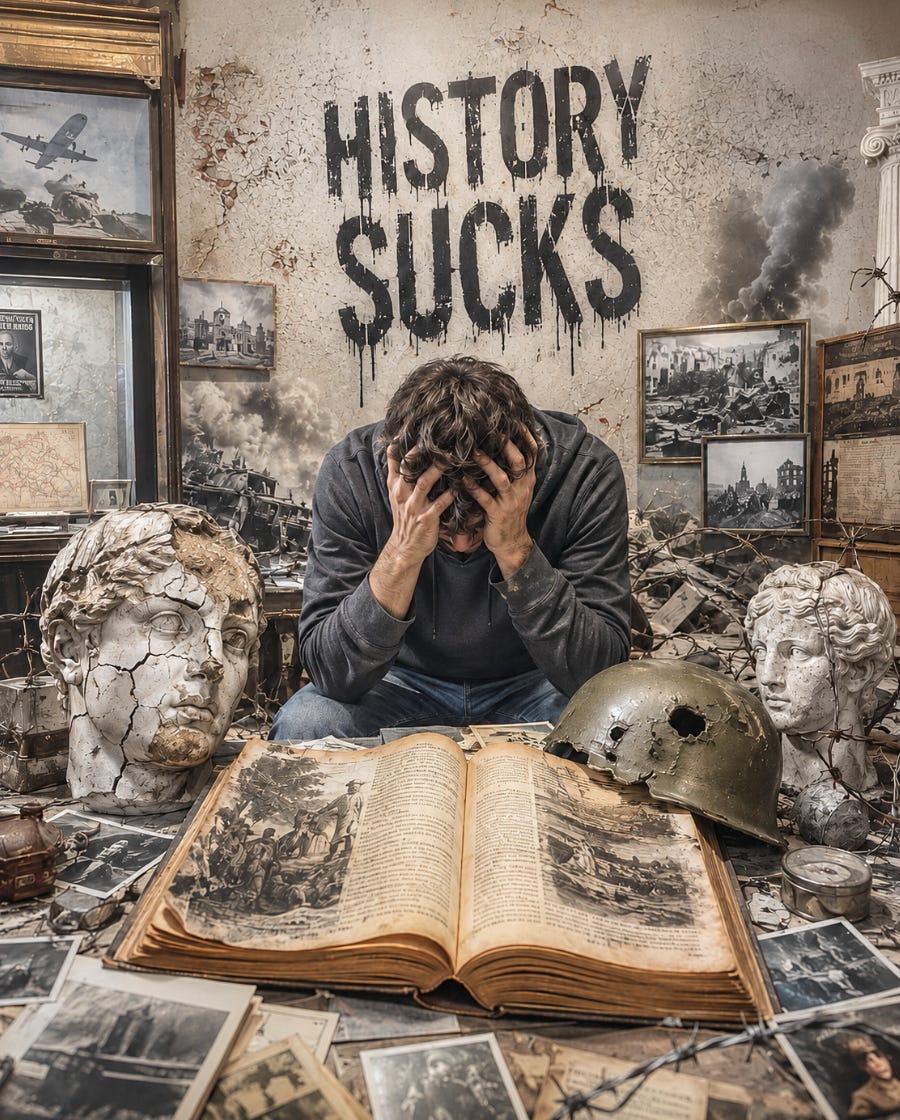
This suggests a provocative proposition: history sucks.
That does not mean that the study of history is boring, pointless, or intellectually worthless. Nor does it mean that every past society was miserable, or that human existence has been an uninterrupted procession of violence and disaster. The argument is almost the reverse. Most human life, including most life in the past, was not composed of famous events. It consisted of work, meals, families, friendships, worship, gossip, courtship, illness, childhood, old age, and the innumerable routines through which people made their lives. The past was full of ordinary existence. History, however, is a selection made from that past, and the selection is heavily weighted toward the moments when ordinary existence was interrupted.
Thus, the past is everything that happened. But History is what later societies choose, or are able, to remember, investigate and narrate. Historians require subjects, evidence, explanations and some reason that a reader should care. As a result, history has traditionally been organized around events: the accession of rulers, the fall of governments, the outbreak of wars, the signing of treaties, the movement of borders, the collapse of empires, economic crises, and the outbreak of revolutions. These events are historically important partly because they were humanly destructive. They altered or ended lives, overturned expectations, and forced millions of people to adapt to conditions they had not chosen.
Georg Wilhelm Friedrich Hegel captured part of the problem when he observed that “periods of happiness are blank pages” in world history. His larger philosophical argument was more complicated, but the phrase identifies a basic feature of historical narration. Harmony does not usually produce a turning point. A peaceful harvest, a stable marriage, or an uneventful decade may be deeply valuable to those who experience it, but it does not readily become a chapter heading. Disruption does. The things that make life worth living are often historically insignificant, while the things that make history interesting frequently make life unbearable.
Historical significance and human desirability may therefore be inversely related. Consider the years that almost everyone recognizes immediately: 1789, 1914, 1917, 1929, 1939 or 2001. Their familiarity does not come from widespread happiness. They evoke images of revolution, war, financial collapse, and mass death. A year in which institutions functioned, crops grew, children survived, and no armies crossed the frontier may have been a very good year in which to live. It is unlikely to be remembered as historically important. A timeline does not usually record that millions of people got through a particular year without becoming historically significant.
This is not merely a cynical comment about the historian’s predilections. It reflects a truth about selection effect. Events become visible when they disturb continuity. The news media operates according to a similar logic, captured in the maxim associated with Florida television executive Joel Cheatwood: “If it bleeds, it leads.” Nothing disastrous happened today is not normally a headline, even though it may be the best possible news for nearly everyone. A bridge that remains standing is not reported; a bridge that collapses becomes an event. In the same way, historical writing is naturally drawn to moments at which the expected order of things fails.
For much of the history of historical writing, this tendency was reinforced by the state and the documents it produces. Traditional political history concentrated on rulers, ministries, armies, diplomacy, and constitutional change. States produced archives, preserved official correspondence and defined which occurrences mattered. Their documents described taxation, legislation, military mobilization, rebellion, territorial administration, and relations with other states. History consequently appeared as a sequence of actions undertaken by kings, presidents, generals, and governments. Ordinary people entered the story mainly as soldiers, taxpayers, workers, rebels, refugees, or casualties.
The nation-state was not simply one subject among others. It supplied the framework within which the past was arranged. National histories explained how a people acquired territory, institutions and political identity. Wars and revolutions became foundational episodes. Schoolchildren learned dates on which monarchs succeeded, battles were fought, constitutions adopted, and independence declared. Even when the events were catastrophic for those who experienced them, later generations could convert them into stories of national purpose.
During the twentieth century, historians mounted a sustained rebellion against this approach. It is broadly correct to associate the breakthrough with the 1960s, especially in Britain and the United States, but the movement began earlier. In France, Marc Bloch and Lucien Febvre founded the journal associated with the Annales school in 1929. They rejected the narrow dominance of political, diplomatic and military history and encouraged a more interdisciplinary study of societies, economies, geography and collective mentalities. Fernand Braudel later distinguished between the dramatic surface of events and the slower temporalities of geography, commerce, demography, and social structure. From this perspective, the famous event might be less important than the conditions developing beneath it over decades or centuries.
Other currents widened the challenge. Social and economic historians studied class, labor, population, and everyday material life. The journal Past and Present, founded in 1952, became an important forum for historically informed social analysis. E. P. Thompson’s The Making of the English Working Class, published in 1963, treated working people not as passive objects of industrialization but as historical actors who interpreted and shaped their own circumstances. His 1966 essay “History from Below” helped give a name and program to an approach centered on ordinary people and their experiences. The social history that rose rapidly to prominence during the 1960s and 1970s was therefore not invented from nothing in that decade. It brought earlier intellectual currents into the center of the profession.
The expansion continued. Women’s history challenged accounts in which half the human population appeared only occasionally. Oral historians recorded voices that had never entered official archives. Historians of childhood, sexuality, the family, food, clothing, manners, emotion, popular religion, work, and leisure demonstrated that ordinary life was not merely decorative background, rather it was itself historical. Human beings had not always understood privacy, childhood, marriage, shame, cleanliness, violence, or the body in the same way. Apparently natural habits were revealed as products of time and culture.
These developments constituted a real correction. They make it impossible to claim seriously that historians only study nation-states or exceptional events. Modern history can take almost anything as its subject. It can examine how people slept, what they ate, how they insulted one another, how houses were organized, or what gestures were considered polite. It can reconstruct a village, a household or even a single life. The academic discipline has spent much of the past century trying to recover the blank pages to which Hegel referred.
But the correction does not abolish the original problem. It may, in fact, reveal how deep it is.
The first reason is that miserable events possess what might be called causal density. Wars, revolutions, epidemics, famines, forced migrations and state collapses do not attract attention only because historians enjoy drama, they can alter many dimensions of human life at once.
Such moments compress change. Slow developments are real and can be more important in the long term, but catastrophes often create a before and an after that contemporaries themselves recognize. An invasion does not merely provide historians with an exciting story. It can destroy the conditions under which thousands of ordinary stories were being lived. A financial collapse is an abstraction until it closes businesses, empties savings, postpones marriages, breaks families and changes political expectations. Difficult events matter because their consequences spread far beyond the institutions that initiated them.
The second reason is archival. Disruption generates records.
Most people in the past did not leave diaries, memoirs or collections of private correspondence. They became visible to literate institutions when those institutions wanted something from them or believed that they had done something wrong. Governments counted people to tax or conscript them. Courts recorded them when they were accused, sued, punished or asked to testify. Churches documented irregular belief, marriage and sexual conduct. Relief authorities listed the hungry, displaced or destitute. Armies recorded recruits, deserters and casualties. Colonial states classified populations in order to govern them.
This creates one of history’s cruelest paradoxes. Ordinary people can often be recovered most clearly at the moment when ordinary life became challenging.
Carlo Ginzburg’s The Cheese and the Worms, first published in Italian in 1976, provides a famous example. Ginzburg reconstructed the intellectual world of Menocchio, a sixteenth-century miller, using records produced by the Roman Inquisition. The book demonstrates the extraordinary possibilities of micro-history: a person who would have been invisible in conventional political history becomes the center of an entire historical universe. But Menocchio is visible because he was interrogated and prosecuted. The source that allows the historian to recover an ordinary mind was created by his unfortunate interaction with the authorities.
The point is not that histories of everyday life are secretly histories of elites. It is that the archive itself is subject to the selection bias of the state. Stability leaves fewer traces than conflict. Quiet conformity does not generate a trial transcript. Historians can read official sources against the grain, use objects and buildings, gather oral testimony, study demographic patterns, and find ingenious ways of reconstructing lives. Nevertheless, historical visibility remains unequally distributed. Suffering and dissatisfaction is often better documented than contentment; because it matters.
The third reason is narrative. An event is a story. It generally has a beginning, an escalation, a turning point, and an outcome; and it offers protagonists. Ordinary life is repetitive, distributed and difficult to contain. It does not necessarily culminate, it simply continues.
This is why even histories devoted to everyday experience are often organized around disruption. Historians study family life during war, food during famine, labor during industrialization, gender during revolution, or belief during persecution. The event opens the society to inspection. It functions like a crack in a building, revealing the stresses in the structure. When ordinary expectations fail, people are forced to articulate assumptions they previously took for granted. Conflict tends to make otherwise invisible rules visible.
Social history therefore did not end the reign of the event. It changed the angle from which the event was viewed. Traditional history might ask why a revolution occurred, which faction prevailed, and what constitution followed. History from below asks who participated, who resisted, who remained indifferent, how news traveled, what people believed was happening and whether the proclaimed transformation altered their lives. The revolution remains important, but the population inside it is no longer a crowd in the background.
This is a major intellectual achievement. It democratizes history. Industrialization can now be seen not only a graph of production. It is also about changing work discipline, domestic arrangements, bodily exhaustion, and ideas about time. Colonization is not simply the transfer of sovereignty from one flag to another. It is a reordering of local authority, identity, education, property, and expectation.
Yet this democratization may strengthen rather than weaken the argument that history sucks.
Once the historian looks beyond the palace and battlefield, the human cost of the event becomes more visible. Conventional history could make war appear in terms of abstract strategy and concrete territorial change, both of which obscure the very real impact on human lives. Social history reveals conscription, bereavement, shortages, displacement, and the destruction of ordinary lives. The older, more traditional approach to history made events important because states considered them important. The newer history shows why they were important to people who often felt they had little control over them.
There is, however, a danger in taking the argument too far. Not every important historical change is catastrophic, and not every period of peace is a blank page. Some of the largest transformations in human life unfolded gradually: falling infant mortality, expanding literacy, urbanization, sanitation, changes in diet, longer life expectancy, new forms of household organization, and the spread of mass education. These developments may lack a single dramatic date, but they changed the experience of being alive more profoundly than many battles.
The history of ordinary life also guards against a second distortion: the belief that people in the past did nothing except suffer. Even under oppressive or violent conditions, people loved, joked, celebrated, played, prayed, and made homes. A history concerned only with victimhood can flatten them almost as thoroughly as a history concerned only with rulers.
There is also a risk that event-centered history exaggerates discontinuity. Governments fall quickly, but cultural change takes generations. Braudel’s emphasis on the long duration remains valuable because the event is often less unique than it appears. Beneath the political drama lie geography, demography, trade, technology, habits, and custom, all moving at different speeds.
The strongest form of the argument must therefore preserve both sides. History is not simply a biased collection of disasters that serious scholars should replace with the study of peaceful routines. Difficult events have genuine importance. They concentrate causation, generate evidence, expose hidden structures, and transform the conditions of ordinary life. Their prominence is not just a residue of old-fashioned fascination with kings and wars. Even the most democratic and socially expansive history cannot dispense with them.
At the same time, events are not the whole past. They are points at which the fabric of life stretches, tears, or is abruptly rearranged. To understand the tear, historians must understand the fabric. The significance of a revolution depends on the society it disrupts. The meaning of a famine depends on household economies, food customs, market structures and relations of authority. The effect of war depends on the routines and expectations it destroys. Ordinary life and extraordinary events are not rival subjects. Each gives the other meaning.
The relationship might be expressed this way: ordinary life is the substance of history, but disruption gives history its shape. The ordinary is what people are trying to maintain, improve or recover. The event is what threatens or transforms it. Historians need both, but public memory and popular history will probably remain attracted to the event because the event supplies drama, consequence, and moral urgency.
That attraction is unlikely to disappear. Museums commemorate wars and revolutions. National holidays mark victories, defeats, independence and liberation. Television documentaries promise lost civilizations, assassinations, scandals, and disasters. Political leaders invoke Munich, Vietnam, the Great Depression, or the fall of Rome because crises provide compressed stories with apparently usable lessons. Nobody mobilizes a country by comparing the present to an unusually pleasant and uneventful decade.
The movement toward social history, history from below, women’s history, oral history, cultural history and micro-history has redressed an enormous imbalance. It has shown that the state is not the only historical actor, that power is experienced in homes and workplaces as well as parliaments, and that ordinary habits have histories of their own. It permanently enlarged the discipline.
But it cannot make catastrophe historically ordinary, nor should it try. A war that kills millions is more consequential than a change in table manners, even though manners may tell us something profound about civilization. An epidemic that reorganizes labor and family life deserves disproportionate attention precisely because its effects were disproportionate. The ethical task is not to pretend that all subjects have equal weight. It is to prevent the drama of events from erasing the people who endured them and the ordinary worlds they lost.
“History sucks,” then, is not an argument against history. It is an argument about what makes something historical. The most memorable times are often those in which normal life failed. The people who lived through them did not experience “turning points,” “transitions” or “periods of transformation.” They experienced uncertainty, loss, and the collapse of assumptions. Later historians impose chronology, identify causes, and give the disorder a name.
The apocryphal Chinese curse therefore contains a truth more important than its false attribution. To live in interesting times is to become vulnerable to history. It is to discover that the routines that seemed permanent were temporary, that private life could be invaded by public events and that decisions made by distant institutions could enter the home.
The great achievement of modern historiography has been to follow those events into the home. It has recovered workers, women, children, minorities, villagers, and families from the margins of state-centered narratives. But the people it recovers are still most visible when history happens to them.
The past did not always suck. Most of it was people just trying to live. History sucks because history is disproportionately the record of what interrupted them.
Comments
Nothing yet. Say the first thing.
Sign in to join the conversation.