
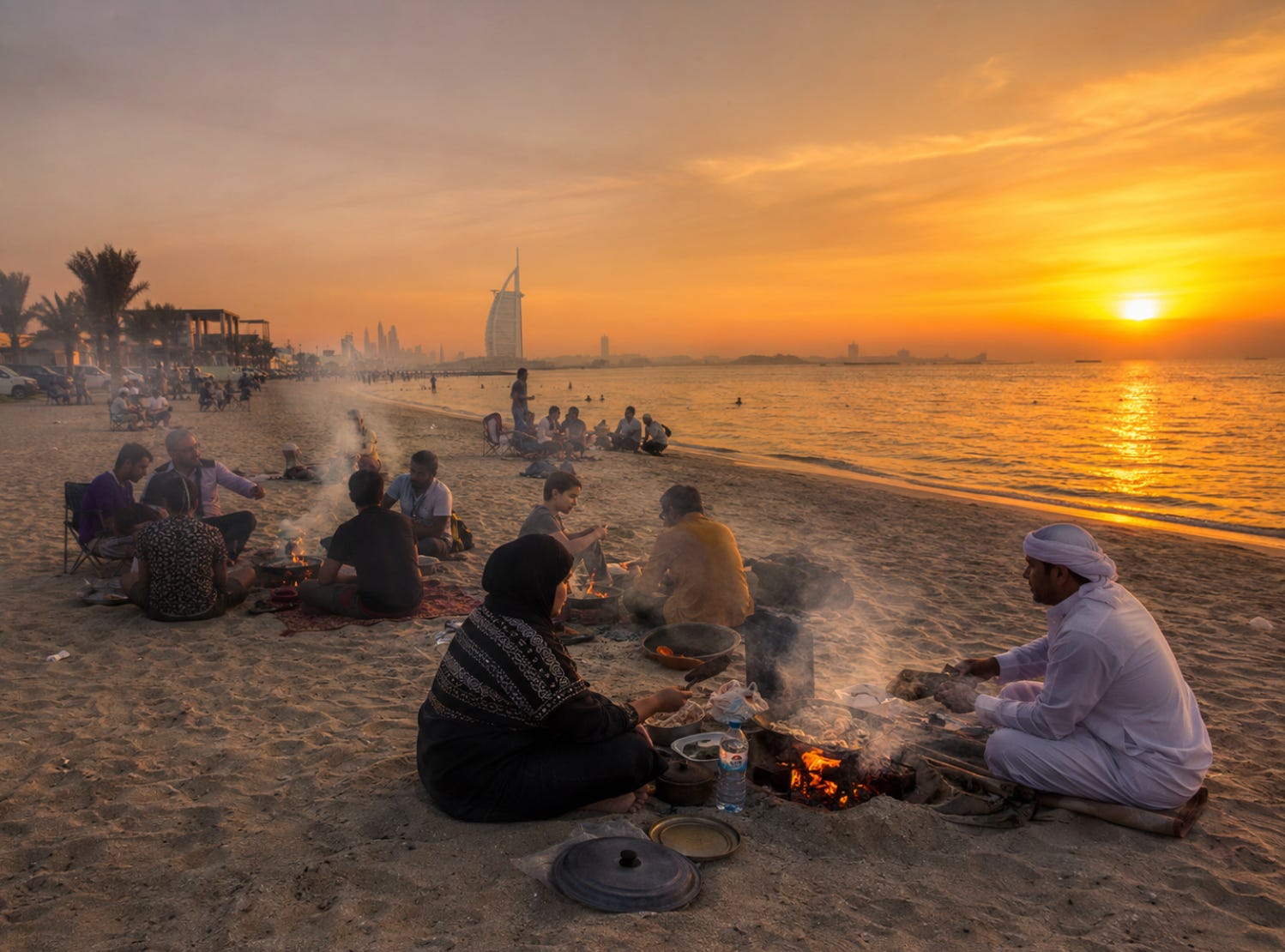
The name Jumeirah is now inseparable from modern Dubai. It evokes villas, beaches, luxury hotels and one of the world’s now most recognizable urban coastlines. A ‘Jumeirah Jane’ is a particular type of British lady who landed in seaside paradise. It was the first place we lived when we moved to Dubai from Baghdad, and remains close to our heart. It’s a beautiful neighborhood, especially nice because it’s a mix of Emiratis and expats.
It is easy to forget, however, that the name is much older than the city that has grown around it. Before Dubai’s dramatic expansion, Jumeirah was a modest coastal settlement inhabited principally by fishermen, pearl divers, and seafaring communities. That was not so long ago, well within living memory, but before much was written down. Its name may preserve a fragment of that older world.
The most common explanation connects Jumeirah with the Arabic word jamrah (جمرة), meaning a glowing coal or ember. Classical and modern Arabic dictionaries are clear about the basic meaning. The plural or collective noun jamr refers to glowing or burning coals, while a single coal is a jamrah. Lane’s Arabic-English Lexicon translates jamrah as a live or burning coal, while major Arabic dictionaries define it as a burning piece of fire.
The regular Arabic diminutive of jamrah is jumayrah. It therefore means “a little ember,” “a small glowing coal” or, more loosely, “little coals.” The formation is grammatically conventional. Arabic creates diminutives of many three-letter nouns through the pattern fuʿayl: a shajarah, or tree, becomes a shujayrah, a little tree; a tamrah, or date, becomes a tumayrah, a little date. By the same process, a jamrah, or ember, becomes a jumayrah, a little ember.
This does not prove that Dubai’s Jumeirah was named after embers. It does show that the interpretation is linguistically possible. “Little ember” is not a fanciful translation invented after the fact. It is exactly the sort of diminutive that Arabic grammar would naturally produce. We like this speculative interpretation, evocative as it is of a particular image of small fires on a beach roasting fish.
But there is a complication. Arabic is generally written without short vowels, so the consonants in جميرة can represent more than one word. Jumayrah, meaning a little ember, must be distinguished from jamīrah, an established dictionary word meaning a braid or lock of hair. The two words look identical when written without vowels, although their pronunciation and derivation differ. The modern place-name is normally written جميرا, without the final letter found in the classical feminine form, probably reflecting local pronunciation and the conventional spelling of an inherited name.
The root j-m-r also has meanings beyond fire. Arabic dictionaries associate it with gathering, concentration and accumulation. Related words can refer to a group of people gathered together, a tribe united into a single body or objects collected in one place. A jamrah may also mean a small stone or pebble, most famously one of the stones associated with the pilgrimage ritual at Mina.
This secondary sense is especially intriguing. The same Arabic root can evoke both glowing coals and people gathering together. The dictionaries do not contain an expression meaning “people gathered around small fires,” and it would be wrong to claim that they directly prove such an interpretation. Nevertheless, the combination offers a suggestive resonance for a coastal settlement in which people may once have assembled around glowing coals.
Emirati historian Jamal bin Huwaireb recorded two explanations repeatedly offered by older residents of Jumeirah. One connected the name with jamr, or glowing coals, because the beach sand became intensely hot in summer. This is entirely plausible, although it is not wholly satisfying. Scorching sand was hardly unique to Jumeirah. Almost every exposed beach and desert settlement along the Gulf would have experienced similar conditions. Bin Huwaireb himself found this explanation unconvincing, observing that hot sand was common throughout the Emirates. He instead favored a derivation from Qumeirah, associated with the moonlike brightness of Jumeirah’s original white sand. A place-name is usually useful because it identifies something distinctive, rather than a feature shared by the whole region. And Emirati Arabic often shifts the Q sound (ق, qāf) to a J (ج, jīm) sound (like many cases in southern Iraqi dialects).
We, do like, however, a slightly different interpretation, one that is not mutually exclusive, because linguistic inheritance is not linear, it is complex and mixed. Jumeirah may also have been associated with the small fires that fishermen, pearl divers and other coastal inhabitants lit along the beach. People returning from the sea would have gathered around glowing coals to cook fish, prepare food, repair equipment, exchange news and rest after the day’s work. Seen from offshore after dark, the scattered fires might also have appeared as a line of tiny embers along the coast.
According to this speculative but linguistically sound interpretation, Jumeirah would not only describe the temperature of the sand or the brightness of the sand. It would also evoke the human geography of the place: a shoreline marked by small fires and the communities gathered around them. The name would mean something close to “the place of the little embers.”
The uncertainty surrounding the name also reflects the extraordinary speed of the Emirates’ transformation. Dubai developed so rapidly during the second half of the 20th century that the modern metropolis remains chronologically very close to a world that was recorded largely through memory and oral tradition. The glass towers and highways are new, but the fishing settlements, pearl-diving communities, and tribal landscapes they replaced are separated from the present by only a generation or two.
This was not prehistory in the strict archaeological sense. The region possessed literature, government records, commercial documents, and longstanding connections with the wider world as a trading entrepôt. In practical terms, however, much of everyday life was never systematically recorded in the headlong rush to ultra-modernity. The names of beaches, wells, tracks, fishing grounds, anchorages, and small settlements were often passed orally from one generation to another. Their meanings may have been widely understood locally, but never written down.
In this particular sense, the modern Emirates stands unusually close to its own prehistory. It’s one of the things that makes it most interesting. We can see the survival until very recently of a world in which much local knowledge remained oral and passed down through family and community shared knowledge. Dubai moved within living memory from a small maritime and trading society to a leading global city. Its development happened so quickly that the documentary record did not always keep pace with the physical transformation.
Much that might explain an old place-name may therefore have disappeared before historians thought to record it. The people who knew why a particular beach, inlet, or sandbank (upon which a famous international hotel may well now be located) carried its name may have regarded the explanation as too obvious to preserve. By the time the question became historically interesting, the original social and physical context had already begun to vanish.
Neither explanation can be demonstrated conclusively. The moonlit-sand theory is possible, as is the conventional idea of ground so hot that it resembled glowing coals. The Arabic dictionaries support the linguistic possibility of “little ember,” but they cannot tell us what the people who first used the name had in mind. The image of fishermen and families gathered around small beach fires nevertheless seems especially appropriate to Jumeirah’s history. It brings together the dictionary meanings of embers and gathering, the maritime economy of the old settlement, and the appearance of small fires on glowing sand scattered along a dark coastline.
Before Jumeirah became one of the world’s most recognizable urban districts, it was a small community beside the Gulf. Its name preserves the memory not of business tycoons, highways, seven star hotels, or great events, but of something far more intimate: tiny embers glowing on the beach, fish cooking over the coals, and people gathering together at the edge of the sea on a beach whose sand was so bright it glowed in the moonlight.
Norman M. Ricklefs & Thérèse Tayah
See also:
E.W. Lane, An Arabic-English Lexicon, ed. Stanley Lane-Poole, 8 vols. (Delhi: Kalpaz Publications, 2017), s.v. جمر.
Jamal bin Huwaireb, «ماذا يعني اسم منطقة “جميرا”؟», Al Bayan, 4 January 2014: https://www.albayan.ae/opinions/diary/2014-01-04-1.2033801
Comments
Nothing yet. Say the first thing.
Sign in to join the conversation.