
You’re reading Nordic EdTech News. From policy shifts and product launches to funding rounds and market trends, it’s the smartest way to stay in the loop across the Nordic and Baltic EdTech ecosystem. Not subscribed yet? Join the list now.
I’m Jonathan Viner. I help EdTech leaders and investors turn complexity into clarity, make smarter decisions and scale with confidence and impact. Contact me here to talk about working together.
Hello and welcome to today’s Nordic EdTech News. My thanks to everyone who reads and subscribes 🙏.
NEN 155 reported on Estonia’s move to upskill its population for AI, so it’s encouraging to see Denmark making excellent progress towards the same goal. The Danish AI Competence Council confirmed that 314,000 Danes have gained new AI skills in the last year (Link). That’s great progress towards the target of upskilling 1 million Danes in AI before the end of 2028.
Encouragingly, the Latvian Ministry of Education and Science has also recently announced a new national AI initiative to start this work in schools and vocational education (Link). The program will begin with the creation of a national AI expert community and a network of AI leadership schools.
As part of this, Google.org is giving €200,000 to Riga TechGirls to support the initiative’s delivery. Anna Andersone, the organisation’s CEO, sad: “This initiative aims to give educators in Latvia the confidence, tools and support to use AI in a way that truly improves the learning process, not complicates it.”
And yet….Norway’s Minister of Education, Kari Nessa Nordtun, has recently suggested that existing limitations on screen use should be further extended to the oldest schoolchildren (Link). She’s even proposed that schools should revert to having dedicated computer rooms to police their use. Her rationale for these plans again links the decline in students’ learning outcomes to increasing device usage.
This fundamental confusion of correlation and causation also lies at the heart of two recent articles celebrating Norway and Sweden’s increasing focus on books in schools. The articles by the BBC and The Times are, as Beth Havinga says here, wildly over-hyped and as I argue here, only offer a critique of implementation and not of the tools themselves.
It was pleasing therefore to see DI, Sweden’s business newspaper, arguing last week that the government’s screen strategy has gone too far. As the article states: “Swedish students are lagging behind in digital skills and understanding of AI. This is inconsistent with the strategy of increasing the number of students who are good at science, technology and mathematics.”
Of course, these anti-digital governments are also swimming in the opposite direction to an increasingly enlightened European position on EdTech. In fact, a recent meeting brought together 15 founders and leaders from across European EdTech to “discuss how digital innovation can strengthen education and skills systems across the EU.” That dialogue forms part of the European Commission’s work to prepare the 2030 Roadmap on the future of digital education and skills. But it’s not yet clear how all individual countries will align with that strategy.
Interestingly recently released spending data from the Finnish Publishing Association reiterates the reality of the situation. Spending on educational materials in compulsory and upper secondary schools in 2025 is up €600k year on year, yet the print / digital split remains unchanged. €80.3 million (63.4%) spent on print and €46.4 million on digital (36.6%).
Whilst we’re on educational materials, it was announced last week that Praxis Forlag and Akademisk Forlag will officially merge (Link). The move combines Praxis Forlag’s “strong expertise and solid position in youth and vocational education” with Akademisk Forlag’s respected publications in higher education. Congratulations to Morten Blichfeldt Andersen, who’ll head up the combined operation.
Given the political climate above, it’s perhaps no surprise that AcadeMedia Adult Education is “intensifying its long-term search for growth outside Sweden’s borders.” The creation of AcadeMedia Career International will include parts of their EdTech portfolio (Hypocampus, EdAider and Omniway) and aims to help achieve the long-term goal of 50% of group turnover coming from outside the Swedish school system (Link).
And finally, I was delighted to contribute to Ludenso’s Thought Leaders in Publishing series, where I spoke about the Nordic Education Shift and AI. I’m sure this will be high on the agenda at MoodleMoot Nordic 2026, which I’ll be moderating in Copenhagen at the end of September.
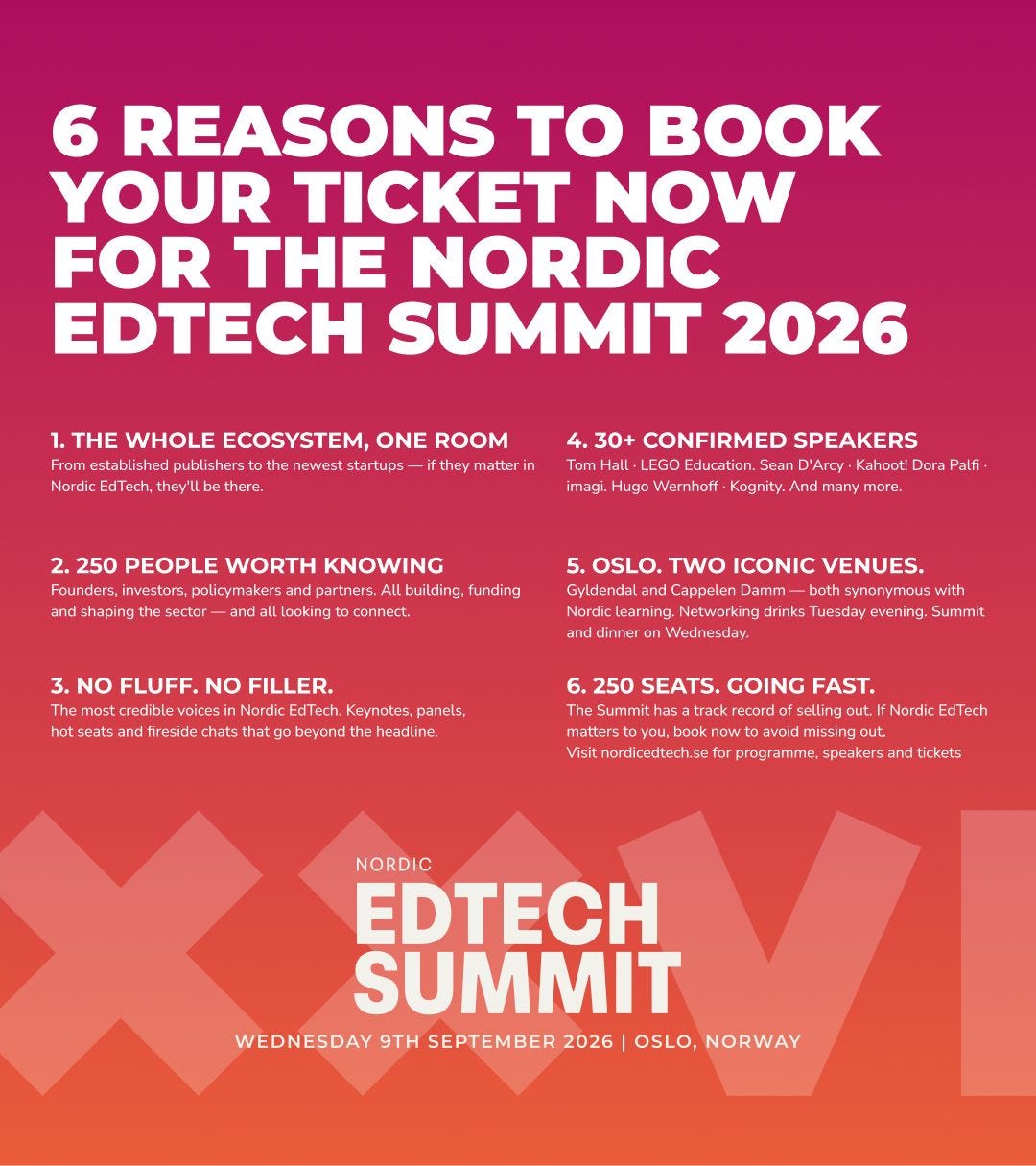
This year’s Nordic EdTech Summit is just over four months away and tickets are moving fast. On 9 September in Oslo, 250 people focused on Nordic EdTech will be in one room including founders, investors, policymakers and ecosystem leaders.
The programme is already shaping up to be the strongest yet, with 30+ speakers already confirmed. With just 250 seats and a track record of selling out, booking early is the only way to guarantee your spot.
Still not convinced? Here are six reasons why you should act now.
If you’ve got a story that you’d like me to include in a future issue of this newsletter, please email hello@10digits.org, tag me on X or LinkedIn or use #nordicedtech / #balticedtech.
Thanks for reading, Jonathan
High schools join forces to develop AI to support teachers CPD and to build a ‘gym-gpt’ for students (Link). Whilst a new EVA report suggests that more than one in three high school teachers want more AI skills.
“Denmark saves on teaching materials, but pays the price in learning.”
Fascinating podcast with Anders Laustsen, CEO of Famly, on his return to Copenhagen to reinvent the business with AI.
GradeAid has been accepted into the NVIDIA inception programme. (Link)
90% of students at the Dundalk Institute of Technology agreed that Labster’s virtual labs increased their confidence with experimental science. (Link)
Country Manager, Salesforce Denmark: “AI is redefining the entry-level job: Judgment becomes the most important skill.”
Estonia should be among the first countries to turn the use of AI into a real competency for school graduates through a mandatory exam. (Link)
//kood celebrate the graduation of their 5th batch of students and prepare to launch in Moldova.
The Next Step in EdTech Collaboration - new initiatives from the City of Helsinki to support EdTech companies to grow and scale.
Interesting to note that negotiations are underway to establish Finland’s largest university through the merger of 4 currently separate institutions. (Link)
How 3DBear helped Oulu University of Applied Sciences build an immersive learning space for health education. (Link)
Congratulations to all of the shortlisted entries in the Finnish Learning Awards 2026. (Link)
New podcast in which Sanoma CEO, Rob Kolkman, outlines how the business is powering growth through its learning business. (Link)
Atlas Primer has partnered with Reykjavik University to bring conversational role play into the courses they develop and deliver. (Link)
Great to see this EdTech showcase as part of the forthcoming Iceland Innovation Week.
Latvian universities have launched a new project to review the “digitalisation of the study process.” (Link)
State funding (approx. €35 per student) for the purchase of educational materials is insufficient and needs local government top up. (Link)
The government has agreed amendments to the Education Law, which means schools must prepare policies for the use of mobile phones. (Link)
Good to see EdTech Lithuania and the Lithuanian government hosting a conference on “Lifelong Learning: The New Skills Economy.”
Boom Training (part of Turing College) has been approved by the UK’s Department for Work and Pensions to deliver AI Leadership courses. (Link)
Don’t miss the Ctrl+Alt+Delete screen debate if you’re at NKUL in Trondheim next week.
NOK 9,000,000 has been announced in grants for the publication of textbooks in Norwegian and Sami for use in higher education. (Link)
Attensi has been named a Lighthouse Tech Award Winner for Best Innovative or Emerging Tech Solution in the Talent Development category. (Link)
No Isolation continues to grow and expand its presence in the Netherlands as well as being a key solution to tackle student absenteeism in Sweden.
Scrimba has passed two million users on the platform that helps “devs learn faster and grow their careers.” (Link)
Udir (The Norwegian Directorate of Education) is making changes to prevent AI from being used to cheat in exams. (Link)
UiT The Arctic University of Norway is running 12 new assessment pilots. They’re divided into three categories: Technology-supported assessment, Control & monitoring and assessments that integrate AI. (Link)
Amazing to see the Swedish EdTech community collaborating at ASU GSV - wish I could have been there!
13 municipalities around Gothenburg are collaborating to explore how they can meet the challenges of education through and with the help of AI. (Link)
Imvi Labs is gaining traction in Japan with new partners and research studies. (Link)
Five Värmland municipalities join Magma as the business launches a new maths competition for its global user base. (Link)
Memmo (formerly known as Bright) has now reached 30,000 users and has raised almost €300,000 in a bridge funding round. Magma founders Henrik Appert and Arvid Gilljam have joined as investors. (Link)
Tilda is now called Shiftic to reflect the fact that it’s primarily being used to drive behaviour change rather than as an AI planning tool for learning. (Link)
Methodological support for choosing teaching materials via Swedish Edtech Industry and is part of the industry’s quality work. (Link)
Thanks for reading this newsletter. If you think that your colleagues and wider network would find it useful, please share it with them!
No posts
Comments
Nothing yet. Say the first thing.
Sign in to join the conversation.