
You’re reading Nordic EdTech News. From policy shifts and product launches to funding rounds and market trends, it’s the smartest way to stay in the loop across the Nordic and Baltic EdTech ecosystem. Not subscribed yet? Join the list now.
I’m Jonathan Viner. I help EdTech leaders and investors turn complexity into clarity, make smarter decisions and scale with confidence and impact. Contact me here to talk about working together.
Hello and welcome to today’s Nordic EdTech News. If you caught some of these stories on LinkedIn last week, here’s the fuller picture.
Once again, the Nordic countries are being held up as the poster children of the global screen-ban movement. This time it’s the Economist making the case, positioning Sweden, Denmark and Finland as enlightened governments, citing academic research to justify phone bans and hundreds of millions in spending to bring back textbooks.
Two major new studies landed this week. Both complicate that story considerably.
The OECD’s new Early Learning and Child Wellbeing Study tracked 23,000 five-year-olds across eight countries and found that digital device use at home was weakly, and only occasionally negatively, associated with outcomes. Worth noting: the study itself assessed those children using tablets. Meanwhile, the largest quasi-experimental phone ban study to date, covering nearly 5,000 US schools, found the average effect on test scores was zero. No attendance gains. No behaviour improvements. Disciplinary incidents actually went up.
And then there was the Norwegian kindergarten teacher who published an open letter to her Education Minister making a point that shouldn’t need making: digital tools in early years are not passive screen time. They are language, creativity, exploration, play. When the debate gets reduced to screens versus no screens, we’ve already lost the argument and lost sight of what is actually happening in classrooms.
But this is not only a Nordic problem. Los Angeles Unified, America’s second-largest school district, just voted to restrict screens, ban student-led YouTube use and audit every EdTech contract on its books. Andrew Marcinek offers a powerful critique of thirteen years of failed leadership here with the same missing variable: not the technology, but the absence of intentionality in how it was selected, deployed and supported. His five-pillar framework for what to do instead is also worth your time.
Back in Norway, the debate has moved into higher education. A lecturer who banned screens from his own classes triggered a national conversation before four leading institutions pushed back, declining to support any blanket ban. Students also expressed concern that such a ban would reduce their access to learning and increase inequality. (Link)
All of this makes this new Eurostat data worth sitting with for a moment. Sweden tops the European table for generative AI use in education at 21% — not in classrooms, but among the general population: students, adult learners, people figuring things out in their own time. Denmark is close behind at 17.9%, Estonia at 15.4%. Two of the Nordic countries that are legislating most visibly against screens in schools are the same ones where citizens have already decided, without being asked, that AI is part of how they learn. The policy debate and the behavioural reality continue to travel in opposite directions.
Onto company news. Sweden’s Albert Group reported Q1 revenue of SEK 32.3 million with EBITDA of SEK -3.7 million. Both were expected and flagged in advance (Link). The more telling number is cash: SEK 57.6 million at quarter end, up SEK 15 million on year-end. Full-year targets (positive EBITDA and positive cash flow) remain in place.
Skolon crossed one million paying users in Q1, with revenue growing 18.9% to SEK 38.3 million (Link). CEO Oliver Lundgren made another point worth amplifying: with 39% of Swedish students below basic digital literacy thresholds and the EU targeting below 15% by 2030, schools are not choosing between analogue and digital. They face a much larger task and demand for secure, pedagogically integrated platforms is only going in one direction.
Sanoma’s Q1 report highlighted improved adjusted operating profit in the Learning division (Link). More interestingly, it also confirmed the business had acquired Vicens Vives, a highly respected Spanish K12 learning content provider. The acquisition is in line with their strategy “to grow our K12 learning business in current operating countries and to build on our existing scalable foundation.“
Staying on acquisitions, the extended deadline for submitting non-binding bids for Aschehoug, the leading Norwegian publisher, has now passed. National press reports indicate a number of local and international players are interested.
And finally, Swedish LMS provider Learnster has acquired Learnify Tools, bringing together two platforms with complementary strengths in digital learning for banking, finance and insurance (Link). The combined group now reaches more than 600,000 users across 300-plus organisations, with particular depth in compliance and regulatory training through partnerships with Contento and InsureEd. Learnster is explicit that this is the start of a broader acquisition strategy.
For many (but not all!) readers it’s a short week this week, but whatever you’re doing, I hope you have a good one.
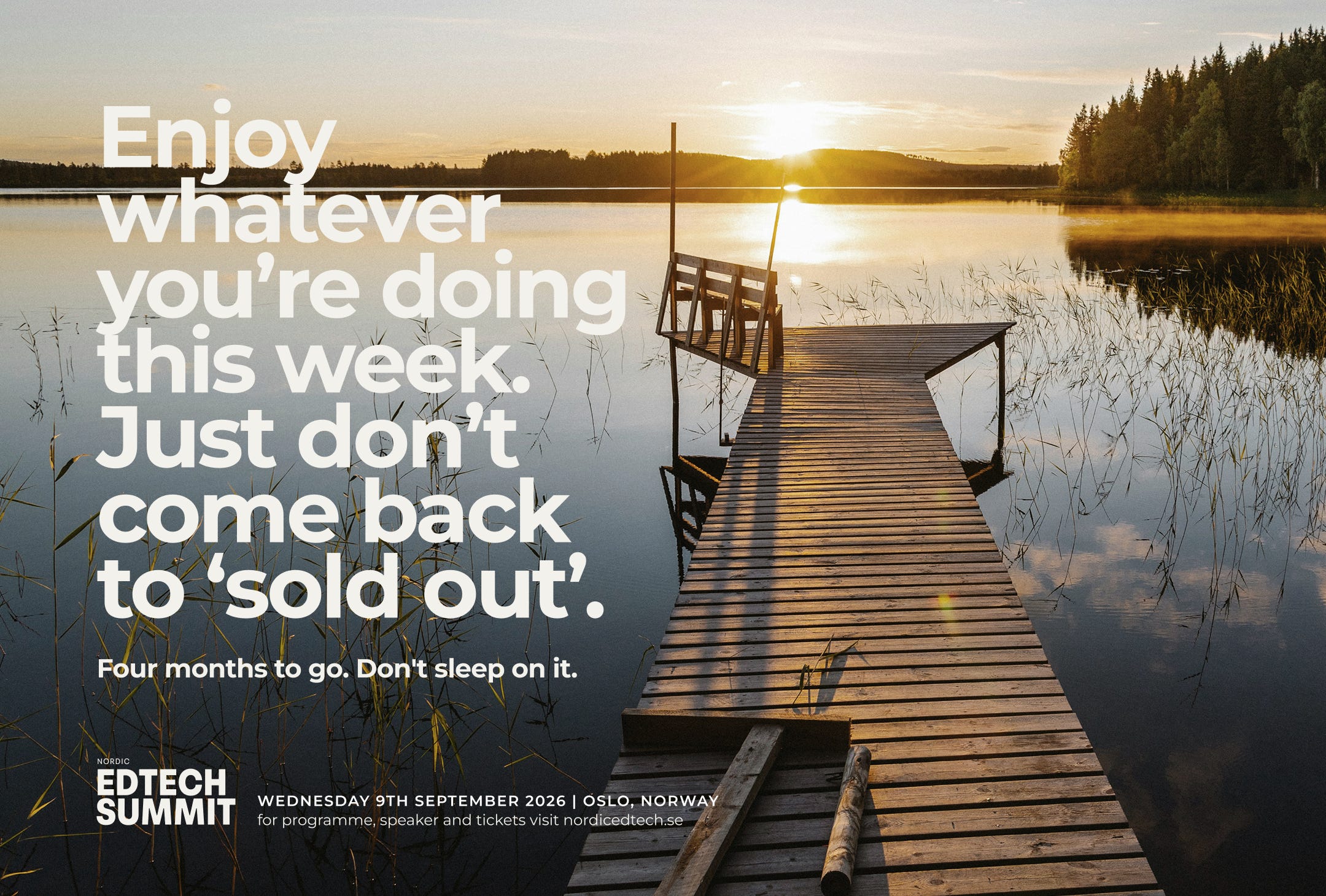
This year’s Nordic EdTech Summit is just over four months away and tickets are moving fast. So don’t sleep on getting your tickets booked. With just 250 seats and a track record of selling out, booking early is the only way to guarantee your spot.
If you’ve got a story that you’d like me to include in a future issue of this newsletter, please email hello@10digits.org, tag me on X or LinkedIn or use #nordicedtech / #balticedtech.
Thanks for reading, Jonathan
Students send 10,000 messages on Aula every day. Yet parents and staff don’t seem to know what they’re using the platform for. (Link)
DTU’s Rector warns Denmark’s new government against rapid AI cuts at universities. (Link)
Technical problems for EasyIQ caused difficulties for schools that were conducting final written exams in Danish for 9th grade students. (Link)
Ordbogen successfully handled nearly 6 million searches whilst students were completing their spelling tests. (Link)
SAS CISO: “AI is not hype – it’s your next skill requirement.”
uQualio was named Best Purpose-Driven EdTech Company by EU Business News. (Link)
Interesting public discussion (in Estonian) about the role of AI and whether it should be a trainer or a servant.
ALPA Kids identify Brazil as their next expansion market and start building for success. (Link)
Annie Advisor has been selected as one of the Top 50 startups for the NN Social Innovation Startup Award 2026. (Link)
Congratulations to all the winners at the Finnish Learning Awards 2026. (Link)
HEI Schools are bringing “Finland’s World-Class Pedagogy to Nepal.” (Link)
The agenda has been confirmed and sign ups are now open for the Helsinki EdTech Day (2nd June 2026). (Link)
Great to see such positive impact from Qridi’s work with Nord Anglia schools globally to improve students’ meta cognition skills. (Link)
Valamis has formed a global partnership with IFS putting “training, certifications and compliance sit next to the work itself.” (Link)
Wilma has updated its messaging functionality to enable “smoother everyday life in municipalities and educational institutions.” (Link)
Issues 105 to 107 of the Connected Learning newsletter have included excellent insights into the increasing use of AI in Icelandic schools. Do check them out.
Bare si det, Bara tala’s Norwegian business, continues to gain traction as MB Norway provides access to it for Ukrainian entrepreneurs. (Link)
Challenges ahead as state funding now only accounts for 19% of the total needed to buy textbooks and digital resources. (Link)
With a notable focus on critical thinking and creativity, the Tesonet Foundation has invested €100,00 to become a strategic patron of the MO Museum. (Link)
How students at high school in Oslo use AI (Link) and how Vestland County Council is giving its students access to safe AI (Link).
New research featuring Curipod shows how student teachers “relate their experiences of AI-generated feedback to future teaching practice.” (Link)
Ludenso has been awarded an Efficacy Bronze Certification by EduEvidence. (Link)
No Isolation wins contracts with the London Boroughs of Bromley and Bexley to support SEND services for schools across the capital. (Link)
Norrköping Municipality develops guidelines for teachers and school leaders to support the responsible use of AI. (Link)
Fascinating article from the UK about a parent taking the city of Gothenburg to court over its use of an algorithm to allocate school places.
Memmo has signed a partnership agreement with Pearson, which will see their e-texts (including quizzes and audiobook capabilities) appear on the platform. (Link)
Detailed profile of Joel Hellermark, CEO of Sana, in Dagens Nyheter. (Link)
Skolon has been nominated as a finalist for the nEdEx School & Trust Leadership Awards in the UK. (Link)
Case study from Storyals showing how they’ve helped Lidingö municipality incorporate responsible AI use into everyday work. (Link)
New report from Swedish Edtech Industry: Digital sovereignty in schools is interpreted differently and complicates school preparedness.
Thanks for reading this newsletter. If you think that your colleagues and wider network would find it useful, please share it with them.
No posts
Comments
Nothing yet. Say the first thing.
Sign in to join the conversation.